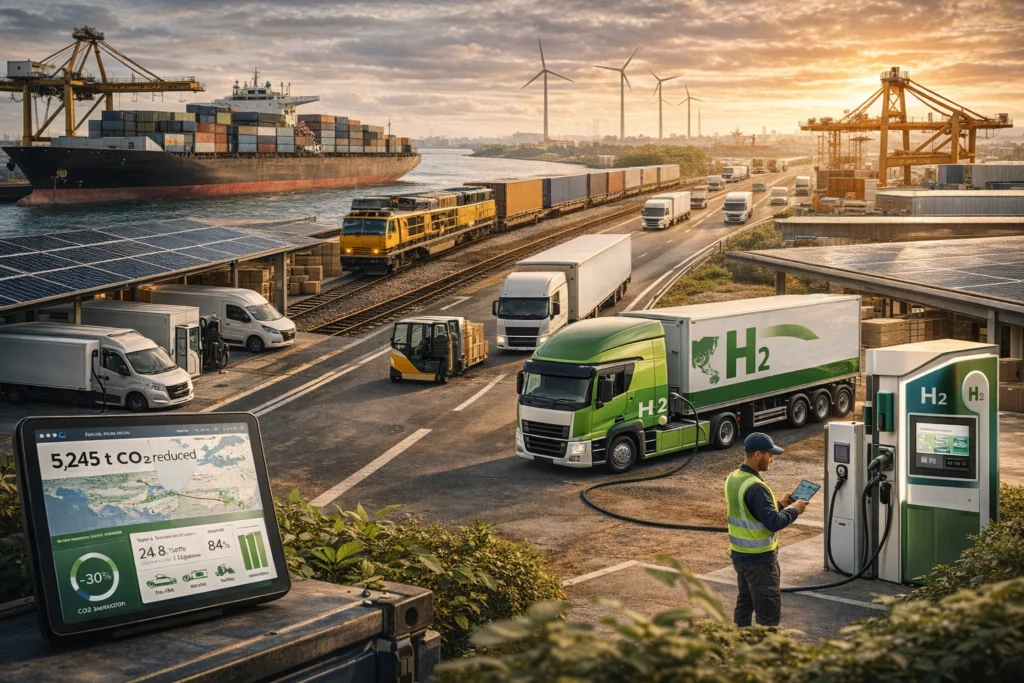
EU freight rules 2026 add up to 28 dated changes across sea, road, customs, packaging and product regulation: as of 28 September 2026, 22 are already in force, passed or adopted, and 6 are still to come.
Among EU logistics regulations in 2026, carbon surcharges and truck tolls reach shippers on the invoice. Customs entry data, CBAM (Carbon Border Adjustment Mechanism), PPWR (Packaging and Packaging Waste Regulation) and EUDR (EU Deforestation Regulation) arrive as paperwork.
Since 1 January 2026, the EU Emissions Trading System (EU ETS), the carbon market ships pay into, has covered 100% of in-scope shipping emissions, methane and nitrous oxide included (European Commission).
The €150 customs-duty exemption ended on 1 July 2026. B2C distance sales, meaning goods sold online to consumers, now pay a €3 flat duty per item on parcels worth €150 or less until 1 July 2028 (Council of the EU). A VAT-registered B2B importer pays normal duty by HS (Harmonized System) code, with no PID (product identifier) data or €2 handling fee.
Key takeaways
- The EU freight rules 2026 timeline has 28 dated changes; 6 fall between 30 September and 30 December 2026.
- Carriers’ Q4 carbon surcharges on sea freight are due to reset on 1 October 2026.
- Only 4 of the 28 changes apply solely to B2C distance sales.
- PPWR has covered transport packaging such as pallets, stretch film and straps since 12 August 2026.
- The new Union Customs Code (UCC) applies generally from September 2027.
- EUDR applies to large and medium operators from 30 December 2026; ETIAS, the planned EU travel authorisation, is not a 2026 event.
On this page:
- Short answer
- Master timeline
- B2B vs B2C
- January to June
- July
- August and September
- Still to come
- Balkan and Black Sea
- Worked example
- Beyond 2026
- Q4 checklist
- FAQ
Twenty-eight dated changes make up the EU freight rules 2026 calendar, from the EU ETS on 1 January to EUDR on 30 December. The table sets the new EU transport rules for 2026 beside customs, packaging and product rules.
The “Where you feel it” column applies the Invoice, Paperwork or Pass-through triage from a shipper’s point of view; “(B2C)” marks rules for consumer distance sales only.
| Label | What it means | What you do |
|---|---|---|
| Invoice | The cost reaches you as a surcharge, toll, duty or fee on a bill | Ask for it as a separate line on every quote |
| Paperwork | You must supply data, file, register or hold documents; a gap can stop the cargo | Give it an owner and a deadline |
| Pass-through | The obligation sits with a carrier, haulier, manufacturer or platform and reaches you indirectly or not at all | Watch it; no action needed |
| Date (2026) | Rule | Mode | Who carries it | Where you feel it | Status at 28 Sep 2026 |
|---|---|---|---|---|---|
| 1 Jan | EU ETS maritime covers 100% of 2026 emissions; methane and N₂O added | Sea | Shipping line | Invoice | In force |
| 1 Jan | CBAM definitive period: authorised declarant needed above 50 t a year | Customs | Importer | Paperwork | In force |
| 1 Jan | ECMT permits issued in electronic form only | Road | Haulier | Pass-through | In force |
| 1 Jan | Bulgaria adopts the euro (€1 = BGN 1.95583) | All | Anyone invoicing in Bulgaria | Paperwork | In force |
| 1 Jan–3 Feb | ICS2 replaces ICS1 for road in several states; message v3 mandatory in all modes from 3 Feb | Customs | Carrier and forwarder, using your data | Paperwork | In force |
| Feb | Poland road tolls up 33% | Road | Haulier | Invoice | In force |
| 31 Mar | CBAM: deadline to apply for authorisation and keep importing meanwhile | Customs | Importer | Paperwork | Passed |
| 31 Mar–30 Jun | FuelEU Maritime first cycle: verified reports, first penalties, Document of Compliance | Sea | Shipping line | Invoice | Passed |
| 10 Apr | Entry/Exit System (EES) fully operational at Schengen external borders | Road | Non-EU drivers | Pass-through | In force |
| 1 Jun | ICS2 road rollout complete (Croatia, Latvia, Poland, Romania, Slovakia) | Customs | Carrier and forwarder | Paperwork | In force |
| 1 Jun | Bulgaria truck tolls add a CO₂ component | Road | Haulier | Invoice | In force |
| Jun | CountEmissionsEU (Reg. (EU) 2026/1030) in force; applies from 2 Dec 2030 | All | Transport operators | Pass-through | Adopted |
| 24 Jun | New ADR roadside-check rules (Del. Dir. (EU) 2025/1801) | Road (dangerous goods) | Shipper, carrier, consignee | Paperwork | In force |
| 1 Jul | €150 duty exemption ends; €3 flat duty per item on parcels ≤€150 | Customs | Seller, platform, declarant | Invoice (B2C) | In force |
| 1 Jul | PID data voluntary; simplified invalidation for returned goods removed | Customs | Declarant | Paperwork (B2C) | In force |
| 1 Jul | Smart tachographs and drivers’ hours rules for vans over 2.5 t, up to 3.5 t, in international work | Road | Van operator | Pass-through | In force |
| 1 Jul | Netherlands km truck charge replaces the Eurovignette; Flanders adds a CO₂ class | Road | Trucks over 3.5 t | Invoice | In force |
| 7 Jul | Automatic emergency braking mandatory on newly produced trucks | Road | Manufacturer, fleet | Pass-through | In force |
| 12 Aug | PPWR (Reg. (EU) 2025/40) applies, transport packaging included | Packaging | Importer, packaging manufacturer | Paperwork | In force |
| 1 Sep | Netherlands truck charge cut 22.3% until 31 Dec | Road | Trucks over 3.5 t | Invoice | In force |
| 19 Sep | New Union Customs Code (Reg. (EU) 2026/2108) published in the Official Journal | Customs | Importer, indirect representative | Paperwork | Adopted |
| 21 Sep | €2 handling fee set by delegated act C(2026) 6694 | Customs | Declarant (platform, seller) | Invoice (B2C) | Adopted |
| 30 Sep | ETS: allowances for 70% of verified 2025 emissions surrendered | Sea | Shipping line | Pass-through | Upcoming |
| 1 Oct | Romania’s TollRo km charge replaces the rovinietă | Road | Haulier | Invoice | Upcoming |
| 1 Oct | Carrier Q4 emissions surcharges reset (e.g. Maersk LCL, per W/M) | Sea | Shipper | Invoice | Upcoming |
| Oct (TBC) | IMO session on the Net-Zero Framework reconvenes | Sea | IMO member states | Pass-through | Upcoming |
| 1 Nov | PID mandatory; UCC distance-sales provisions apply; €2 fee in place by this date | Customs | Declarant, platform, seller | Paperwork (B2C) | Upcoming |
| 30 Dec | EUDR applies to large and medium operators | Product | Operator, trader | Paperwork | Upcoming |
Status key: In force = applies now – Passed = one-off deadline gone – Adopted = law adopted or published, applying later – Upcoming = date still ahead.
Sources: European Commission, EUR-Lex, Council of the EU, ITF, IMO, Access2Markets, trans.info, Maersk, Lloyd’s Register, Reuschlaw, vatupdate, LoadHub, AEBTRI, Interteam, Ti/Upply/IRU road-rate benchmark. Triage and status by Sea Gate Logistics, 28 September 2026.
The 28 rows split into 10 Invoice, 11 Paperwork and 7 Pass-through changes. By status, 17 are in force, 2 have passed, 3 are adopted and 6 are upcoming. The 30 September ETS surrender is Pass-through because the shipping line holds it; shippers pay through the surcharges dated 1 January and 1 October.
Invoice rows need a line on your quote, Paperwork rows need an owner and a date, and Pass-through rows only need watching.
B2B vs B2C: which EU customs changes in 2026 apply to you
Four of the 28 rows apply only to B2C distance sales: the €3 duty, voluntary PID data, the €2 fee act and the 1 November row that makes PID mandatory. The other 24 make no such distinction.
| Rule | B2C distance sales (to consumers) | B2B import to a VAT-registered business |
|---|---|---|
| €3 flat duty (from 1 Jul) | €3 per item (per tariff line) on parcels ≤€150, until 1 Jul 2028 | Doesn’t apply: normal HS-based duty |
| PID data (voluntary 1 Jul, mandatory 1 Nov) | Mandatory from 1 Nov | Exempt |
| €2 handling fee (by 1 Nov) | Applies per item (the unit is still being settled) | Doesn’t apply |
| UCC distance-sales provisions (1 Nov) | The seller or platform becomes the importer | No distance-sales change; general application from Sep 2027 |
| EU ETS and FuelEU costs | In the freight rate | A separate surcharge on sea freight (per W/M for LCL) |
| Truck tolls (NL, Flanders, BG, RO, PL) | In the carrier’s rate | In the road rate |
| ICS2 entry data | Applies | Applies |
| CBAM (above 50 t a year) | Applies to CBAM goods | Applies to CBAM goods |
| PPWR packaging | Applies | Applies, pallets and film included |
| EUDR (from 30 Dec) | Applies to listed commodities | Applies to listed commodities |
Industry guidance from Avalara confirms that a VAT-registered importer pays normal HS-based duty, not the €3 flat rate.
In our view, the 2026 rules most B2B shippers will feel are the carbon surcharges and tolls on the invoice, not the e-commerce changes that made the headlines. That changes if you also sell direct to consumers (or let a marketplace do it for you).
For B2C sellers shipping from Türkiye (Turkey), the Incoterms® 2020 rule decides who pays the €3 duty: the seller under Delivered Duty Paid (DDP), the buyer under Delivered at Place (DAP). DDP vs DAP for shipments from Türkiye after de minimis compares the two.
January to June 2026: carbon costs, CBAM and ICS2
Five of the year’s changes took effect on 1 January 2026 alone. The EU ETS now covers 100% of emissions on intra-EU voyages and at berth and 50% on voyages into or out of the EU (European Commission). Among the EU shipping regulations in 2026, the ETS reaches shippers as a surcharge. Maersk’s Q1 2026 charge was about €59/TEU on Asia–North Europe (carrier tariff, Measured).
FuelEU Maritime, the EU cap on the greenhouse-gas intensity of ships’ energy, closed its first compliance cycle on 30 June 2026 (Lloyd’s Register), and carriers pass both costs on: see how ETS and FuelEU surcharges are built into freight rates.
For importers, CBAM in 2026 means a threshold test: since 1 January, only an authorised CBAM declarant may import cement, iron and steel, fertilisers or aluminium above 50 tonnes per importer a year (Regulation (EU) 2025/2083). A guide to CBAM for importers in 2026 covers the 2027 dates.
The ICS2 deadlines in 2026 moved road freight onto Import Control System 2, the EU’s pre-arrival safety and security filing. Message version 3 became mandatory in all modes on 3 February, and the road rollout finished on 1 June (icustoms; Maersk). Forwarders now lodge the road entry summary declaration (ENS) at least 1 hour before arrival (trans.info).
Since 24 June 2026, Delegated Directive (EU) 2025/1801 has set new roadside checks for ADR, the European agreement on carrying dangerous goods by road.
July 2026: the end of the €150 duty exemption and new road rules
Four of the year’s 28 dated changes landed on 1 July 2026, and a fifth followed on 7 July, when automatic emergency braking (AEB) became mandatory on newly produced trucks.
De minimis was the value below which goods entered duty-free. The removal of the €150 de minimis in July 2026 brought a temporary €3 flat duty per item, counted per tariff line, for B2C distance sales worth €150 or less (Council of the EU). PID data became voluntary on 1 July. B2C sellers should also know what the Import One-Stop Shop (IOSS) still does after de minimis.
Rules on tachographs in vans from July 2026 cover vans over 2.5 t and up to 3.5 t in international hire-and-reward work or cabotage, meaning a foreign haulier’s domestic runs (Regulation (EU) 2020/1054). Each van needs a smart tachograph (G2V2), about €1,000 net plus fitting (trans.info), and shippers may see the van tachograph and Mobility Package rules in express-van rates.
On 1 July a km-based truck charge, the vrachtwagenheffing, replaced the Eurovignette, the old time-based charge, on about 3,000 km of Dutch roads. Flanders added a CO₂ class the same day, lifting a Euro VI truck over 32 t in class 1 from €0.204 to €0.285/km, roughly 40% more (Interteam; Viapass).
August and September 2026: packaging rules and the new Union Customs Code
Regulation (EU) 2025/40 has applied since 12 August 2026. The PPWR requires a declaration of conformity, the signed statement that packaging meets the rules, and a technical file for every packaging type.
What PPWR means for importers from August 2026 goes beyond retail boxes. Pallets are in scope. So are stretch film, straps, crates and drums, because the rules reach transport packaging — the layer no consumer ever sees. Each must carry the manufacturer’s name and postal address (Reuschlaw; Latham).
Regulation (EU) 2026/2108, the new UCC, was published in the EU’s Official Journal on 19 September 2026 (EUR-Lex). It will apply generally from September 2027 and sets up the EU Customs Authority and the EU Customs Data Hub.
On 21 September 2026 the European Commission adopted C(2026) 6694, a delegated act, meaning one that fills in details of an existing law. It sets the €2 EU handling fee on parcels, charged per item on distance-sales goods (vatupdate). The fee is due to apply by 1 November 2026 at the latest, subject to the Parliament and Council objection window.
The Commission text says “per item”; national readings differ on whether that means per article or per tariff line, and the unit will be settled when the act is final.
30 September to 30 December 2026: the rules still to come
By 30 September 2026, shipping lines must surrender allowances for 70% of their verified 2025 emissions under the EU ETS for shipping in 2026 (European Commission), the first of six changes left in the EU freight rules 2026 timeline.
Maersk announced on 18 September 2026 that its revised Q4 emissions surcharge for LCL, covering the EU ETS and FuelEU Maritime, will apply from 1 October 2026. It will be charged in US dollars per W/M, meaning per cubic metre or per tonne, whichever is greater. Carriers price it from EU Allowance (EUA) futures, which traded at €80–90/t in mid-2026 (Measured).
Romania’s distance-based TollRo charge is also due to replace the rovinietă, a time-based road vignette, on 1 October 2026.
Member states of the International Maritime Organization voted 57 to 49 on 17 October 2025 to adjourn adoption of its Net-Zero Framework for shipping (IMO). An extraordinary session is due in October 2026, date to be confirmed. Until adoption, nothing changes on a quote.
On 1 November 2026, PID data will become mandatory on B2C distance-sales import declarations, alongside the UCC’s distance-sales provisions and the €2 fee (European Commission, TAXUD; KPMG). See what the PID data requirements mean from 1 November.
EUDR will apply from 30 December 2026 to large and medium operators placing listed commodities such as cocoa, coffee, soya or wood on the EU market. Micro and small operators will follow on 30 June 2027 under the revision the Council of the EU signed off on 18 December 2025.
The Balkan and Black Sea corridor: tolls, EES queues and the euro
Bulgaria has used the euro since 1 January 2026 at €1 = BGN 1.95583, so customs values, duties and import VAT are now declared in euro (Access2Markets; European Commission).
Two of the truck toll changes in Europe in 2026 sit on this corridor. Bulgaria added a CO₂ component on 1 June 2026 (AEBTRI). From 1 October, Romania’s TollRo (its start slipped from 1 July) will charge Euro VI trucks of 12 t or more RON 0.48/km on motorways and RON 0.24/km on national roads (LoadHub).
Why would a system built to register travellers slow down freight? Since the EU Entry/Exit System (EES) became fully operational on 10 April 2026, a non-EU truck driver’s first crossing records fingerprints and a facial image, like any traveller’s (European Commission, Home Affairs).
EES applies at Bulgaria’s crossings with Türkiye. For truck drivers, EES also records every day spent in the Schengen area, so the limit of 90 days in any 180 is now enforced digitally. During the phased rollout, on 27 January 2026, lorry drivers from Serbia, Bosnia and Herzegovina, Montenegro and North Macedonia blockaded more than 20 EU border crossings in protest at that enforcement (Euronews).
ECMT permits, the multilateral road-haulage permits allocated through the International Transport Forum, have been electronic-only since 1 January 2026 (ITF). Permit quotas are a separate limit, covered in the road-permit bottleneck on Türkiye–EU trucking.
At Kapitan Andreevo, the Bulgaria–Türkiye crossing, truck queues reached about 25 km in January 2026, with 15–20 hour waits; typical waits run 4–12 hours (BTA; Nakordoni). When we quote road groupage from Türkiye into Burgas, we build the Kapitan Andreevo wait into the transit estimate rather than quoting drive time alone.
Worked example: one B2B LCL shipment into Burgas in Q4 2026
Take 3 m³ of steel pipe fittings on two wooden pallets with stretch film and straps, weighing 1.8 t, shipped LCL in a shared container from Shanghai to Burgas for a VAT-registered Bulgarian importer and arriving in November 2026 (all figures Estimated, for illustration).
Which of the 28 dated changes does one ordinary pallet load meet? The table checks the EU regulations for importers in 2026 one at a time.
| Rule | Touches this shipment? | What happens | Where you feel it |
|---|---|---|---|
| EU ETS and FuelEU (Q4 surcharge from 1 Oct) | Yes | Charged per W/M: 3 m³ against 1.8 t makes 3 W/M (Estimated) | Invoice |
| ICS2 | Yes | The forwarder files the house ENS; you supply the 6-digit HS code, a precise description and consignee details | Paperwork |
| CBAM | Yes, below the threshold | Treated as an iron-and-steel good (check the CN code against the CBAM list); an importer bringing in about 12 t a year (Estimated) stays under 50 t, so no authorised declarant status is needed, but the running total must be tracked | Paperwork |
| PPWR | Yes | Pallets, film and straps are transport packaging: declaration of conformity, manufacturer’s name and postal address on the packaging | Paperwork |
| Bulgaria’s euro | Yes | Customs value, duty and import VAT declared in euro | Paperwork |
| Bulgarian truck toll (CO₂ component) | Only if trucked inland from Burgas | Priced into the road leg | Invoice |
| EUDR | No | Steel isn’t an EUDR commodity, and a pallet used only to carry goods is outside EUDR | Not affected |
| €3 duty, PID, €2 fee, UCC distance-sales rules | No | A B2B import to a VAT-registered business pays normal HS-based duty | Not affected |
Five of the eight lines apply, a sixth only if the pallets travel on by truck, and no B2C headline rule touches this booking. The same wooden pallet sits outside EUDR but inside PPWR as transport packaging (Commission EUDR guidance; Reuschlaw).
When we prepare an LCL quote into Burgas, the HS code and a precise goods description are the first things we ask for, because an incomplete ICS2 filing can mean a “Do Not Load” instruction or a hold.
A two-pallet load like this suits a consolidated cargo service, and when LCL beats a full container covers the break-even point.
Beyond 2026: the dates already set for 2027–2034
CBAM certificate sales open on 1 February 2027, the first fixed date after the EU freight rules 2026 timeline ends. In the table, eFTI (electronic freight transport information) is the EU framework for digital transport documents.
| Date | What happens | Who it hits |
|---|---|---|
| 1 Feb 2027 | CBAM certificate sales open | Importers above 50 t a year |
| 2027 (date to be announced) | ETIAS starts, after slipping from late 2026 | Non-EU travellers |
| 30 Jun 2027 | EUDR applies to micro and small operators | Small traders |
| 9 Jul 2027 | Member States must accept eFTI data from certified platforms | Carriers, forwarders |
| Sep 2027 | New UCC applies generally | Importers, customs representatives |
| 30 Sep 2027 | First CBAM declaration and surrender (2026 imports); ETS surrender for 100% of 2026 emissions | Importers; shipping lines |
| 1 Jan 2028 | ETS2 for road-transport and building fuels starts, postponed from 2027 | Hauliers, via road rates |
| 28 Feb 2028 | Simplified declarations need the Customs Data Hub for equivalent facilitation | Declarants |
| 1 Jul 2028 | €3 flat duty ends; Data Hub opens for e-commerce; €150 IOSS threshold withdrawn | B2C sellers, platforms |
| 2 Dec 2030 | CountEmissionsEU obligations apply (ISO 14083 method) | Transport operators |
| 1 Mar 2031 / 1 Mar 2034 | Customs Data Hub voluntary, then mandatory for all operators | All declarants |
In our view, the 2027 date most B2B importers should put in the diary is 30 September 2027, the first CBAM declaration. The caveat: it only bites above 50 tonnes a year.
Before 31 December: a Q4 2026 checklist for shippers
Six of the 28 dated changes in the EU freight rules 2026 timeline fall after 28 September 2026, so what changes when now becomes what to do by when.
| By | Do this | If you… |
|---|---|---|
| 1 Oct | Ask for the Q4 emissions surcharge per W/M as its own quote line | ship by sea into or out of the EU |
| 1 Oct | Check that TollRo is priced into road quotes | have loads crossing Romania |
| Every booking | Send the 6-digit HS code, a precise goods description and consignee details | import anything (ICS2) |
| Now | Get declarations of conformity for pallets, film and straps, and check the manufacturer’s name and address are on them | import packed goods (PPWR) |
| Every shipment | Track your CBAM tonnage against the 50 t threshold; budget for certificates from 1 Feb 2027 | import iron, steel, aluminium, cement or fertilisers |
| 1 Nov | Add PID data, the €3 duty and the €2 fee to landed cost, and confirm who is the importer | sell B2C into the EU |
| 30 Dec | Have EUDR due diligence ready for cattle, cocoa, coffee, oil palm, rubber, soya or wood products | are a large or medium operator |
Send us your HS codes, route and pallet count, and we’ll tell you which of these rows touch your next shipment.
New shippers can start with how to ship freight as a small business.
FAQ
What EU freight rules change in 2026?
The EU freight rules 2026 timeline holds 28 dated changes across sea, road, customs, packaging and product regulation. They run from the EU ETS on 1 January to EUDR on 30 December 2026.
Does the end of the €150 duty exemption affect B2B shipments?
The €150 exemption ended for all imports on 1 July 2026, but the €3 flat duty, PID data and €2 fee apply only to B2C distance sales. VAT-registered B2B importers pay normal HS-based duty.
Who pays the EU ETS surcharge on ocean freight?
The shipping line must surrender allowances for 70% of its verified 2025 emissions by 30 September 2026; shippers pay through surcharges. Maersk’s Q4 LCL surcharge will apply from 1 October 2026, in USD per W/M.
Does the EU packaging regulation (PPWR) cover pallets and stretch film?
Yes: since 12 August 2026, Regulation (EU) 2025/40 has covered transport packaging such as pallets, stretch film and straps. A pallet used only to carry goods still sits outside EUDR.
When does the EU Deforestation Regulation apply?
EUDR will apply from 30 December 2026 to large and medium operators and from 30 June 2027 to micro and small ones. It covers cattle, cocoa, coffee, oil palm, rubber, soya, wood and derived products.
What does the new Union Customs Code change for importers, and when?
Regulation (EU) 2026/2108 was published on 19 September 2026 and will apply generally from September 2027. From 1 November 2026, its distance-sales provisions will make the seller or platform the importer.
Is ETIAS starting in 2026?
No: the Financial Times reports ETIAS has slipped to 2027. The border system that did change in 2026 is the Entry/Exit System, fully operational since 10 April 2026.
About the author
This article was prepared by the Sea Gate Logistics editorial team, drawing on the company’s experience as an EU-registered freight forwarder in Burgas, Bulgaria, with 20+ years of collective logistics expertise across ocean, road, air, and consolidated (LCL) cargo.