The EU Customs Data Hub is a single online portal where businesses will log all product and supply-chain data once, instead of filing into the 27 separate national customs systems that exist today (European Commission). It is the technical heart of the biggest reform of EU customs since the Customs Union was created in 1968. A “Data Hub” here means one shared database and interface that every importer, exporter, and forwarder feeds, and that customs authorities read from. Running it is a new body called the EU Customs Authority, or EUCA, an EU-level agency that manages the Hub and coordinates the national customs offices. The Hub uses machine learning, artificial intelligence, and human review to build what the Commission calls a 360-degree view of each supply chain, predicting problems “before the goods have even started their journey to the EU” (European Commission). It marks a shift from declaration-based clearance, where you file a document per shipment, to data-driven clearance, where authorities analyse a live data picture (Bird & Bird). Replacing the fragmented national IT estate is projected to save Member States up to 2 billion euros a year (European Commission).
Key takeaways
- The Data Hub = one EU portal; log data once, not 27 times.
- EUCA is the new authority (in Lille) that runs it.
- It opens for e-commerce on 1 July 2028 and becomes mandatory for all goods on 1 March 2034.
- Liability shifts: on non-EU lanes, your forwarder can become importer of record.
The reform behind it, in one paragraph
On 26 March 2026, the European Parliament and the Council reached political agreement on the Commission’s May 2023 proposal, endorsing what both institutions describe as the largest overhaul of the EU Customs Union since 1968 (Consilium; European Commission). The package still needs formal approval by Parliament and the Council before it becomes law, so dates can move. This guide is written for SME importers and exporters who physically move goods across EU borders, not for trade lawyers. If you buy a pallet of components from China or sell finished goods into Serbia, the changes below will touch your paperwork, your costs, and possibly who is legally on the hook for the duty.
The 2028 to 2034 timeline
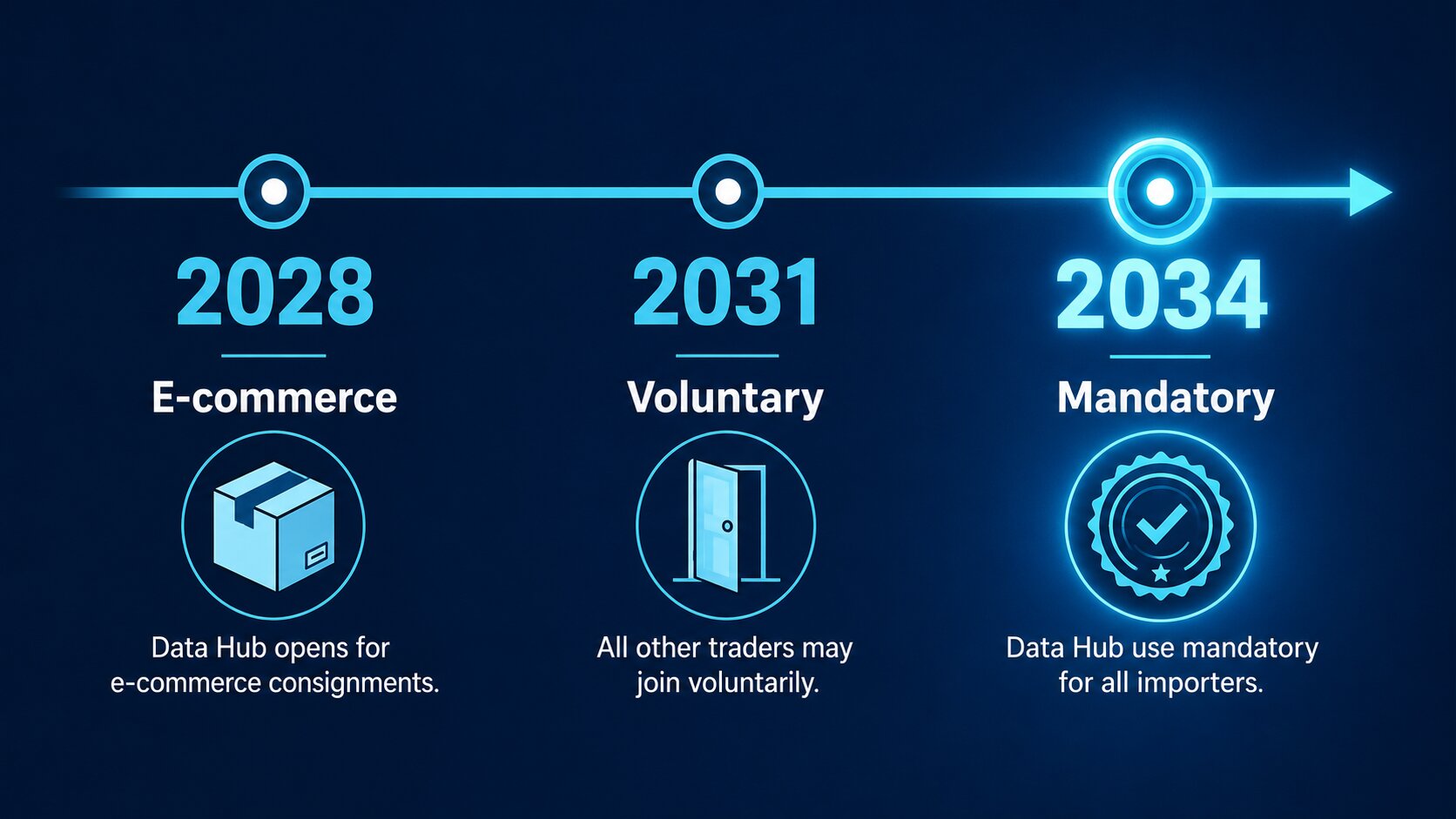
Three dates matter, and they arrive in sequence rather than all at once. The reform starts narrow (e-commerce only) and widens over six years, which gives most traders time to prepare rather than scramble. Note that 2028 does not mean every importer must join the Hub; it means the e-commerce channel goes first.
| Date | Milestone | Who it affects |
|---|---|---|
| 1 July 2028 | Data Hub opens | E-commerce imports only |
| 2031 | Voluntary access | Other importers who opt in early |
| 1 March 2034 | Mandatory for all goods movements | Every importer and forwarder |
The phased approach is deliberate. Platforms and their logistics providers absorb the first wave in 2028, larger data-mature importers can test the Hub voluntarily from 2031, and full mandatory use lands in March 2034 (European Commission; Consilium). For an SME, the practical read is that you have until roughly 2031 to get comfortable, unless you sell online, in which case 2028 is your real deadline.
From declaration-based to data-driven: what changes in practice
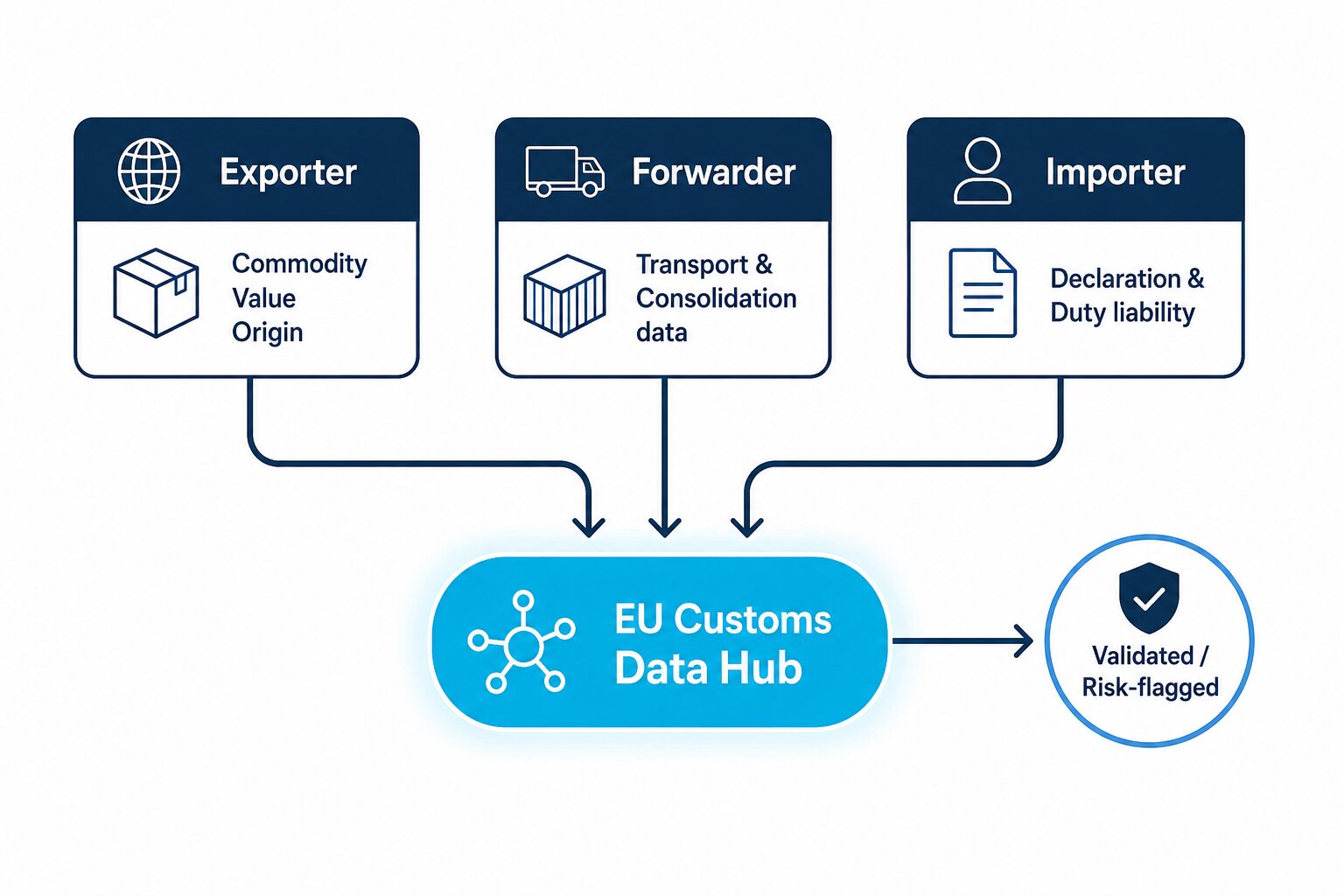
Today you (or your broker) submit a customs declaration per consignment, often after the goods are already moving. Under the Hub, you enter data once, up front, and that same dataset is reused across the journey rather than re-keyed at each border. The system then applies AI-driven risk prediction before departure, so a shipment can be flagged while it is still sitting at the origin warehouse (European Commission). Item-level detail replaces the aggregate figures that some national systems accepted; Germany’s ATLAS, for example, tolerated summarised entries that the Hub will expect line by line.
The cross-referencing is the part SMEs underestimate. The Hub compares the declared value of your goods across three separate filings:
- the exporter’s export declaration at origin,
- the forwarder’s transport-cost declaration,
- the importer’s commercial invoice.
If those three numbers do not reconcile, the discrepancy is flagged at the moment of submission rather than discovered months later in an audit (Bird & Bird; FLEX Logistik). That changes the game for anyone who has ever been casual about invoice values. Clean, consistent data stops being good hygiene and becomes the thing that gets your container released. Getting the paperwork right at source has always mattered, and our shipping terms glossary covers the documents involved; under the Hub, small inconsistencies surface immediately.
EUCA: the new authority in Lille
Lille, France was selected as the seat of the EU Customs Authority on 25 March 2026 (Consilium). EUCA develops and manages the Data Hub, runs EU-level risk analysis across all incoming trade, and coordinates the 27 national customs authorities so that decisions are more consistent from one port to the next. The agency is expected to employ roughly 250 staff (Estimated). For an importer in Burgas or a seller shipping into Rotterdam, EUCA is the body deciding how risk scoring works, even though your day-to-day contact stays with your national customs office.
Trust and Check traders: the fast lane
A new tier sits above the familiar AEO status. AEO, or Authorised Economic Operator, is today’s trusted-trader certification; the reform adds a higher category called Trust and Check traders (Consilium). To qualify, a business must meet stringent criteria on transparency, data quality, and compliance history. The reward is substantial: in some cases such traders can release goods into free circulation with no active customs intervention at the border, subject to retrospective checks on their own data, and they can clear all their imports through their home Member State regardless of which port the goods actually enter (Consilium).
Who realistically gets there first? Large, data-mature importers with clean systems and full-time compliance teams. Most SMEs will not qualify on day one, and that is fine. What a smaller importer can do instead is work through a forwarder that holds strong status and disciplined data practices, so you benefit from smoother clearance without carrying the certification yourself. Building the data quality that Trust and Check demands is also the same work that keeps you out of trouble everywhere else.
The e-commerce shake-up: 150 euros gone, platforms as deemed importer
The 150-euro customs-duty exemption on low-value parcels is abolished under the reform. In its place, the online platform that sold the goods becomes the “deemed importer,” meaning the platform (not the shopper) is liable for duty and VAT at the moment of purchase (European Commission). A deemed importer is simply the party the law treats as the importer for tax purposes, even if it never physically handles the box. A temporary charge of 3 euros per item applies from 1 July 2026 until 1 July 2028 as a bridge, and low-value goods move to a simplified tariff of roughly four buckets rather than the full nomenclature (European Commission; EY). The Commission expects around 1 billion euros a year in extra revenue, and non-compliance penalties have been reported at 1 to 6 percent of goods value (Globalior). If you sell cross-border online, this reshapes your landed-cost maths; our guides on IOSS after the de minimis change and on DDP versus DAP walk through the pricing and Incoterms® 2020 choices that follow.
Who’s liable now: importer, platform, or forwarder?
Liability is the question that keeps SME importers up at night, and the reform sharpens it on non-EU lanes. When goods come from China, Turkey, the UAE, or Serbia and the wider Balkans, and the buyer has no legal establishment inside the EU, the forwarder acting as indirect representative becomes the importer of record and assumes the customs and tax risk that goes with it (FLEX Logistik; Bird & Bird). An indirect representative files in its own name on behalf of a client; an importer of record is the party legally responsible for the declaration, the duty, and any error in it. That is a meaningful exposure, because the Hub’s value cross-checking means an understated invoice from a supplier can land on the representative’s desk as a flagged discrepancy.
We see this concretely on our Balkan and China corridors. When we consolidate cargo for a client who has no EU entity, we are the ones whose name sits on the declaration, so we care about the accuracy of a Chinese supplier’s invoice as much as our client does. The lesson for SMEs is to ask, in plain terms, who is importer of record on each non-EU lane before goods ship. If your Turkish supplier’s paperwork is thin, that gap becomes someone’s liability, and the ongoing Turkey–EU Customs Union modernization only raises the stakes on documentation quality.
What it means for consolidated and LCL shippers specifically
Groupage adds a wrinkle the Hub does not forgive easily. LCL, or Less than Container Load, means several shippers’ goods share one container, so a single Data Hub submission has to reconcile data from multiple suppliers at once. If five suppliers feed one groupage load and one of them sends a sloppy invoice or a wrong HS code, that single weak link can flag the whole submission. Data quality across suppliers, not the freight itself, becomes the bottleneck. This is precisely where a forwarder who knows each supplier’s paperwork habits earns its keep, chasing the missing line-item before it reaches the Hub rather than after. For SMEs shipping a pallet rather than a full box, our consolidated / LCL service is built around exactly this kind of per-supplier data discipline.
What SME importers should do before 2028
Preparation is unglamorous and mostly about data hygiene. Work through this list over the next 18 months rather than in a panic close to the deadline:
- Get your EORI number in order and confirm it is valid for every Member State you clear through.
- Audit your HS-code accuracy on your top products; wrong codes will surface instantly under item-level checks.
- Clean your commercial-invoice and value data so exporter, forwarder, and importer figures reconcile.
- Ask your forwarder directly about their Data Hub migration roadmap and their data-quality processes.
- Clarify who is importer of record on each non-EU lane (China, Turkey, UAE, the Balkans) in writing.
- If you sell online, treat 1 July 2028 as a hard date and check whether your platform absorbs deemed-importer duties for you.
None of this requires new software today. It requires knowing where your data is messy and fixing it while there is time.
FAQ
What is the EU Customs Data Hub?
It is a single EU online portal where businesses log all product and supply-chain data once, replacing the 27 national customs IT systems (European Commission). Customs authorities analyse that shared data with AI and human review instead of processing separate declarations per shipment. It is the core of the customs reform agreed on 26 March 2026.
When does it become mandatory?
The Hub opens for e-commerce imports on 1 July 2028, becomes voluntary for other importers in 2031, and is mandatory for all goods movements from 1 March 2034 (European Commission; Consilium). The reform still needs formal approval, so dates could shift. E-commerce sellers face the earliest deadline.
Where is EUCA based?
The EU Customs Authority will be seated in Lille, France, chosen on 25 March 2026 (Consilium). It manages the Data Hub, runs EU-level risk analysis, and coordinates the 27 national customs authorities. It is expected to have around 250 staff (Estimated).
What is a Trust and Check trader?
It is a new top tier of trusted trader, above the current AEO status, for highly transparent businesses that meet strict criteria on transparency, data quality, and compliance history (Consilium). Such traders can, in some cases, release goods with no active customs intervention, subject to retrospective checks, and clear all imports through their home Member State. Most SMEs will not qualify immediately.
Does the reform change who is liable, importer or forwarder?
Yes, on non-EU lanes. If the buyer has no EU establishment, the forwarder acting as indirect representative becomes the importer of record and carries the customs and tax risk (Bird & Bird; FLEX Logistik). That makes it essential to agree, per lane, who holds that role before goods ship.
What happened to the 150-euro exemption?
The 150-euro customs-duty exemption on low-value parcels is abolished, and online platforms become deemed importers liable for duty and VAT at purchase (European Commission). A temporary 3-euro-per-item charge applies from 1 July 2026 to 1 July 2028, with a simplified four-bucket tariff for low-value goods. Penalties for non-compliance have been reported at 1 to 6 percent of goods value (Globalior).
The EU Customs Data Hub turns clearance from a stack of per-shipment declarations into one continuously analysed data picture, and the traders who reconcile their numbers early will move goods fastest. If you import through non-EU lanes or ship groupage, the sensible next step is a short conversation with your forwarder about who holds the importer-of-record role and how your data will reach the Hub. Sea Gate Logistics works these corridors daily, and we are happy to review your lanes and quote a consolidated shipment when you are ready.