How freight rates are calculated comes down to four layers: a base rate, carrier surcharges, terminal and local charges, and customs and compliance costs. The base rate is the number that arrives in a quote email. The other three turn that number into an invoice.
Industry figures from NTS Logistics and Unishippers put accessorial charges at 40–60% over the base rate, with an all-in rate typically running 40–80% higher than base. On LCL the gap is wider: CFS handling at both ends, terminal handling, bunker adjustment and documentation together often add 50–80% on top of base ocean freight, according to Suaid Global.
The compliance layer thickened in 2026. The EU Emissions Trading System now covers 100% of reportable emissions, FuelEU Maritime penalties become payable from 1 May 2026, and the Carbon Border Adjustment Mechanism (CBAM) definitive period opened on 1 January 2026. Every line on a freight invoice belongs to one of three classes: negotiable, fixed or avoidable. Knowing which class a charge sits in is the difference between querying an invoice and paying it.
Key takeaways
- A freight rate has four layers. Base rate, carrier surcharges, terminal and local charges, then customs and compliance costs. Each layer is set by a different party.
- Surcharges add 40–80% over the base rate on industry estimates from NTS Logistics and Unishippers. The rate you were quoted is not the invoice you will receive.
- Every charge is negotiable, fixed or avoidable. That three-way test works on any quote, including one nobody here has ever seen.
- 2026 added a regulatory layer. EU ETS reaches 100% of reportable emissions, FuelEU Maritime penalties apply from 1 May 2026, and CBAM went definitive on 1 January 2026.
Scope and audience: written for SME importers and exporters who receive freight quotes they cannot read. It covers how freight rates are calculated for ocean, European road and air freight, not duty or HS classification, insurance underwriting or lane-by-lane forecasting. General guidance, not tax or legal advice.
The short answer: how freight rates are calculated in four layers
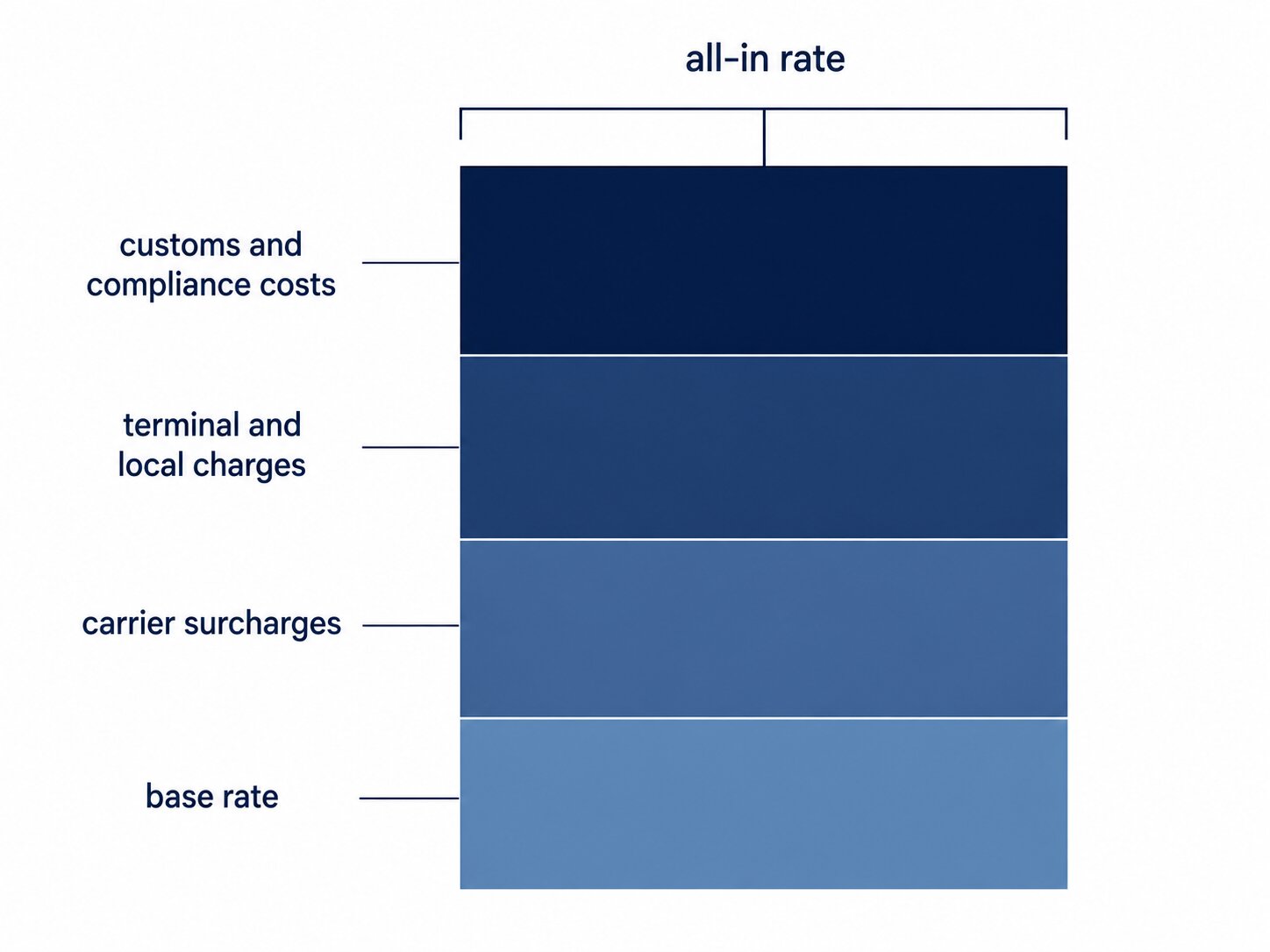
Each layer is priced by a different party, and a quote may cover one of them or all four.
- Base rate: the carrier’s price for moving cargo between two points, quoted per container, per cubic metre (CBM), per loading metre (LDM) or per chargeable kilo.
- Carrier surcharges: adjustments the shipping line adds to its own tariff, such as BAF, LSS, GRI and PSS.
- Terminal and local charges: Terminal Handling Charge (THC) at each end, ISPS security, Container Freight Station (CFS) handling on LCL, documentation and Bill of Lading fees.
- Customs and compliance costs: clearance fees, import duty and VAT, and since 2026 the EU ETS surcharge.
The base rate buys the movement, nothing else. It is set by the shipping line, or by an NVOCC (Non-Vessel Operating Common Carrier) reselling space it bought in bulk. An all-in freight rate covers every charge that quote names, which is not the same as every charge you will pay: a port-to-port all-in still leaves destination clearance, duty and delivery outside it.
Two forwarders quoting the same lane usually differ on scope rather than price. One priced port-to-port, the other door-to-door with clearance included (our service list names which is which). The two numbers are not comparable until both sides name their layers.
Negotiable, Fixed or Avoidable: how to read any charge
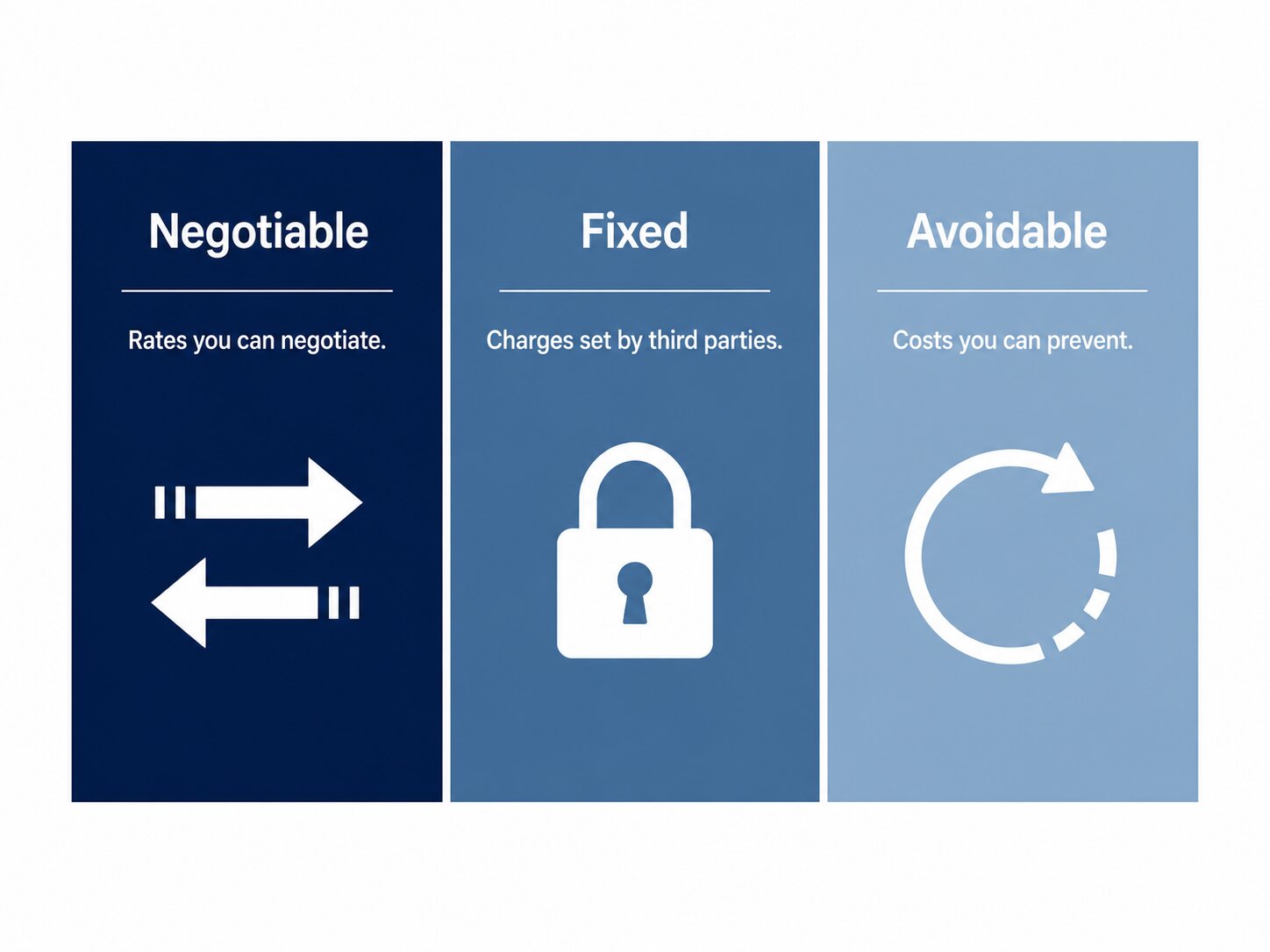
Around twenty separate line items can appear on a single ocean freight invoice, and each one belongs to exactly one of three classes. That classification is the Negotiable / Fixed / Avoidable test, and it works on a quote we have never seen.
- Negotiable: set by the party quoting you, out of their margin, their own fee schedule or their negotiating weight with the carrier.
- Fixed: a pass-through of someone else’s tariff or a statutory cost, collected by your forwarder but decided by a terminal, a carrier or a tax authority.
- Avoidable: triggered by something you did or failed to do, which means it can be engineered down to zero.
The test is one question per line: who decided this figure, and what would have to change for it to be smaller? If the answer is the party sending the invoice, negotiate it. If it is a published tariff, verify the tariff and move on. If it is your own booking date or your own paperwork, fix the process rather than argue about the price.
Most surcharge guides define the acronyms or quote the ranges; very few say which class a charge belongs to, and that is the part that decides what you do next. On the lanes we quote out of Burgas, the fee lines shippers never question (documentation, customs clearance) are usually the ones we set ourselves.
How freight rates are calculated line by line: every charge on a 2026 ocean invoice
The table applies the framework to all twenty of them, using typical 2026 ranges from freight-pricing sources: Estimated industry figures rather than quotes, so any single lane sits somewhere inside them. Every freight surcharge is explained here by who sets the number, not by what the acronym stands for. For market context on the base-rate layer, Drewry’s World Container Index stood at $4,297 per 40ft on 6 August 2026.
| Charge | Acronym | Who sets it | Typical 2026 range | Class |
|---|---|---|---|---|
| Base ocean freight | n/a | Carrier | $40–180 per CBM on LCL; FCL by lane and index | Negotiable |
| Bunker Adjustment Factor | BAF | Carrier | $200–600 per container (15–25% of base) | Fixed |
| Low Sulphur Surcharge | LSS | Carrier | Inside the same 15–25% fuel block, sometimes billed apart | Fixed |
| Currency Adjustment Factor | CAF | Carrier | 0–5% of the base rate | Fixed |
| General Rate Increase | GRI | Carrier | $500–3,000 per container | Avoidable (book before the effective date) |
| Peak Season Surcharge | PSS | Carrier | $500–2,000 per container | Negotiable on contract, Fixed on spot |
| Terminal Handling Charge, each end | THC / OTHC / DTHC | Terminal | $100–350 per container; $20–40 per CBM or B/L on LCL | Fixed (double-charging is avoidable) |
| Port security | ISPS | Port / terminal | $10–30 per container | Fixed |
| Container Imbalance Charge | CIC | Carrier | Route-dependent; stacks with GRI and PSS in Q3/Q4 | Fixed |
| CFS consolidation and de-consolidation (LCL) | CFS | Consolidation warehouse | $15–40 per CBM at each end | Fixed |
| Documentation / Bill of Lading fee | B/L | Forwarder | $25–75 per B/L | Negotiable |
| Telex release / surrender | n/a | Carrier or forwarder | $25–50 | Avoidable (use an express release or a seaway bill) |
| Manifest amendment | ENS / AMS / ISF | Carrier | $30–100 | Avoidable (file correct data first time) |
| War risk / congestion surcharge | n/a | Carrier | Cape of Good Hope routings add $800–1,500 per container | Fixed |
| EU Emissions Trading System surcharge | EU ETS | Carrier | ≈ €59/TEU, Q1 2026 (Maersk, Singapore–Rotterdam) | Fixed |
| Customs clearance fee | n/a | Forwarder or broker | Set by whoever files the declaration | Negotiable |
| Import duty and VAT | n/a | Tax authority | Statutory, by HS code and customs value | Fixed |
| Demurrage (container inside the terminal past free time) | n/a | Carrier / terminal | $100–150 per container per day, $400+ at premium ports, after 3–7 free days | Avoidable |
| Detention (container outside the terminal past free time) | n/a | Carrier | $100–150 per container per day, $400+ at premium ports, after 4–7 free days | Avoidable |
| Destination storage | n/a | Terminal or warehouse | Daily tariff once free time expires | Avoidable |
The Fixed block is where most of the money sits, which is why most of a freight rate is settled before anyone starts haggling. The Avoidable block is small line by line, substantial in aggregate, and the only part a shipper can take to zero.
Fuel and rate-adjustment surcharges: BAF, LSS, CAF, GRI, PSS
Fuel adjustment alone runs 15–25% of the base rate, or $200–600 per container on industry figures from NYSHEX and ExFreight. Five acronyms cover the ocean freight surcharges that move a rate after it is quoted:
- BAF (Bunker Adjustment Factor): the fuel surcharge on an ocean rate, recalculated monthly or quarterly against a fuel index as bunker prices move.
- LSS (Low Sulphur Surcharge): covers compliant fuel under IMO sulphur rules.
- CAF (Currency Adjustment Factor): covers exchange-rate movement between the tariff and the carrier’s cost currency, typically 0–5% of the base rate.
- GRI (General Rate Increase): a carrier-announced across-the-board increase on a trade lane, effective from a stated date.
- PSS (Peak Season Surcharge): a temporary surcharge applied when demand peaks and capacity tightens.
Hapag-Lloyd announced a flat GRI of USD 1,000 per container effective 1 March 2026, on Asia-origin cargo to the West Coast of South America, Mexico, Central America, the East Coast of South America and the Caribbean. COSCO’s GRI from 1 July 2026 covers the Far East, Indian Subcontinent, Middle East and Oceania into the United States and Canada, at USD 2,400 per 20ft to USD 3,798 per 45ft.
CMA CGM’s East Africa PSS ran USD 750/TEU to Mombasa, USD 500/TEU to Dar es Salaam and USD 900–1,100/TEU to Zanzibar.
Stacking is the part shippers fail to budget for. Carriers commonly apply a GRI, a PSS and an equipment imbalance charge inside the same Q3/Q4 window, so three increases can land on one invoice in a single quarter.
Terminal, handling and documentation charges
$100–350 per container at each end is what a terminal charges to move a box between quay and yard, so every shipment pays it twice (ExFreight industry figures). On LCL it converts to $20–40 per cubic metre or per Bill of Lading. Two charges sit alongside it: ISPS security at $10–30 per container, covering port and vessel security under the IMO’s ISPS Code, and CIC (Container Imbalance Charge), for repositioning empty equipment. LCL also carries CFS handling at $15–40 per CBM, origin and destination.
The paperwork lines are smaller and more numerous:
- Documentation / Bill of Lading fee: $25–75 per B/L
- Telex release: $25–50 to release cargo without original documents
- Manifest amendment: $30–100 when a detail changes after filing
- VGM (Verified Gross Mass): mandatory weight certification for every loaded container
- Advance manifest filing: ENS into the EU, AMS and ISF into the United States
None of this is carrier margin. US practice calls these lines accessorial charges, anything billed on top of the line-haul move, and each is a tariff set by a terminal, a port authority or a customs system, which is why the framework classes most of them as Fixed.
The 2026 regulatory layer: EU ETS, FuelEU Maritime and CBAM
Three EU rules put a price on the same voyage in 2026, and only one of them reaches you as a surcharge on the freight invoice.
EU ETS
The maritime phase-in reaches 100% of reportable emissions in 2026, up from 70% in 2025 and 40% in 2024, and methane and nitrous oxide enter scope for the first time (European Commission, DG Climate Action). It covers 100% of emissions on intra-EU voyages and 50% on voyages into or out of the EU.
EU ETS surcharge 2026 levels follow that widening base: Maersk published roughly €59 per TEU for Q1 2026 on Singapore to Rotterdam, and Asia to North Europe surcharges moved from about $114 to $168 per FEU. Sector-wide, the ETS bill is projected to rise from roughly $1.4bn in 2025 to $2.7bn in 2026 (Estimated).
FuelEU Maritime
The GHG-intensity limit for 2025–2029 is 89.34 g CO₂e/MJ against a 91.16 g CO₂e/MJ baseline (Lloyd’s Register and DNV compliance timetable). A ship above it pays about EUR 2,400 per tonne of VLSFO-equivalent energy deficit, from 1 May 2026, with documents of compliance due by 30 June. Shippers never see that invoice: the cost folds into the base rate the way bunker cost always has.
CBAM
The definitive period started on 1 January 2026 (European Commission / Access2Markets). Importers above the 50-tonne mass threshold must hold authorised CBAM declarant status, certificate sales begin on 1 February 2027, and the first surrender deadline is 30 September 2027, covering 2026 imports. CBAM is a landed-cost line on covered goods (iron and steel, aluminium, cement, fertilisers, electricity and hydrogen), not a freight surcharge.
Road and air: different units, different surcharges
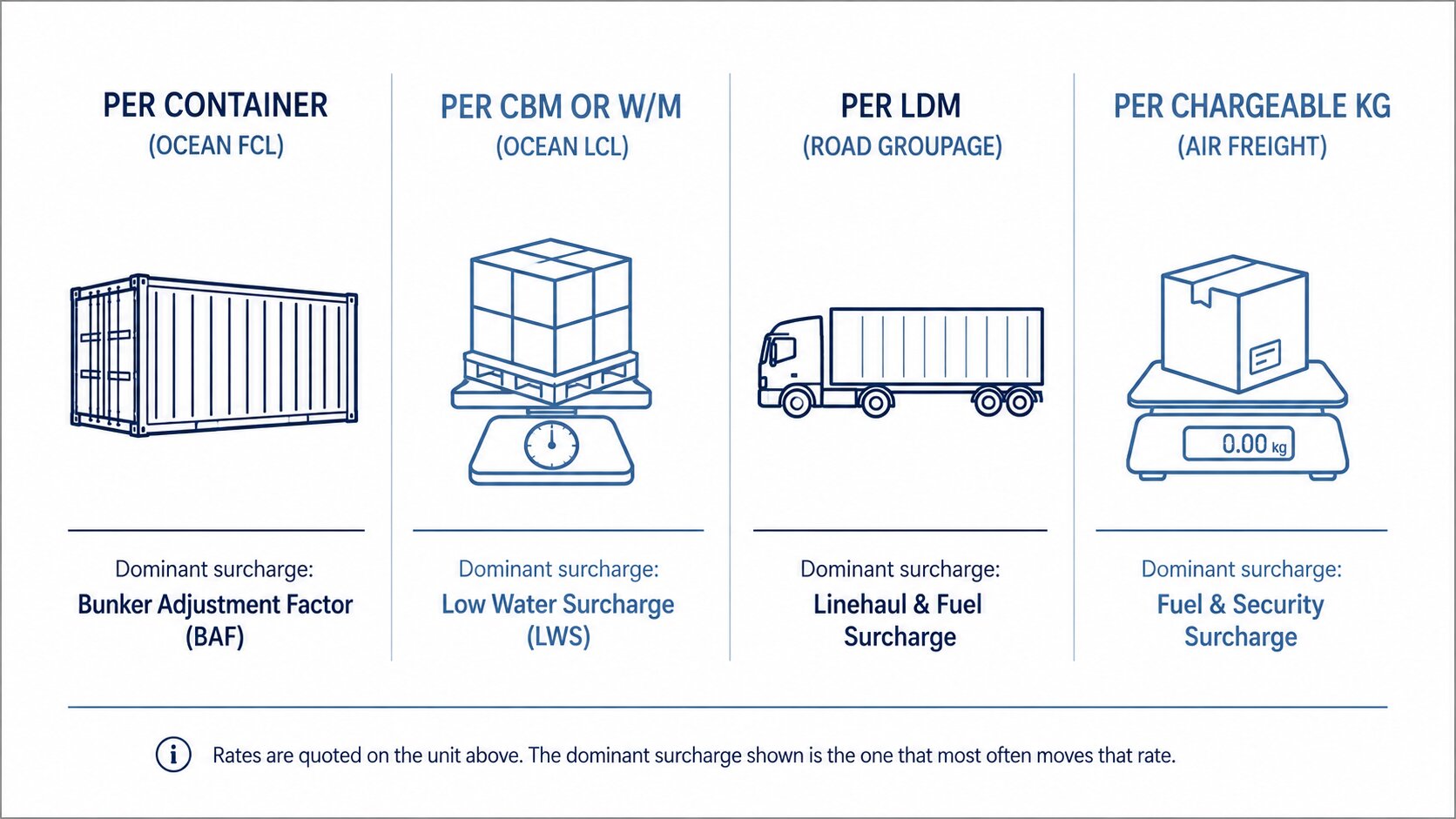
In multimodal transport, how freight rates are calculated does not change; the unit each charge attaches to does. European groupage is priced per loading metre, air per chargeable kilo, ocean per container or per cubic metre, and a different surcharge dominates each bill.
| Mode | Pricing unit | Dominant surcharge |
|---|---|---|
| Ocean FCL | Per container (20ft / 40ft / 45ft) | BAF, plus THC at each end |
| Ocean LCL | Per CBM, or per w/m (weight or measure, whichever is greater) | CFS consolidation and de-consolidation |
| European road groupage | Per LDM (loading metre) | Diesel index pass-through and tolls |
| Air | Per chargeable kg | Fuel surcharge (FSC) plus security surcharge (SSC) |
European road freight spot rates hit 146.8 points in Q2 2026 on the Ti/Upply/IRU European Road Freight Rate Benchmark, up 14.6 quarter on quarter, with contract rates at 148. Diesel drove it: an EU average of EUR 1.94 per litre in Q2 2026, up 27% year on year, peaking at EUR 2.19 in April. Poland raised tolls 33% in February 2026, 40% above the year before.
Pass-through is uneven, though. Spain and France run national fuel indices while Italy’s mechanism is limited, so the same fuel spike reaches the rate differently by country. Spain to Germany groupage ran €144–200 per LDM in Q2 2026, the unit quoted across the road lanes we run.
Airfreight bills on chargeable weight, the greater of actual and volumetric weight (cm³ ÷ 6000, a density of 167 kg per m³, per IATA). Industry figures put the fuel surcharge at EUR 0.30–1.50 per kg and security at EUR 0.10–0.22 per kg; the same sources report the two together, in dollars, at $0.80–2.50 per kg over the base rate.
Why an LCL invoice carries more lines than an FCL one
A 2 CBM consignment and a 33 CBM full container carry the same Bill of Lading, the same documentation fee at $25–75, and the same customs entry. Consolidated cargo then adds CFS consolidation at origin and de-consolidation at destination, each $15–40 per CBM, plus THC billed at $20–40 per CBM or per B/L rather than per container. None of those lines shrinks because the cargo did.
The fixed block spreads over 2 CBM instead of 33, so the smaller the shipment, the larger the share of the invoice that has nothing to do with moving goods. Per-CBM comparisons between forwarders mislead badly here: a low per-CBM rate with unnamed CFS and documentation fees can land above a higher rate that itemises them. It is also why combining several suppliers into one booking shifts the arithmetic more than negotiating the ocean leg does.
Incoterms decide which side of the invoice each charge lands on
The same origin terminal handling charge can land on the seller’s invoice and again on the buyer’s, and neither document is technically wrong. The ICC’s Incoterms® 2020 rules allocate cost and risk between seller and buyer, and the term written into the sales contract decides which charges reach you at all.
- EXW (Ex Works): the buyer carries everything from the seller’s door, including export clearance and origin handling.
- FOB (Free On Board): the seller covers origin charges and export clearance; the buyer pays freight and every destination charge.
- DAP (Delivered At Place): the seller covers freight and destination handling; the buyer pays import duty, VAT and clearance.
- DDP (Delivered Duty Paid): the seller covers everything, import duty and VAT included.
So why does a FOB buyer so often still see origin THC sitting on a forwarder’s quote? Because the quote was priced port-to-port without anyone checking the term. Under FOB the seller has already paid that handling, which makes the second charge a straight duplicate. The same logic explains why a DAP price and a DDP price for one shipment are not comparable numbers.
Worked example: a quoted groupage rate versus the final invoice
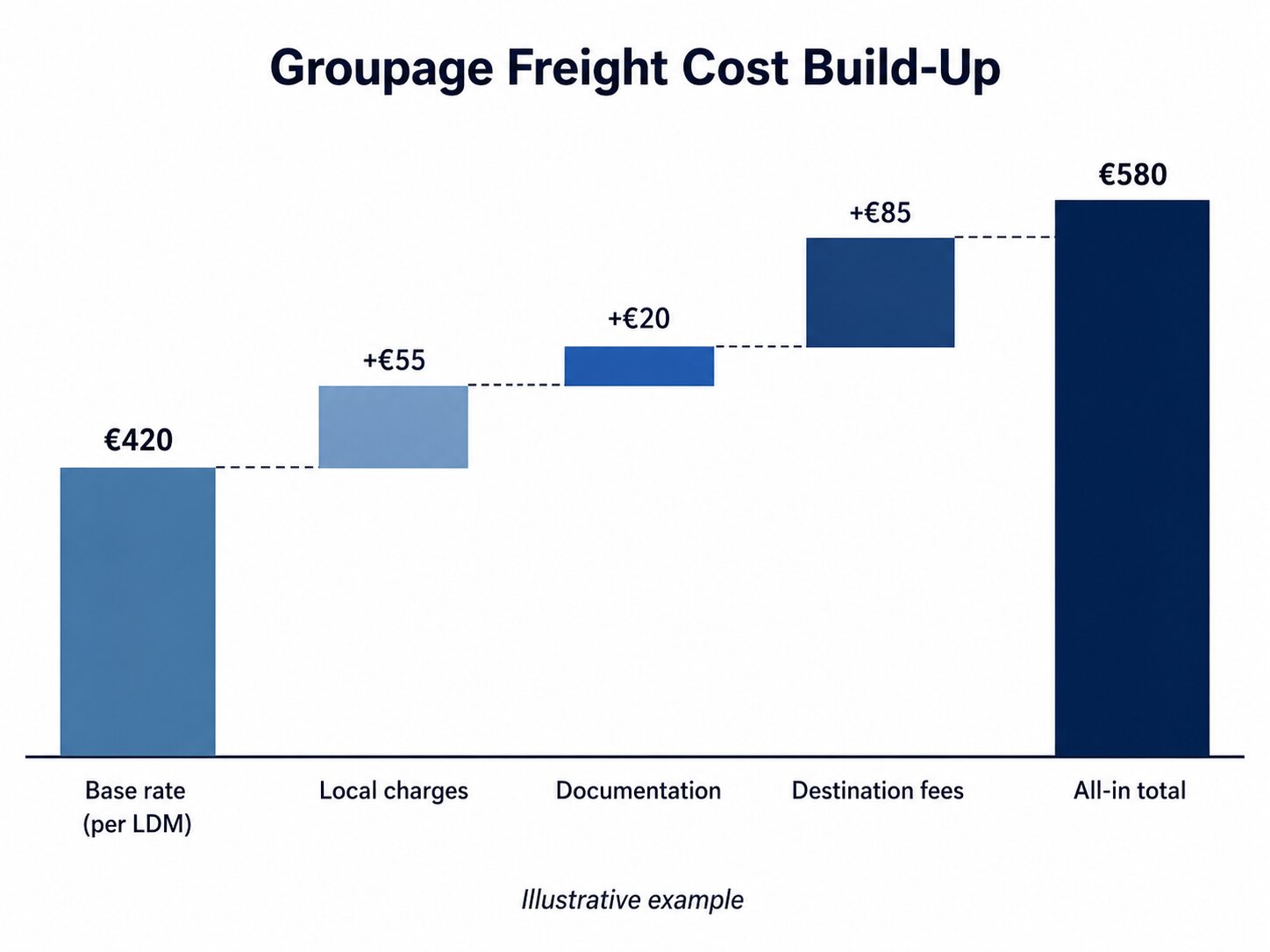
Two pallets, roughly 3 CBM and 1.5 loading metres, moving Spain to Germany as groupage. Every figure in this freight rate breakdown is illustrative: base freight from the Ti/Upply/IRU European Road Freight Rate Benchmark (Spain to Germany groupage at €144–200 per LDM, Q2 2026, Measured), handling and documentation from industry per-CBM and per-B/L ranges (Suaid Global, ExFreight, Estimated). This is not a Sea Gate quote and not a client shipment.
| Line | Basis | Low | High |
|---|---|---|---|
| Base groupage freight | 1.5 LDM × €144–200 per LDM | €216 | €300 |
| Origin consolidation handling | 3 CBM × $15–40 per CBM | $45 | $120 |
| Destination de-consolidation | 3 CBM × $15–40 per CBM | $45 | $120 |
| Documentation / B/L fee | per B/L | $25 | $75 |
| All-in | euro and dollar lines kept separate | €216 + $115 | €300 + $315 |
The benchmark is published in euro and the local charges in dollars, so the all-in row keeps each line in its source currency. The add-on lines run about 53% of the base freight at the floor and about 105% at the ceiling (115 against 216, then 315 against 300). That brackets the 40–80% industry figure and overshoots it at the top, because a 3 CBM consignment carries the same flat documentation fee as a full trailer.
On the lanes we quote, the two places SME shippers actually get caught are narrower than this table suggests: origin charges paid a second time under FOB, and free time expiring while a delivery slot is still being arranged.
Eight questions that make two quotes comparable
A quote naming four charges and a quote naming twelve can carry the same headline rate. Comparing freight quotes starts with the eight questions below, each one tied to a class in the framework.
- Which Incoterm is the quote based on, since that decides whether origin charges are already the seller’s cost?
- Is the price port-to-port or door-to-door, and at exactly which point does it stop?
- Are origin and destination local charges included, and are they itemised by name rather than bundled into one line?
- Is the rate all-in, and which surcharges does that phrase actually name in this quote?
- How long is the rate valid, and is a GRI or PSS due inside that window, making it Avoidable by booking earlier?
- How much free time comes with it, stated separately in days for demurrage and for detention?
- Which fee lines are the forwarder’s own rather than a terminal or carrier tariff, since those are the Negotiable ones?
- What triggers a re-rate: a VGM correction, a manifest amendment, or a reweigh at the terminal?
Ask for the charges by name, not for a lower number.
FAQ
Why is my freight invoice higher than the rate I was quoted?
The quote you received was almost certainly the base rate. Carrier surcharges, terminal and local charges, and customs costs are added on top, and industry figures put an all-in rate 40–80% above base, with accessorial lines alone at 40–60% (NTS Logistics / Unishippers, Estimated).
How much do surcharges add to a freight rate?
On ocean freight they commonly add 40–80% over the base rate. LCL sits higher: CFS handling at both ends, THC, BAF, documentation and storage often add 50–80%. In air freight, fuel and security surcharges add $0.80–2.50 per kg (Estimated ranges).
What is the difference between demurrage and detention?
Demurrage is charged for leaving the container inside the terminal beyond free time; detention is charged for keeping it outside the terminal beyond free time. Free time typically runs 3–7 days for demurrage and 4–7 days for detention. Accrual runs $100–150 per container per day, rising above $400 at premium ports such as Los Angeles / Long Beach (Estimated).
Which freight surcharges can I negotiate?
The negotiable lines are set by the party quoting you: base ocean freight, the documentation or Bill of Lading fee at $25–75, and the customs clearance fee. BAF, LSS, CAF, THC, ISPS and the EU ETS surcharge pass through another party’s tariff or a statutory cost, so they are fixed. Demurrage, detention and telex release at $25–50 are avoidable, because your own process triggers them.
What is the EU ETS surcharge on a 2026 shipping invoice?
It is a carrier charge passing through the cost of EU emission allowances, and the 2026 phase-in reaches 100% of reportable emissions, up from 70% in 2025. It covers 100% of emissions on intra-EU voyages and 50% on voyages into or out of the EU. Maersk published roughly €59/TEU for Q1 2026 on Singapore–Rotterdam.
Does an all-in rate really include everything?
An all-in freight rate folds base freight plus named surcharges into one figure, so it covers only the charges the quote lists. Destination local charges, customs clearance, import duty and VAT, and any demurrage or detention normally sit outside it. Ask which surcharges are named inside the figure.
Do LCL shipments have more charges than FCL?
Yes. LCL pays CFS consolidation and de-consolidation at $15–40 per CBM each end, THC at $20–40 per CBM or per Bill of Lading, and the same documentation set as a full container. Spread over 2 CBM instead of 33, that fixed-fee block takes a much larger share of the invoice.