Learning how to ship freight as a small business comes down to six steps: confirm your cargo is freight, pick a mode, estimate cost, prepare documents, sort out customs, and book through a forwarder. Cargo generally counts as freight once it tops 150 lb (about 68 kg) or sits on a pallet. Your mode is either road (LTL or FTL) or sea (LCL or FCL). LCL (less than container load) lets you ship a single pallet instead of paying for a whole container. Cost is built on chargeable weight, the greater of your shipment’s actual or volumetric weight. The core paperwork is a commercial invoice, a packing list, and a Bill of Lading (the carrier’s receipt and contract for your goods). For international moves, you need a free EORI number and an agreed set of Incoterms® 2020 with your supplier, which decide who pays for what. Booking through a freight forwarder (a company that arranges and manages your shipment from pickup to delivery, including customs) ties these steps together.
Freight is palletized or bulk cargo, while a parcel is a single small box a courier handles. This guide covers international SME freight (modes, cost, documents, and customs), not domestic parcel post. It is written for small-business importers and exporters shipping their first pallets.
Key Takeaways
- Pick your mode first: road (LTL/FTL) for nearby land routes, sea (LCL/FCL) for overseas.
- LCL is the small-shipper’s friend: you pay only for the space your pallets use, not a full container.
- Cost runs on chargeable weight, the greater of actual or volumetric (dimensional) weight.
- Keep three documents ready: commercial invoice, packing list, and Bill of Lading.
- An EORI number is mandatory and free for EU import and export trade.
- Incoterms 2020 decide who pays freight, customs, and duties, so agree them before you ship.
- A freight forwarder earns its fee by consolidating cargo, clearing customs, and managing the route end to end.
Freight Shipping Modes: LTL, FTL, LCL, FCL and Air Compared
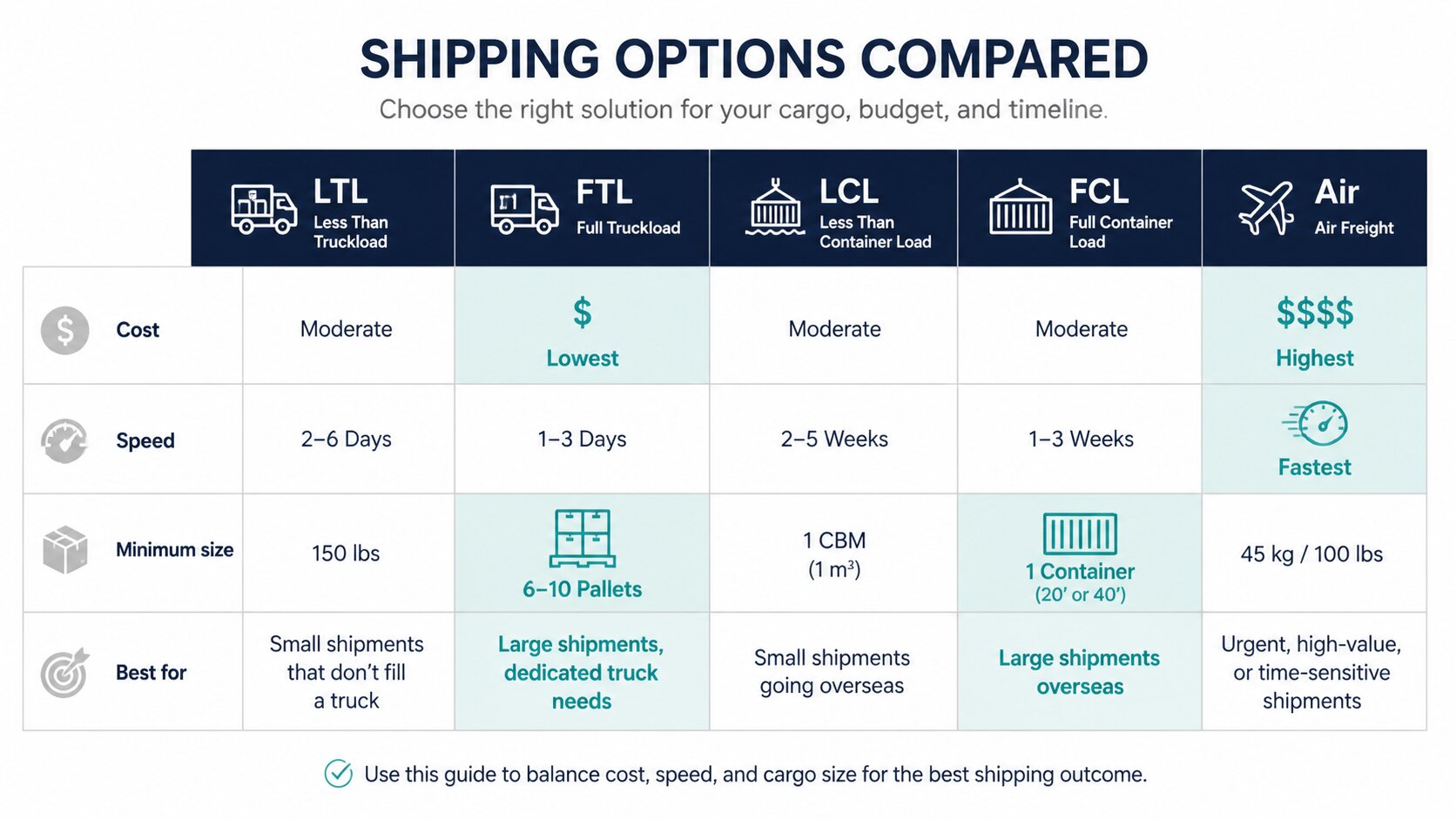
Five core modes cover almost every B2B freight move, and the right one depends on volume, speed and budget.
| Mode | What it is | Best for | Typical transit (Estimated) | Cost basis |
|---|---|---|---|---|
| LTL (Less-than-Truckload) | Shared trailer, 1-6 pallets | Small road shipments | Intra-EU ~2-7 days | Per pallet/weight |
| FTL (Full Truckload) | Whole truck | Larger or urgent road loads | ~2-7 days | Flat truck rate |
| LCL (Less than Container Load) | Shared sea container, billed by volume (CBM) | A pallet to a few m³ | EU↔China ~30-45 days | Per CBM/chargeable weight |
| FCL (Full Container Load) | Full 20’/40′ container | Container-filling volume | ~30-45 days | Flat container rate |
| Air freight | Plane, fastest option | Urgent or high-value cargo | Intercontinental ~3-8 days | Per chargeable kg (expedite 2-3× sea/road) |
LCL is the wedge for small shippers. You share a sea container with other businesses and pay only for the space your cargo occupies, billed by cubic metre (CBM). Ship one pallet, not a whole box you can’t fill. This is also called groupage, the practice of grouping several shippers’ goods into one container.
FCL (Full Container Load) works the other way. You book the entire 20′ or 40′ container at a flat rate, which makes sense once your volume can fill most of it. Below that threshold, LCL almost always costs less.
In our experience, the businesses that benefit most are first-time importers moving 1-3 pallets who assumed sea freight meant buying a full container. It rarely does. As an illustration, two standard pallets work out to roughly 2.4 CBM, so on LCL you pay for that 2.4 CBM rather than a whole container.
How Freight Cost Is Calculated (Chargeable Weight Explained)
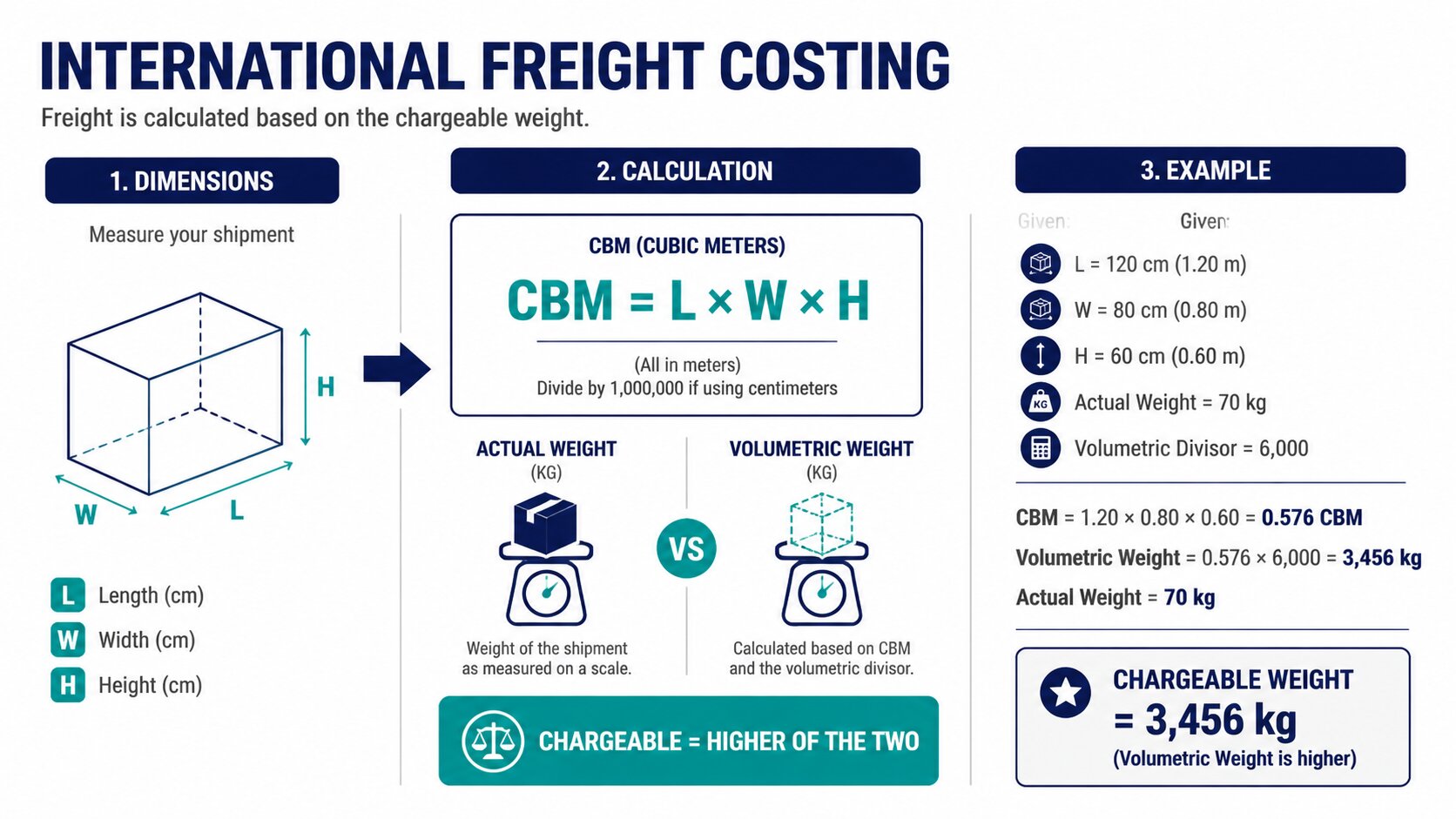
Carriers bill you on chargeable weight, which is the greater of your actual gross weight and your volumetric (dimensional) weight, per Freightos. A light but bulky shipment can cost the same as a dense, heavy one. The space it occupies is what gets priced.
Volumetric weight starts from volume. CBM (cubic metres) = length × width × height, all measured in metres. From there, each mode applies a conversion factor to turn space into a billable weight.
Worked example. A pallet measuring 1.2 m × 1.0 m × 1.1 m = 1.32 CBM.
- Ocean LCL bills roughly 1 CBM = 1,000 kg, so that pallet is about 1,320 kg-equivalent (Estimated; some carriers use 1.5 as a working default).
- Air freight uses 1 CBM = 167 kg, so 1.32 CBM ≈ 220 kg volumetric. You’re charged on the greater of 220 kg versus the actual weight.
So why does a light, bulky pallet cost more than the scale suggests? Because you’re renting space, not buying weight allowance. A pallet of cushions and a pallet of tiles take the same room in the container, even though one weighs a fraction of the other.
The practical lever is timing. Booking 1-2 weeks ahead gives the forwarder room to consolidate your cargo and quote a better rate. Last-minute expedite fees can run 2-3× higher (Estimated), because urgent space is scarce and priced accordingly. Measure accurately, declare real dimensions, and plan early.
Understanding Freight Class (US) vs CBM (International)
US domestic LTL freight runs on a classification system that international shippers almost never touch. The National Motor Freight Classification (NMFC) groups goods into 18 classes from 50 to 500, scored by density, handling, stowability and liability, according to NMFTA. Lower class means lower rate, so a dense, easy-to-stack product prices better than a light, awkward one.
The four factors behind each class:
- Density (weight relative to space occupied)
- Handling (ease of loading and moving)
- Stowability (how well it fits with other freight)
- Liability (risk of damage, theft or spoilage)
NMFTA began an overhaul of this system in July 2025 that continues into 2026, shifting the model toward density-based classification. The goal is fewer disputes over which class applies.
International ocean and road freight works differently. It prices on CBM and chargeable weight, not freight class. An EU importer moving pallets from China to Burgas deals in cubic metres and kilograms, not NMFC codes. That’s why most European shippers rarely meet freight class at all.
Packaging and Palletizing Your Freight
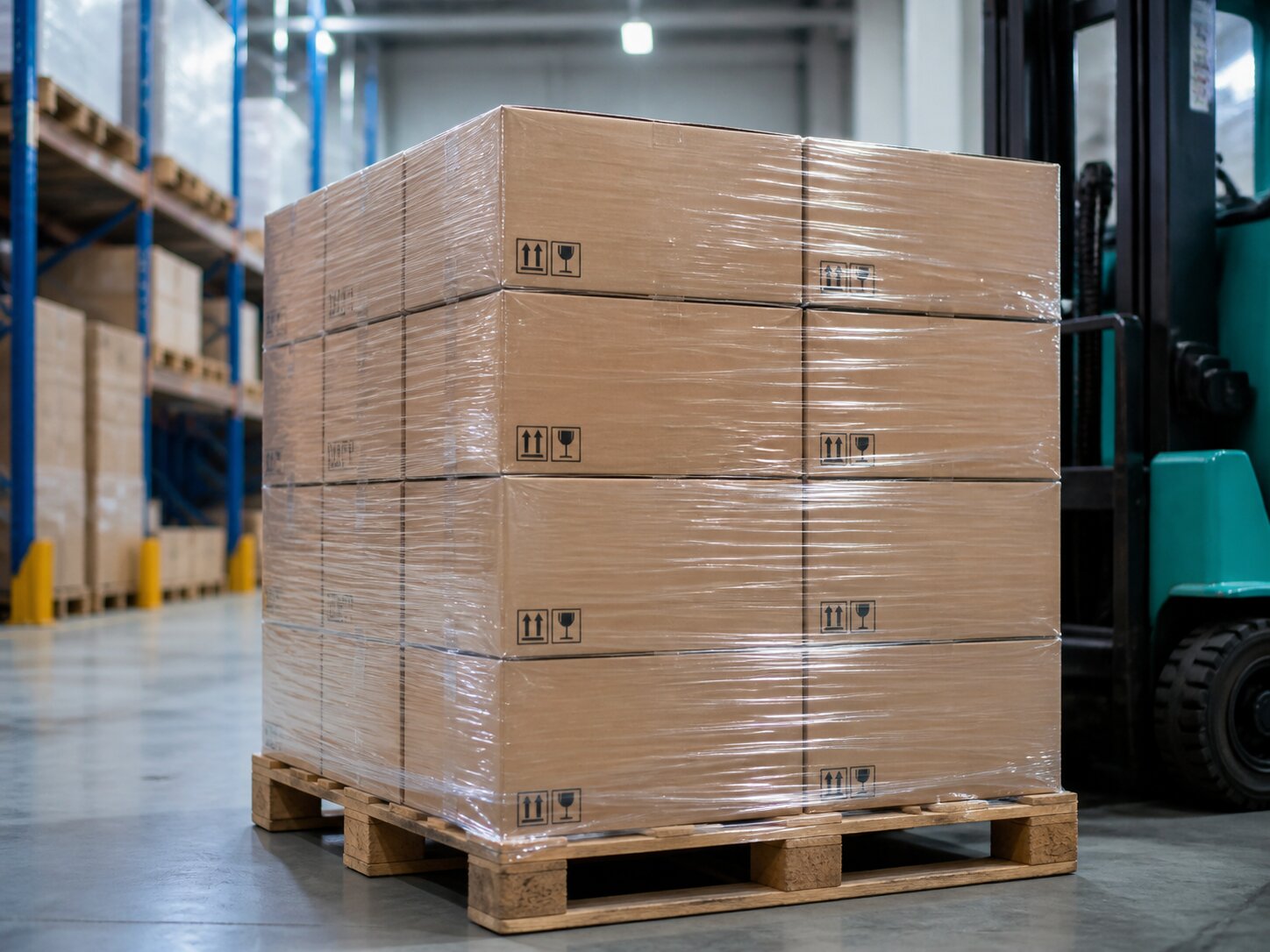
Six steps prevent most freight damage and pricing surprises before your cargo leaves the dock:
- Use a sound standard pallet (for example, a EUR pallet at 1.2 m × 0.8 m).
- Stack squarely within the pallet footprint, with nothing overhanging the edges.
- Shrink-wrap and strap the load so it stays one stable unit in transit.
- Label every pallet with consignee, destination and handling marks.
- Keep within stack height and weight limits for the mode.
- Record exact dimensions and weight for the quote.
Bulky-but-light packing quietly inflates your bill. A loosely stacked, overheight pallet takes more space, which raises its volumetric (chargeable) weight even though it isn’t heavier. Tight, square loads keep that number down.
Poor packing also shifts liability. If a pallet collapses because it was badly wrapped or overhung its base, the damage usually falls on you, not the carrier. Well-built pallets stack and consolidate better in LCL, so your cargo shares the container cleanly and travels with less risk.
Documents You Need to Ship Freight Internationally
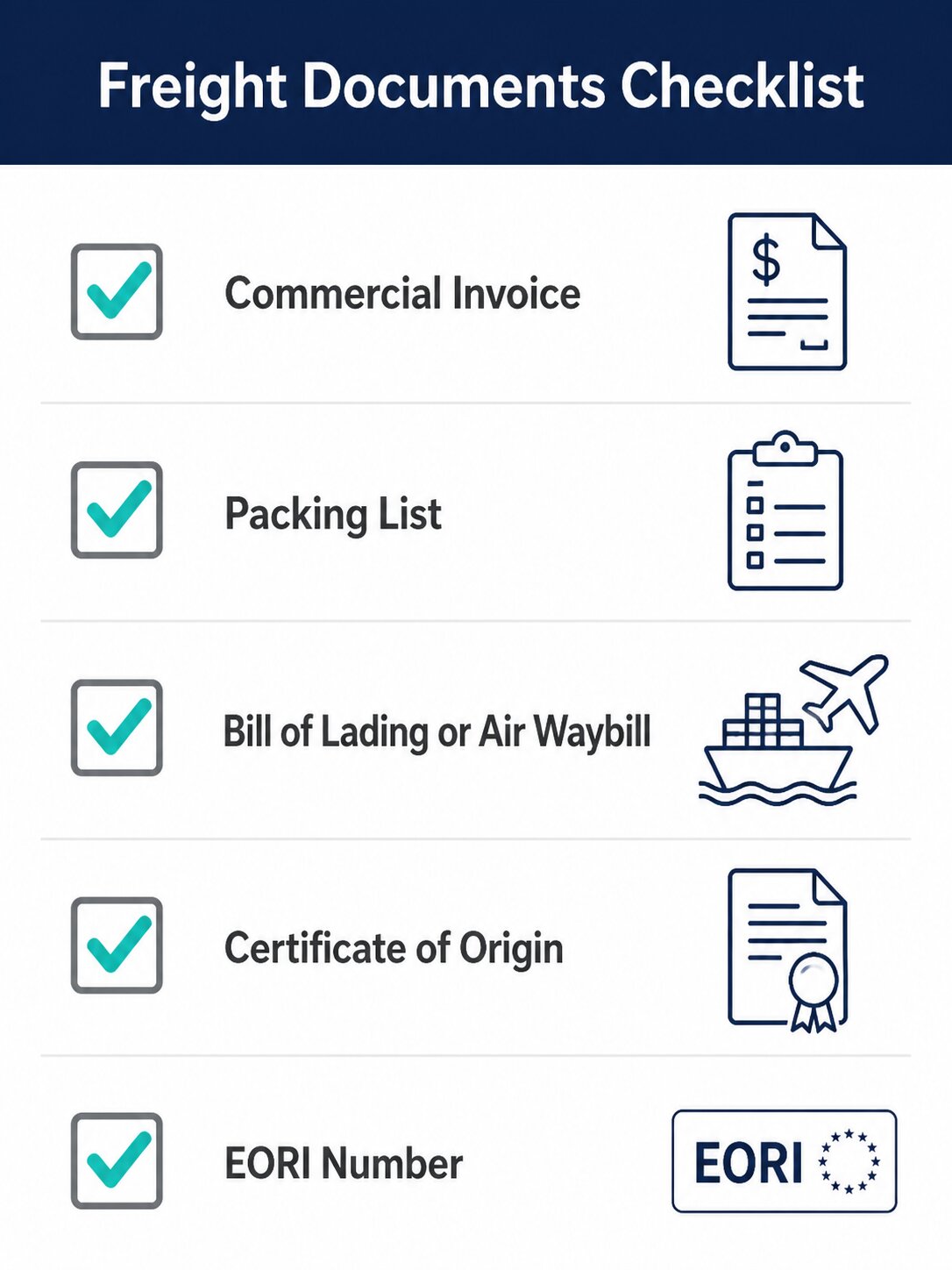
A single wrong field on the commercial invoice (a mismatched value, a missing tax ID) can hold a shipment at the border for days. Most cross-border delays trace back to paperwork, not the cargo itself. Get the documents right and the goods keep moving.
Here is the core set for an international shipment:
- Commercial invoice: the legal proof of sale and the basis customs uses to assess duties and import VAT. It must carry both parties’ details and EORI numbers (the EU importer/exporter ID, defined below).
- Packing list: itemizes what sits in each carton or pallet, with weights, dimensions and contents, so customs and the carrier can check the load against the declaration.
- Bill of Lading (B/L): the carrier’s receipt and the contract of carriage; for air freight, the equivalent is the air waybill. The B/L controls release of the goods at destination.
- Licences / certificate of origin: required for certain controlled goods, or to claim a preferential (reduced) duty rate under a trade agreement.
Consistency across these documents matters as much as the documents themselves. A mismatch between the B/L consignee and the registered EORI holder can flag the declaration for manual review, and manual review means delay. A forwarder normally prepares or checks this paperwork for you before anything reaches the border, which is where most errors get caught.
Incoterms 2020: Who Pays for What
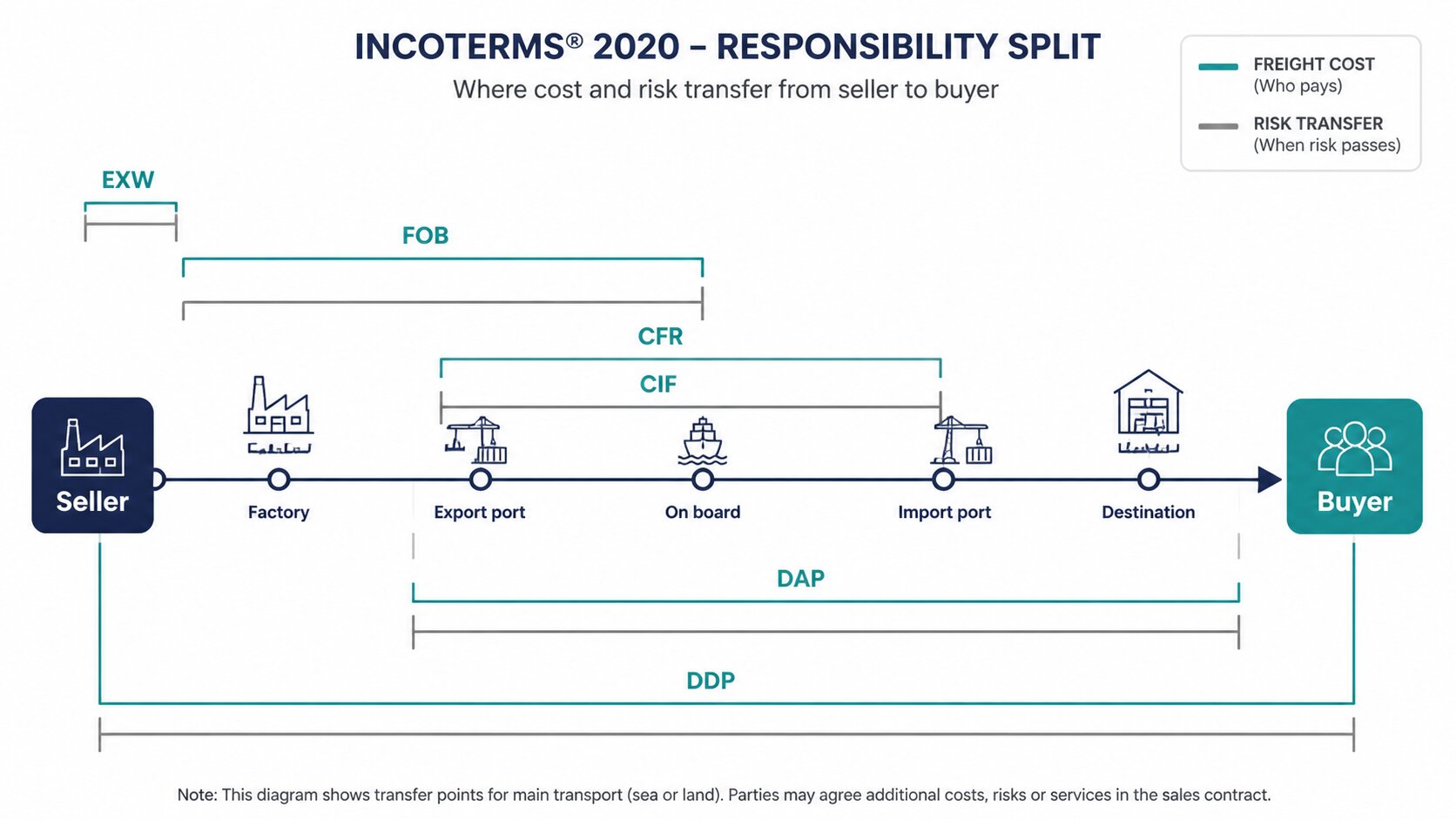
Most disputes between a buyer and supplier start with a simple gap: each assumed the other was paying for the freight. Incoterms 2020 close that gap. These are the ICC’s (International Chamber of Commerce) standard trade terms that set who pays for carriage, insurance and customs, and the exact point where risk passes from seller to buyer. The agreed term appears on the commercial invoice.
According to trade.gov, there are 11 Incoterms rules: 7 that work for any mode of transport (EXW, FCA, CPT, CIP, DAP, DPU, DDP) and 4 written specifically for sea and inland waterway transport (FAS, FOB, CFR, CIF).
Think of them as a spectrum of responsibility. At one end sits EXW (Ex Works), where the buyer does almost everything from the supplier’s door. At the other sits DDP (Delivered Duty Paid), where the seller handles almost everything, including import duties. FOB and CIF land in the middle and are common defaults for sea freight.
So who pays customs duties, you or your supplier? It depends entirely on the agreed term, as the table below shows.
| Incoterm | Who arranges main freight | Who clears import & pays duties/VAT |
|---|---|---|
| EXW (Ex Works) | Buyer | Buyer |
| FOB (Free On Board) | Buyer (from the port) | Buyer |
| CIF (Cost, Insurance, Freight) | Seller (to destination port) | Buyer |
| DAP (Delivered At Place) | Seller | Buyer |
| DDP (Delivered Duty Paid) | Seller | Seller |
If you are importing for the first time, FOB or CIF keep costs predictable while you learn where each charge falls.
EU Customs Basics: EORI, Import VAT, Duties and CBAM
No EU customs authority will release your goods without an EORI number on the declaration. It is the single identifier that ties your business to every import and export you make across the bloc. Sorting it out before your first shipment saves a stuck container later.
Here is what a first-time EU importer needs to understand:
- EORI (Economic Operators Registration and Identification) is mandatory for any business importing into or exporting from the EU. Per the EU Commission, it is free to apply for, and customs won’t clear your goods without it.
- Import duty and import VAT both fall due at the point of import, each assessed on the customs value of the goods (typically the goods, plus freight, plus insurance).
- HS code (Harmonized System code) classifies your product and sets its duty rate. Get the code wrong and you pay the wrong duty, with possible penalties on top.
- CBAM (Carbon Border Adjustment Mechanism) entered its definitive period on 1 January 2026 and, according to the EU Commission, applies to carbon-intensive imports such as steel, aluminium, cement and fertilisers.
Does CBAM affect your shipment? For most SMEs, no. It adds reporting and cost obligations only for importers of those specific carbon-intensive goods; if you trade in other products, it passes you by. Import duty and VAT are usually the figures that surprise a new importer, so estimate both before you commit to an order. Sea Gate is EU-registered and handles EU clearance directly, so the EORI, classification and VAT side is checked on your behalf rather than left to chance.
Should You Use a Freight Forwarder? (Decision Framework)
Three different intermediaries get confused all the time, and picking the wrong one costs you money. A freight forwarder arranges and manages the whole shipment, booking carriers, consolidating cargo, handling documents and customs, though it usually doesn’t own the trucks or ships itself. A freight broker does something narrower: it matches you to a carrier and steps back. A 3PL (third-party logistics) goes wider, adding warehousing and order fulfilment on top of transport.
So which one fits a small business sending its first pallets abroad? A forwarder usually does, and the checklist below shows when.
- You’re shipping internationally and crossing at least one customs border.
- You want to consolidate a pallet or two into LCL instead of paying for a full container.
- You don’t have customs or EORI experience yet.
- You’d rather have one accountable contact than juggle a carrier, a customs agent and a port terminal separately.
On Europe↔China LCL we typically see 1-3 pallet shippers who can’t justify a full container but still need clean documents and on-time customs clearance. One responsive person tracking the booking, the Bill of Lading and the import VAT tends to matter more than shaving a few euros off the freight rate.
This is the lane Sea Gate Logistics works in daily. Our consolidated cargo service lets you ship a pallet, not a container, across Balkan, Eastern-Europe, CIS and China corridors, with one contact and a transparent quote returned within the working day. Four years in, with 1,000+ shipments delivered and 20+ years of collective team experience, we built the EU-compliant paperwork side so first-timers don’t have to learn it the hard way.
Your First Freight Shipment: Step by Step
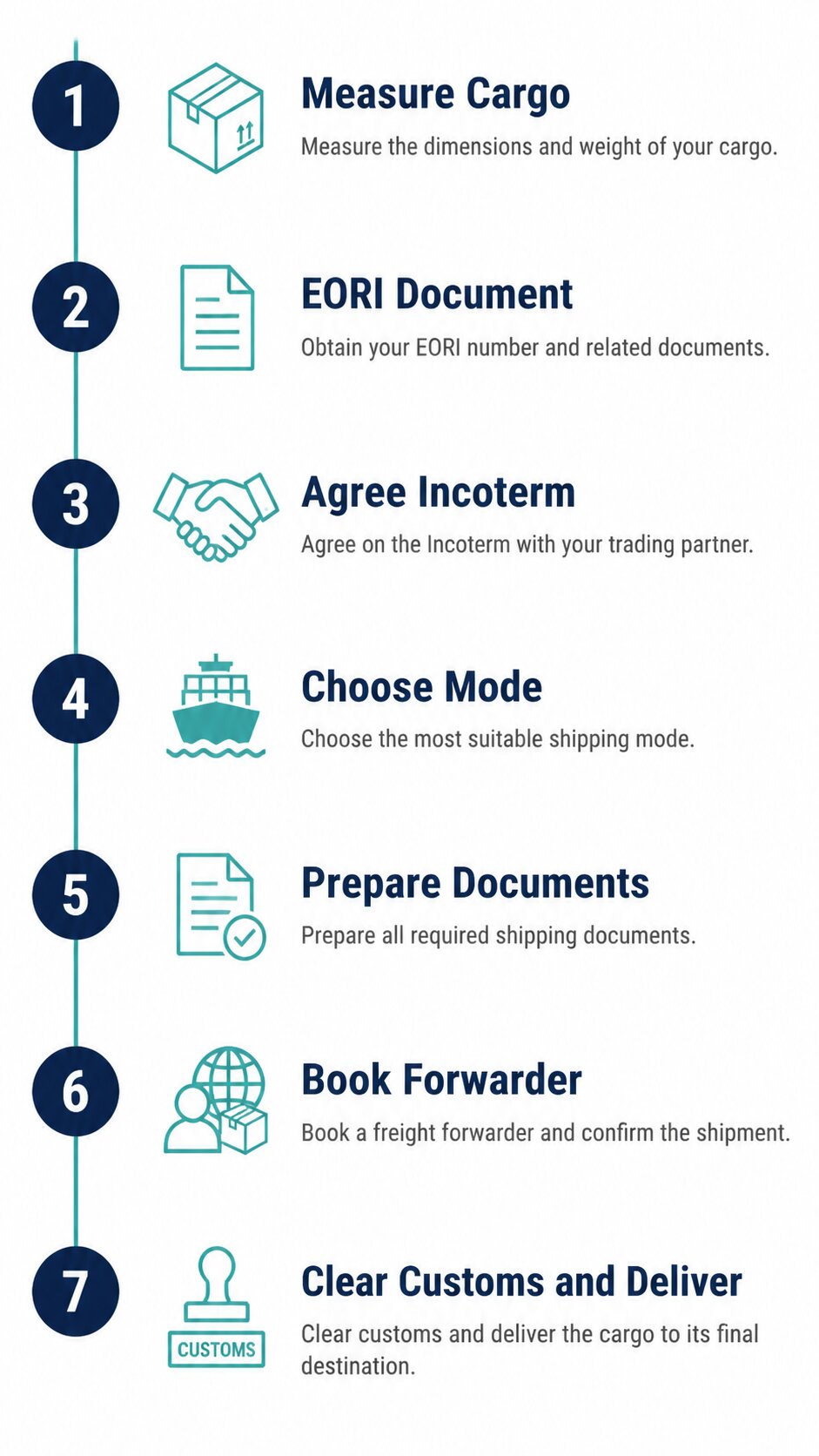
Everything above turns into one practical sequence, and these seven steps are the spine of it.
- Confirm it’s freight and measure it. Record the weight plus CBM (length × width × height in metres). These two numbers drive every quote you’ll receive, so measure the palletized load, not the bare product.
- Register for an EORI number. This code is free and mandatory for EU import and export. Apply before you book, because carriers and customs reference it on every document.
- Agree the Incoterm with your supplier. FOB (Free On Board) or CIF (Cost, Insurance and Freight) are predictable defaults for sea freight. The Incoterm fixes exactly who pays for what and where responsibility passes.
- Choose your mode. Use LCL for a pallet or two, FCL or FTL (full container or full truck load) when volume justifies the whole unit, and air freight for urgent or high-value cargo. Cost and transit time shift sharply between them.
- Prepare documents. You’ll need a commercial invoice, a packing list and a Bill of Lading. Check that company names and the EORI number match across all three, since one mismatch can hold a shipment at the border.
- Book through a forwarder and get a transparent quote. Confirm what the price includes: origin charges, freight, destination charges and customs. Knowing the full breakdown up front means no surprise invoices later.
- Track, clear customs, pay duty and import VAT, then take delivery. Keep your documents within reach in case customs queries the declaration. Clearance is usually quick when the paperwork is consistent.
Choosing Your Approach: Quick Decision Summary
Back to the question we opened with: how does a small business actually ship freight without overpaying or getting stuck at customs? The table below maps the common situations to a mode and a first move.
| Your situation | Recommended mode | Key documents | Next step |
|---|---|---|---|
| One pallet, cost-sensitive | LCL (sea) | Invoice, packing list, B/L | Get an LCL quote |
| Several pallets, intra-EU | LTL / groupage road | Invoice, packing list, CMR | Compare road rates |
| Full container volume | FCL (sea) | Invoice, packing list, B/L | Book a container |
| Urgent or high-value | Air freight | Invoice, packing list, air waybill | Request air transit time |
CMR here means the road consignment note, the standard contract document for international trucking. For most first-time shippers with one or two pallets, LCL by sea gives the best balance of cost and reach, while intra-EU loads often move faster by groupage road. Match your volume and urgency to the row that fits, then ask for a quote so the numbers are real rather than estimated.
If you’d like those numbers for your own pallets, our online rate calculator gives you a starting figure in minutes, and the team can confirm a full quote within the working day.
Frequently Asked Questions
What is the cheapest way to ship freight for a small business?
The cheapest options are LCL (less than container load) by sea or LTL groupage by road. Both consolidate your cargo with other shippers’ goods, so you pay only for the space you use rather than a whole container or truck. For one or two pallets, this often cuts the freight bill by half or more compared with booking a full unit.
What weight counts as freight versus a parcel?
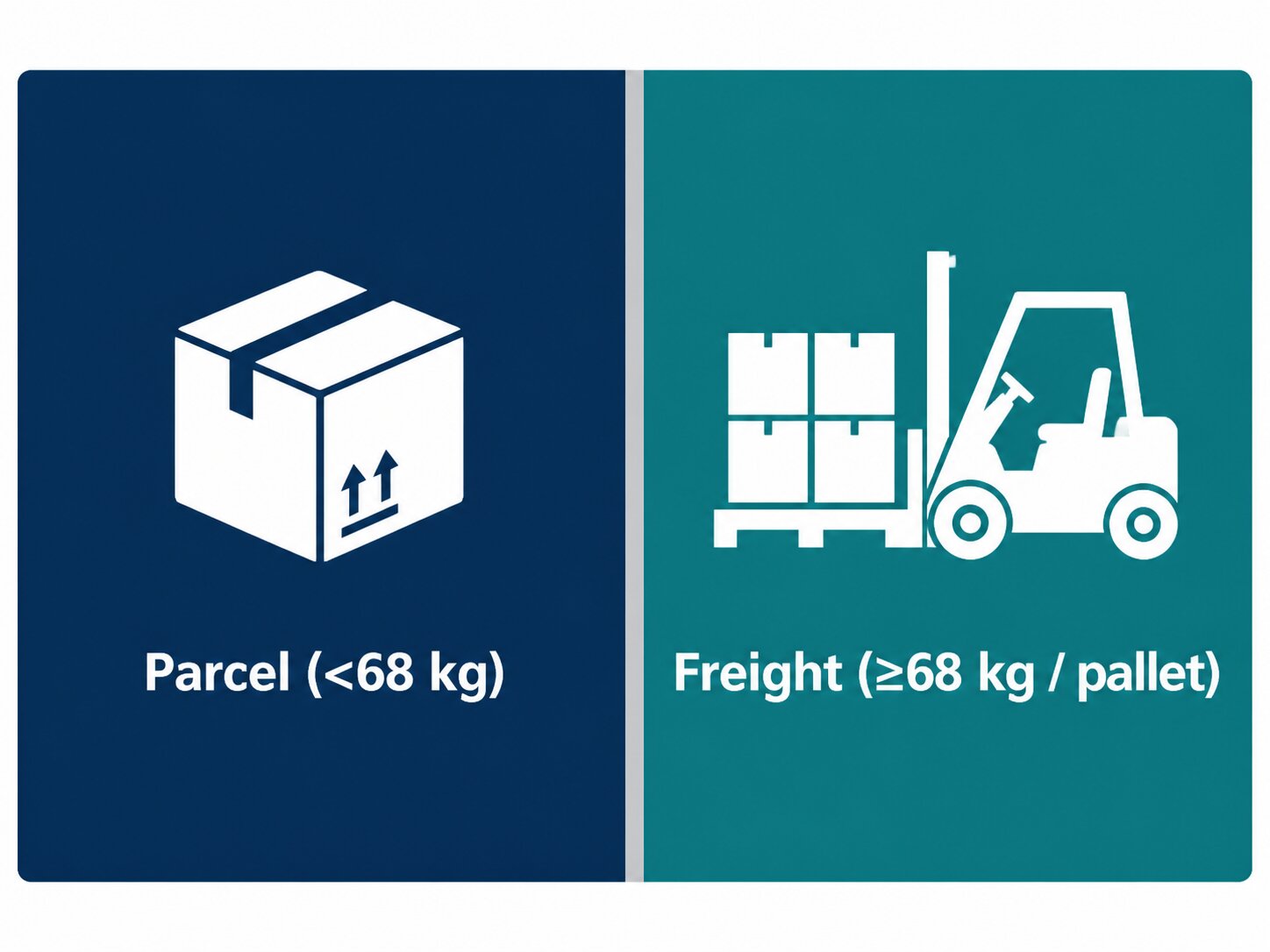
A shipment is generally treated as freight once it exceeds about 150 lb (68 kg) or is loaded onto a pallet. Below that, it usually ships as a parcel through standard courier networks. Palletized or oversized goods almost always move as freight regardless of exact weight.
Do I need a freight forwarder to ship internationally?
No, a forwarder isn’t legally required, and you can arrange carriers and customs yourself. In practice it handles the parts that stop most first-timers: booking carriers, consolidating cargo, preparing documents and clearing customs. For an initial international shipment, that support removes the main points where things go wrong.
How is freight shipping cost calculated?
Cost is based on chargeable weight, which is the greater of actual weight and volumetric weight. For ocean freight, roughly 1 CBM is treated as 1,000 kg; for air freight, 1 CBM is treated as 167 kg. Bulky but light cargo therefore gets priced on its volume, not its scale weight.
What’s the difference between LTL and LCL?
LTL (less than truckload) means sharing road trailer space with other shippers, priced largely by weight and pallet count. LCL (less than container load) means sharing a sea container, priced mainly by CBM. LTL suits regional and intra-EU road moves, while LCL fits longer ocean routes.
Who pays customs duties, me or my supplier?
That depends on the agreed Incoterm. Under DDP (Delivered Duty Paid) the seller covers import duty and VAT, while under EXW, FOB or CIF the buyer pays them. Always confirm the Incoterm before booking so the import charges land with the party you expect.