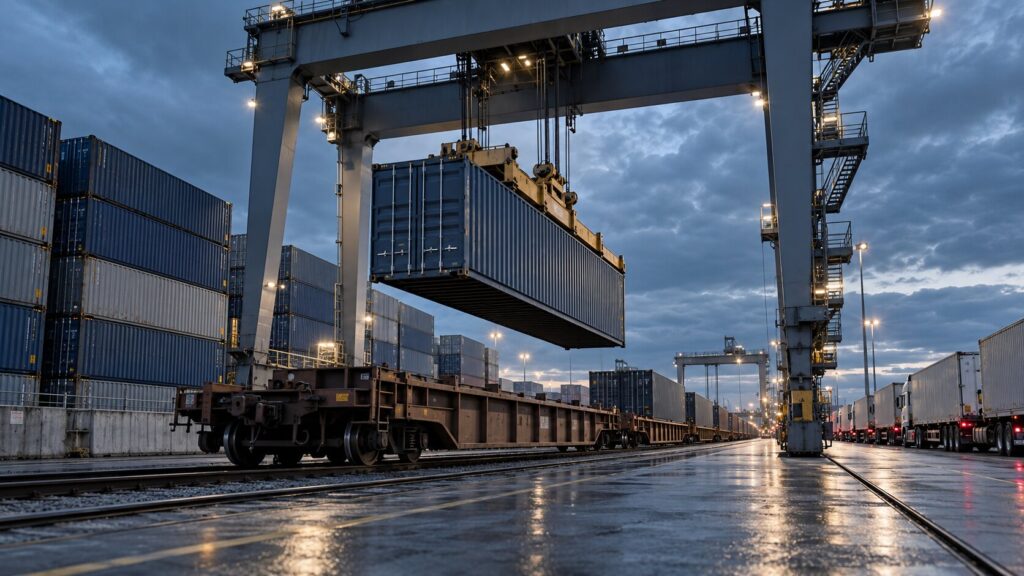
The Balkan transit route is the main road corridor for truck freight from Türkiye (Turkey) to Central Europe, running through Bulgaria, Serbia and Hungary. Serbia is outside both the EU and the Schengen area. A truck routed through Serbia crosses the EU external border three times: at Kapıkule–Kapitan Andreevo, Kalotina–Gradina and Horgoš–Röszke. Goods trucked from Türkiye usually move under one T1 transit declaration or a TIR carnet until clearance at the destination customs office.
Industrial goods with an A.TR movement certificate pay no EU customs duty under the EU–Türkiye Customs Union, but import VAT still applies. Market quotes from Turkish road-freight operators put the realistic 2026 planning range for Istanbul–Munich at 5–7 days by full truckload (FTL), border waits included, and 2–4 days longer for shared-truck groupage. An all-EU routing from Türkiye through Romania meets the EU external border only once but adds about 180–200 km, according to the Pupin Initiative. Bulgaria and Romania have been full Schengen members since 1 January 2025.
Key takeaways
- The Balkan transit route crosses the EU external border three times via Serbia.
- Over 40% of Türkiye’s exports to the EU travel by road (IKV, 2025).
- Goods cleared in Bulgaria, then trucked via Serbia, need a T2 before departure.
- Non-EU drivers face Entry/Exit System (EES) biometric checks, fully operational since 10 April 2026.
- Serbia saves 180–200 km; Romania saves two external-border crossings. Decide per shipment.
This guide is for SME importers, exporters and logistics managers shipping by road between Türkiye and Central Europe. It covers the corridor, borders, customs per leg, transit times, costs, 2026 rules and route choice, not container sea or air freight; permits get a short summary.
In this guide
- Why road dominates
- The route leg by leg
- Border crossings and waits
- Customs on each leg
- The T2 trap
- Transit times, costs and groupage
- Permits, drivers and 2026 rules
- Serbia vs Romania vs Ro-Ro
- Pre-booking checklist
- FAQ
- Next step
Why road freight from Turkey to Europe runs through the Balkans
EU imports of goods from Türkiye reached €103.3 billion in 2025, and two-way goods trade hit a record €217.6 billion, according to the European Commission’s EU trade figures for Türkiye. A DG Trade factsheet dated 20 May 2026 ranks Türkiye as the EU’s fifth-largest trade partner, with 4.2% of EU goods trade. In 2025 the EU took 42.7% of Türkiye’s goods exports, DG Trade adds.
Over 40% of Türkiye’s exports to the EU move by road, according to a 6 May 2025 brief by the Economic Development Foundation (IKV). For goods moving from Türkiye to Germany, the same brief puts the road share at about 73%.
Most of that road freight leaves Türkiye at two border posts: IKV reported 775,467 road-freight vehicles using Kapıkule and Hamzabeyli in 2023, 88.6% of all freight-vehicle crossings from Türkiye to Europe. Both open into Bulgaria, where the Balkan transit route enters the EU.
The Balkan transit route leg by leg: Istanbul to Budapest
Pan-European Corridor X is the shortest through-route between Central Europe and Greece or Türkiye, with a 2,226 km alignment from Salzburg to Istanbul, according to a Pupin Initiative analysis of 26 November 2025. In Serbia the corridor follows the A1/E75 motorway from Horgoš to Preševo (the main line continues south towards Greece), with branch Xc running from Niš via Dimitrovgrad to Sofia.
The Balkan transit route, also called the TEM corridor, uses Turkish and Bulgarian motorways as far as Sofia, then Corridor X through Serbia. Route planners put Istanbul–Sofia at about 550 km and Istanbul–Budapest via Sofia and Belgrade at about 1,320 km.
| Leg | Roads | Main towns | Border at the end of the leg | Type of border |
|---|---|---|---|---|
| 1. Istanbul → Kapıkule | TEM corridor | Edirne | Kapıkule (TR) – Kapitan Andreevo (BG) | EU and Schengen external border, entry |
| 2. Kapitan Andreevo → Sofia | Maritsa and Trakia motorways | Svilengrad, Plovdiv | None | Inside the EU |
| 3. Sofia → Kalotina | E80 | Sofia | Kalotina (BG) – Gradina (RS) | EU and Schengen external border, exit; Serbian entry |
| 4. Gradina → Belgrade | Corridor X branch Xc, then A1/E75 | Dimitrovgrad, Niš | None | Inside Serbia, outside the EU and Schengen |
| 5. Belgrade → Horgoš | A1/E75, Corridor X | Belgrade | Horgoš (RS) – Röszke (HU) | EU and Schengen external border, re-entry |
| 6. Röszke → destination | Hungarian and Austrian motorways | Szeged, Budapest, Vienna, then southern Germany | Internal Schengen borders | Inside the EU |
Sources: Pupin Initiative, 26 November 2025; 2026 market quotes from Turkish road-freight operators.
Trucks have a second crossing from Türkiye into Bulgaria. The Hamzabeyli–Lesovo crossing lies about 34 km from Kapıkule, on the same EU and Schengen external border. After Röszke, the Turkey to Germany truck route passes Szeged, Budapest and Vienna with only internal Schengen borders left. Our overview of Europe’s key freight corridors gives the wider European context.
Border crossings and truck waiting times: Kapıkule, Kalotina, Röszke
During a January 2026 jam triggered by Greek farmers’ protests, Kapitan Andreevo processed 3,000 trucks in 24 hours, 1,428 entering Bulgaria and 1,572 leaving, the Bulgarian News Agency (BTA) reported. Kapitan Andreevo is Bulgaria’s busiest road border with Türkiye; it faces the Kapıkule border crossing, and its customs post handles transit, departure, destination and full import and export control. On the Balkan transit route, queues at three border pairs move the delivery date more than the driving does.
| Border pair | Direction | Typical truck wait | Peaks and records | Timing tip |
|---|---|---|---|---|
| Kapıkule–Kapitan Andreevo | TR → BG, EU entry | About 6 h per crossing on average (IKV, 2025) | Up to 72 h recorded (IKV); January 2026: 25 km queue, 15–20 h wait (BTA); record 3,442 commercial vehicles on 7 December 2025 (BTA) | Divert to the Hamzabeyli–Lesovo crossing when the queue builds |
| Kalotina–Gradina | BG → RS, EU exit | No reliable published average; the longest truck queues form on weekday nights | Friday after 14:00, weekends, July–August | Bulgaria and Serbia have agreed to build a truck-only Kalotina 2 – Gradina 2 crossing |
| Horgoš–Röszke | RS → HU, EU re-entry | An estimated 2–6 h because of EU entry customs control (live border trackers) | More than 10,000 vehicles a day across all traffic | Shortest queues 01:00–06:00 |
Check the Kapitan Andreevo waiting time on a live border tracker before the truck leaves Istanbul. For the Serbian exit, plan a weekday daytime crossing at Kalotina–Gradina and avoid Friday afternoons, weekends and July–August. All three crossings operate 24/7. A truck that reaches Röszke between 01:00 and 06:00 usually meets the shortest queue of the day, according to live border trackers.
Customs on each leg: A.TR, T1 transit through Serbia and where goods are cleared {#customs-per-leg}
An A.TR movement certificate proves free circulation within the EU–Türkiye Customs Union, in force since 31 December 1995, so industrial goods pay no EU duty. Swedish Customs stresses that the A.TR is not a certificate of origin. Under the EU’s customs transit rules, a T1 declaration, processed in the New Computerised Transit System (NCTS), suspends duties and VAT on non-Union goods until the office of destination.
An office of transit is the customs office where the movement is recorded on entering a contracting party to the Common Transit Convention (CTC). A TIR carnet from the International Road Transport Union (IRU) bundles transit document and guarantee, and the Entry Summary Declaration (ENS) is the carrier’s pre-arrival safety filing in Import Control System 2 (ICS2).
| Leg | Customs status of the goods | Procedure / document | Customs event |
|---|---|---|---|
| Türkiye: Istanbul → Kapıkule | Turkish export | Export declaration; A.TR; T1 in NCTS or TIR carnet opened at the office of departure; Türkiye in the CTC since 1 Dec 2012 | Export clearance |
| Kapitan Andreevo (BG) | Non-Union goods entering the EU | ENS filed in ICS2 before arrival; T1 or TIR presented | First EU entry point; office of transit |
| Bulgaria → Kalotina | Non-Union goods in transit, duties and VAT suspended | T1 or TIR continues | Exit from the EU |
| Serbia: Gradina → Horgoš | Goods in common transit | T1 continues; Serbia in the CTC since 1 Feb 2016; no ENS for Serbia | Office of transit at Gradina |
| Röszke (HU) | Non-Union goods re-entering the EU | T1 or TIR; ICS2 obligations apply again | Office of transit at Röszke |
| Destination, e.g. Germany | Release for free circulation | T1 closed at the office of destination; A.TR: no customs duty on industrial goods; import VAT due; importer’s EORI | Import clearance |
Two clearance models work on the Balkan transit route. In the first model, the T1 or TIR carnet runs from Türkiye to the office of destination, for example in Germany, where the goods are released for free circulation. In the second model, the goods are released for free circulation at Kapitan Andreevo when the buyer wants border clearance. Both models need the importer’s EORI number, the EU identifier required for customs declarations. Combining the second model with a Serbian routing triggers the T2 trap.
Two Sea Gate guides explain how T1, T2 and TIR work through Serbia and North Macedonia and where the Customs Union modernisation stands in 2026.
The T2 trap: EU-cleared goods crossing Serbia by road
T2 internal Union transit is the procedure that lets Union goods, those already in free circulation in the EU, cross a non-EU country without losing that status. Serbia has applied the Common Transit Convention since 1 February 2016 but remains outside the EU.
What happens to goods cleared in Bulgaria that then leave the EU for a day in Serbia? Revenue Ireland’s Union transit guide states that Union goods sent between Member States “by road through the territory of a common transit country” must be placed under T2 before departure. Without a T2, the goods can reach Röszke as non-Union goods, which reopens the question of customs duty and import VAT.
Shippers have four ways to avoid the problem:
- Open a T2 in NCTS before the truck leaves Bulgaria.
- Keep the goods under T1 or a TIR carnet and clear them at destination, not in Bulgaria.
- Route the truck via Romania, an EU Member State that joined Schengen in full on 1 January 2025, so the goods never leave the EU.
- Confirm at booking whether the forwarder or a customs broker will issue the T2.
In our view, the T2 question belongs in the booking, not at Röszke. It arises only when goods are cleared at Kapitan Andreevo or collected by an EU buyer in Bulgaria and then trucked through Serbia to Hungary or Germany.
Transit times, costs and groupage from Turkey to Europe {#transit-times-costs}
Two published ranges exist for the transit time Istanbul to Munich by truck. For a full truckload, the figure is 3–5 days when borders run normally and 5–7 days as the realistic 2026 planning range once border waits are included. On the Balkan transit route, the extra two days come from border waits, not from longer driving.
| Lane | FTL, normal border times | FTL, 2026 planning range | Groupage |
|---|---|---|---|
| Istanbul → Munich | 3–5 days | 5–7 days | FTL time + 2–4 days |
| Istanbul → Frankfurt | 3–6 days | n/a | 5–8 business days, 1–3 departures a week |
| Istanbul → Hamburg / Ruhr | 4–6 days | n/a | FTL time + 2–4 days |
Source: 2026 market quotes from Turkish road-freight operators; normal-border ranges assume no major queues.
The same operator quotes put tolls for an Istanbul–Frankfurt trip at an estimated €420–480 per truck in 2026, across Bulgaria, Serbia, Hungary, Austria and Germany. Serbia’s slice is easy to isolate. ONYX TMS, in “Road tolls in Serbia 2026”, puts it at about 15,120 RSD (~€130) for a 40-t truck. That covers the full Corridor X crossing from the Hungarian border to the Bulgarian border.
Groupage from Turkey to Europe pays off for 1–10 pallets, according to those 2026 quotes. The shipper books pallet spaces instead of a whole trailer (a standard trailer holds about 33 euro-pallets). The price is time: groupage adds 2–4 days, and main lanes see 1–3 departures a week. Take a hypothetical case: a Budapest importer orders 4 pallets from an Istanbul supplier. Moving them as groupage means sharing a trailer instead of paying for 33 pallet spaces.
At Sea Gate Logistics, we are an EU-registered forwarder in Burgas, Bulgaria, on the Bulgaria–Türkiye road axis, arranging FTL and groupage on these lanes, including consolidated cargo for smaller loads.
Permits, drivers and the 2026 rule changes on the corridor {#rules-2026}
The EU–Türkiye Customs Union covers the goods, not the trucks, so Turkish trucks on the Balkan transit route need a transit permit per country crossed plus a bilateral destination permit. IKV’s 2025 brief puts road permit quotas at about 375,000 for Bulgaria, 110,000 for Hungary since 2020 and 21,000 for Austria, the tightest. A TIR carnet does not replace a road permit, the IRU notes. We explain how Turkey–EU road permit quotas work separately.
The EU’s Entry/Exit System (EES), phased in from 12 October 2025, stores non-EU drivers’ fingerprints and facial images, then records each entry and exit at external borders. Summer-2026 EES waits reportedly peaked at about 5 hours.
EES also enforces the 90/180-day rule, which Western Balkan truckers protested with a 7-day blockade of all Serbian and North Macedonian crossings from 26 January 2026, Balkan Insight reported. About 370 trucks were stuck in North Macedonia, the Serbian Chamber of Commerce estimated €100 million a day in lost exports, and no permanent fix had been agreed as of August 2026.
| Date | Change | Effect on the corridor |
|---|---|---|
| 1 Jan 2026 | Bulgaria adopts the euro | Tolls priced in euro |
| 1 Jan 2026 | ECMT permits fully digital | Paper permits end |
| 1 Jan 2026 | ICS1 off in several member states | ENS filed on ICS2 |
| 26 Jan 2026 | 90/180-rule blockade by truckers | Serbian crossings shut for days |
| 1 Apr 2026 | Serbian e-TAG for Category IV heavy vehicles | Needed on the Belgrade bypass (ONYX TMS) |
| 10 Apr 2026 | EES fully operational | Non-EU drivers’ entries and exits recorded |
| 1 Jun 2026 | BG Toll CO₂ component under Directive (EU) 2025/2459 | Higher per-km tolls for older trucks (IRU; AEBTRI) |
| 1 Jun 2026 | ICS2 live in Croatia, Latvia, Poland, Romania and Slovakia | ICS2 EU-wide |
| 1 Oct 2026 | TollRo will replace Romania’s rovinietă above 3.5 t | Euro VI trucks of 12 t+ will pay RON 0.48/km on motorways |
Serbia vs Romania vs Ro-Ro: the kilometres-vs-border-events test {#serbia-vs-romania}
Avoiding Serbia on the Balkan transit route adds about 180–200 km and an estimated €150–400 of operating cost per trip at IRU rates of €0.50–2.00 per km, according to the Pupin Initiative’s corridor analysis. In return, the truck crosses the EU external border once, not three times.
The three routings compared
| Routing | Extra distance vs Serbia | EU external-border crossings | Customs events after Kapitan Andreevo | EES entry/exit checks for a non-EU driver | Typical extra wait | Best fit |
|---|---|---|---|---|---|---|
| Serbia via Corridor X | 0 | 3: Kapitan Andreevo in, Kalotina out, Röszke in | Offices of transit at Gradina and Röszke; ICS2 on re-entry | 3 | Kalotina–Gradina queue + Röszke 2–6 h | Hungary, Austria, Czechia, southern Germany |
| Romania, all-EU | +180–200 km, about €150–400 more per trip | 1: Kapitan Andreevo | None until destination | 1 | Ruse–Giurgiu bridge 2–4 h | Romania, eastern Hungary, Poland; fallback when Serbian borders jam |
| Ro-Ro Türkiye–Trieste | No Balkan road legs | 1: port of Trieste | Port import or transit formalities | 1 if accompanied; none for unaccompanied trailers | Varies by sailing | Italy, western Austria, southern and western Germany, France |
Wait figures are estimates from live border trackers and trafficban.com; the Ruse–Giurgiu bridge is under repair as of September 2026.
The kilometres-vs-border-events test
We call this trade-off the kilometres-vs-border-events test: fewer kilometres via Serbia, fewer border events via Romania. Is saving 190 km worth two extra external-border crossings?
This estimate uses published ranges, not measured trips: Pupin’s detour, an assumed 70–80 km/h truck average and the table’s waits. Via Romania, 190 extra km take roughly 2.5 hours, and the 2–4 hour bridge queue lifts the penalty to about 4.5–6.5 hours. Via Serbia, the penalty is the Kalotina–Gradina wait plus 2–6 hours at Röszke. Serbia wins on time only while those waits total under roughly 4.5–6.5 hours — and Kalotina–Gradina has no reliable published average.
The €150–400 saving excludes tolls, which differ by routing along with transit permits, so request both quotes before settling the Serbia vs Romania route.
- Default to Serbia for Hungary, Austria, Czechia and southern Germany under T1 or TIR, when Serbian waits look normal.
- Switch to Romania when Kalotina or Röszke queues build, Serbian crossings are disrupted, as in January 2026, or goods were cleared in Bulgaria.
- Choose Romania for Romanian, eastern Hungarian and Polish destinations.
- Choose Ro-Ro to Trieste for Italy, western Austria, southern and western Germany and France, or when transit permits run short.
In our view, Serbia is the sensible default for Central Europe under T1; once goods are cleared in Bulgaria, Romania wins by removing the T2 step.
When Ro-Ro to Trieste beats both roads
Ro-Ro skips the Balkan road legs and most transit permits. The Port of Trieste’s 2025 figures show 317,296 Ro-Ro units handled, up 7.42%, helped by new routes to Türkiye. As of February 2026, the Grimaldi Group ran 8 weekly sailings on its Trieste–Patras–Ambarlı–Gemport line with about 4,000 Ro-Ro units a week, AdriaPorts reported, and DFDS also runs Türkiye–Trieste links.
Other bypasses include Greece–Italy ferries, block trains and a Sakarya–Constanța Black Sea link proposed by Turkish exporters in January 2025, per Hürriyet Daily News. Our cost comparison of road, Ro-Ro and sea from Turkey sets out the prices.
Before you book: a Balkan transit route checklist {#checklist}
Eight documents cover a typical FTL load from Türkiye to Germany, based on European Commission guidance and current market practice, so check each one with the forwarder at booking.
- CMR consignment note
- Commercial invoice
- Packing list
- Turkish export declaration
- A.TR movement certificate for industrial goods, or EUR.1 for agricultural goods
- Transit document: a T1 in NCTS or a TIR carnet, plus a T2 if the goods are released in Bulgaria and then routed via Serbia
- ENS filed by the carrier before the truck reaches Kapitan Andreevo
- Importer’s EORI number for the import declaration
Ask the forwarder these six questions before you confirm the booking.
- Serbia, Romania or Ro-Ro to Trieste: which routing will the truck take, and why?
- Where will the goods be cleared: at Kapitan Andreevo or at the office of destination?
- Who files the ENS, and how long before the truck reaches Kapitan Andreevo?
- If the goods are released in Bulgaria, who opens the T2 before departure?
- Which transit permits does the carrier hold for the chosen routing?
- For groupage: which departure day applies, and where is the consolidation point?
FAQ: road freight from Turkey to the EU {#faq}
Which countries does a truck cross from Turkey to Germany?
A truck on the Balkan transit route crosses six countries: Türkiye, Bulgaria, Serbia, Hungary, Austria and Germany, following the TEM corridor and, inside Serbia, Pan-European Corridor X. The all-EU alternative swaps Serbia for Romania.
How long does road freight from Turkey to Germany take?
Istanbul–Munich by full truckload takes 3–5 days when borders run normally; 5–7 days is the realistic 2026 planning range once border waits are included. Groupage adds 2–4 days, and Istanbul–Frankfurt groupage takes 5–8 business days.
Do trucks from Turkey go through Serbia or Romania?
The main truck corridor from Türkiye runs through Serbia, because Pan-European Corridor X is the shortest road to Central Europe. Since 1 January 2025, the Romanian routing stays inside Schengen after Kapitan Andreevo but adds about 180–200 km.
Where are goods from Turkey cleared: at the Bulgarian border or at destination?
Goods from Türkiye can be cleared in two places. Under a T1 declaration or a TIR carnet, clearance happens at the office of destination. Clearance at Kapitan Andreevo in Bulgaria requires a T2 if the truck then crosses Serbia.
Do you pay customs duty on goods trucked from Turkey to the EU?
Industrial goods with an A.TR movement certificate pay no EU customs duty under the EU–Türkiye Customs Union, in force since 31 December 1995. Import VAT is still due at destination. Agricultural goods need an EUR.1 certificate to claim preferential origin.
How long do trucks wait at Kapıkule?
IKV puts the average Kapıkule truck wait at about 6 hours per crossing, with up to 72 hours recorded. In January 2026 the Bulgarian News Agency reported a 25 km queue and 15–20-hour waits. Hamzabeyli–Lesovo is the alternative to Kapıkule.
Can I send a few pallets from Turkey to Europe by road?
Yes, groupage lets shippers send 1–10 pallets from Türkiye to Europe by road without paying for a full truckload of about 33 euro-pallets. Groupage adds 2–4 days versus a full truckload, and main lanes see 1–3 departures a week.
Planning your next Türkiye–EU road shipment {#next-step}
Most road cargo from Türkiye to Central Europe enters the EU in Bulgaria, then continues along the Balkan transit route through Serbia or the all-EU routing via Romania. Serbia saves kilometres, and Romania saves border events.
To request a road-freight quote for your lane, send the route, the pallet count and where the goods will be cleared; our team in Burgas prices FTL or groupage and explains the routing.