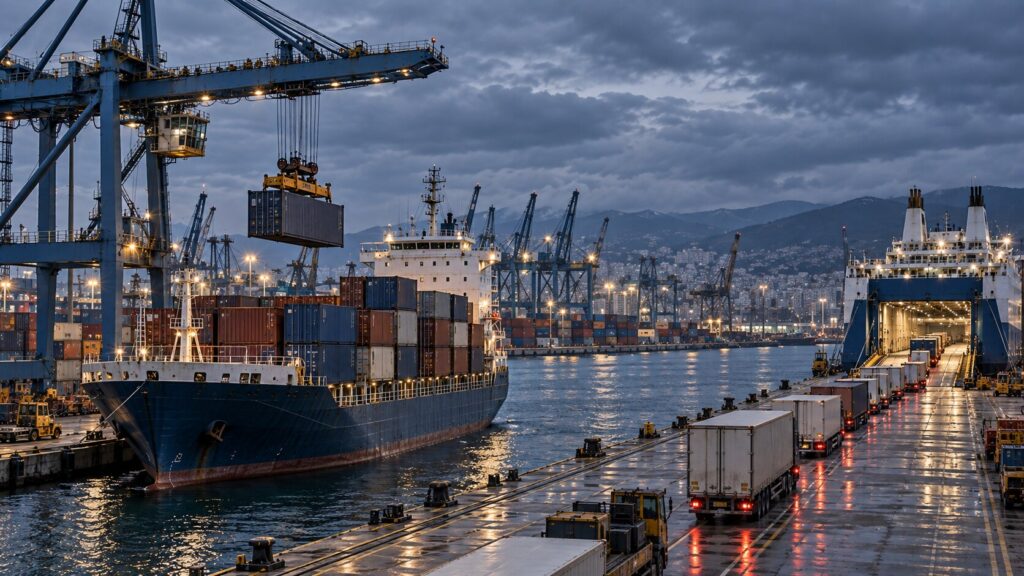
Covered here: choosing between Piraeus and Thessaloniki when shipping via Greek ports, the inland Balkan leg, the customs event, and the route into Armenia. Not covered: rates, or Northern European gateways beyond transit time. Written for SME importers and exporters moving full container loads and part loads, FCL and LCL, into the Balkans and the South Caucasus.
What shipping via Greek ports gets you: the short answer
Shipping via Greek ports means picking between two ports that do different jobs. Piraeus is a deep-sea transshipment hub: it takes the large Asia–Europe services and handled about 4.64 million TEU (twenty-foot equivalent units) across all piers in 2025. Thessaloniki is a hinterland gateway, smaller at 617,000 TEU, sitting at the foot of the corridors into Bulgaria, North Macedonia and Serbia.
From Shanghai, Piraeus is about 20 days against 28 to Rotterdam and 33 to Hamburg. The eight-day ocean saving can be spent again inland if the box lands at the wrong port.
Cargo bound for the Western Balkans or Armenia usually should not be cleared in Greece; it moves under T1 external transit to a customs office near the buyer. Armenia is landlocked, so a Greek gateway reaches it by Black Sea feeder to Poti in Georgia. The right port makes the last mile and the customs event cheapest, not the sailing.
Key takeaways
- Piraeus: ocean time and vessel size. About 4.64 million TEU across all piers in 2025, of which 3.98 million at Piers II–III, down 6.0%.
- Thessaloniki: the inland leg. 617,000 TEU in 2025, up 9.1%; Pier 6 lifts capacity to 1.5 million TEU.
- Ex-Shanghai, a Mediterranean call saves roughly 8 days against Rotterdam, 13 against Hamburg.
- Clear where the buyer is, not where the ship lands: T1 suspends duty across the EU.
- Shipping via Greek ports reaches landlocked Armenia through Poti, or via Constanța and the ferry
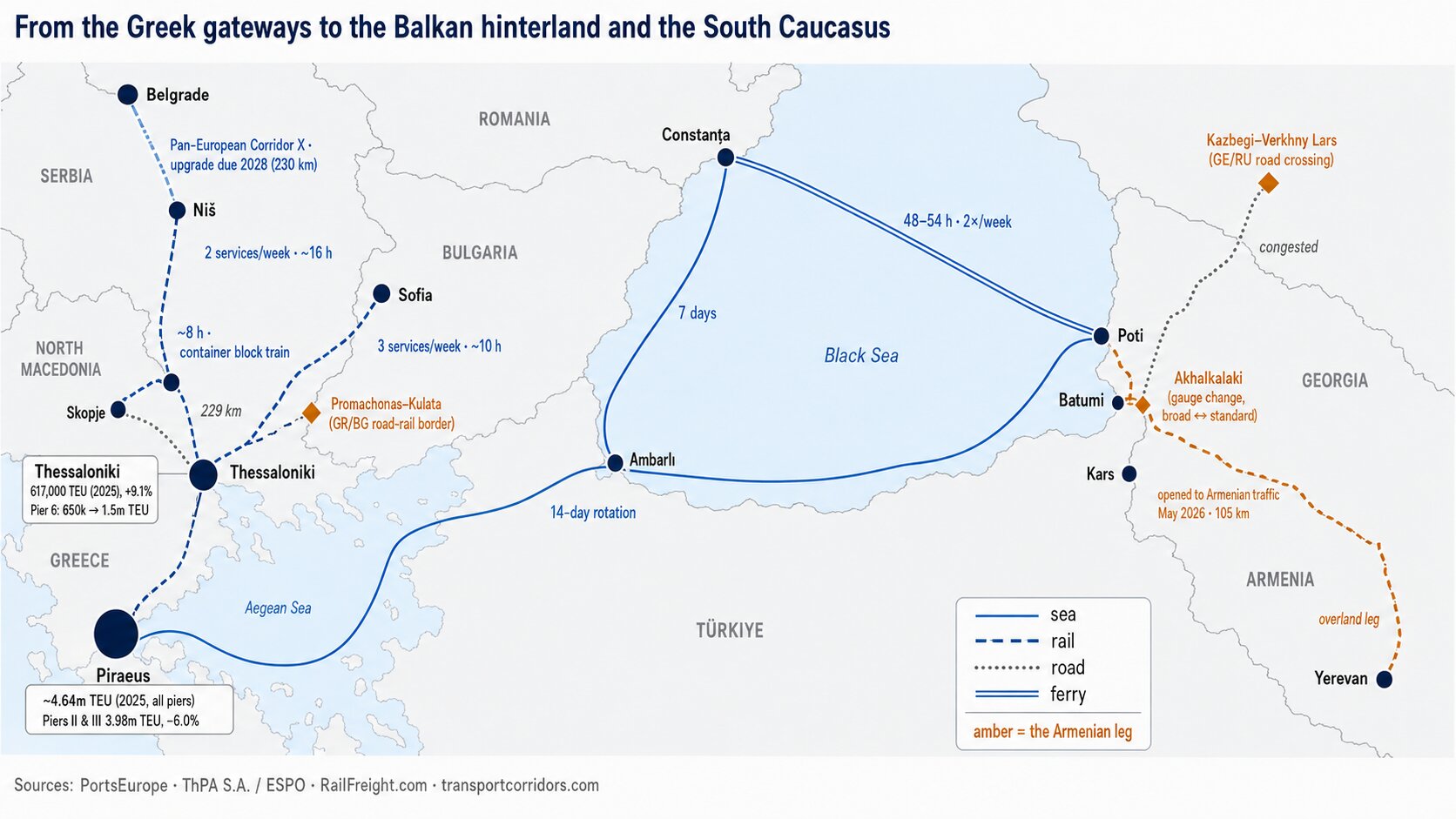
The two Greek gateways, the Balkan rail and road links inland, and the Black Sea leg onward to Armenia. Rail hours and ferry frequencies are published schedule figures.
Piraeus vs Thessaloniki: the 2025–2026 numbers side by side
| Port | 2025 throughput | Trend | Operator | Customs status | Hinterland reach | Best-fit cargo |
|---|---|---|---|---|---|---|
| Piraeus | ~4.64m TEU (3.98m Piers II–III + 664,581 Pier I) | −6.0% (Piers II–III) | COSCO Shipping, 67% of Piraeus Port Authority S.A. | Free Zone of Piraeus Port | China-Europe Land-Sea Express rail; Med and Black Sea feeders | Deep-sea FCL, transshipment |
| Thessaloniki | 617,000 TEU | +9.1% | ThPA S.A.; Pier 6 by METKA-TEKAL | Free Trade Zone, AEO-certified | Rail to Sofia, Skopje, Niš; road via Promachonas–Kulata | Balkan FCL and LCL |
The two lines move in opposite directions, and that is the useful part. Piraeus Container Terminal took 3.98 million TEU in 2025, down 6.0%, and the first half of 2026 came in at 1.995 million TEU against 2.054 million, per PortsEurope. Pier I still set an all-time record of 664,581 TEU.
Thessaloniki’s container terminal added 51,000 TEU. Its Pier 6 contract with METKA-TEKAL, signed November 2025 at €195.6 million, adds 513 m of quay over a 40-month build, dredged for ULCVs (ultra-large container vessels up to 24,000 TEU). For anyone shipping via Greek ports, that reads as spare capacity at Piraeus while Thessaloniki grows into the role that matters for inland Balkan delivery.
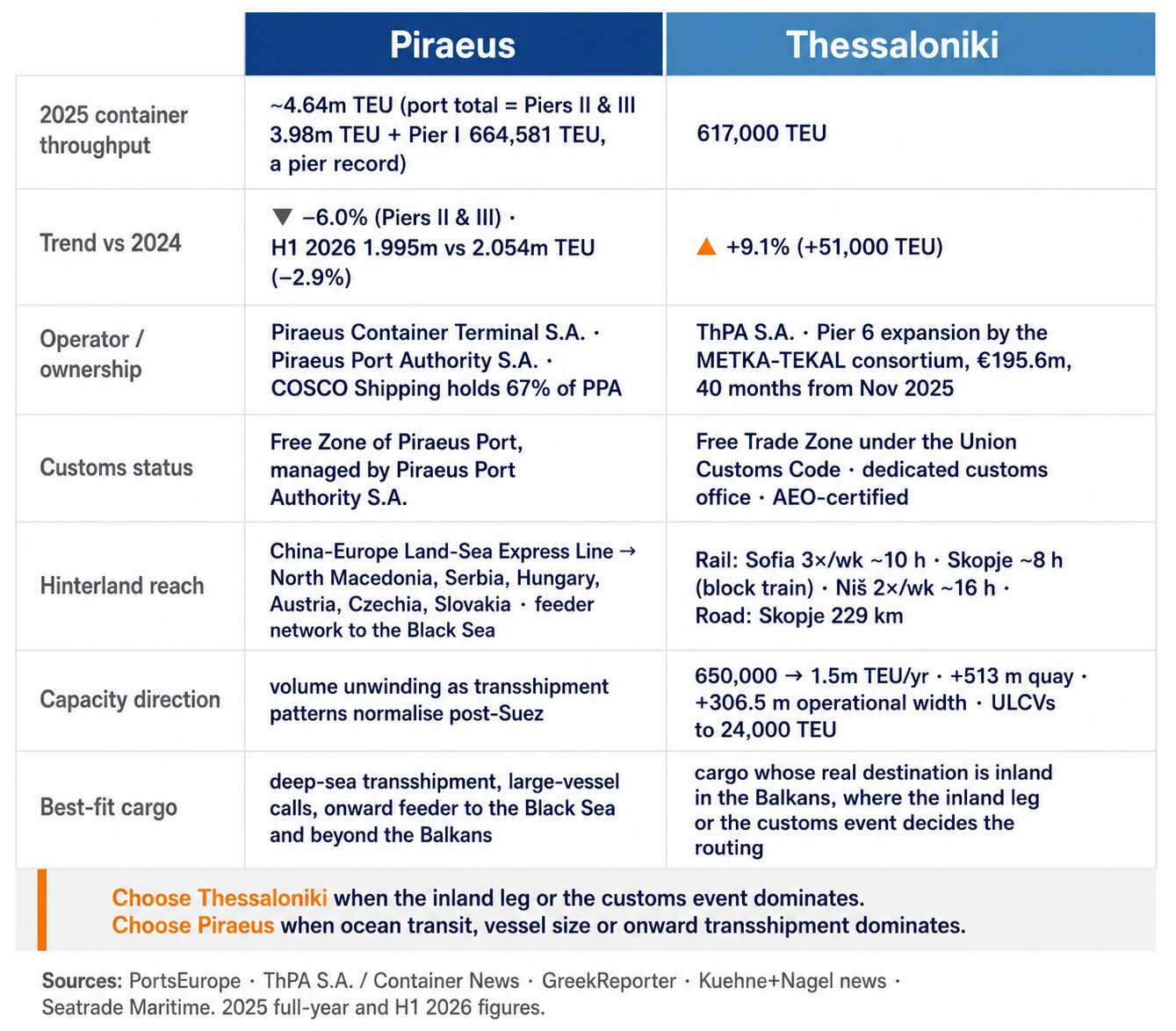
How much time a Mediterranean gateway saves ex-Asia
| Origin | Piraeus | Rotterdam | Hamburg |
|---|---|---|---|
| Shanghai | 20 days | 28 days | 33 days |
| Singapore | 13 days | 21 days | 26 days |
Published port-to-port schedule times via Suez, not door-to-door, from Port Economics, Management and Policy.
The Piraeus vs Rotterdam transit time gap is eight days ex-Shanghai, thirteen against Hamburg. One carrier schedule quotes 22 days, so treat it as a 20–22 day range. Routing around the Cape of Good Hope instead of Suez adds roughly 7 to 14 days, per Maersk.
What the delta is not is a delivery-date saving. A container that lands at Piraeus and then takes a truck run up to Niš in Serbia, the length of Corridor X by road, hands much of that saving back.
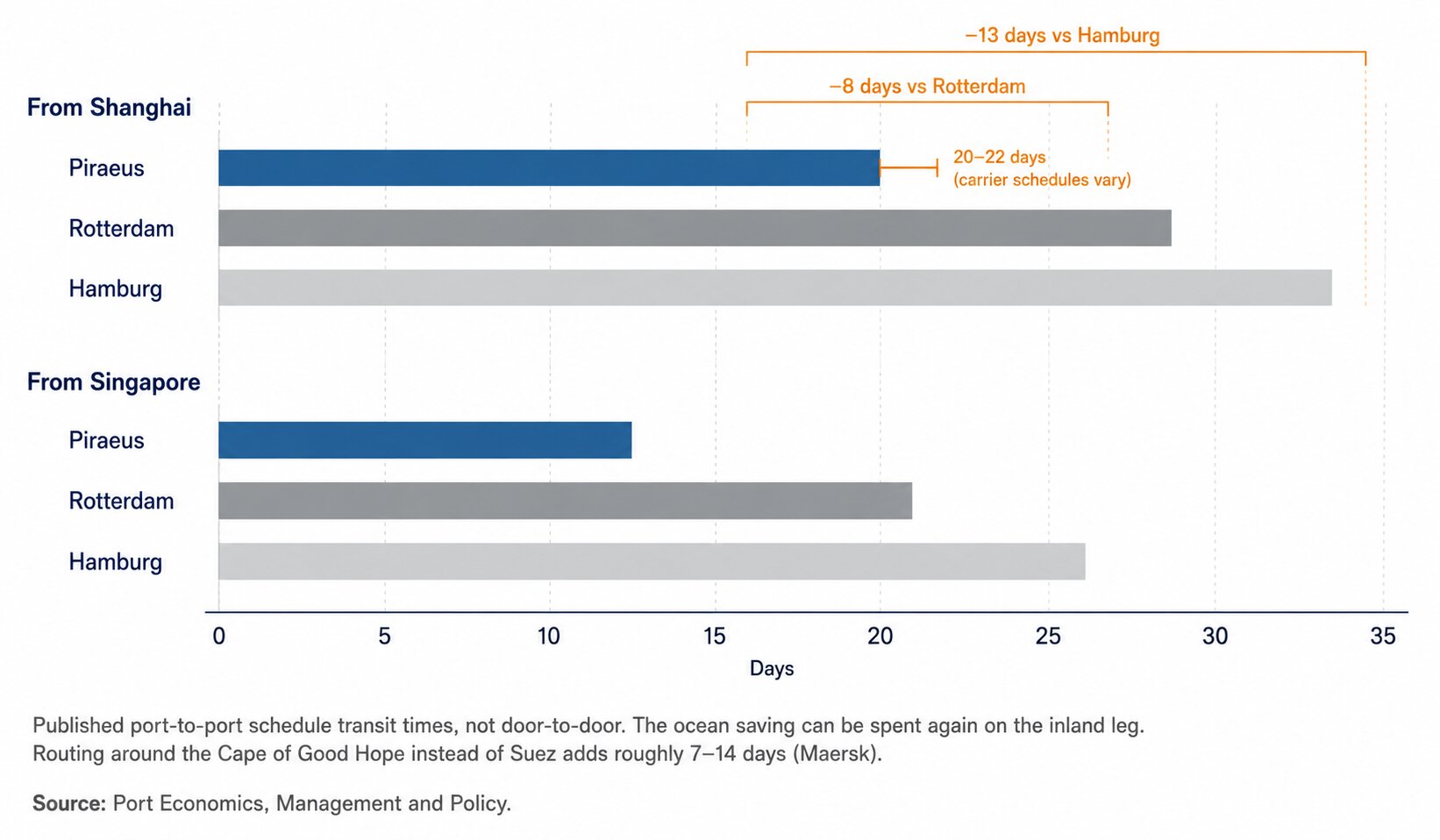
The Last-Mile-First Rule: four questions that pick your gateway
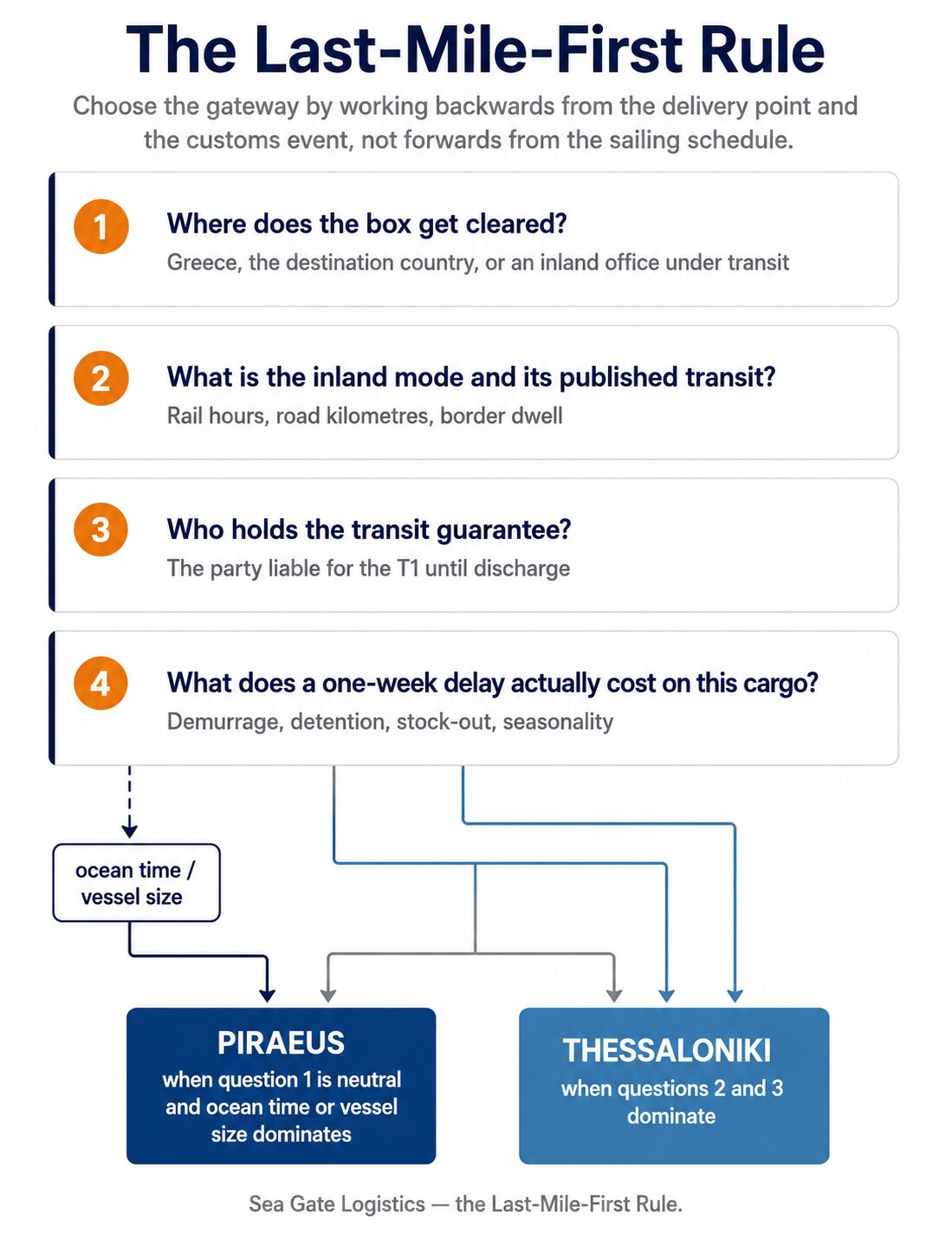
Most gateway decisions get made from the sailing schedule down. The Last-Mile-First Rule reverses that: when shipping via Greek ports, pick the port by working backwards from the delivery address and the customs event, then check whether the ocean leg still works.
- Where does the box get cleared? Clearance in Greece puts the goods into free circulation, duty and import VAT fall due, and an EORI number is needed. If the buyer sits in Serbia or Armenia, clearance belongs at destination and the box travels under transit. This answer alone often removes one port.
- What is the inland mode, and its published transit? Rail hours, road kilometres, border dwell. Thessaloniki to Skopje is about 8 hours by rail or 229 km by road, and Piraeus sits further down the same corridor.
- Who holds the transit guarantee? The T1 guarantee stays with a named principal until the goods reach the office of destination. Incoterms® 2020 settles who pays the freight, not who carries that liability.
- What does a week of delay cost this cargo? Demurrage and detention are the visible line. Stock-outs and seasonality are not, and they are usually larger.
If questions 2 and 3 dominate, the gateway is Thessaloniki. If question 1 is neutral (the goods stay in the EU either way) and ocean time, vessel size or an onward feeder dominates, the gateway is Piraeus. In our experience the rule has one limit: where the receiving country’s border post rather than the port is the constraint, no gateway choice fixes it.
Out of Thessaloniki: rail and road into the Balkans
| Destination | Mode | Published transit | Frequency |
|---|---|---|---|
| Skopje, North Macedonia | Rail, container block train | ~8 hours | Scheduled |
| Sofia, Bulgaria | Rail | ~10 hours | 3/week |
| Niš, Serbia | Rail | ~16 hours | 2/week |
| Skopje, North Macedonia | Road | 229 km (~2 h 35 min car drive time; truck time Estimated, add border dwell) | Continuous |
Rail hours, not sailing days, decide most Balkan deliveries, and the figures above come from ThPA S.A. and the European Sea Ports Organisation. Thessaloniki port’s Balkan gateway role rests on Pan-European Corridor X: Belgrade → Niš → Skopje → Thessaloniki, with branches to Budapest and Sofia.
The EU-financed Belgrade–Niš–Skopje upgrade is slated for 2028, returning 230 km to double track and electric traction, and a Thessaloniki–Sofia service is targeted for 2027. ThPA S.A. also works with Hellenic Train and Bulgaria’s BDZ on a Mediterranean–Balkans–Central Europe corridor.
Road traffic crosses into Bulgaria at Promachonas–Kulata, the same crossing our Bulgarian road lanes use. We plan road legs for shipping to the Balkans from Greece around that crossing rather than the port gate, because that is where the variance sits.
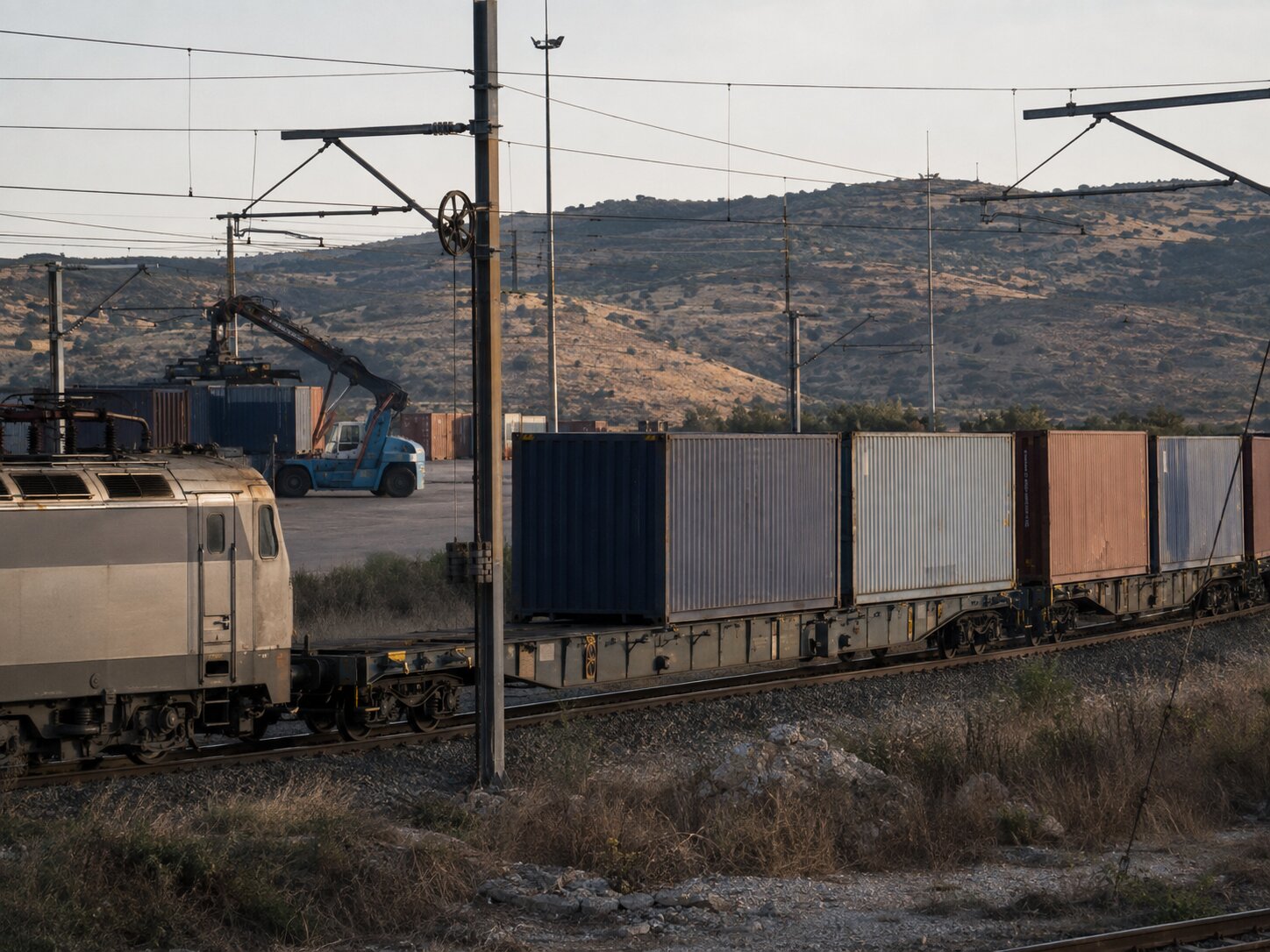
The Piraeus transshipment hub: feeders and the rail line north
Transshipment means moving a container from one vessel to another without it leaving the port; a feeder service is the smaller ship carrying it onward to a regional port.
COSCO Shipping holds 67% of Piraeus Port Authority S.A., taking 51% for €280 million in the 2016 privatisation and 16% more in October 2021. Port of Piraeus container shipping reaches inland by rail: the China-Europe Land-Sea Express Line runs into North Macedonia, Serbia, Hungary, Austria, Czechia and Slovakia, and COSCO’s OceanRail Logistics took 60% of PEARL, Piraeus Europe Asia Rail Logistics. The Free Zone of Piraeus Port is run by the same authority.
Where the box gets cleared: T1, Free Zones and why Greece often isn’t the answer
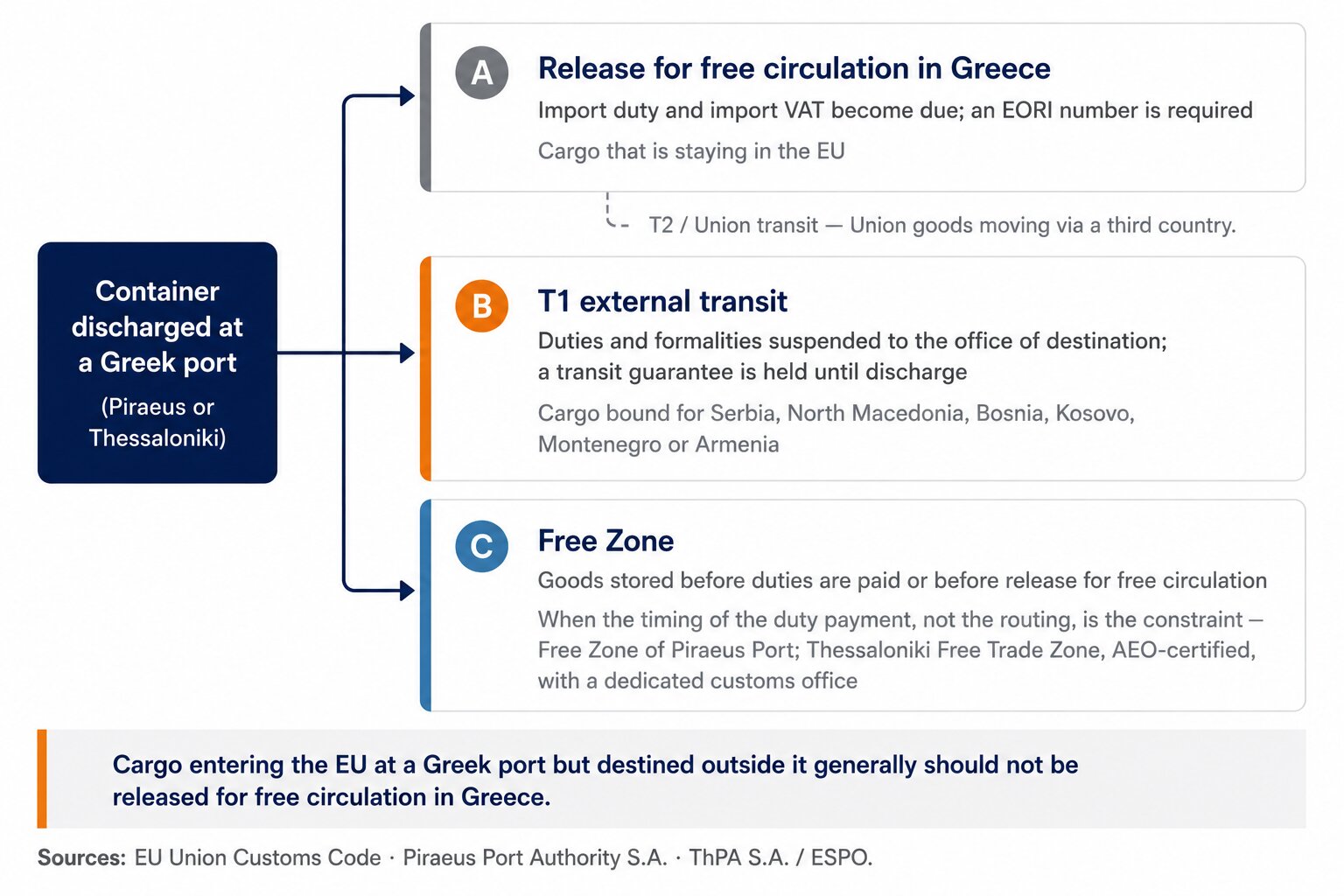
Three terms decide Greek port customs clearance, and the Union Customs Code defines all three.
- T1, external transit: non-EU goods cross EU territory with duty and formalities suspended until the office of destination.
- T2, Union transit: Union goods move through a third country and keep their Union status.
- Free Zone: an enclosed part of the customs territory where goods sit before duty is paid or released for free circulation.
So where should the box clear? Cargo entering the EU at a Greek port but destined for Serbia, North Macedonia, Bosnia and Herzegovina, Kosovo, Montenegro or Armenia generally should not be released for free circulation in Greece. It travels under T1 to a customs office near the buyer, per the Union Customs Code, and duty is paid once, where it will be collected. The Thessaloniki Free Zone earns its place where that decision is still open.
The zone offers temporary customs storage, bonded warehousing and a customs office on site, and ThPA S.A. holds an Authorised Economic Operator licence. Cargo staying in the EU needs an EORI number, and import VAT falls due on release, the point where a transit movement becomes a domestic Greek delivery.
Routing Armenian cargo through a Greek gateway, end to end
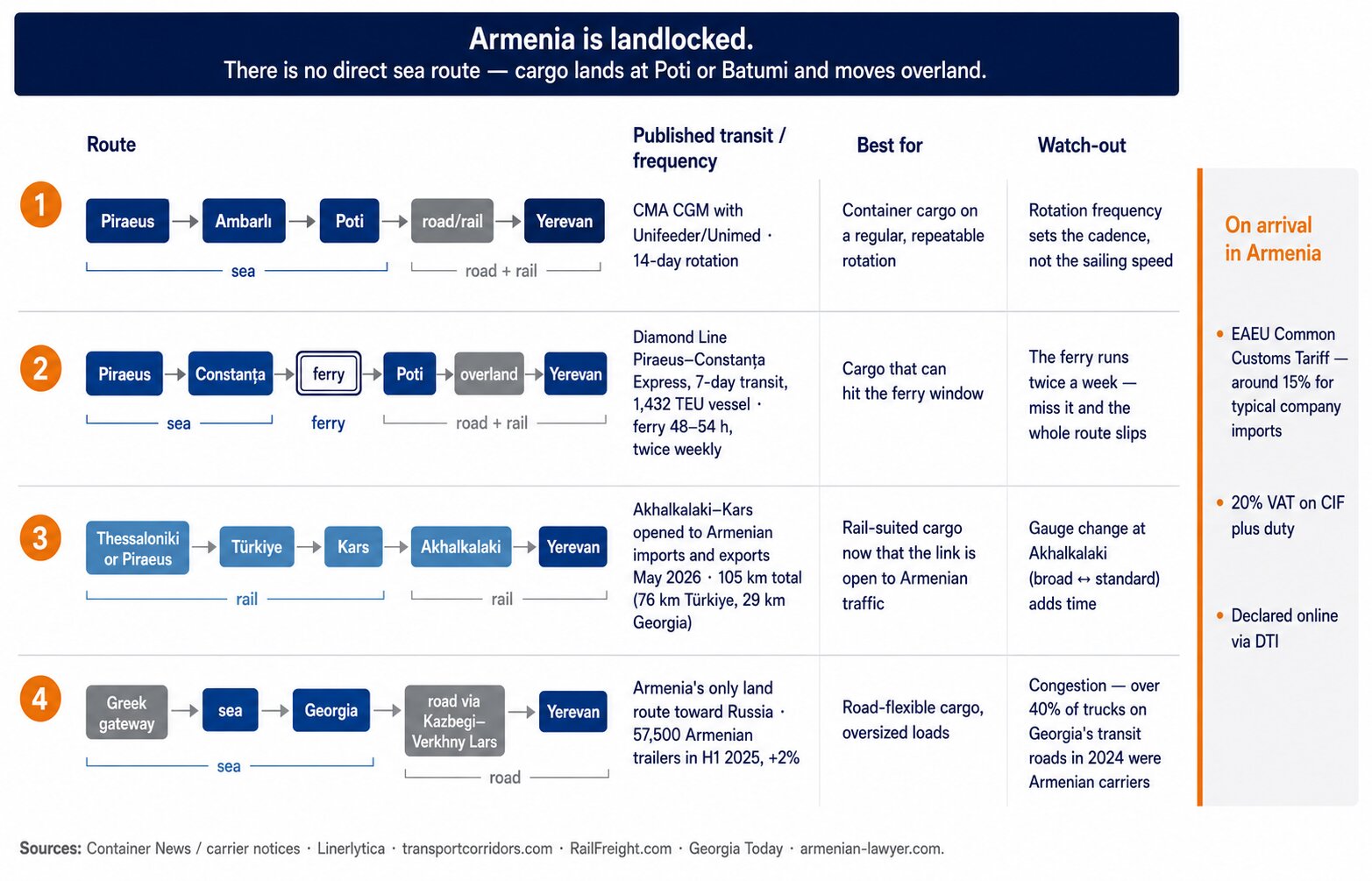
Shipping cargo to Armenia starts from a constraint no routing removes: Armenia is landlocked. Cargo lands at Poti or Batumi in Georgia and moves overland to Yerevan.
| Routing option | Legs | Transit / frequency | Best for | Watch-out |
|---|---|---|---|---|
| Piraeus → Poti feeder | Piraeus – Ambarlı – Poti (CMA CGM with Unifeeder/Unimed, launched April 2023), then overland | 14-day rotation | FCL on a fixed rotation | Rotation frequency, not sailing time |
| Piraeus → Constanța → Poti ferry | Piraeus–Constanța Express (Diamond Line, 1,432 TEU, launched June 2024), then the E60 ferry | 7 days, then 48–54 hours twice weekly | Trucks, vehicles, oversized cargo | Two sailing windows to hit |
| Greek gateway → Türkiye → Akhalkalaki–Kars rail | Feeder or road to Türkiye, then Baku–Tbilisi–Kars rail | Opened to Armenian cargo May 2026; Kars–Mersin ≤60 h is the trilateral agreement’s target, not a measured transit | Rail-suitable, EU-facing cargo | Gauge change at Akhalkalaki |
| Road via Kazbegi–Verkhny Lars | Poti or Batumi, then road to Yerevan | Continuous | Time-sensitive part loads | Over 40% of Georgia’s transit trucks in 2024 were Armenian |
Feeder rotations change. The services above are cited from their launch announcements and the schedules should be confirmed at the time of booking.
Poti handles more containers than any other port in the South Caucasus, with feeders from Romania, Bulgaria and Türkiye and on-dock rail onto the Georgian Railway network. That rail link is what makes Poti port Armenia transit work in practice. Georgia carried 57,500 Armenian trailers in the first half of 2025, up 2%.
RailFreight.com reported the Akhalkalaki–Kars line opening to Armenian imports and exports in May 2026, the country’s first rail link running toward the EU, over a 105 km stretch. A gauge change is where cargo transfers between broad-gauge and standard-gauge rolling stock, and at Akhalkalaki that step adds time to every consignment.
Price the destination side before the route. Armenia applies the EAEU Common Customs Tariff, around 15% for typical company imports, plus 20% VAT on CIF value plus duty, declared online through DTI. Where 15% duty plus VAT adds roughly 38% to CIF value, a two-day routing difference rarely decides anything.
What the 2026 return of Suez traffic changes for a Greek routing
Maersk completed its first Red Sea transit since the disruption in late 2025, the ME11 service resumed via the Red Sea and Suez in mid-February 2026, and CMA CGM returned its India–Mediterranean Express fully to Suez from January 2026.
The disruption never handed Piraeus volume in the first place. Piraeus Container Terminal fell 7.8% in 2024, to 4,228,474 TEU from 4,586,535 TEU, per COSCO Shipping Ports’ own results. Piraeus Port Authority put the 2025 decline down to weakening Mediterranean transshipment demand. Alphaliner reads it as Red Sea service reconfigurations sending cargo to Spanish and northern European gateways instead. That is two down years running, not a correction after a boom.
The 2.9% dip in the first half of 2026 continues that line rather than reversing it, and analysts expect normalisation to play out over quarters, not weeks. The risk for anyone shipping via Greek ports runs the other way: a surge of simultaneous arrivals can extend port dwell times at Mediterranean hubs, Piraeus included.
Two pallets, not a container: the LCL angle on these lanes
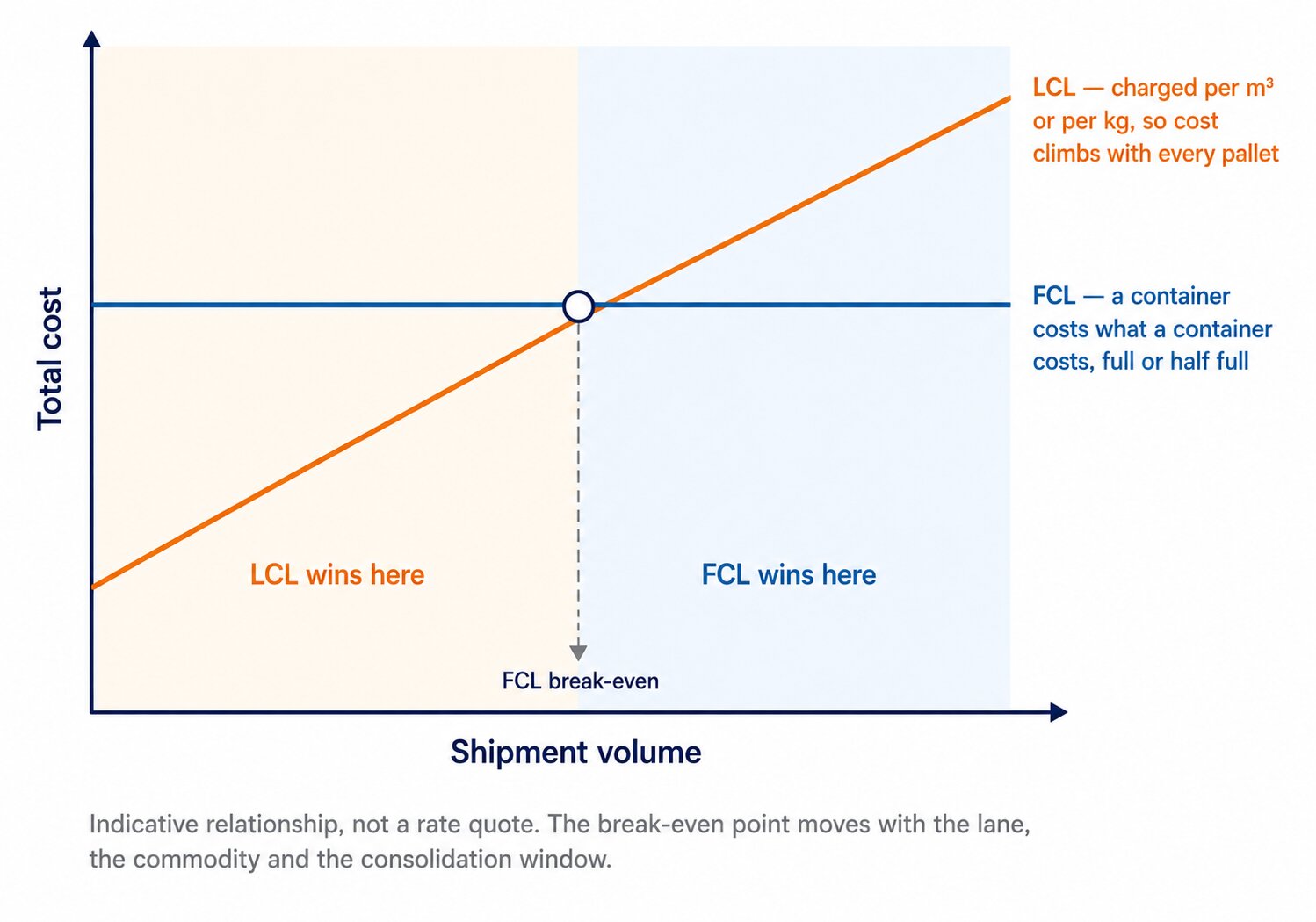
LCL, or Less than Container Load, is ocean freight where several shippers’ consignments share one container and each pays by volume or weight. Two pallets for Skopje do not justify a full container, and the consolidation point then matters more than the sailing date.
On the lanes we quote, a short ocean leg into a Greek gateway plus roughly 8 rail hours to Skopje, one of the North Macedonia lanes we consolidate for, generally beats a Northern European routing with hundreds of road kilometres behind it. One transit guarantee covers the consolidated box. The honest limit: LCL means waiting for the consolidation window and paying per m³ or per 1,000 kg, so above a certain volume FCL wins, and that break-even moves with the lane.
Consolidated cargo is our flagship service on Balkan and CIS lanes, run from an EU-registered base in Burgas, Bulgaria.
Choosing your Greek gateway: the recommendation
Shipping via Greek ports comes down to two branches, and your cargo belongs to one. Choose Thessaloniki when the destination is inland in the Balkans and either the inland leg or the customs event dominates the cost: rail hours are published, the Free Trade Zone and AEO status make clearance predictable, and Promachonas–Kulata is close.
Choose Piraeus when ocean transit, vessel size or an onward feeder dominates: 20 days from Shanghai, deep-sea services, Black Sea connections toward Poti and Constanța.
Run the four questions of the Last-Mile-First Rule before booking. If the answers come out close, send us the delivery address and the commodity and we will price both routings for shipping to the Balkans from Greece.
FAQ
Which Greek port should I use for cargo going to the Balkans?
Thessaloniki, in most cases: rail runs to Sofia (3 a week, about 10 hours), Skopje (about 8 hours) and Niš (2 a week, about 16 hours). Piraeus fits when the ocean leg or the vessel size decides the booking.
How much faster is Piraeus than Rotterdam from Asia?
About 8 days from Shanghai: 20 days to Piraeus against 28 to Rotterdam and 33 to Hamburg. One carrier quotes 22 days, so read it as a 20–22 day range, and on the ocean leg only.
Can I ship to Armenia through a Greek port?
Yes, with a Black Sea leg, because Armenia is landlocked and cargo lands at Poti or Batumi. CMA CGM with Unifeeder–Unimed has called Piraeus, Ambarlı and Poti on a 14-day rotation since April 2023; the Piraeus–Constanța Express, launched June 2024, runs 7 days to a ferry crossing to Poti in 48–54 hours, twice weekly. Confirm current sailings when you book.
Do I have to clear customs in Greece if my goods are going to Serbia or Armenia?
No, and usually you should not. Non-EU goods move under T1 external transit with duty suspended until the office of destination, per the Union Customs Code. Clearing in Greece means paying EU duty and import VAT on goods that then leave the EU.
What is the Thessaloniki Free Zone and when does it help?
It is a Free Trade Zone under the Union Customs Code, with temporary customs storage, bonded warehousing and a customs office on site, and ThPA S.A. holds an Authorised Economic Operator licence. It helps when goods should sit in Europe uncleared: staged distribution, an unconfirmed buyer, deferred duty.
Is there rail freight from Thessaloniki into the Balkans?
Yes. A Thessaloniki–Skopje container block train runs about 8 hours, Sofia has 3 services a week at about 10 hours, and Niš 2 a week at about 16 hours. The Belgrade–Niš–Skopje upgrade is due by 2028, returning 230 km to double track.
Can a small shipper use Piraeus or Thessaloniki without a full container?
Yes, through LCL or road groupage: consignments from several shippers share one container and each pays by volume or weight, so two pallets ride the lane a full load uses. The tradeoff is the consolidation window, usually a few days against FCL.