The cheapest way to ship from Turkey to Europe is almost always road groupage (part-load) for anything under a few pallets, because you pay for the truck space you use instead of a whole vehicle. For a single pallet Turkey to Germany, part-load road runs around €747 with a 5–7 day transit, against roughly €4,355 to book a full truck on the same lane (Brosan Logistics, 2026). The answer changes with volume. Heavy or dense cargo bound for a Western port can come out cheaper by sea LCL, and once your goods fill a vehicle, a full truckload (FTL) or full container (FCL) beats every per-unit rate. Air is the fastest option and the most expensive, near $10/kg on the same route.
One factor moves the final bill more than the freight quote: the EU–Türkiye Customs Union. Industrial goods in free circulation cross in both directions with no customs duty (European Commission), so the real saving often sits in the paperwork, not the transport mode. This guide compares each way to move cargo on cost, speed, and duty, then hands you a rule for picking by shipment size.
Key takeaways
- Small load (1–5 pallets): road groupage wins. You pay per pallet or per cubic metre, not for an empty truck. Around €747 for one pallet to Germany, 5–7 days (Brosan, 2026).
- Heavy/dense or bulky-but-not-urgent: check sea LCL. 2026 LCL rates run roughly $30–$180 per CBM globally; Turkey–EU sits mid-range and moves slower (Suaid Global; Freightos).
- Full load: FTL road or FCL sea. A flat vehicle rate beats every per-unit charge once you fill the space.
- Duty is the hidden lever. Industrial goods move duty-free under the Customs Union with an A.TR certificate. That can outweigh the freight difference entirely.
- Compare total landed cost. A tempting freight rate loses to handling, customs, and destination fees more often than shippers expect.
Scope and audience: this compares freight modes (road, sea, rail, air) for commercial cargo moving from Turkey into the EU and the Balkans, written for SME importers and exporters shipping roughly one pallet up to a full load. It does not cover parcel courier, personal effects, or vehicle (RoRo car) shipping, which price differently.
On this page
- Why volume decides the cheapest mode
- The four ways to move cargo Turkey → Europe
- Road freight: groupage vs full truck
- Sea freight: LCL vs FCL
- Mode comparison at a glance
- The customs lever most guides skip
- Total landed cost, not the freight quote
- Which mode should you pick?
- How to get the cheapest rate
- FAQ
Why volume decides the cheapest mode
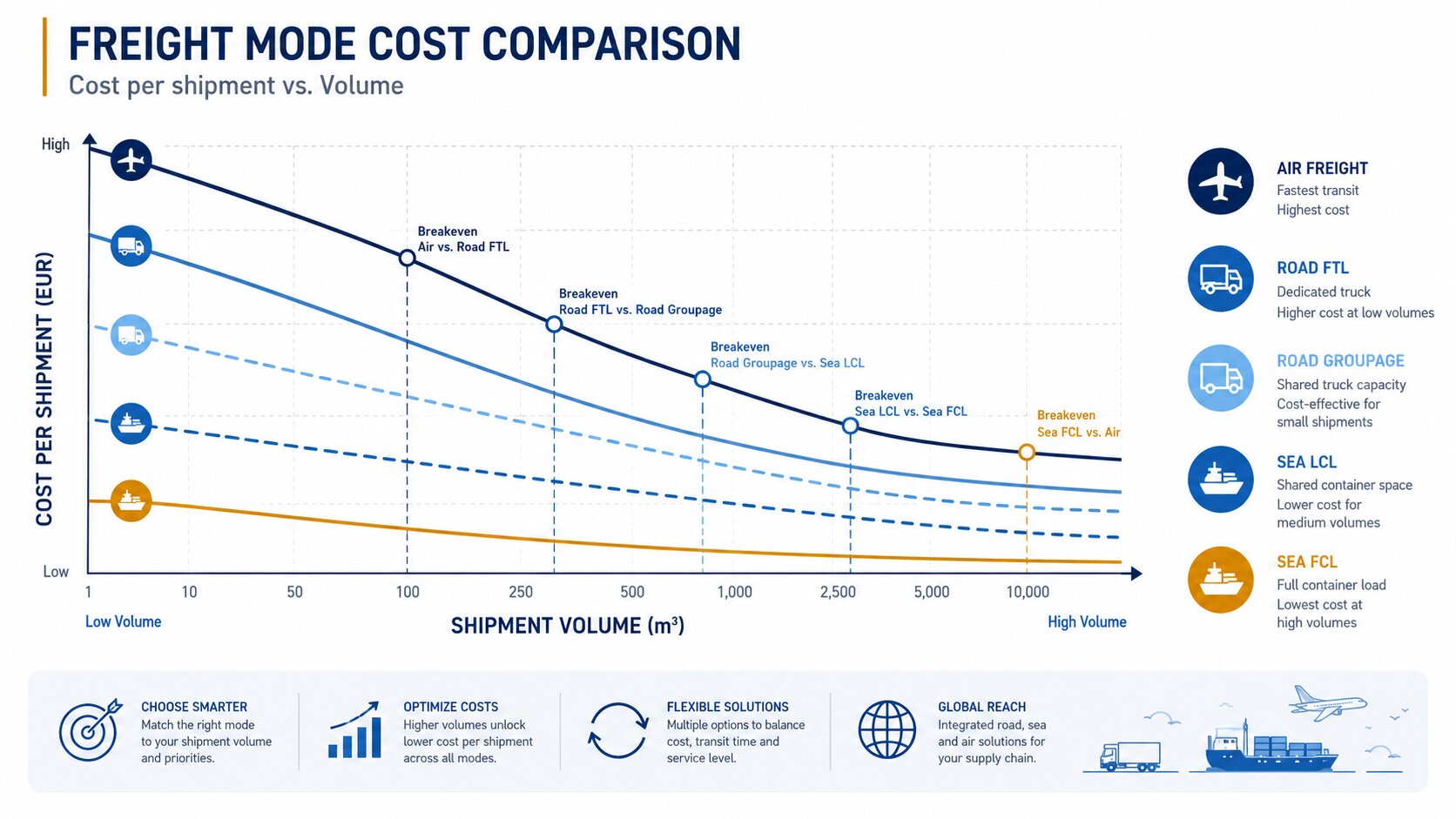
Freight pricing rewards filled space. A part-load service charges you for the pallets or cubic metres you occupy, so a small consignment stays cheap. A full truck or container carries a flat price whether it leaves at 60% or 100% full, which means the cost per pallet falls as you add cargo. Somewhere between those two models sits a break-even, and that crossover is what actually decides the cheapest way to ship from Turkey to Europe for your specific load.
For most SME shipments the crossover is generous. A truck holds around 33 euro-pallets; you can load a good share of it on a part-load rate before booking the whole vehicle starts to pay off. Below that line, groupage is the default cheapest choice on this lane. Above it, you switch to a full load. The rest of this guide puts numbers to each band.
The four ways to move cargo Turkey → Europe
Four modes serve the corridor, and they rank predictably on price and speed.
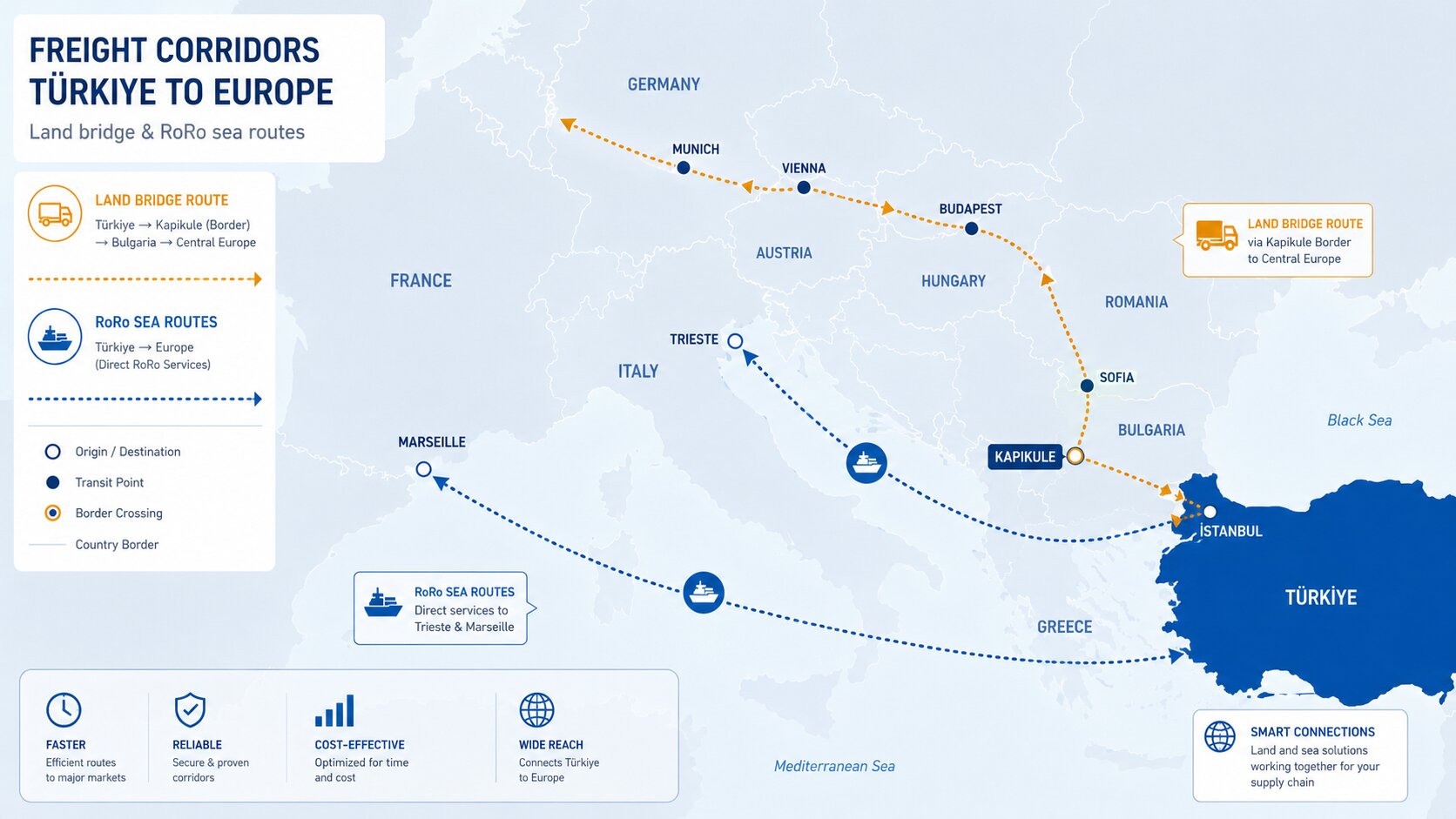
- Road is the workhorse. Trucks run the land bridge through Bulgaria (the Kapıkule border crossing) into Central Europe, or roll onto RoRo ferries toward Trieste and French ports to skip driving days on Western lanes. Best all-round value for most cargo.
- Sea suits heavy, dense, or bulky goods with time to spare. Containers sail from Istanbul, Izmir, and Mersin to Hamburg, Rotterdam, and Marseille-Fos.
- Rail and multimodal (sea plus rail, or road plus rail) can trim cost on some longer lanes, though schedules are thinner.
- Air covers urgent or high-value cargo. Quick (1–3 days) and priced to match.
Which of these is cheapest is not fixed. It shifts with weight, volume, destination, and how fast you need the goods. Road and sea carry the real contest for SME budgets, so they get the detail below.
Road freight: groupage vs full truck
Road is where most Turkey–Europe cargo actually moves, and it splits into two products with very different economics.
Groupage (LTL / part-load) consolidates several shippers’ goods into one truck running a fixed weekly schedule. You pay for your slice: per pallet or per cubic metre. For a business sending two or three pallets, this is usually the cheapest way to reach Europe from Turkey. One pallet to Germany sits near €747 on a 5–7 day transit (Brosan Logistics, 2026). No empty space on your invoice.
Full truckload (FTL) gives you the whole vehicle. The flat rate lands anywhere from €1,200–€1,800 for a 40ft truck on shorter Central-Europe lanes up to about €4,355 on longer Western routes (Freightos guidance; Brosan, 2026). Once you are loading a dozen-plus pallets, that flat figure divided across your cargo undercuts the per-pallet rate, and you gain a direct door-to-door run with no consolidation stops.
The Balkan corridor is where this lane is won or lost. On routes through Bulgaria we typically see the shortest customs queues when paperwork is clean at Kapıkule, and a stalled document there costs more days than any freight rate saves. Groupage suits the pallet-count shipper; FTL suits the full load or the time-sensitive one.
Sea freight: LCL vs FCL
Water enters the picture when cargo is heavy, dense, or simply large enough that road stops making sense. It mirrors road’s split.
LCL (Less than Container Load) is the sea version of groupage: your goods share a container and you pay per CBM or per 1,000 kg, whichever is greater. Global 2026 LCL rates span roughly $30–$180 per CBM, with Turkey–EU in the mid-band (Suaid Global; Freightos). The catch is time. LCL adds 5–15 days over a full container once you count origin and destination CFS handling (the container freight station where shared boxes are packed and unpacked) plus customs (Freightos).
FCL (Full Container Load) books the whole box, sealed origin to destination. A 20ft container to France runs about $1,800–$3,900, a 40ft around $3,700–$7,200 (Freightos; Globy, 2026). For a full load with no rush, FCL is often the lowest cost per unit of any mode.
Is sea ever cheaper than road here? For dense cargo (tiles, machinery parts, canned goods) headed to a Western or Northern port, yes: weight-based road rates climb fast, while a container swallows the weight for one flat price. For light, palletised goods to Central Europe, road almost always stays ahead.
Mode comparison at a glance
| Mode | Typical cost (2026, Estimated) | Transit | Best for |
|---|---|---|---|
| Road groupage (LTL) | ~€747 / pallet (TR→DE) | 5–7 days | 1–8 pallets, SME part-loads |
| Road full truck (FTL) | €1,200–€4,355 / truck | 5–7 days | Full loads, time-sensitive cargo |
| Sea LCL | ~$30–$180 / CBM | 12–25 days door-to-door | Heavy/dense small loads, no rush |
| Sea FCL | $1,800–$7,200 / container | 10–21 days + inland | Full containers, lowest per-unit |
| Air | ~$10 / kg | 1–3 days | Urgent, high-value, light cargo |
Figures are indicative ranges for the Turkey–Europe corridor and move with fuel, season, and destination. Treat them as a starting frame, then price your exact lane. (Sources: Brosan Logistics; Freightos; Suaid Global; Globy, 2025–2026.)
The customs lever most guides skip
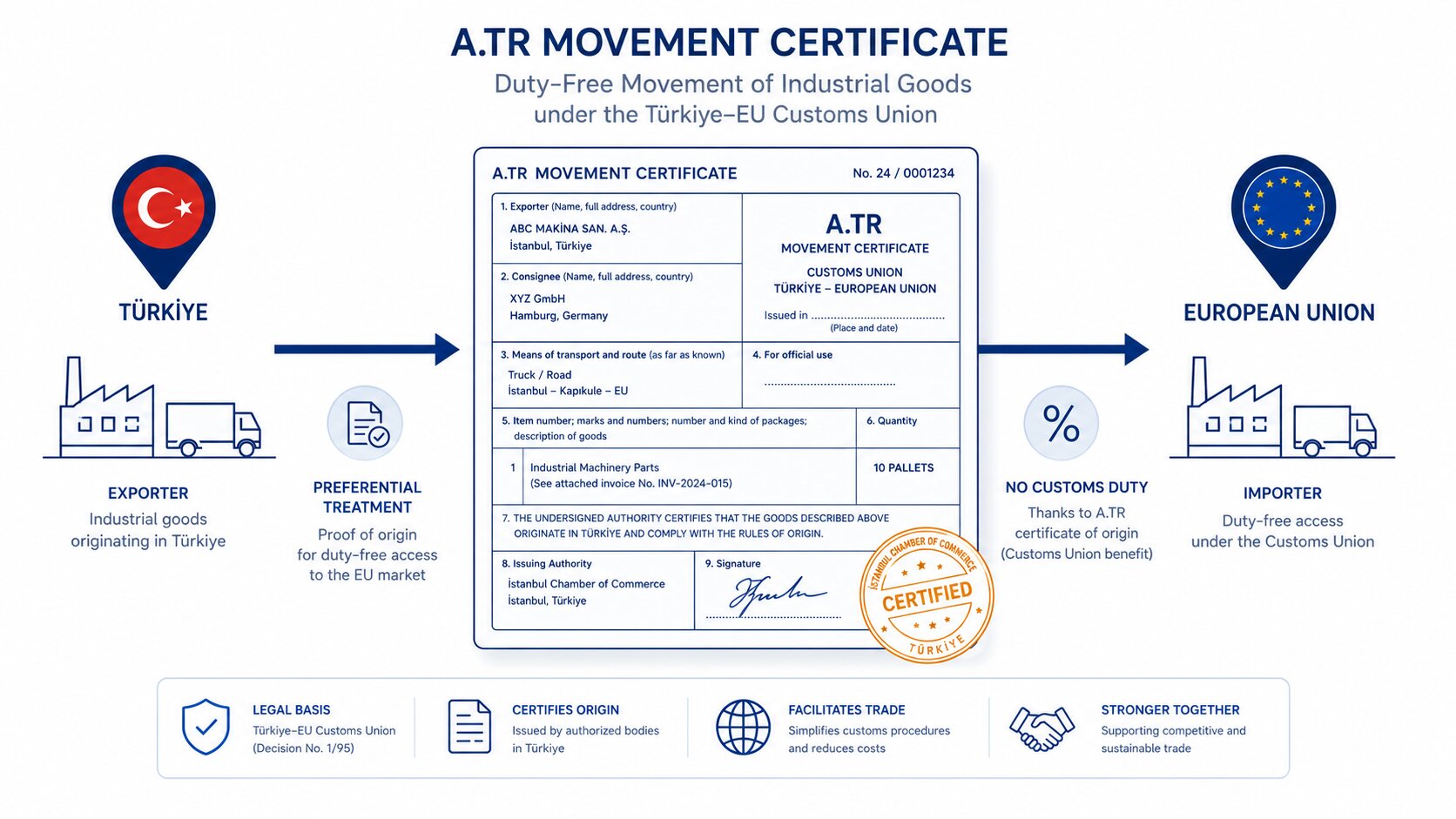
Here is the part that pure freight comparisons leave out, and it often decides the cheapest total. The EU–Türkiye Customs Union has been in force since 1995, built on the 1963 Ankara Agreement and its 1970 Additional Protocol (European Commission). Under it, industrial goods in free circulation move between Turkey and the EU with no customs duty in either direction.
To claim that exemption you need an A.TR movement certificate, which proves the goods are in free circulation. Get it right and a shipment of, say, machined components pays zero duty on arrival. Get it wrong (or ship a product category the Union excludes) and duty lands on top of your freight. Agricultural goods and certain specific products sit outside the arrangement and can carry tariffs or quotas, so the certificate is not a blanket pass.
There is a second document worth knowing. A T1 transit declaration lets cargo cross several countries (common on the Balkan land bridge) without settling duty at each border (Dimotrans). For a Turkish exporter, the practical takeaway is blunt: the mode saves you tens to a few hundred euros; the customs treatment can save (or cost) far more. Sort the paperwork before you optimise the truck.
Total landed cost, not the freight quote
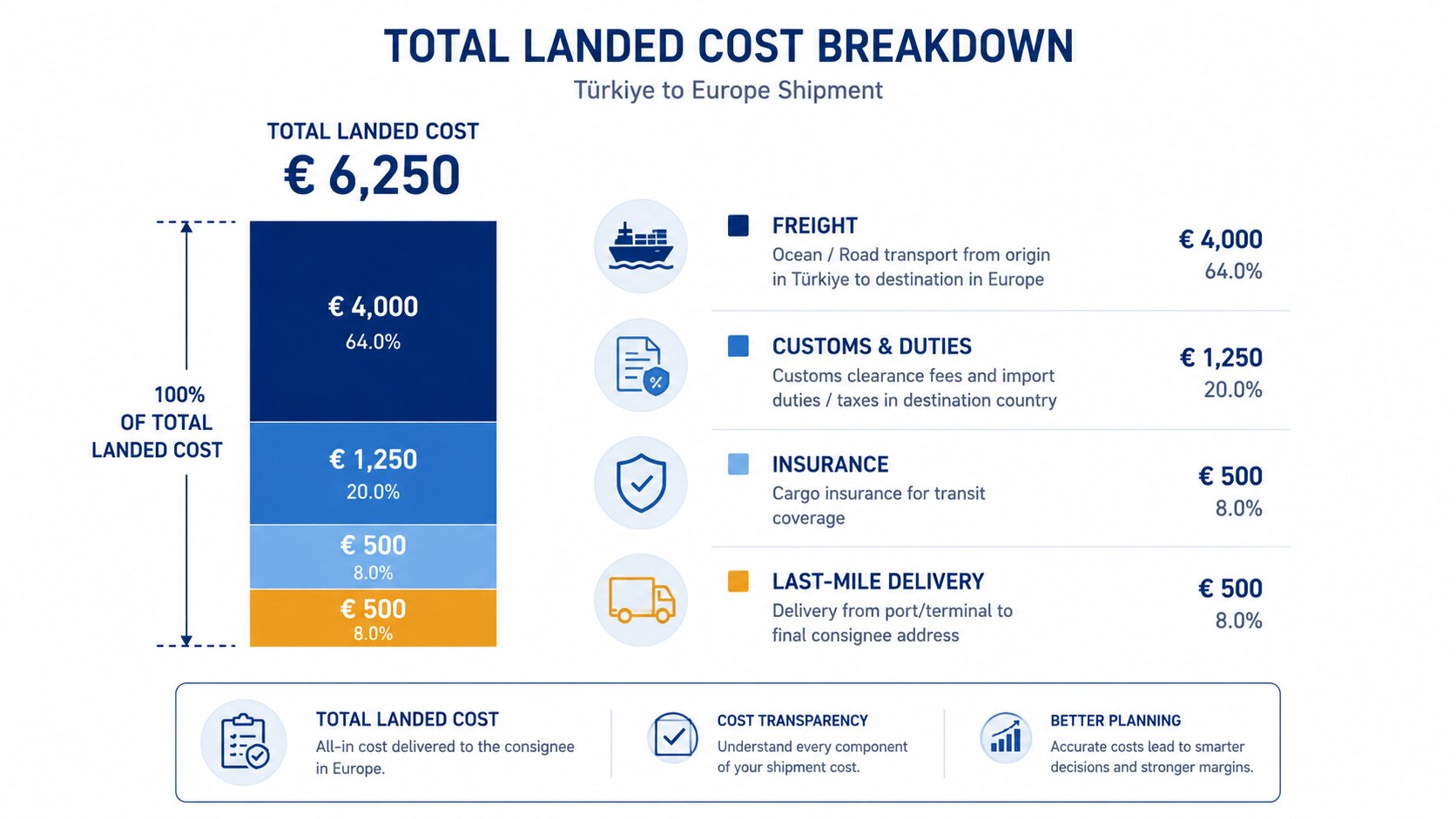
The number on a freight quote is not the number you pay. Landed cost is freight plus origin charges, destination handling, customs clearance, any duty, and delivery. LCL and groupage both carry handling fees that a sealed full load avoids, and those fees do not shrink because the headline rate looked low.
A short worked example. Say two pallets of industrial parts move Turkey to Germany:
- Route A, sea LCL: low per-CBM freight looks attractive, then origin CFS, destination CFS/deconsolidation, and 20-plus days of transit stack on. Cheap freight, slower cash cycle, more handling lines.
- Route B, road groupage: ~€747 per pallet, 5–7 days, one clean customs step, A.TR certificate for duty-free entry.
For most SME part-loads to Central Europe, Route B wins on landed cost even when Route A wins on the freight line alone. The lesson holds beyond this example: always compare the all-in figure. [Case study placeholder: a real Sea Gate Turkey→EU landed-cost comparison to be inserted.]
Which mode should you pick?
Match the mode to the shipment size and priority.
- 1–3 pallets, standard goods, Central Europe: road groupage. Cheapest, and fast enough.
- 4–10 pallets: price groupage against a light FTL; the crossover often lands here.
- Full load, no rush, dense cargo: FCL sea or FTL road, whichever your destination favours (FCL for Western ports, FTL for the land bridge).
- Heavy but under a container, flexible timing: sea LCL can beat weight-based road rates.
- Urgent or high-value: air, and accept the premium for the 1–3 day transit.
When two options sit close, the tie-breaker is rarely the freight rate. It is transit time against your cash cycle, and whether your customs paperwork qualifies you for duty-free entry.
How to get the cheapest rate
The mode sets the ceiling; these levers lower the actual price.
- Consolidate orders. Combining several suppliers into one groupage or LCL shipment can cut cost by around 30% versus shipping each separately (Freightos guidance).
- Get your A.TR certificate right the first time. Duty-free entry beats any freight discount for qualifying industrial goods.
- Palletise efficiently. Weight-and-space pricing punishes badly stacked cargo; a tidy pallet can drop you a price band.
- Stay flexible on dates. Fixed weekly groupage departures are cheaper than an on-demand truck.
- Compare all-in quotes, not freight lines. Ask each forwarder for landed cost including destination handling and clearance.
- Use one forwarder across modes. A single contact who can switch you between road, LCL, and FTL as volume changes avoids the markup of rebooking.
Would we call any single mode “the cheapest” in the abstract? No — and any guide that does is guessing at your cargo. The cheapest route is the one matched to your volume, your destination, and your duty status.
FAQ
What is the cheapest way to ship from Turkey to Europe?
For small shipments (one to a few pallets), road groupage (a part-load service where you pay only for the space you use) is usually cheapest, around €747 per pallet to Germany on a 5–7 day transit (Brosan, 2026). For full loads, a full truck or full container is cheaper per unit.
Is road or sea cheaper from Turkey to Europe?
Road is cheaper for palletised goods to Central Europe and for anything time-sensitive. Sea (LCL or FCL) can win for heavy, dense, or bulky cargo bound for Western and Northern ports, where weight-based road rates climb. Compare both on total landed cost.
How long does freight take from Turkey to Europe?
Road runs 5–7 days to most of Central Europe. Air is 1–3 days. Sea FCL is roughly 10–21 days plus inland delivery, and sea LCL adds 5–15 days on top for consolidation and handling.
Do I pay customs duty shipping from Turkey to the EU?
Industrial goods in free circulation move duty-free under the EU–Türkiye Customs Union, provided you present a valid A.TR movement certificate (European Commission). Agricultural goods and some specific product categories fall outside it and may carry duty or quotas.
How much does it cost to send one pallet from Turkey to Germany?
Around €747 for a single pallet by road part-load on a 5–7 day transit (Brosan Logistics, 2026, Estimated). The exact figure depends on weight, dimensions, and destination city.
What is groupage, and why is it cheaper?
Groupage (also called LTL or part-load) combines several companies’ cargo into one truck running a fixed schedule. Because you pay for your portion rather than an empty vehicle, it is the cheapest road option for shippers who cannot fill a full truck.
Not sure which mode fits your next Turkey–Europe shipment? Send us the pallet count, weight, and destination, and we will price road groupage, LCL, and full-load side by side on landed cost — so you see the cheapest total, not just the cheapest freight line.