Shipping through Serbia and North Macedonia means crossing two customs borders that free-trade agreements do not erase. CEFTA, the free-trade agreement covering the Western Balkans and Moldova, governs trade between its own parties. It gives nobody duty-free access to the EU. Access to the EU market runs on each country’s bilateral Stabilisation and Association Agreement (SAA) plus the origin rules of the Pan-Euro-Mediterranean (PEM) Convention. Freight that only passes through moves under common transit, because both countries sit outside the EU customs territory yet inside the Common Transit Convention (North Macedonia since 1 July 2015, Serbia since 1 February 2016).
That distinction decides your paperwork, your duty bill and how long your truck stands still. It also catches out experienced shippers, because the corridor looks continuous on a map. Thessaloniki to Skopje to Belgrade to Budapest is one motorway, Pan-European Corridor X, and a truck covers it in under two days of driving. Customs sees four separate events on that road.
In 2025, goods trade between the EU and the six Western Balkan partners passed €88 billion, and the EU accounted for 62% of the region’s total trade (Council of the EU). This is a well-worn lane, not an exotic one. The rules on it changed more in 2026 than in the previous five years combined.
Key takeaways
- CEFTA is not an EU agreement. It covers trade among Albania, Bosnia and Herzegovina, Kosovo*, Moldova, Montenegro, North Macedonia and Serbia. Duty-free entry into the EU comes from the SAA and a valid proof of preferential origin, not from a CEFTA document.
- Passing through is a customs regime, not a formality. Union goods keep their status across Serbia and North Macedonia only under internal transit (T2) in NCTS. Non-Union goods move under T1 or a TIR carnet.
- Origin is where the money is. A EUR.1 certificate or an invoice declaration turns a Serbian or Macedonian invoice into a zero-duty EU import. Since 1 January 2026 the PEM area runs two separate cumulation zones, and materials cannot be cumulated across them.
- Three EU rules landed on this corridor in 2026. The Entry/Exit System (full operation 10 April), ICS2 for road (ICS1 switch-off from 1 January) and CBAM’s definitive period (from 1 January). Each has a different filer and a different cost.
- The border, not the road, sets your transit time. Green Lane processing at Preševo–Tabanovce has run in both directions since 2021. Queue length varies more by day and hour than by distance.
Scope and audience: this guide is written for SME importers, exporters and buyers whose freight is carried through or out of Serbia and North Macedonia by road, by sea plus road, or in groupage. It covers the customs frameworks, the transit and origin documents, and the 2026 changes that affect cost and time. It does not cover haulier licensing or road-permit quotas, nor product-specific veterinary and phytosanitary controls.
On this page
- Two agreements doing two different jobs
- Which regime is your shipment actually in?
- Transit paperwork: T1, T2, TIR and NCTS
- The origin trap: CEFTA origin is not EU preference
- What changed in 2026
- Where the time actually goes on Corridor X
- The costs that never show on a freight quote
- A shipper-side playbook for this corridor
- FAQ
Two agreements doing two different jobs
Seven parties sit inside CEFTA 2006: Albania, Bosnia and Herzegovina, Kosovo*, Moldova, Montenegro, North Macedonia and Serbia. The agreement was signed in Bucharest in 2006 as a single regional replacement for a web of bilateral deals. It has shrunk as members left for the EU, with Bulgaria, Croatia and Romania all exiting on accession. What it does is liberalise trade inside that group. A Serbian manufacturer selling to a Macedonian distributor pays no duty, provided the goods qualify as originating under the shared origin rules.
The EU relationship is separate. Serbia and North Macedonia each hold a Stabilisation and Association Agreement, a bilateral framework that builds a free-trade area with the EU alongside political and legal alignment. Serbia’s tariff dismantling ran on a six-year schedule that finished on 1 January 2014.
A short list of sensitive agricultural goods (certain meats, dairy, honey, some vegetables) keeps protection in the 20-50% range until accession, according to Serbia’s Ministry for European Integration. Neither country is in the EU customs union. That single fact generates every document below.
| CEFTA 2006 | SAA (Serbia / North Macedonia ↔ EU) | |
|---|---|---|
| Who it covers | The seven CEFTA parties | One Western Balkan country and the EU-27 |
| What it delivers | Duty-free trade inside the region | Duty-free EU market access for qualifying goods |
| Proof required | EUR.1 or origin declaration under PEM rules | EUR.1 or origin declaration under PEM rules |
| Customs border | Remains between every party | Remains at the EU frontier |
| Common external tariff | No | No |
Two agreements, one shared origin rulebook, and no customs union anywhere in the picture. So when a supplier tells you the goods are “CEFTA duty-free”, the honest follow-up question is: duty-free into which market?
Which regime is your shipment actually in?
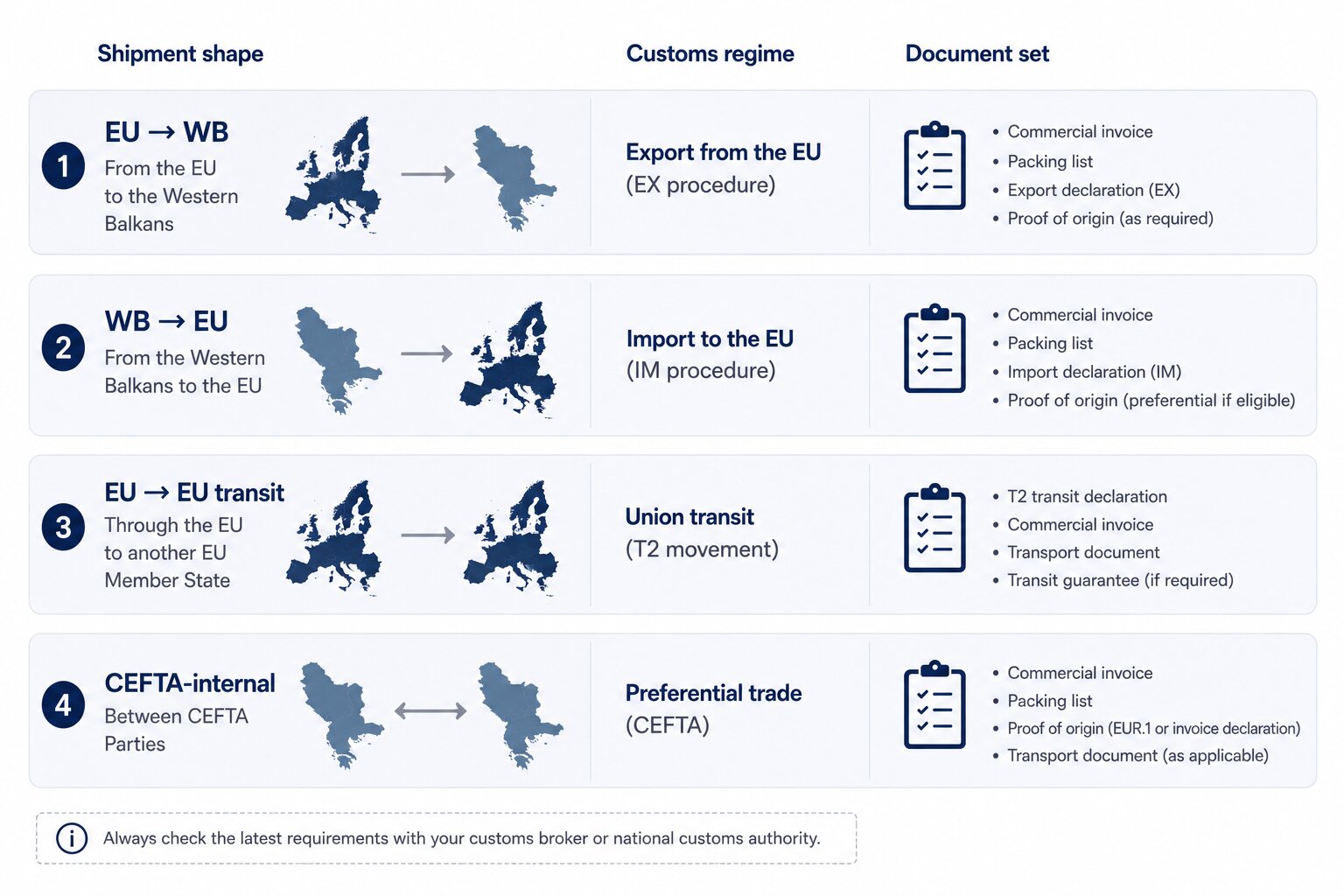
Four shipment shapes cover most of what moves on this corridor. Each puts your cargo under a different regime with a different document set. Reading your own shipment off this table takes about ten seconds, and it settles the argument before the border does.
| Shipment shape | Regime | Core documents | Duty outcome |
|---|---|---|---|
| EU seller → Serbian or Macedonian buyer | Export from the EU, import into a third country | Export declaration, invoice, EUR.1 or origin declaration, CMR | Local import duty and VAT; preferential rate if origin is proven |
| Serbian or Macedonian seller → EU buyer | Import into the EU | Import declaration, invoice quoting the EU importer’s EORI, EUR.1 or origin declaration, ENS filed by the carrier | Preferential duty (usually zero on industrial goods) plus import VAT |
| EU → EU with a leg through Serbia or North Macedonia | Common transit | T2 declaration in NCTS, guarantee, CMR | No duty; Union status preserved if transit is correct |
| Serbia ↔ North Macedonia, or any CEFTA pair | CEFTA trade | Import and export declarations, EUR.1 or origin declaration | Duty-free within CEFTA if the goods originate |
The third row is the one that costs people money. Goods in free circulation in the EU lose Union status when they leave the customs territory, unless they travel under internal transit. A pallet moving from Thessaloniki to Vienna through Skopje and Belgrade therefore needs a T2 opened before it exits Greece. Skip it and the goods arrive in Austria as non-Union goods.
Import duty and VAT then fall due on the full value of cargo that was in free circulation an hour earlier. Recovery is possible with proof of status. It is also slow, unpleasant work that nobody bills for accurately.
Transit paperwork: T1, T2, TIR and NCTS
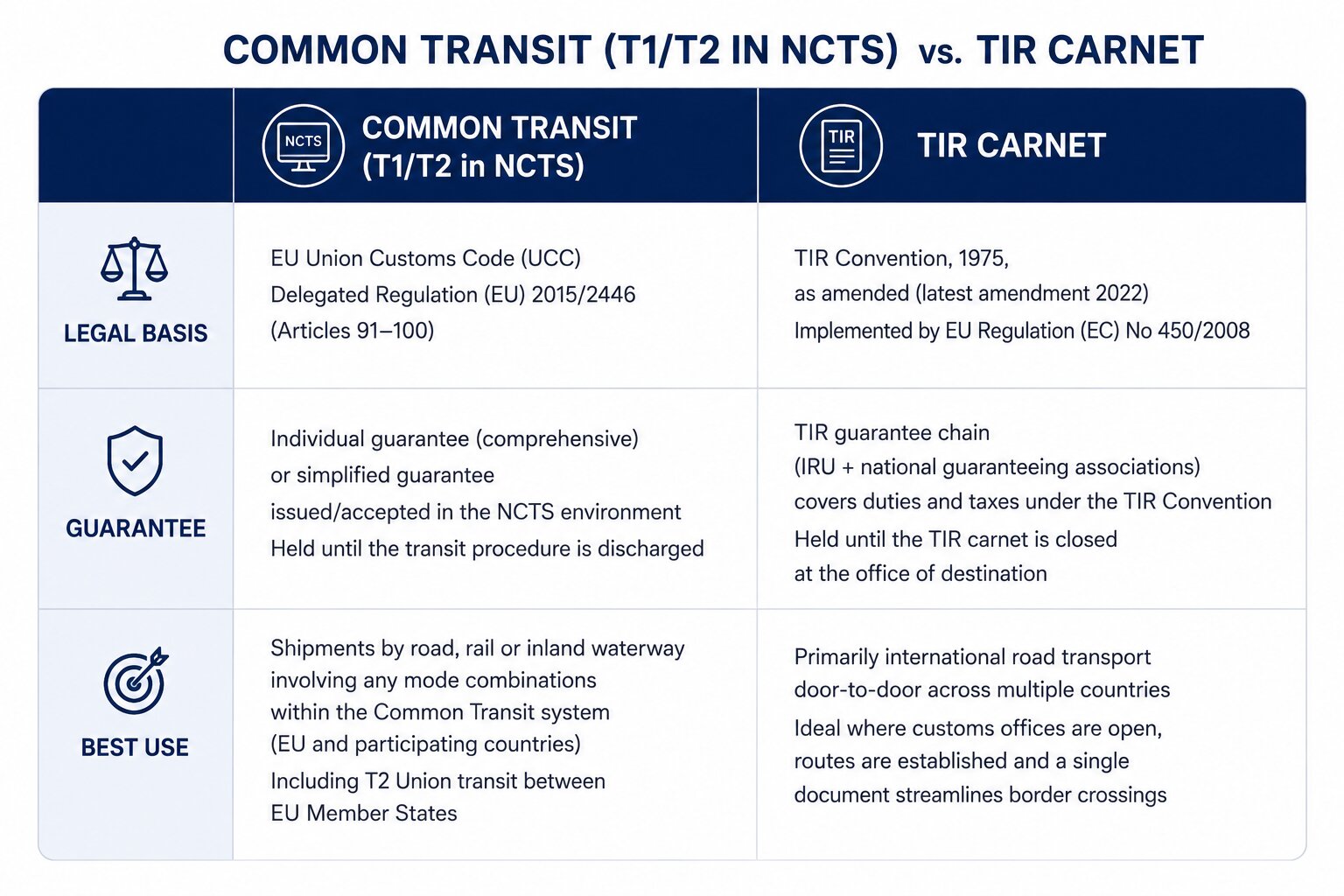
Common transit exists precisely because this journey crosses non-EU territory. Under the Common Transit Convention, the EU-27, EFTA, Türkiye, the UK, Ukraine, Georgia and both of our corridor countries run one shared electronic system for goods moving under duty suspension: the New Computerised Transit System, or NCTS (European Commission, Taxation and Customs Union). North Macedonia joined on 1 July 2015 and Serbia on 1 February 2016. That is why a truck can leave Bulgaria and reach Slovenia on a single declaration.
T1 covers non-Union goods, such as Chinese electronics landed at Thessaloniki and trucked north. T2 covers Union goods and preserves their status across the third-country legs. Both are filed in NCTS by a principal, usually the exporter, a customs broker or the freight forwarder. Both need a guarantee covering the duty at risk until the office of destination discharges the movement.
| T1 / T2 (common transit) | TIR carnet | |
|---|---|---|
| Legal basis | Common Transit Convention | TIR Convention, administered by the IRU |
| System | NCTS, electronic | Carnet, plus eTIR where implemented |
| Guarantee | Comprehensive or individual, arranged by the principal | Built into the carnet, commonly capped at €100,000 |
| Best for | Movements inside the CTC area, including EU↔Serbia↔EU | Journeys running beyond the CTC area, into Türkiye, the Caucasus or Central Asia |
| Typical weak point | Guarantee limits and unclosed movements | Carnet cost and fewer approved offices |
Which one belongs on your shipment? If the route starts and ends inside the CTC area, common transit is usually cheaper and lighter to administer. If the truck continues into a non-CTC market, TIR earns its cost by covering the whole run on one document.
The failure mode worth watching is a movement that never gets discharged at destination. The guarantee stays blocked, and the principal answers a customs debt letter months later. Ask your forwarder how discharge is monitored, not whether it is.
The origin trap: CEFTA origin is not EU preference
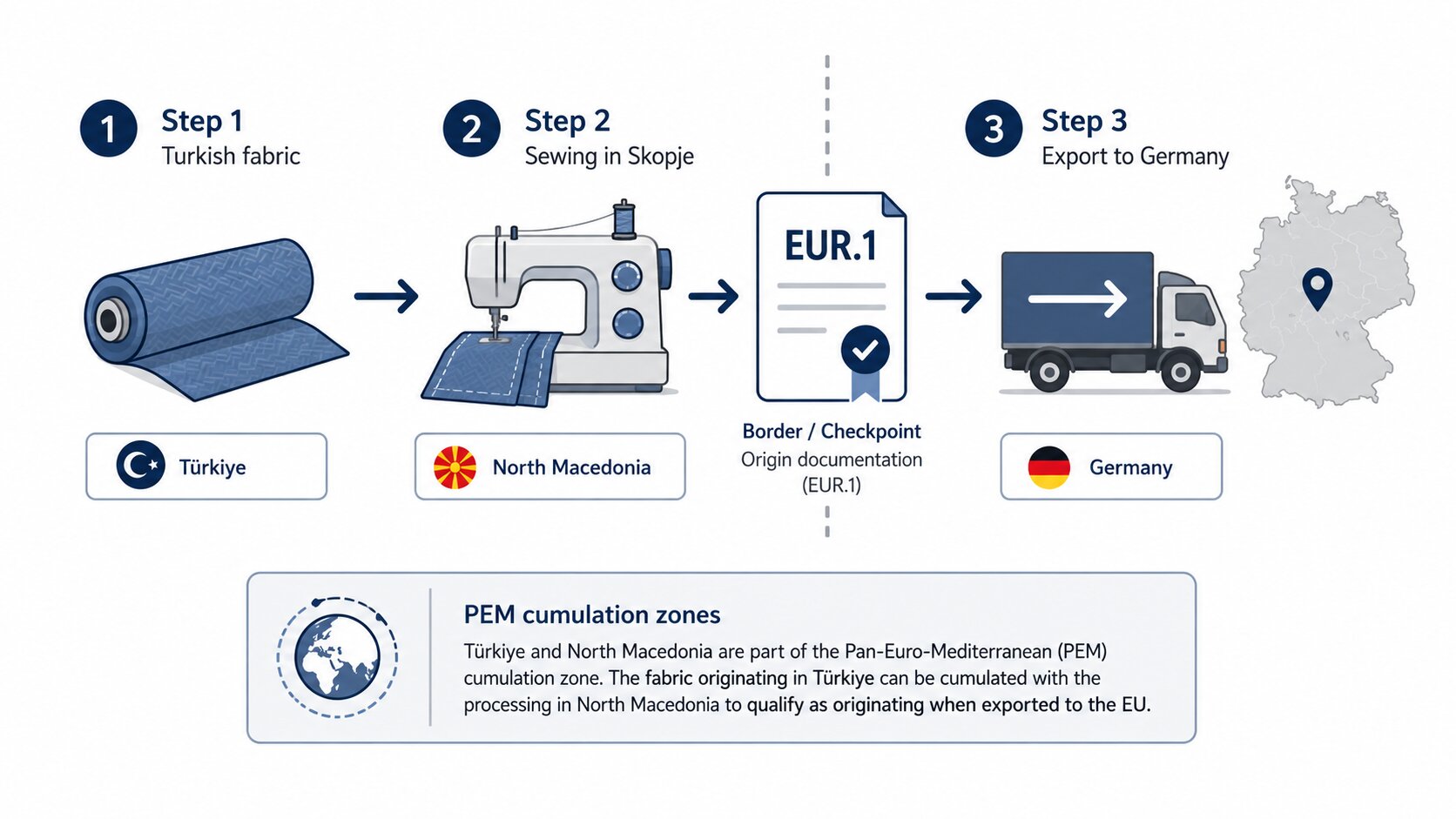
Zero duty on an EU import is never automatic. It is claimed, and the claim rests on a proof of preferential origin: a EUR.1 movement certificate stamped by the exporting country’s customs, or an origin declaration on the invoice from an approved exporter. Since 1 January 2025 the PEM Joint Committee has allowed EUR.1 certificates issued electronically, which removes a courier step that used to hold up clearance by a day or two.
CEFTA’s rules of origin are the PEM rules (CEFTA). That shared rulebook is what makes diagonal cumulation possible: materials from one party count towards origin in another. A Macedonian garment maker can buy Turkish fabric, sew in Skopje, and still ship to Germany at preferential rates, provided the processing meets the product rule and every country in the chain is linked by agreements with matching origin rules.
Here is the part that changed. The revised PEM rules entered into force on 1 January 2025, and from 1 January 2026 the convention effectively operates as two cumulation zones. One runs on the original rules, one on the revised rules, and no cumulation is permitted between them (PEM Convention information note, October 2025). A supply chain that worked in 2024 can fail an origin audit in 2026 without anything physical changing about the goods. If your product carries materials from three or more countries, check it with your supplier in writing before the next order rather than after a customs authority queries the certificate.
Three habits keep this clean. Ask suppliers for supplier declarations covering the materials, not only a stamped certificate for the finished goods. Keep origin evidence for the full retention period your customs authority sets, because preference is verified after clearance far more often than at the border. And treat an origin declaration from a non-approved exporter above the value threshold as what it is: an unusable claim.
What changed in 2026
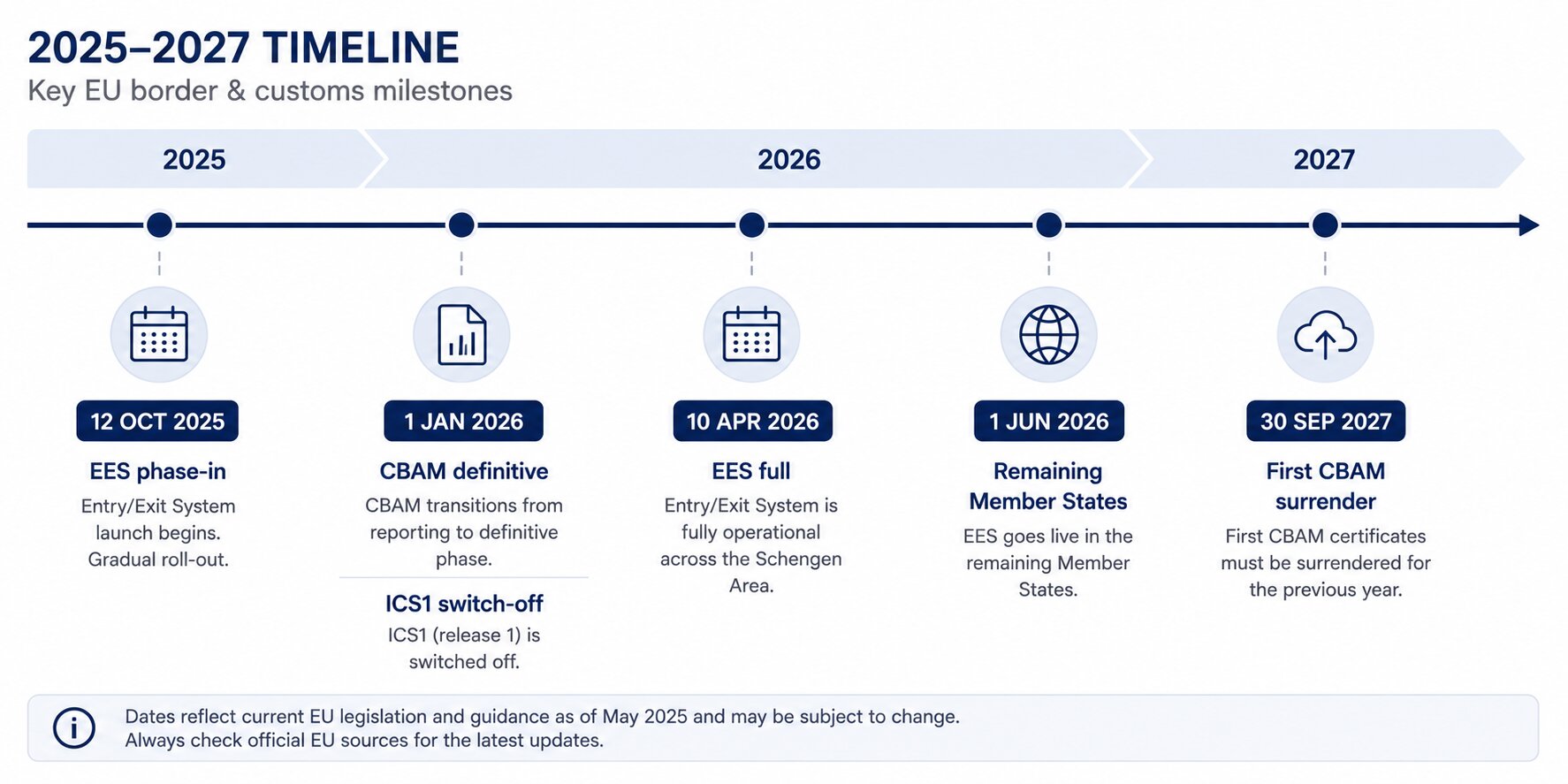
Three separate EU rules reached this corridor within four months of each other. Each has a different filer and a different cost. No single agency announced them together, which is why shippers met them one surprise at a time.
| Change | Live from | Who files | What it costs you |
|---|---|---|---|
| EES (Entry/Exit System), biometric registration of non-EU nationals at Schengen borders | Phased from 12 October 2025, full operation 10 April 2026 | The driver, at the border | Longer processing per crossing; the 90/180-day stay limit constrains driver availability |
| ICS2 Release 3 for road, the pre-arrival safety and security declaration (ENS) | ENS mandatory since 1 April 2025; ICS1 decommissioned in several member states from 1 January 2026, with Croatia, Latvia, Poland, Romania and Slovakia following on 1 June 2026 | The carrier or haulier | Goods stopped at the border if data is incomplete; better HS and consignee data needed from you |
| CBAM definitive period, carbon certificates for covered goods | 1 January 2026, first surrender 30 September 2027 for 2026 imports | The authorised CBAM declarant (the EU importer) | Certificate cost above a 50-tonne annual de minimis, on cement, iron and steel, aluminium, fertilisers, electricity and hydrogen |
The EES story is the loud one. Professional drivers from the Western Balkans fall under the same 90-days-in-180 Schengen limit as tourists, and transport associations calculate that international drivers need roughly 130 working days in a 180-day window to run normal schedules. Protests involving up to 75,000 trucks blocked freight terminals in January 2026, and the Serbian Chamber of Commerce estimated export losses near €100 million a day during the blockades (bne IntelliNews). Associations from Serbia, North Macedonia, Montenegro and Bosnia and Herzegovina then set the European Commission a deadline of 10 August 2026 to propose a durable fix.
As of August 2026, no permanent exemption for professional drivers has been agreed. The practical read for a shipper is simple: driver-days are now a scarce input on this corridor, and scarce inputs get priced.
CBAM is the quiet one, because it hits importers rather than hauliers. The Energy Community’s readiness tracker puts the estimated annual CBAM cost at around €612.5 million for Serbia and €200 million for North Macedonia, and neither has secured an exemption. Serbia introduced a carbon tax of €4 per tonne in early 2026 and announced a carbon market modelled on the EU ETS, which narrows the gap over time without closing it now. If you import Serbian rebar, Macedonian aluminium profiles or anything else on the CBAM list, check the 50-tonne threshold first. Below it, the whole regime passes you by.
ICS2 sits in between. The legal obligation belongs to the carrier, but the data is yours. Incomplete goods descriptions, missing HS codes and vague consignee details are what turn a filing into a border stop. “Various goods” has not been an acceptable description for years, and in 2026 it is a delay you pay for.
Where the time actually goes on Corridor X
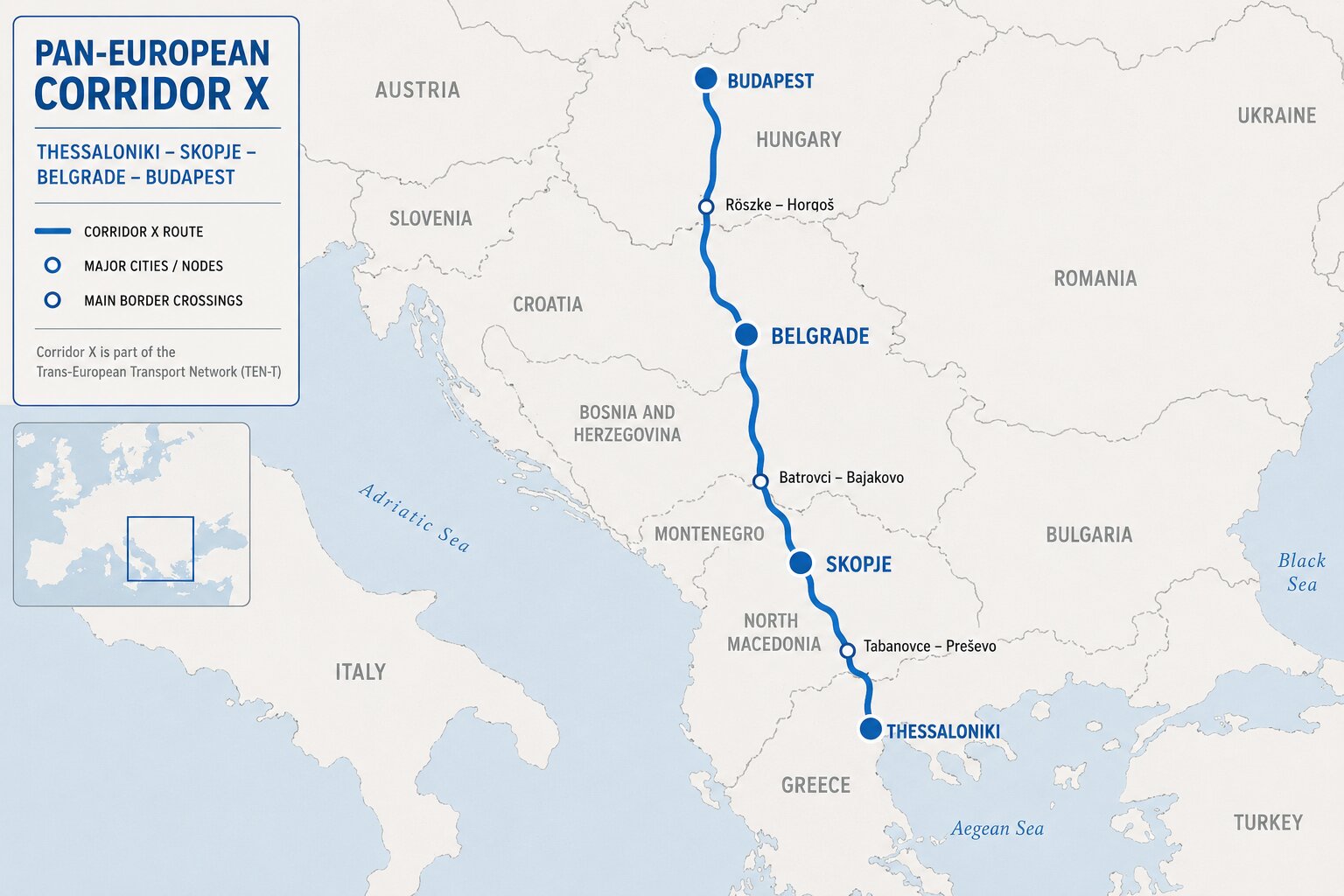
Distance is rarely the constraint on this lane. A 2015 World Bank study valued waiting at Western Balkan borders at roughly 26 million hours a year, cited by the Transport Community. Conditions have improved since, and the pattern holds: trucks move well and stop badly.
Green Lanes are the regional answer. The first dedicated priority truck lane opened at Preševo–Tabanovce, the Serbia–North Macedonia crossing on Corridor X. The “one-stop-go” model, where the two customs services process a truck once rather than twice, has run in both directions since 2021. The first Green Lane between the Western Balkans and the EU became operational between Greece and North Macedonia in 2022.
Extension work continues. The EU has committed €54 million to 11 priority border crossing points. Customs administrations in Albania, Moldova and North Macedonia signed bilateral agreements with Greece, Bulgaria and Italy in December 2025, and memoranda on electronic data exchange through the SEED+ system followed in March 2026 (European Commission; CEFTA).
What that means on a normal week:
- Typical truck queues at Preševo–Tabanovce run about 15-45 minutes, stretching to 1-2 hours around holiday weekends (Estimated, from live border-tracker aggregates).
- The quietest window is usually a weekday between 10:00 and 15:00. Friday and Sunday evenings are the worst, and summer diaspora traffic amplifies both.
- Batrovci, on the Serbia–Croatia leg towards Central Europe, is where EU external border formalities bite. That crossing deserves the schedule buffer, rather than the internal Balkan ones.
On Balkan groupage runs we plan around the crossing calendar rather than the odometer, because a day of dispatch flexibility usually buys more than a faster truck does. Clean documents matter more than either. A T1 with a mismatched consignee turns a 30-minute queue into a half-day.
The costs that never show on a freight quote
A freight rate covers the truck. Shipping through Serbia and North Macedonia charges for several things that sit outside that rate, and they surface after the invoice.
- Guarantee cost. Every transit movement ties up a guarantee for the duty at risk. TIR caps that exposure at around €100,000 per carnet. A standing guarantee under common transit costs a percentage of the reference amount and blocks credit while movements stay open.
- Unclosed transit. A movement that is never discharged at destination becomes a customs debt claim against the principal, often months later, at full duty and VAT.
- Re-clearance after a status failure. Union goods that lose status because no T2 was opened get taxed on arrival value. On a €40,000 consignment at a 4% duty rate, that is €1,600 of duty plus about €8,300 of import VAT to finance (recoverable for a VAT-registered importer, though only after the fact).
- CBAM certificates. For covered goods above 50 tonnes a year, certificate purchase becomes a new line item on 2026 imports, payable in 2027.
- Driver-day scarcity. The 90/180 constraint limits how many EU-bound runs a Western Balkan driver can legally perform. That tightens capacity and firms rates on the lane.
- Demurrage and detention. Delayed clearance on the sea legs feeding this corridor (Thessaloniki, Burgas, Bar) accrues container charges that have nothing to do with the road at all.
A shipper-side playbook for this corridor
None of the above is negotiable at the border. All of it is manageable before the truck loads, and six habits cover most of the risk in shipping through Serbia and North Macedonia.
- Decide the regime before you book, not at dispatch. Read your shipment off the table above and name the document: T2, T1, TIR carnet or a straight import declaration. Half the delays on this lane come from a regime chosen late.
- Get origin evidence in writing with the purchase order. Ask for the EUR.1 or the approved-exporter declaration reference at order stage, plus supplier declarations for the materials. Verification happens after clearance, when suppliers have stopped answering quickly.
- Send your forwarder complete goods data. Precise descriptions, 8-digit HS codes, real consignee details and the agreed Incoterms® 2020 rule. That is what feeds the ENS the carrier has to file under ICS2.
- Consolidate low-volume freight. For anything under a full truck, groupage or consolidated cargo puts your pallets on one transit declaration alongside other shippers, instead of paying for a whole vehicle and its guarantee. On a 2-3 pallet order from Skopje or Belgrade, that is often the difference between shipping monthly and shipping when you need to.
- Ask whether your forwarder or its agents hold AEO status. An Authorised Economic Operator (AEO) is a trader certified by customs as low-risk and reliable. CEFTA has run a validation procedure for mutual recognition of national AEO programmes since Decision No 1/2019, and AEO mutual recognition is a stated 2026 priority. Authorised operators face lighter controls, which on this corridor converts directly into hours.
- Check the CBAM list before your first 2026 order. If the product sits in cement, iron and steel, aluminium, fertilisers, electricity or hydrogen, run the 50-tonne annual calculation now rather than in the 2027 declaration season.
FAQ
Is Serbia or North Macedonia part of the EU customs union?
Neither is. Both are EU candidate countries with Stabilisation and Association Agreements, which create free trade in goods but leave customs borders and separate tariffs in place. Both are contracting parties to the Common Transit Convention, North Macedonia since 1 July 2015 and Serbia since 1 February 2016, which is what allows goods to move through them on a single transit declaration.
Does CEFTA give duty-free access to the EU market?
No. CEFTA liberalises trade among its own parties: Albania, Bosnia and Herzegovina, Kosovo*, Moldova, Montenegro, North Macedonia and Serbia. Duty-free entry into the EU comes from the relevant Stabilisation and Association Agreement, and it has to be claimed with a valid proof of preferential origin such as a EUR.1 certificate or an invoice declaration.
Do I need a T1 for goods passing through Serbia?
You need a transit declaration, and which one depends on the customs status of the goods. Non-Union goods move under T1. Union goods travelling from one EU point to another through Serbia or North Macedonia should move under T2, which preserves Union status. A TIR carnet is the alternative where the journey continues beyond the Common Transit Convention area.
What documents does a truck need to enter the EU from North Macedonia?
The carrier files an entry summary declaration (ENS) in ICS2 before arrival. The goods need a commercial invoice showing the EU importer’s EORI number, precise descriptions with HS codes and the agreed Incoterms® 2020 rule, a CMR consignment note (the road transport contract), the transit or import declaration, and a EUR.1 or origin declaration where preference is claimed. Product-specific certificates apply on top for food, plants, chemicals and dangerous goods.
Does CBAM apply to goods from Serbia and North Macedonia in 2026?
Yes, where the goods fall within the covered sectors: cement, iron and steel, aluminium, fertilisers, electricity and hydrogen. The definitive period started on 1 January 2026, importers below a 50-tonne annual mass threshold are exempt, and certificates for 2026 imports are surrendered by 30 September 2027. Neither country has secured an exemption.
How long do trucks wait at the Preševo-Tabanovce crossing?
Typical queues run about 15-45 minutes, extending to 1-2 hours on holiday weekends and during peak summer traffic (Estimated, from live border-tracker data). Green Lane processing with the “one-stop-go” model has operated in both directions since 2021, and weekday crossings between 10:00 and 15:00 are usually the quietest.
Can small shipments use these corridors economically?
Yes, through groupage or LCL consolidation. Several shippers share one vehicle and, on the road legs, one transit movement, so a 2-3 pallet consignment carries a share of the documentation and guarantee cost rather than all of it. That is normally the practical route for SME importers who cannot fill a truck on the Balkan lanes.
Free trade on the invoice, as this corridor keeps demonstrating, is not free passage on the map. Three frameworks matter for shipping through Serbia and North Macedonia, not one: CEFTA for regional trade, the SAA plus PEM origin rules for the EU market, and common transit for everything that only passes through. Name them correctly before you book, and 2026’s new layers (EES, ICS2 and CBAM) become line items you planned for rather than delays you explain.
If you are moving freight on the Balkan corridors and want the regime and documents confirmed before you commit, send us the route and cargo details. We come back with a quote and the paperwork list the same working day.