eCMR, the electronic CMR consignment note, will not replace paper in 2026–2027: paper CMR stays legal. Under the CMR’s 2008 Additional Protocol, in force since 5 June 2011, a compliant electronic note has paper’s legal value. The eCMR Protocol has 42 parties, per the UN Treaty Collection status as at 20 October 2026. The International Road Transport Union, IRU, put eCMR use below 1% of CMR operations in September 2025, its latest published figure.
From 9 July 2027, EU authorities must accept electronic freight transport information, or eFTI, from certified platforms. Operators may keep paper at least until a review expected around February 2029, per the European Commission’s eFTI timeline. Routes crossing a non-party such as Croatia or Bosnia and Herzegovina call for a paper fallback agreed in advance.
Key takeaways
- Where the Protocol applies, electronic notes equal paper; it also allows reverting to paper.
- On 20 October 2026, the UN registry listed 42 eCMR parties among 58 CMR parties.
- Five EU states are not parties: Croatia, Cyprus, Ireland, Malta and Belgium, which never ratified.
- Spain’s DeCA control document, digital from 5 October 2026, covers domestic trips only.
- Serbia’s accession takes effect around 2 November 2026; Croatia and Bosnia and Herzegovina stay outside.
For SME shippers, freight forwarders and hauliers on EU, Balkan, Türkiye and CIS lanes, this guide covers legal status, eFTI and corridor readiness, not CMR liability claims.
Contents
- What is an eCMR?
- Paper CMR vs eCMR
- Three clocks
- Countries in 2026
- Is eCMR mandatory?
- Spain and Romania
- Corridor matrix
- Route test
- Savings and barriers
- Shipper checklist
- Verdict and timeline
- FAQ
What is an eCMR? The electronic consignment note in plain terms
Signed in Geneva on 19 May 1956, the Convention on the Contract for the International Carriage of Goods by Road, or CMR Convention, turned 70 in 2026. Under Article 9, its consignment note proves the contract and receipt of the goods unless disproved, which shapes how the consignment note works as evidence in a CMR claim.
eCMR, also written e-CMR, is the electronic CMR consignment note, governed by the 2008 Additional Protocol concerning the Electronic Consignment Note, or eCMR Protocol. Under Article 2 of the text of the Additional Protocol, such a note “shall be considered to be equivalent” to paper.
Article 3 requires a reliable electronic signature. Article 4 requires the same particulars as paper, integrity once the note is final and detectable amendments. A scanned or photographed paper CMR is only a copy, so it is not an eCMR.
Paper CMR vs eCMR: side-by-side
Legal value is equivalent where the Protocol applies; reach and handling time differ.
| Paper CMR | eCMR | |
|---|---|---|
| Legal basis | CMR Convention, Geneva, 19 May 1956 | Additional Protocol, 2008; in force since 2011 |
| Legal value | Prima facie evidence of the contract (Art. 9) | Equivalent to paper (Protocol Art. 2) |
| Where it applies | 58 CMR parties | 42 Protocol parties (Serbia from around 2 Nov 2026) |
| Signature | Signed by sender and carrier (Art. 5) | Reliable electronic signature (Protocol Art. 3) |
| Copies | Three originals: sender, goods, carrier (Art. 5) | Electronic record; procedures agreed by parties (Protocol Art. 5) |
| Handling time per freight order (manual vs eCMR) | About 23 minutes | About 9 minutes |
Sources: UN Treaty Collection, 20 October 2026; SIRA Consulting for the Danish Ministry of Transport, via trans.info, November 2025.
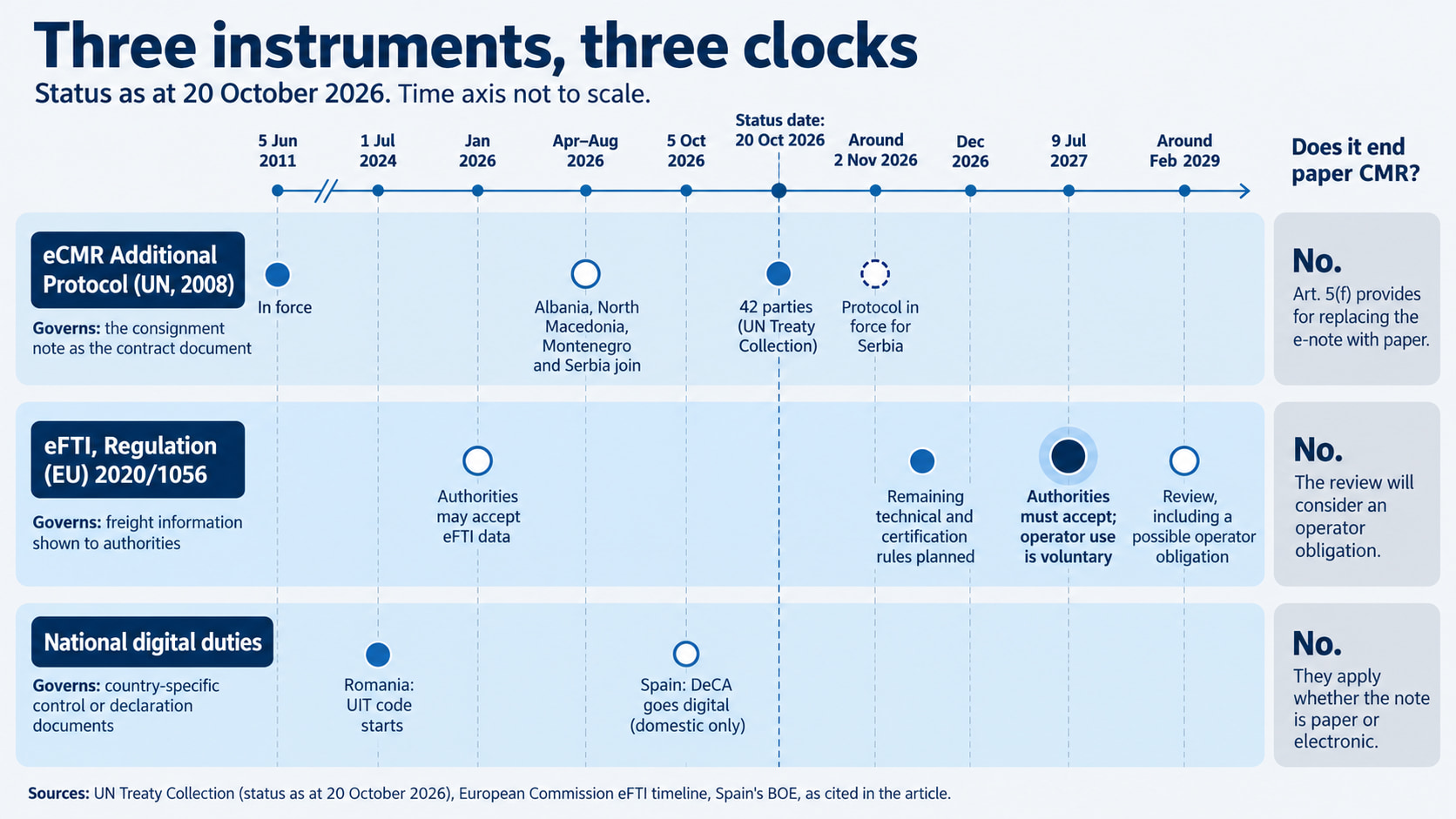
Three instruments, three clocks: the Protocol, eFTI and national rules
Three legal instruments shape road freight paperwork, and only one governs the consignment note itself.
| Instrument | Governs | Who must act | Status | Ends paper CMR? |
|---|---|---|---|---|
| eCMR Protocol (UN, 2008) | The consignment note as contract document | Nobody; parties opt in (Art. 5) | 42 parties at 20 Oct 2026 (UN registry) | No; Art. 5(f) allows reverting to paper |
| eFTI, Regulation (EU) 2020/1056 | Freight data shown to authorities | EU authorities; operator use voluntary | Must accept from 9 Jul 2027 | No; not before a review expected around Feb 2029 |
| National digital duties | Control or declaration documents | Operators in that country | Spain’s DeCA 5 Oct 2026; Romania’s UIT 1 Jul 2024 | No; they apply whatever the note’s format |
“Three instruments, three clocks” is the frame for any headline: paper CMR’s status depends on which clock you check. The clocks run independently: eFTI binds EU authorities, Croatia’s included, but gives an eCMR no Protocol equivalence in Croatia or any other non-party, and switching to eCMR does not remove a national duty.
How many countries accept eCMR in 2026?
42 states are parties to the eCMR Protocol, according to the UN Treaty Collection status as at 20 October 2026. Belgium is the only state that signed the Protocol but never ratified it, and only parties are bound. Serbia, the last of 4 Western Balkan joiners in 2026, deposited its instrument on 4 August. Article 8 sets entry into force 90 days after deposit, so by our calculation the Protocol applies there from around 2 November 2026.
Guides from October 2025 to July 2026 still quote 36 to 40 eCMR countries, counted before the 2026 Balkan accessions. IRU’s tally sits one higher (its August 2026 announcement called Serbia the 43rd), but the UN registry is the authoritative count.
Inside the EU, 22 of 27 Member States are parties; the other five are Croatia, Cyprus, Ireland, Malta and Belgium. eCMR in Belgium runs through a Benelux cross-border pilot with the Netherlands and Luxembourg, extended until 9 July 2027, according to CLECAT, the European freight forwarders’ association.
Is eCMR mandatory from July 2027? What the eFTI regulation requires
From 9 July 2027, the duty to accept digital freight documents falls on EU authorities, not on hauliers or shippers. The eFTI regulation, Regulation (EU) 2020/1056, does not make eCMR compulsory: operator use stays voluntary, according to the European Commission’s eFTI page.
Since January 2026, authorities may accept data from certified eFTI platforms, whose functional requirements Implementing Regulation (EU) 2025/2243 sets. Remaining technical and certification rules are planned for December 2026, according to the Commission; see the timeline of 2026 EU freight rules. The eFTI 2027 deadline behind most “eCMR 2027” headlines turns “may accept” into “must accept”.
EU road law already accepts electronic cabotage evidence. Article 8(4a) of Regulation (EC) No 1072/2009, added by the Mobility Package, lets hauliers prove cabotage (domestic runs by foreign carriers) “using a revisable structured format”, such as an eCMR.
Spain’s digital DeCA and Romania’s UIT code: separate national duties
On 5 October 2026, Spain’s administrative control document for road freight, the DeCA, went digital under Law 9/2025 on Sustainable Mobility. The resolution published in Spain’s Official State Gazette limits it to domestic transport, cabotage included; international trips keep the CMR note or an eCMR. Vendor headlines reading “eCMR mandatory in Spain from October 2026” are wrong for international carriage.
Since 1 July 2024, international road freight loaded or unloaded in Romania needs an RO e-Transport declaration and a UIT code, a unique transport identifier; pure transit is excluded. Thresholds of over 500 kg or RON 10,000 per consignment are commonly cited by industry sources, though figures differ; confirm them with ANAF, Romania’s tax authority.
For border routines, see what Schengen membership changed for Romanian and Bulgarian road freight.
An electronic CMR note leaves the UIT duty unchanged: the code applies in any format.
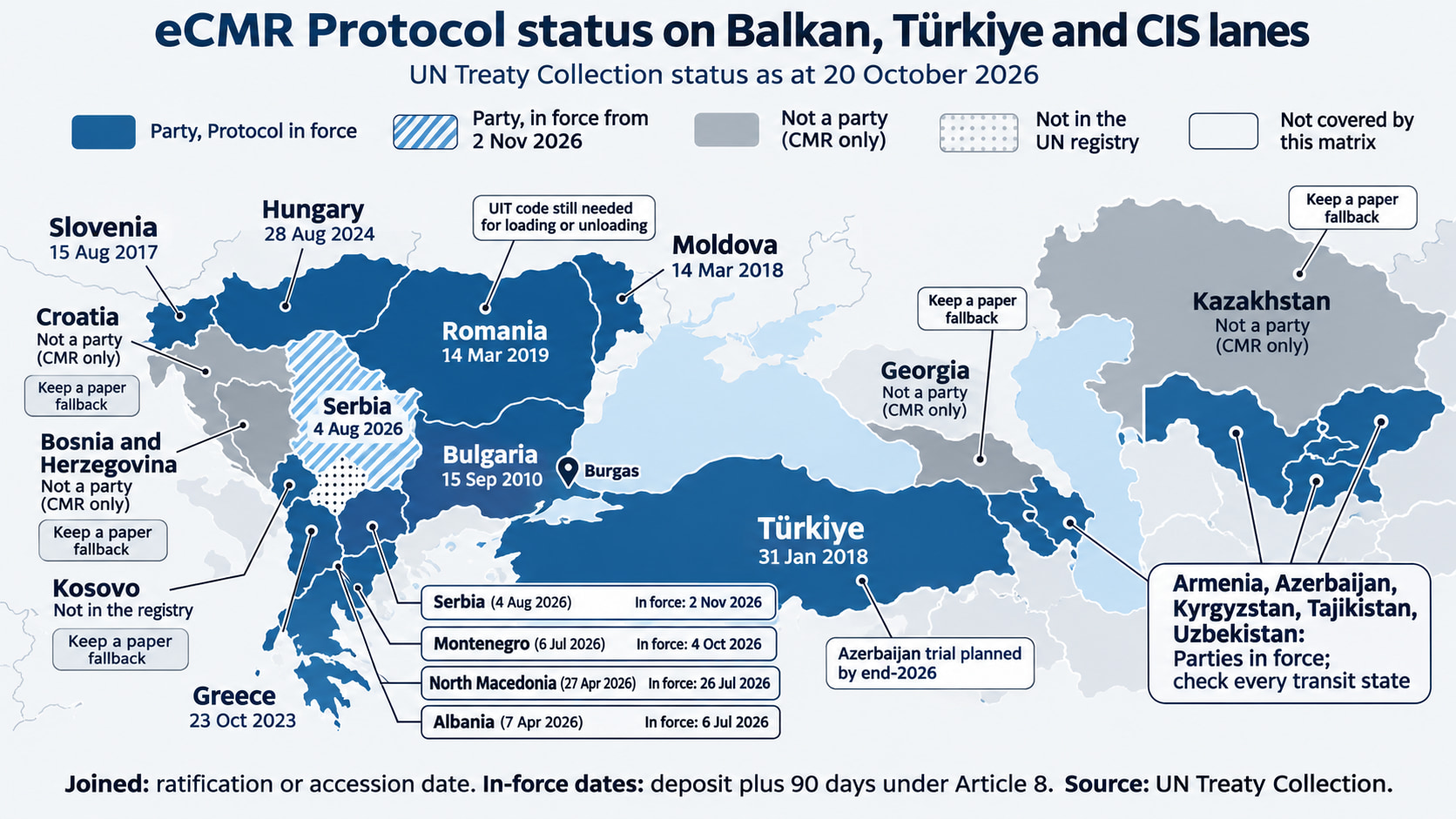
Corridor readiness matrix: Balkan, Türkiye and CIS lanes in October 2026
Of these, Bulgaria, Sea Gate’s base, joined first, in 2010.
| Country | Status (UN registry, 20 Oct 2026) | Joined | Practical note |
|---|---|---|---|
| Bulgaria | Party | 15 Sep 2010 | In force at origin (Burgas) |
| Slovenia | Party | 15 Aug 2017 | In force |
| Türkiye | Party | 31 Jan 2018 | In force; Azerbaijan trial planned by end-2026* |
| Moldova | Party | 14 Mar 2018 | In force |
| Romania | Party | 14 Mar 2019 | In force; UIT code still required |
| Greece | Party | 23 Oct 2023 | In force |
| Hungary | Party | 28 Aug 2024 | In force |
| Albania | Party | 7 Apr 2026 | In force since around 6 Jul 2026 |
| North Macedonia | Party | 27 Apr 2026 | In force since around 26 Jul 2026 |
| Montenegro | Party | 6 Jul 2026 | In force since around 4 Oct 2026 |
| Serbia | Party | 4 Aug 2026 | In force from around 2 Nov 2026 |
| Armenia, Azerbaijan, Kyrgyzstan, Tajikistan, Uzbekistan | Parties | 2019–2024 | In force; check transit states |
| Croatia | Not a party (CMR only) | None | Paper fallback |
| Bosnia and Herzegovina | Not a party (CMR only) | None | Paper fallback |
| Georgia, Kazakhstan | Not parties (CMR only) | None | Paper fallback |
| Kosovo | Not in the registry | None | Paper fallback |
In-force dates for 2026 joiners: deposit plus 90 days, give or take one day. *Interfax reported an Azerbaijan–Türkiye eCMR technical meeting in Ankara on 5 March 2026 and a first Azerbaijan–Russia–Türkiye trial shipment expected by the end of 2026.
Every state on the Türkiye–Bulgaria–Serbia transit route to Hungary is a party, with Serbia covered only from around 2 November 2026. Customs is a separate check: see CEFTA customs rules for Serbian and North Macedonian legs.
The matrix records legal coverage; the Türkiye row shows market readiness lagging.
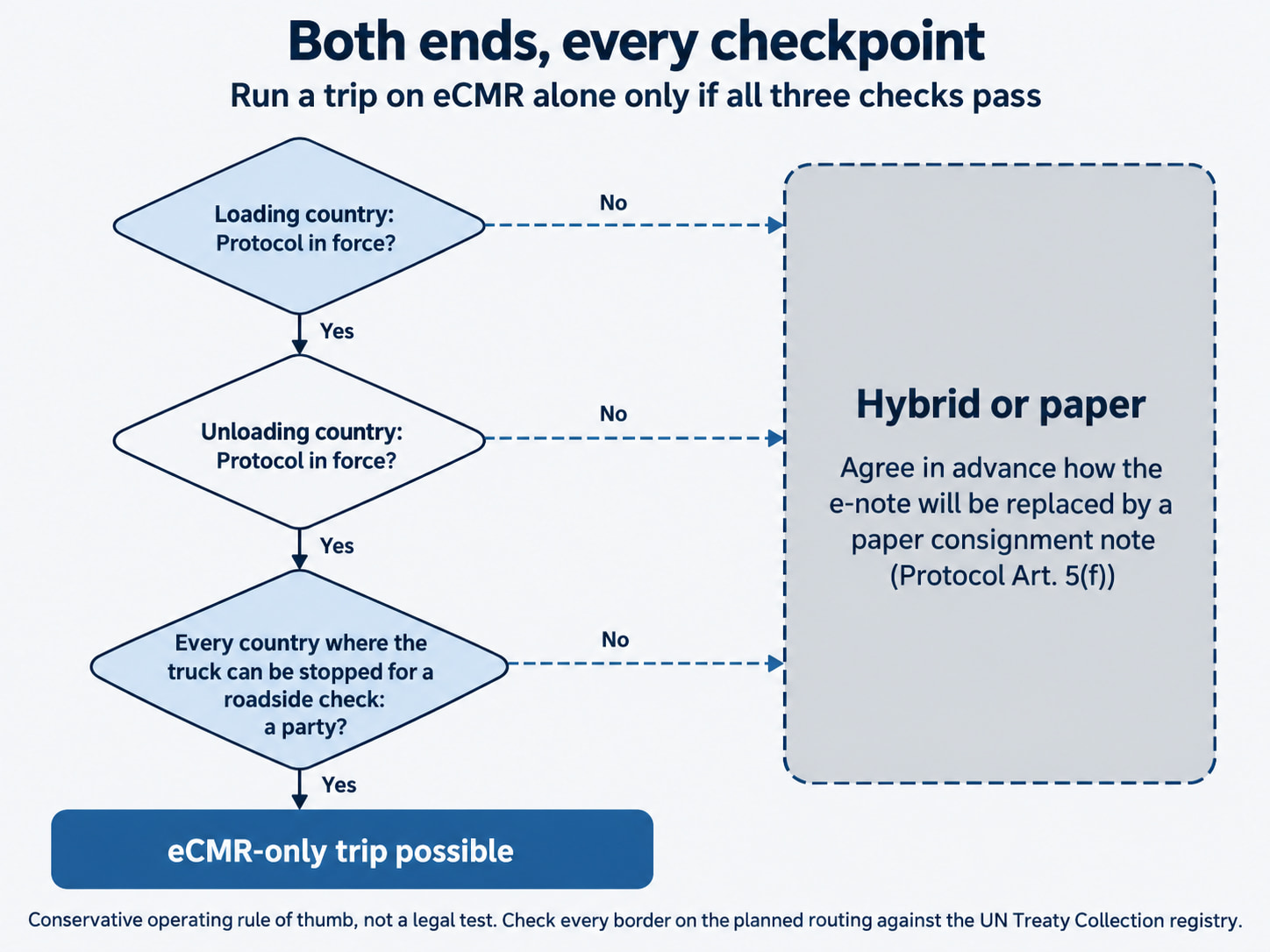
The “Both ends, every checkpoint” route test: when to keep a paper fallback
Both ends, every checkpoint: run eCMR alone only if the loading and unloading countries, and every country with a possible roadside check, apply the Protocol. It is a conservative rule of thumb with no legal force. Where a leg fails, agree a paper replacement in advance under Article 5(f); the table calls such trips hybrid.
Why count transit-only countries? Some eCMR providers read EU posting-of-drivers rules as letting an e-note cross non-parties; that reading is unverified against the legal text, so the test ignores it.
| Route | Result on 20 Oct 2026 | Why |
|---|---|---|
| Bulgaria → North Macedonia → Albania | eCMR-only possible | All in force by around July 2026 |
| Türkiye → Bulgaria → Serbia → Hungary | Hybrid until around 2 Nov 2026 | Serbia’s start date |
| Thessaloniki → North Macedonia → Serbia | Hybrid until around 2 Nov 2026 | Same Serbian date |
| Bulgaria → Serbia → Croatia → Slovenia | Hybrid | Croatia not a party |
| Türkiye → Georgia → Azerbaijan → Kazakhstan | Paper or hybrid | Georgia and Kazakhstan are not parties |
On Balkan groupage, we check every border against the UN registry and agree a paper CMR fallback with the carrier before any electronic-only trip.
What digital CMR saves, and why adoption is still below 1%
IRU counts about 280 million international CMR transactions a year, with digital CMR below 1% of them in its September 2025 figure. Yet an Italian Uniontrasporti and IRU pilot cut admin time per consignment from about 50 to about 20 minutes and costs by 54–83%, trans.info reported in November 2025.
IRU estimates that wide use would save 75–102 million working hours a year in Europe.
IRU’s analysis of eCMR adoption barriers names four:
- Interoperability: “eCMR will only become scalable” across platforms, says Cédric Oelhafen, IRU IS/IT Associate Director.
- Recognition: uncertain acceptance by enforcement authorities and customs.
- Signatures: no practical guidance on signing and authentication.
- Platforms: few reliable ones.
A paper fallback on any leg likely erodes the Danish ministry study’s saving of about 14 minutes per order, since both processes then run side by side.
eCMR checklist for SME shippers: what to agree before loading
The sender signs a CMR note alongside the carrier, so an eCMR needs your participation as well as the haulier’s software.
- Ask at booking if the trip runs on eCMR and on which platform; record it in the transport order.
- Agree the Protocol’s Article 5 procedures: issue, amendments, confirmation of delivery and replacement by a paper note.
- Name who signs as sender for your company, and with which electronic signature method.
- Run every border through the “Both ends, every checkpoint” test; arrange a paper fallback where it fails.
- Agree how each consignment on a shared truck, such as 2 pallets of groupage and consolidated cargo from Burgas to Thessaloniki, appears on the note.
- Request platform proof of delivery confirmed by your consignee, the party receiving the goods, so invoicing does not wait for signed paper.
- Cover national add-ons: a UIT code for Romanian loading or unloading, and 1-year minimum retention of Spanish domestic DeCA files.
Is the paper consignment note dying? Our verdict and the timeline to 2029
Paper CMR is being demoted, not abolished.
| Date | Milestone | Effect on paper CMR |
|---|---|---|
| January 2026 | Authorities may accept eFTI data | None |
| April–August 2026 | 4 Western Balkan states join | More Balkan legs covered |
| 5 October 2026 | Spain’s domestic DeCA goes digital | None internationally |
| Around 2 November 2026 | Protocol in force for Serbia | Türkiye–Bulgaria–Serbia–Hungary chain covered |
| 9 July 2027 | eFTI applies; Benelux pilot’s reported end | Still legal; authorities must accept eFTI data |
| Around February 2029 | eFTI review | Review weighs obliging operators |
A 2024 CargoON market report, cited by trans.info, expected de facto full adoption by 2029, an industry forecast rather than a legal deadline. Our view: paper stays the standard fallback on mixed Balkan and Caucasus routes until at least 2029, as the Protocol permits reverting to paper and several states there are not parties.
What would change that view? An operator obligation from the review would, as would accession by Croatia, Bosnia and Herzegovina, and Georgia.
FAQ
Will paper CMR still be legal after 9 July 2027?
Yes, paper CMR stays legal after 9 July 2027: eFTI obliges EU authorities to accept digital data, not operators to send it. A review expected around February 2029, per the European Commission’s eFTI timeline, will consider obliging operators.
How many countries accept eCMR in 2026?
42 states are parties to the eCMR Protocol, per the UN Treaty Collection status as at 20 October 2026. Serbia, the latest to join, is bound from around 2 November 2026.
Is eCMR valid in Belgium, Croatia or Ireland?
Not under the Protocol: Belgium, Croatia and Ireland are not parties, so an eCMR lacks Protocol equivalence there and a paper fallback is safest. The exception is Belgium’s Benelux cross-border pilot with the Netherlands and Luxembourg, which CLECAT reported as extended until 9 July 2027.
Is a scanned or PDF copy of a CMR an eCMR?
No, a scanned or PDF CMR is a copy of a paper note, not an electronic consignment note. It lacks the reliable electronic signature of Protocol Article 3 and the integrity guarantee of Article 4.
What electronic signature does an eCMR need?
A digital CMR needs a reliable electronic signature under Protocol Article 3. It is presumed reliable when uniquely linked to the signatory, under their sole control and making later changes detectable; other methods allowed by national law also count.
Can a driver show an eCMR on a phone at a roadside check?
Yes in principle: in Protocol countries a compliant digital CMR has the same legal value as paper, though IRU flags uncertain recognition by enforcement authorities. From 9 July 2027, EU authorities must also accept certified eFTI platform data shared through an access link such as a QR code.
As the sender, do I need eCMR software?
Yes, in practice: the sender must be able to apply the Protocol’s reliable electronic signature, directly or through platform access agreed with the carrier or forwarder. Agree the platform and the paper-replacement procedure at booking.
In 2026–2027 the paper consignment note loses its monopoly, not its legal standing. Share the full routing when you request a quote for road freight across the EU, the Balkans and Türkiye, and agree the electronic or paper set-up before loading.
About the author
Sea Gate Logistics Editorial Team. This article was prepared by the Sea Gate Logistics editorial team, drawing on the company’s experience as an EU-registered freight forwarder in Burgas, Bulgaria, with 20+ years of collective logistics expertise across ocean, road, air, and consolidated (LCL) cargo.