Since 1 January 2025, with Romania and Bulgaria in Schengen, trucks no longer stop for border-police checks at the Romania–Hungary, Romania–Bulgaria and Bulgaria–Greece borders. Customs did not change: goods have crossed internal EU borders without customs formalities since both countries joined the EU on 1 January 2007.
Gebrüder Weiss Romania reports that driver border time fell from about 40 hours a month to 10–15. Random mobile checks continue, and Romania’s UIT code (an RO e-Transport shipment ID) and Bulgaria’s UTN (a tracking number for high-fiscal-risk goods) still apply.
No measured freight-rate drop has been published. External borders got stricter: the Entry/Exit System (EES) has been fully operational since 10 April 2026, and non-EU drivers’ Bulgarian and Romanian days have counted toward Schengen’s 90/180 limit since 31 March 2024.
This guide is for shippers, forwarders and procurement teams trucking through Bulgaria and Romania. It covers Schengen road freight checks, paperwork, driver rules and costs as of September 2026, not rail or sea.
Key takeaways
- The change was the border stop, not customs.
- No routine checks at RO–HU, RO–BG, BG–GR since 1 January 2025.
- Driver border time: about 40 → 10–15 hours a month.
- UIT (Romania) and UTN (Bulgaria) still apply.
- External borders tighter: EES since 10 April 2026.
Jump to:
Romania and Bulgaria in Schengen: the 2007–2026 timeline
- 1 January 2007: EU and customs-union entry.
- 31 March 2024: internal air and sea checks end; 90/180 counting starts.
- 12 December 2024: Council Decision (EU) 2024/3212 sets the land-border date.
- 1 January 2025: land-border checks on persons end; Schengen reaches 29 countries, per the European Commission’s Schengen area page.
- End of June 2025: the six-month random-check transition on the Hungary–Romania and Romania–Bulgaria borders ends.
- 15 July 2025: EU cascade visa rules for Turkish citizens, excluding truck drivers.
- 12 October 2025: EES starts at external borders.
- 1 January 2026: Bulgaria adopts the euro; tolls convert without increase.
- 10 April 2026: EES fully operational.
- 2027 (expected): ETIAS; no official date yet.
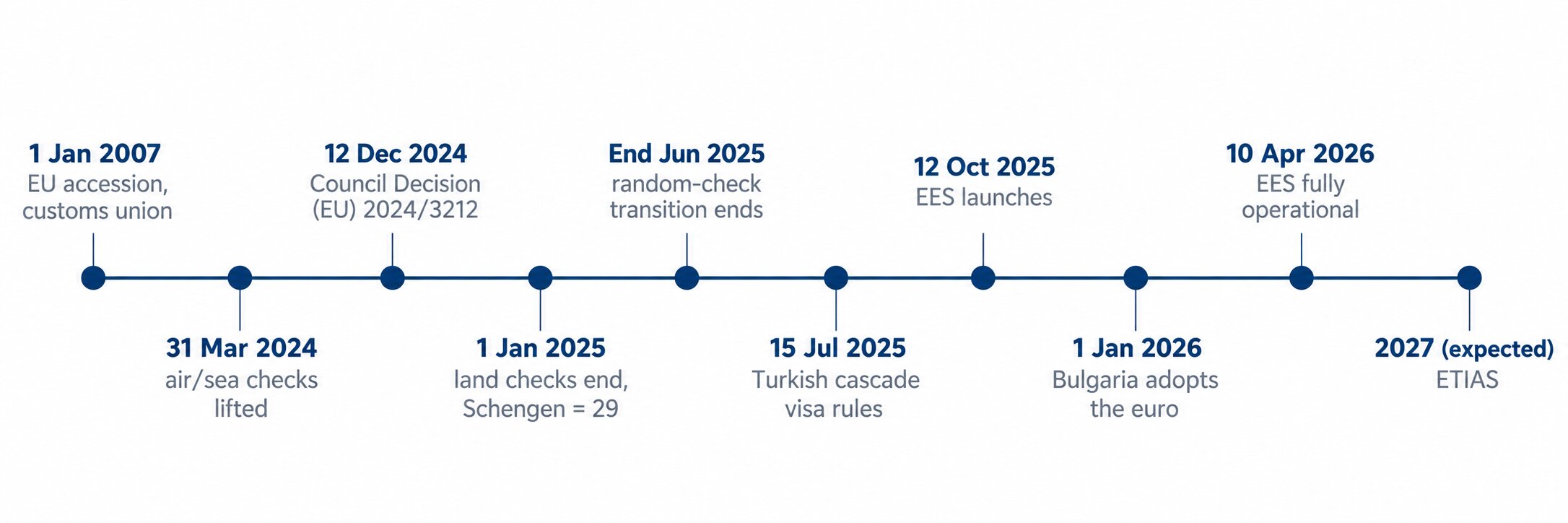
Timeline of Romania and Bulgaria’s Schengen accession from 2007 to the expected 2027 ETIAS launch
Schengen vs the customs union for trucks
Goods have crossed the Bulgaria–Romania border without customs formalities since 1 January 2007. Schengen removes checks on persons at internal borders between its 29 members, while external borders keep them; the EU customs union is separate and covers goods. If goods were already customs-free, what were trucks queuing for? They queued for border-police checks on drivers and vehicles, plus other crossing-point inspections.
The police checks ended when Bulgaria and Romania joined Schengen at land borders, and Bulgaria’s National Revenue Agency (NRA) moved staff to unloading-point inspections using real-time data, Novinite reported. Non-EU goods still clear customs at the external border; see customs and documentation for EU shipments.
Truck waiting times before and after Schengen
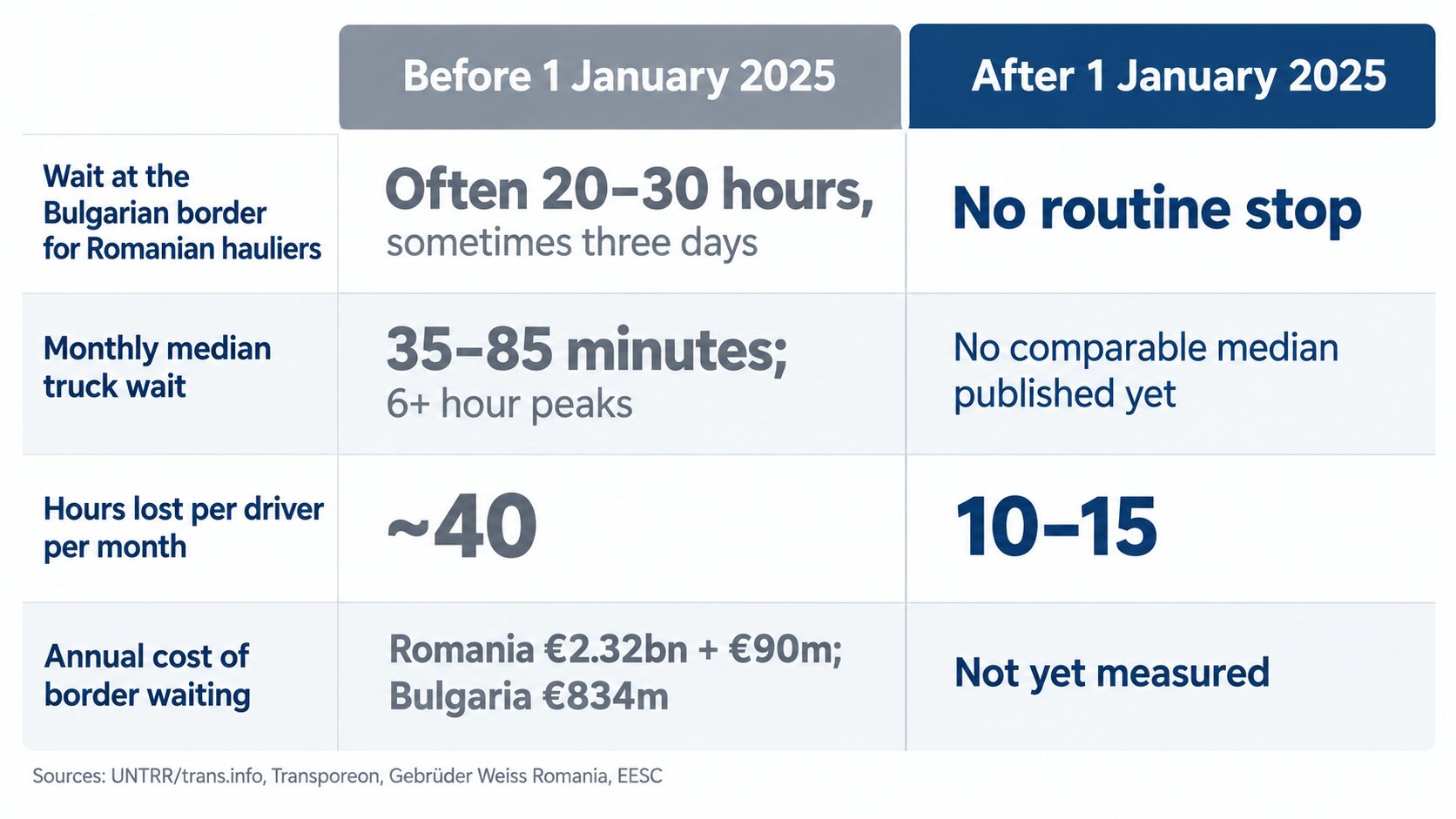
Before 2025, Nădlac II handled about 2,500 trucks a day and Giurgiu–Ruse about 2,400 (Romanian Border Police). Romanian hauliers lost an estimated €19.1 billion to border waiting between 2012 and 2023, according to the National Union of Road Hauliers from Romania (UNTRR).
| Measure | Before 1 January 2025 | After 1 January 2025 | Source |
|---|---|---|---|
| Romanian hauliers’ wait at the Bulgarian border | Often 20–30 hours, sometimes three days | No routine stop; no average yet | UNTRR via trans.info, Sep 2024 |
| Median monthly truck wait, RO and BG borders | 35–85 minutes (2023–2024); 6+ hour peaks, mostly towards Hungary | No comparable median yet | Transporeon via Freight Perspectives, Jan 2025 |
| Hours lost per driver per month | About 40 | 10–15 | Gebrüder Weiss Romania told Business Review, Sep 2025 |
| Annual cost of border waiting | Romania €2.32bn lost revenue + €90m operator costs; Bulgaria €834m | Not yet measured | EESC, Sep 2024 (BG: ERI-BAS study) |
Checks moved inland: Romania’s Border Police ran 260,000+ eDAC database checks in January 2025.
What the saved hours are worth: our estimate
Gebrüder Weiss Romania’s figures imply 25–30 recovered hours per truck per month. Estimated (our arithmetic):
- Hours lost: about 40 per driver per month before, 10–15 after.
- Recovered: 25–30 hours per truck per month, assuming one driver per truck.
- Cost of delay: €786–2,322 per 24-hour truck delay by cargo, per the European Economic and Social Committee (EESC) quoting Emil Angelov of Glavbolgarstroy Holding: ≈€33–97 an hour.
- Value: roughly €820–2,900 per truck per month (25 and 30 hours at those hourly rates), depending on cargo and carrier pass-through (not a measured saving).
Did any of that reach freight rates? No measured corridor-level rate drop since Romania and Bulgaria’s Schengen accession has been published, and Ti’s +4.1% (Romania) and +3.5% (Bulgaria) were 2025 market-growth forecasts. In our view, the gain is reliability, not a discount, though that varies by lane.
Tolls rose instead: BG TOLL for vehicles over 3.5 t went up 10% on 1 April and 10% on 1 September 2025, about 20% in total, unchanged by the January 2026 euro switch. See how freight rates and surcharges are calculated in 2026.
The 2026 Border Map for Bulgaria and Romania
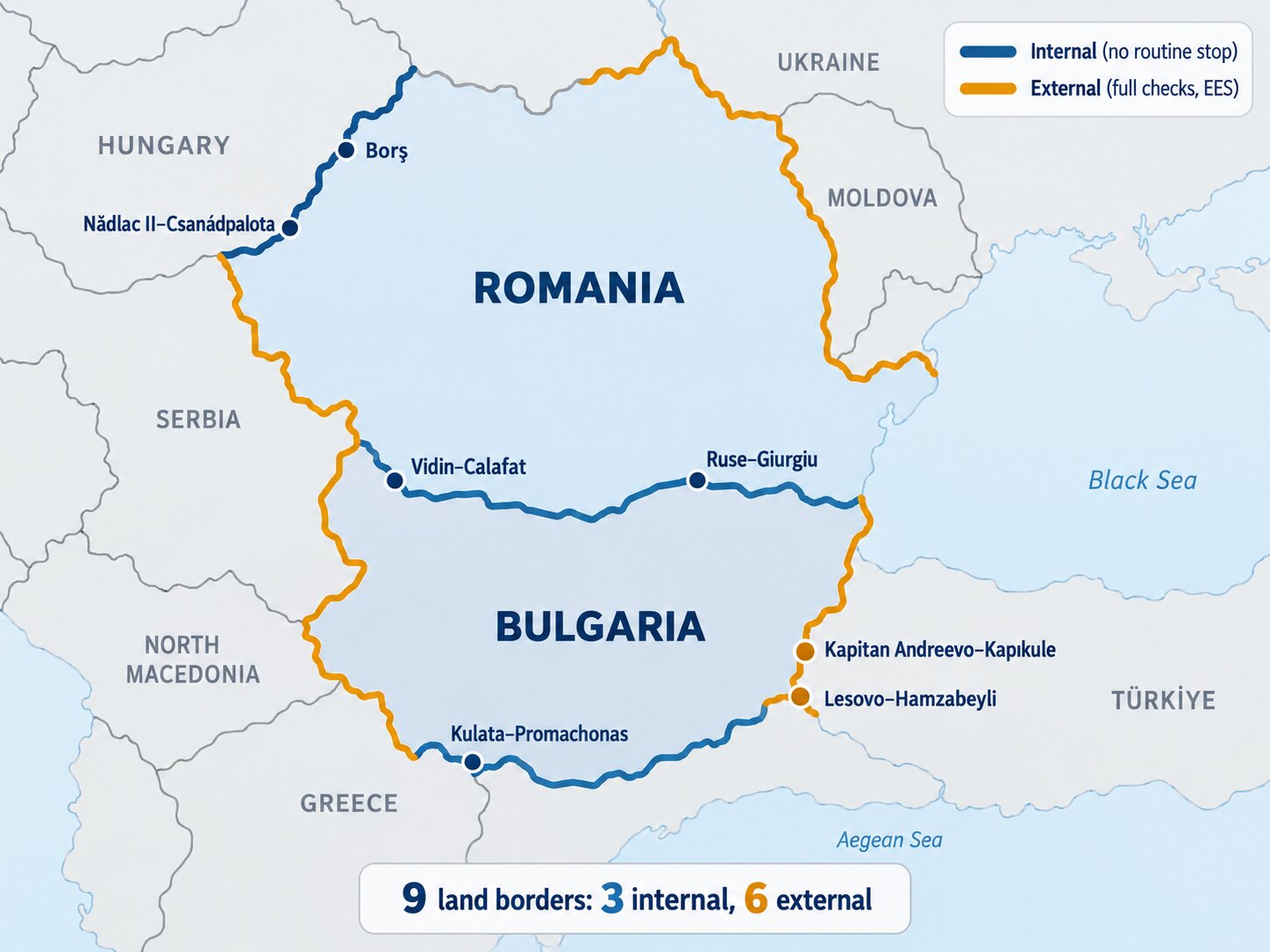
Bulgaria and Romania have nine land borders between them (counting their shared border once): three internal Schengen borders and six external ones on our Balkan road corridors.
| Border (main truck crossings) | Status since 1 Jan 2025 | What is checked now | Latest dated evidence | Plan for |
|---|---|---|---|---|
| Romania–Hungary (Nădlac II–Csanádpalota, Borș) | Internal | Random checks up to 30 km inside Romania; UIT | Random-check transition ended June 2025 | No border buffer |
| Romania–Bulgaria (Ruse–Giurgiu Friendship Bridge, Vidin–Calafat) | Internal | Random checks within 30 km (RO), 20–30 km (BG); NRA unloading checks | HGVs barred ~24 hours on 4 Jun 2026 amid bridge repairs (BTA) | Bridge restrictions, not queues |
| Bulgaria–Greece (Kulata–Promachonas) | Internal | Risk-based customs checks within 20–30 km; UTN | Farmers’ blockades shut Kulata to trucks, Nov 2025–Jan 2026 (BTA) | Protest alerts |
| Bulgaria–Türkiye (Kapitan Andreevo–Kapıkule, Lesovo–Hamzabeyli) | External | Full person checks, EES, customs | Kapitan Andreevo, 22 Jan 2026: ~25 km queue, 15–20 h wait, 3,000 trucks/24 h; Lesovo, 23 Jun 2026: 23 km (BTA) | Queue buffer + driver days |
| Bulgaria–Serbia, Bulgaria–North Macedonia | External | Full person checks, EES, customs | 1 Sep 2026: 90-day rule kept despite driver protests (European Western Balkans) | Driver days + customs |
| Romania–Serbia, Romania–Moldova, Romania–Ukraine | External | Full person checks, EES, customs | EES fully operational 10 Apr 2026; 52 million+ entries/exits Schengen-wide (European Commission) | EES + ETIAS (expected 2027) |
Internal borders can still close for non-Schengen reasons. Routing trucks from Burgas via Ruse–Giurgiu, Kulata and Kapitan Andreevo, we plan the first two around roadworks and protests, and the third around queues.
The external Schengen border got stricter. EES, fully operational since 10 April 2026, according to the European Commission, records each non-EU driver’s face and fingerprints. In January 2026 the Kapitan Andreevo truck queue hit 15–20 hours, close to the 20–30 hours Romanian hauliers once faced at the Bulgarian border. BTA’s report blamed Greek farmers’ protests, Turkish-side congestion and mismatched shift times, not EES.
The trade-off for road freight to Türkiye: internal borders swapped a predictable wait for occasional closures; external borders added biometrics to the old queue.
Schengen road freight paperwork: what trucks still need in 2026
Neither Romania’s UIT code nor Bulgaria’s UTN disappeared when Bulgaria and Romania joined Schengen: both are fiscal declarations, not border checks.
| Item | When it applies | Who arranges it | 2026 rule to remember |
|---|---|---|---|
| UIT code (RO e-Transport, Romania) | Into or out of Romania over 500 kg gross or RON 10,000; pure transit exempt | Shipper, consignee or Romanian beneficiary | Up to 3 calendar days ahead; valid for a limited window (15 days intra-Community, 5 domestic); fines RON 20,000–100,000 |
| UTN (Unique Tracking Number, Bulgaria’s NRA) | High-fiscal-risk goods (e.g. fruit, meat, fuels, tobacco, alcohol) on trucks over 3.5 t | Declared to the NRA before transport; driver carries it | Valid 14 days; stricter rules since 1 May 2025 |
| CMR consignment note (paper or e-CMR) | Every international road consignment | Sender and carrier | Unchanged by Schengen |
| Non-EU driver documents | Drivers from outside the EU | Carrier and driver | 90/180 counting; EES; ETIAS expected 2027 |
| Road-transport permits for non-EU hauliers | E.g. Turkish trucks in transit | Carrier | Unaffected: Schengen covers persons, not market access |
Sources: Gopet (Mar 2026) and Accace (Sep 2025) on Government Emergency Ordinance 41/2022; AHK Bulgaria (Jun 2025); European Commission (Apr 2026).
The UIT duty is not automatically the carrier’s, so agree in writing who files it for freight transportation to Romania. Schengen also left the road-permit quotas that cap Turkey–EU trucking untouched.
The driver-days trap: 90/180, EES and non-EU drivers
Since 31 March 2024, each day a non-EU driver spends in Bulgaria or Romania counts toward Schengen’s limit of 90 days in any 180, according to Fragomen.
- 31 March 2024: counting starts; both countries issue uniform Schengen (C) visas.
- 15 July 2025: the European Commission’s July 2025 visa rules for Turkish citizens grant cascading multi-entry visas to “all Turkish nationals, except truck drivers”.
- 12 October 2025 to 10 April 2026: EES replaces stamps with digital records; the Commission says it “does not introduce any new rules”, yet digital counting (our inference) leaves less slack.
- 1 September 2026: after 2026 protests by Western Balkan drivers, the Commission kept the 90-day rule, pointing to national long-stay (D) visas or residence permits (European Western Balkans).
- 2027 (expected): ETIAS, a travel authorisation for visa-exempt drivers such as Serbians; no official date yet.
For shippers, non-EU driver rotation on Türkiye and Western Balkan lanes is now a capacity question. In our view, a driver’s remaining Schengen days belong on the booking checklist, depending on how each carrier rotates drivers.
A 2026 checklist for road freight to Bulgaria and Romania
With Romania and Bulgaria in Schengen since 1 January 2025, internal-only lanes (RO–HU, RO–BG, BG–GR) mean paperwork and roadworks, not queues. Lanes into Türkiye, Serbia, North Macedonia, Moldova or Ukraine mean queues, EES and driver days.
- Mark each border internal or external using the Border Map.
- Into or out of Romania over 500 kg gross or RON 10,000: agree who generates the UIT code, at most 3 calendar days ahead; consolidated (groupage) road freight over 500 kg needs one too.
- High-fiscal-risk goods on trucks over 3.5 t in freight transport to and from Bulgaria: get the UTN before loading; the driver carries it, valid 14 days.
- Check Ruse–Giurgiu bridge restrictions and Kulata protest alerts the day before dispatch.
- External crossings: add a queue buffer and confirm the driver’s 90/180 headroom.
- Request tolls as a separate quote line and expect no “Schengen discount”.
FAQ: Romania and Bulgaria in Schengen
Do trucks still stop at the border between Bulgaria and Romania?
Trucks have not stopped routinely at the Bulgaria–Romania border since 1 January 2025. Random mobile checks run within 30 km in Romania and 20–30 km in Bulgaria.
Did Schengen change customs for goods going to Romania or Bulgaria?
Schengen did not change customs: Romania and Bulgaria have been in the EU customs union since 1 January 2007. Romania’s UIT code and Bulgaria’s UTN still apply.
When did Romania and Bulgaria fully join Schengen?
Bulgaria and Romania joined Schengen at air and sea borders on 31 March 2024 and at land borders on 1 January 2025. The Schengen area now has 29 countries.
Is the Bulgaria–Turkey border a Schengen border now?
The Bulgaria–Türkiye border is an external Schengen border with full person checks, customs and EES. Kapitan Andreevo truck waits hit 15–20 hours in January 2026, according to BTA.
Do days in Bulgaria and Romania count toward the 90/180 rule for truck drivers?
Non-EU truck drivers’ days in Bulgaria and Romania have counted toward the 90/180 rule since 31 March 2024. On 1 September 2026, the European Commission kept that rule.
What is a UIT code, and who needs one?
A UIT code is Romania’s RO e-Transport identifier for international transports over 500 kg gross or RON 10,000. The shipper, consignee or Romanian beneficiary declares it.
Are road freight rates to Romania and Bulgaria lower after Schengen?
No measured corridor-level drop in road freight rates has followed Romania and Bulgaria’s Schengen accession. BG TOLL rose about 20% in 2025; the gain is an estimated 25–30 driver hours per truck per month.
With Romania and Bulgaria in Schengen, the internal-border wait went; the paperwork and driver rules stayed. To have a lane’s paperwork and routing checked before dispatch, talk to our road freight team or ask for a quote.