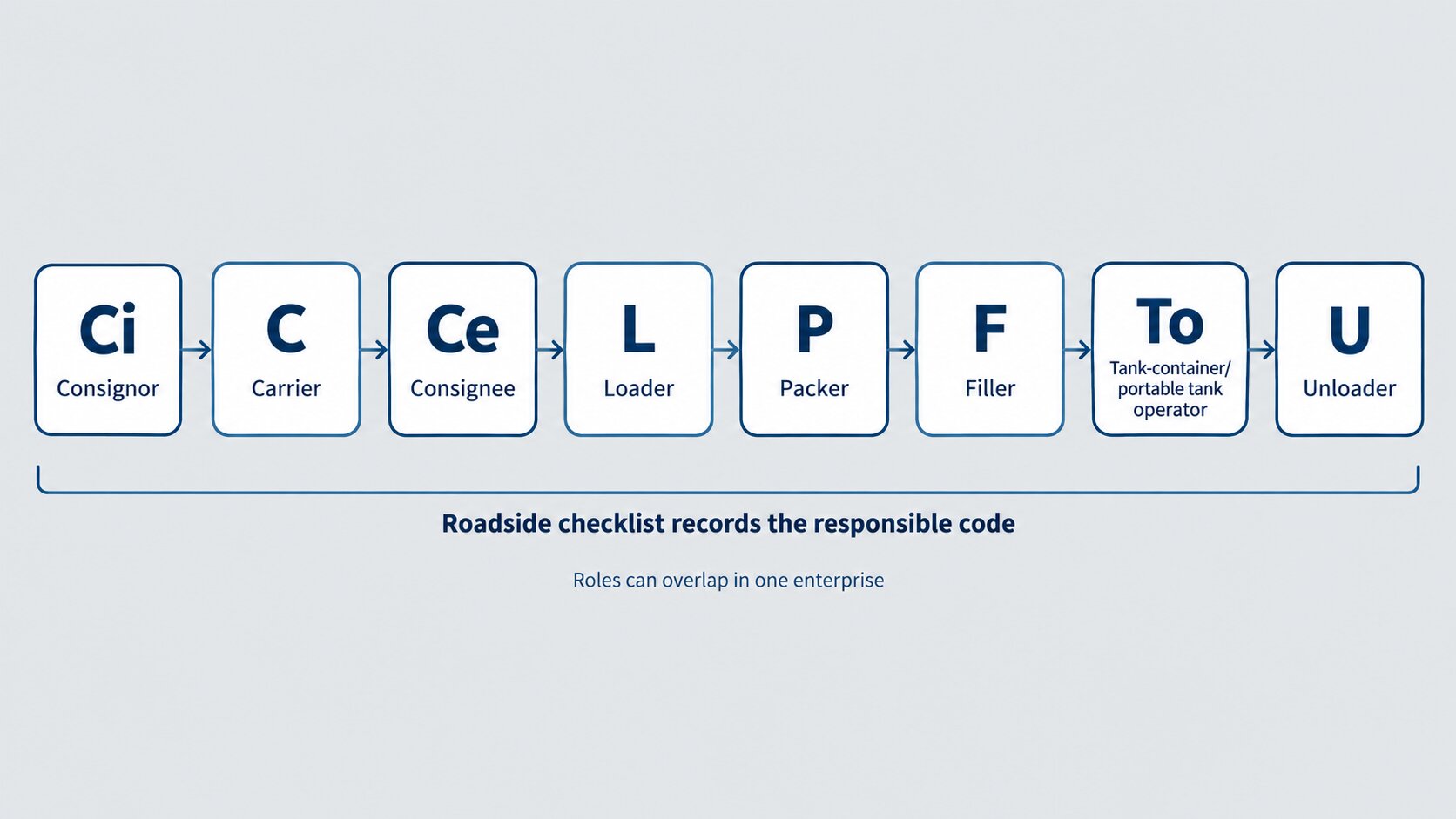
The new ADR rules 2026 did not add duties for shippers or carriers: they changed how EU inspectors record who may be liable when a dangerous goods load fails a roadside check. Chapter 1.4 of ADR, the UN Agreement concerning the International Carriage of Dangerous Goods by Road, sets safety obligations for eight transport-chain participants, from the consignor, usually the shipper, to the unloader.
Commission Delegated Directive (EU) 2025/1801 replaced the EU roadside checklist and has applied since 24 June 2026. The new checklist records the ADR section behind each infringement and the possibly responsible participant, coded from Ci (consignor) to U (unloader). In 2018–2020, EU, Norwegian and Swiss inspectors ran 393,120 dangerous goods roadside checks and found or suspected infringements in about 1 in 5, the European Commission reports. Penalties are set nationally.
Key takeaways
- ADR Chapter 1.4 duties are unchanged in 2026.
- Since 24 June 2026, EU roadside checklists name the ADR section and the possibly responsible participant.
- A roadside finding that jeopardises safety can trigger checks at your premises.
- A freight forwarder named consignor in the contract for carriage is the ADR consignor.
This guide is for SME shippers, consignees and small carriers moving dangerous goods by road in the EU and on Balkan, Türkiye and CIS routes. It covers the 2026 enforcement change and liability, not ADR classes, labels or placards.
On this page:
- What changed
- Participants
- Checklist
- Risk categories
- Enforcement
- Forwarder as consignor
- Corridors
- ADR 2027
- Consignor checklist
- FAQ
Rules vs enforcement: what Directive 2025/1801 changed
The new ADR rules 2026 rest on four legal instruments. ADR’s Annexes A and B apply to domestic and cross-border road transport in the EU through Directive 2008/68/EC. Directive (EU) 2022/1999, the 2022 codification of Directive 95/50/EC, sets uniform roadside-check procedures, and Directive 2025/1801 replaced its Annex I checklist and Annex II infringement list.
Published in the Official Journal on 13 October 2025, Directive 2025/1801 has applied since 24 June 2026, the day after the transposition deadline. Recital 5 says the checklist should “reflect” ADR Chapter 1.4 “by identifying those participants in the transport chain who may incur liability for a given infringement”.
Several top-ranking guides claim the directive creates consignor and consignee obligations “for the first time”. How could a 2025 enforcement act create duties that Chapter 1.4 has imposed for years? It amends neither ADR nor Directive 2008/68/EC.
The obligations did not change; the enforcement record did.
ADR shared responsibility: eight participants and their duties
Section 1.4.1.1 of ADR 2025 makes every participant take “appropriate measures according to the nature and the extent of foreseeable dangers” and comply with ADR “in their respective fields”. Loaders, packers, fillers, tank operators and unloaders owe these safety obligations of participants only “insofar as they know or should have known” the job falls under ADR (1.4.3).
Carriers must not forward a consignment with an observed infringement until the infringement is rectified (1.4.2.2.3), and may seek the authorities’ help to unload, destroy or render harmless goods whose dangerous nature the consignor did not disclose (1.4.2.2.4).
| Participant (code) | Core duties (ADR Chapter 1.4) | May rely on others’ data for |
|---|---|---|
| Consignor (Ci) | 1.4.2.1.1: classified, authorised goods; traceable information and documents; approved, marked packagings; empty uncleaned tanks placarded, closed | classification, documents, packagings, empty-tank placarding |
| Carrier (C) | 1.4.2.2.1: authorised goods; documents and equipment on board; visual check; no overloading; placards; instructions in writing (1.4.2.2.6) | authorisation, documents, weight, placards; visual check via packing certificate |
| Consignee (Ce) | 1.4.2.3.1: no deferred acceptance without compelling reasons; compliance check after unloading | not stated |
| Loader (L) | 1.4.3.1: authorised goods; intact packages; loading and handling rules; container placards; mixed-loading bans | authorisation, container placards, mixed loading |
| Packer (P) | 1.4.3.2: packing and mixed-packing rules; marking and labelling | not stated |
| Filler (F) | 1.4.3.3: tank condition, test dates; authorised goods; filling degree; closures; placards | not stated |
| Tank-container/portable tank operator (To) | 1.4.3.4: construction, inspection, marking; maintenance; checks after repair or accident | not stated |
| Unloader (U) | 1.4.3.7: right goods; damage check; residues cleaned, valves closed; decontamination; placards removed | not stated |
How the ADR roadside checklist now names the responsible participant
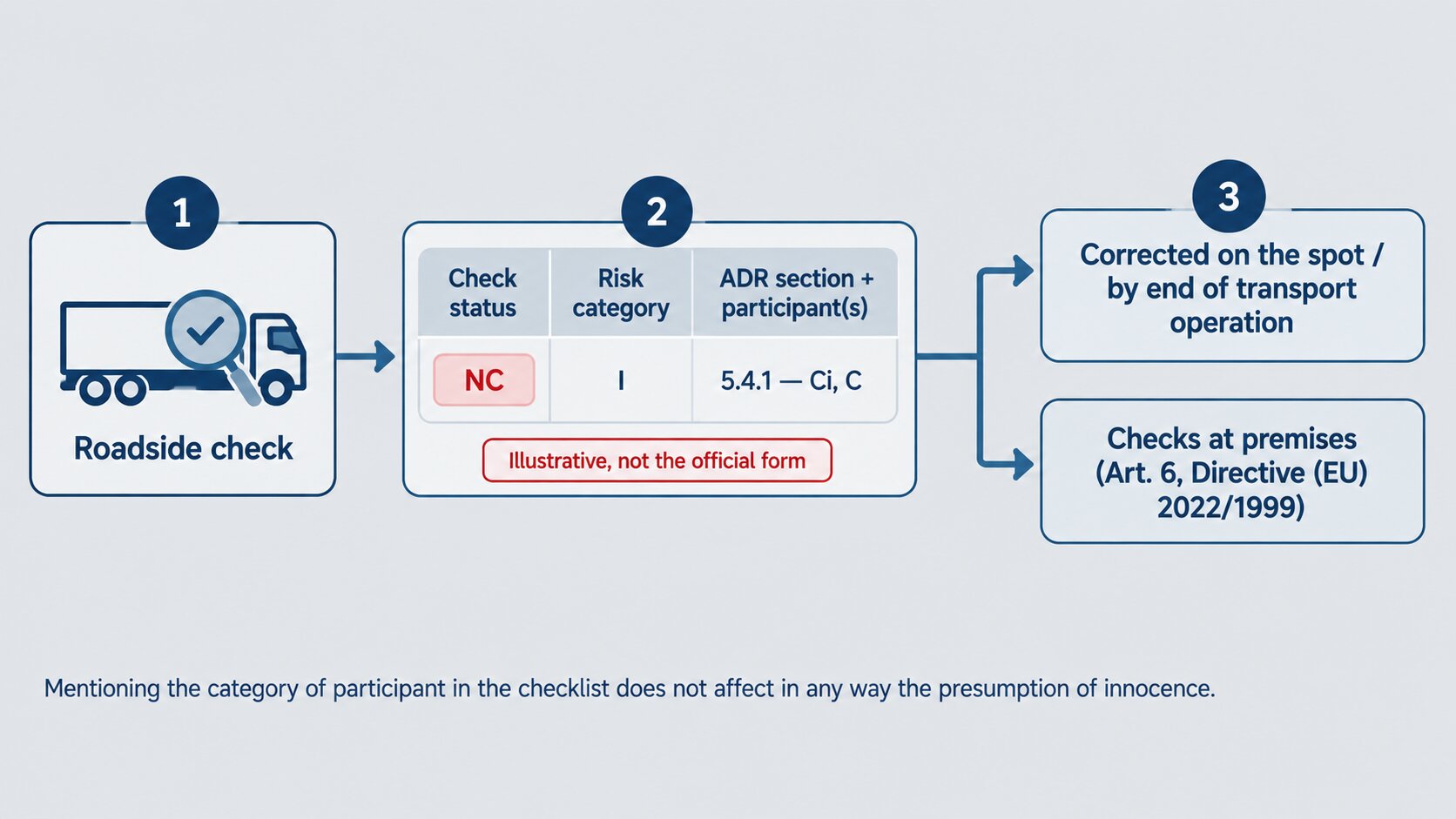
The Annex I roadside checklist has 31 numbered fields; items 12 to 27 each carry a C, NC or NA status, a risk category and a new “ADR section + participant(s)” column (Directive 2025/1801, recitals 6–7).
Under the new ADR rules 2026, footnote 6 defines the codes: “Ci = consignor, C = carrier, Ce = consignee, L = loader, P = packer, F = filler, To = tank operator, U = unloader”. It adds: “Mentioning the category of participant in the checklist does not affect in any way the presumption of innocence.”
The participant-attribution map is Sea Gate Logistics’ reading of Chapter 1.4 (the inspector records the actual code case by case).
| Checklist item | ADR reference | Participant(s) typically named | ADR 1.4 duty |
|---|---|---|---|
| 12 Transport documents | 8.1.2.1(a), 5.4.1, 5.4.2 | Ci, C | 1.4.2.1.1(b); 1.4.2.2.1 |
| 13 Instructions in writing | 8.1.2.1(b), 5.4.3 | C | 1.4.2.2.6 |
| 16 Goods authorised for carriage | 1.1.2.1 | Ci, C, L | 1.4.2.1.1(a); 1.4.2.2.1; 1.4.3.1 |
| 17 Means of containment | 4.1–4.7 | Ci, P, F, To | 1.4.2.1.1(c); 1.4.3.2; 1.4.3.3; 1.4.3.4 |
| 20 Handling and stowage | 7.5.7 | L | 1.4.3.1 |
| 22 Marking and labelling | 3.3–3.5, 4.1.4.1, 5.1, 5.2 | P, Ci | 1.4.3.2; 1.4.2.1.1 |
| 23 Placards and orange plates | 3.4.13, 5.3, 5.5, 7.3, 7.5.11 | C, L, F (Ci for empty uncleaned tanks) | 1.4.2.2.1; 1.4.3.1; 1.4.3.3; 1.4.2.1.1(e) |
A participant code works like a forwarding address for the next check, and field 28 records whether the fix happens on the spot, before the journey ends or at premises.
Art. 6(1) of Directive (EU) 2022/1999 permits ADR checks at premises “as a preventive measure or where infringements which jeopardise safety … have been recorded at the roadside”, and goods leave only once the transport conforms (Art. 6(2)). Consignors are in scope, because Art. 2(d) covers anyone who packages or loads dangerous goods or “cause[s] them to be carried”.
EU law sets no reporting duty for premises checks, so no EU statistics exist.
ADR risk categories I, II and III and what happens at the roadside
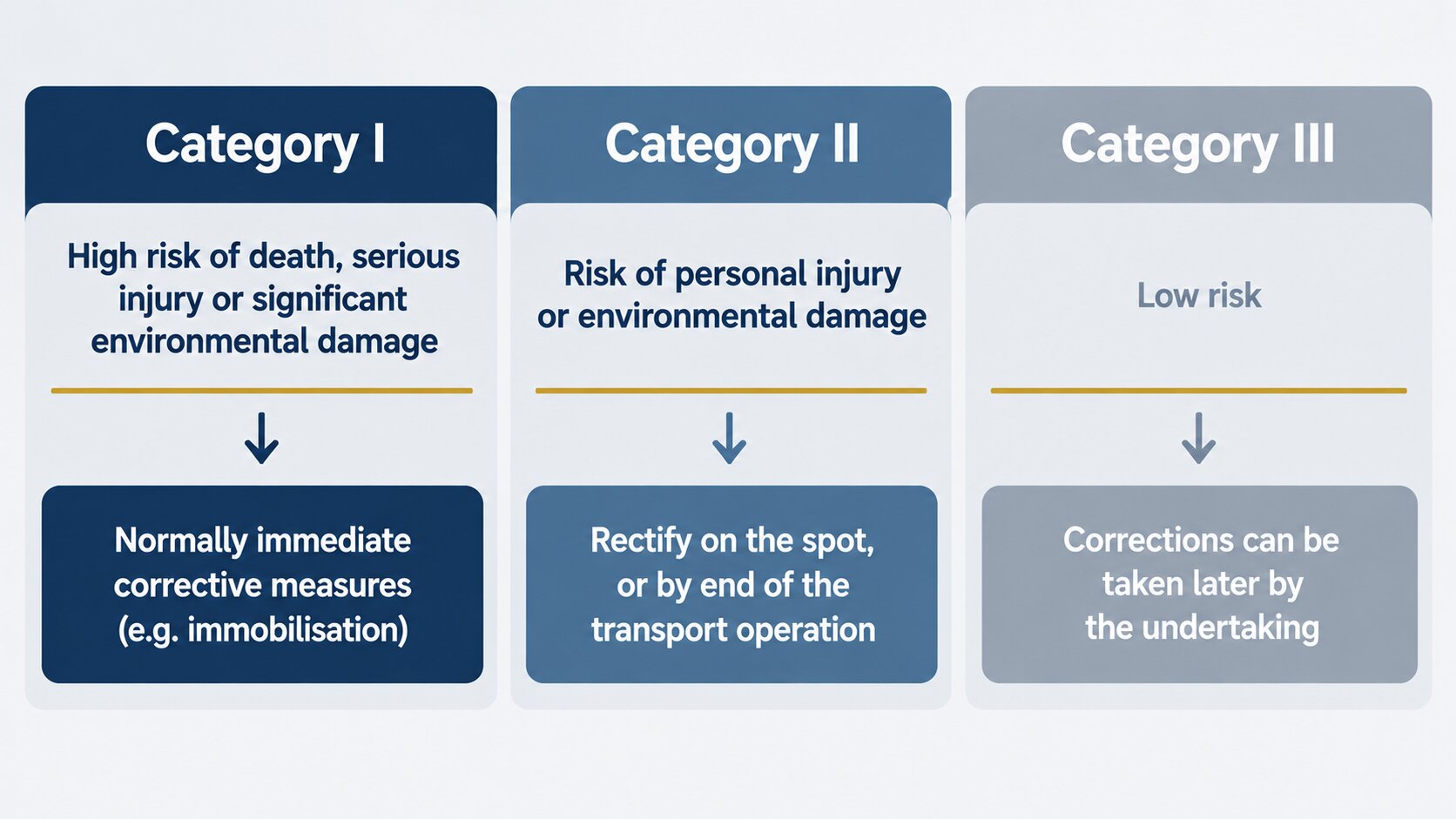
Annex II of Directive (EU) 2022/1999 lists 24 category I, 18 category II and 6 category III failures, and the officer may upgrade or downgrade any of them. Only the most serious infringement per transport unit is reported.
| Category | Legal definition (Annex II) | Roadside consequence | Consignor-relevant examples |
|---|---|---|---|
| I | “high risk of death, serious personal injury or significant damage to the environment” | normally immediate measures, such as vehicle immobilisation | no transport documents; packages without required marks or labels; UN number, proper shipping name or packing group errors enabling a category I infringement; packaging breaching packing instructions |
| II | “risk of personal injury or damage to the environment” | rectify on the spot where feasible, or by the end of the current operation | incorrect labelling, marking or placarding; damaged packaging; untrained staff (Chapter 1.3); document retention failures |
| III | “low risk” | the undertaking can correct it later | wrong label or placard size; non-category-I information missing from documents |
For failures found at premises checks, each definition now sets “other appropriate measures”.
Enforcement in numbers: checks, immobilisations and ADR fines
European Commission report COM(2025) 114, the latest published, covers 393,120 roadside checks in the EU, Norway and Switzerland in 2018–2020. Infringements were found or suspected in 77,311, about 1 in 5. On average, 37% of infringements fell into risk category I. Because checks are targeted, the Commission warns the figures “may not be wholly representative”.
| Year | Non-compliant units | Category I infringements | Vehicles immobilised (EU) | Immobilisation rate (infringing vehicles) |
|---|---|---|---|---|
| 2018 | 19.61% | 37% | 6,849 | 24.54% |
| 2019 | 17.9% | 36% | 7,419 | 28.33% |
| 2020 | 21.62% | 38% | 6,197 | 29.47% |
Fines were the standard sanction: 76% of penalties in 2018, with 24,411 fines against 3,166 cautions and 4,479 other penalties.
ADR itself does not prescribe any penalties. Under 1.4.1.3, legal consequences are left to domestic law, so ADR penalties are national. German law allows fines of up to €50,000 for the offences listed in §10(1) GGBefG (the cap is set in §10(2)).
Carriers risk more than a fine: Annex II is kept consistent with Section 9 of Annex I to Regulation (EU) 2016/403, the serious infringements that may cost an operator its good repute and licence.
When the freight forwarder is the ADR consignor
ADR 1.2.1 defines the consignor as “the enterprise which consigns dangerous goods either on its own behalf or for a third party” or, under a contract for carriage, “the consignor according to the contract for carriage”, such as the sender on a CMR consignment note. The carrier (in practice, the haulier) performs the transport.
Booking carriage in its own name is part of what a freight forwarder does. When we book a truck in Sea Gate’s name, for example to move several clients’ pallets as one groupage load, we are the ADR consignor.
Does the freight forwarder’s dangerous goods responsibility then replace yours? Not entirely, since ADR 1.4.2.1.3 gives the goods owner a written duty: “When the consignor acts on behalf of a third party, the latter shall inform the consignor in writing that dangerous goods are involved and make available to him all the information and documents he needs to perform his obligations.”
Your Incoterms® 2020 rule usually decides who books the main carriage, and so who is named consignor. Check the shipping terms such as Incoterms® 2020 and CMR before booking.
| Your situation | Your ADR role(s) | What you owe |
|---|---|---|
| You contract the carrier yourself | Consignor (plus packer/loader if you pack/load) | 1.4.2.1.1 consignor duties |
| A forwarder contracts carriage in its own name | Third party (plus packer/loader if you pack/load; 1.4.2 NOTE 1) | Written notice and documents, 1.4.2.1.3 |
| You receive the goods | Consignee (plus unloader if your staff unload) | 1.4.2.3.1; 1.4.3.7 |
After 24 June 2026: status on EU, Balkan and Türkiye routes
The European Commission’s infringements package of 15 July 2026 sent letters of formal notice to 14 Member States for failing to communicate complete transposition of Directive 2025/1801: Belgium, Bulgaria, Czechia, Greece, Cyprus, Latvia, Luxembourg, Hungary, Malta, the Netherlands, Austria, Portugal, Romania and Sweden. Statuses below are as of the Commission’s 15 July 2026 package.
| Country | 2025/1801 status | Roadside checks 2020 | Non-compliant 2020 |
|---|---|---|---|
| Bulgaria | formal notice | 598 | 2.34% |
| Greece | formal notice | 5,932 | 0.29% |
| Romania | formal notice | 3,468 | 3.69% |
| Hungary | formal notice | 6,004 | 10.28% |
| Austria | formal notice | 8,134 | 29.84% |
| Germany | not among the 14 notified | 30,413 | 26.99% |
| Italy | transposed; in force 2 June 2026 (per Studio Zunarelli) | n/a | n/a |
| Non-EU ADR parties | not applicable (ADR applies) | n/a | n/a |
Bulgaria ran under 2% as many checks as Germany in 2020; COM(2025) 114 says such gaps may reflect targeting.
In our reading, a late transposition changes the paperwork more than the exposure: ADR duties apply either way through Directive 2008/68/EC; check the national text for the form in use.
On Sea Gate’s Balkan road freight corridors and CIS routes, Türkiye, Serbia, North Macedonia, Albania, Bosnia and Herzegovina, Montenegro, Moldova and Armenia apply ADR but not the EU checklist directive behind the new ADR rules 2026. A Burgas–Belgrade run meets both regimes (routine work in Balkan logistics) on top of the usual cross-border trucking rules in Europe.
ADR 2027 changes and eFTI: the dates to plan around
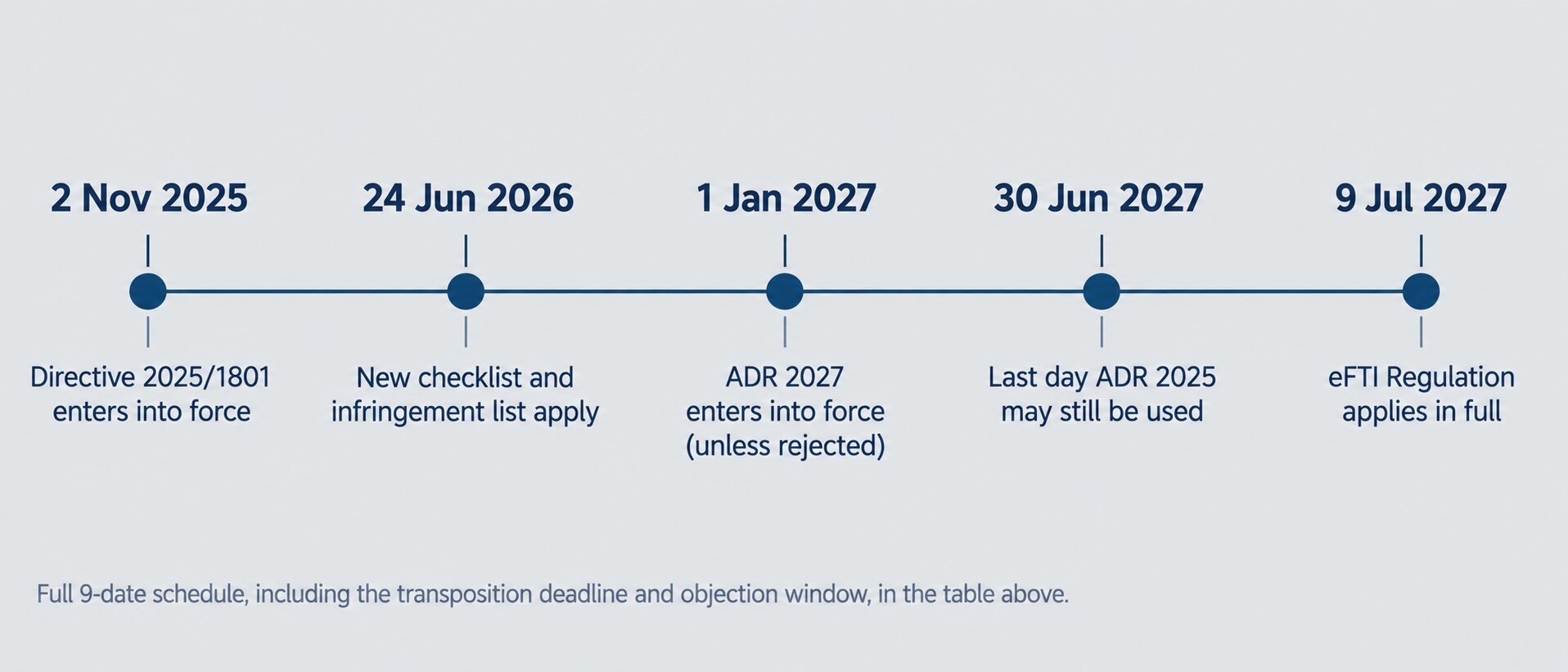
Under UN depositary notification C.N.252.2026 of 1 July 2026, WP.15’s amendments to Annexes A and B are set to enter into force on 1 January 2027 unless rejected. UNECE summaries cover lithium-ion, sodium-ion and hybrid batteries, hydrogen, recycled packaging plastics and vehicle safety. Nothing in them points to changes in the Chapter 1.4 duties; check the consolidated ADR 2027 text once published.
From 9 July 2027, Member State authorities must accept electronic freight transport information (eFTI) from certified platforms under Regulation (EU) 2020/1056. Operator use stays voluntary.
| Date | What happens | Status on 28 Sep 2026 |
|---|---|---|
| 13 Oct 2025 | 2025/1801 published in the Official Journal | done |
| 2 Nov 2025 | 2025/1801 enters into force | done |
| 23 Jun 2026 | Transposition deadline | passed |
| 24 Jun 2026 | New checklist and infringement list apply | in application |
| 15 Jul 2026 | Formal notices to 14 Member States | sent |
| 1 Oct 2026 | ADR 2027 objection deadline | upcoming |
| 1 Jan 2027 | ADR 2027 enters into force (unless rejected) | upcoming |
| 30 Jun 2027 | Last day to use ADR 2025 | upcoming |
| 9 Jul 2027 | eFTI Regulation applies in full | upcoming |
A consignor checklist for the new ADR rules 2026
Eight checks cover the core ADR consignor obligations.
- Record the classification basis: UN number, proper shipping name, class, packing group and supplier data relied on (1.4.2.1.1(a), 1.4.2.1.2).
- Notify your freight forwarder in writing: dangerous goods notice and all documents when it books in its own name (1.4.2.1.3).
- Hand the carrier traceable transport document data: keep a copy with your EU customs paperwork and shipment documentation (1.4.2.1.1(b), 5.4.1).
- Use approved packagings: UN-marked, with correct marks and labels (1.4.2.1.1(c), 1.4.3.2).
- Check the carrier: offer goods only to appropriately identified carriers (1.10.1.2).
- Train staff: everyone who classifies, packs, loads or signs documents; the employer keeps records (1.3.1, 1.3.3).
- Appoint a dangerous goods safety adviser (DGSA): 1.8.3.1 requires one unless you document a national exemption under 1.8.3.2. Run the 1.1.3.6 calculation: limits are 0, 20, 333, 1,000 and unlimited per transport unit for transport categories 0 to 4. Below them, placards, orange plates and instructions in writing fall away (5.3, 5.4.3), but classification, packaging, labelling and the transport document still apply.
- Keep one file per shipment: ready for ADR checks at premises (Art. 6, Directive (EU) 2022/1999).
Frequently asked questions
What changed in the new ADR rules 2026?
Enforcement changed; the duties in ADR Chapter 1.4 did not. Since 24 June 2026, Directive 2025/1801 has required the EU roadside checklist to record the ADR section breached and the participant who may be responsible.
Who is liable for dangerous goods in road transport: the shipper or the carrier?
Both the shipper and the carrier can be liable, each for its own ADR Chapter 1.4 duties. For missing transport documents, the checklist can record both Ci (consignor) and C (carrier). National law sets the consequences.
Does a freight forwarder count as the consignor under ADR?
Yes, when the contract for carriage names the freight forwarder as consignor (ADR 1.2.1). The goods owner must then tell the forwarder in writing that dangerous goods are involved and supply the documents it needs (ADR 1.4.2.1.3).
Can I rely on my supplier’s classification or safety data sheet?
Yes, within limits: ADR 1.4.2.1.2 lets the consignor rely on other participants’ information for (a), (b), (c) and (e) of 1.4.2.1.1, including classification. You must still take appropriate measures and keep the supplier data you relied on.
What are the fines for ADR violations?
ADR itself does not prescribe any penalties, so sanctions are national. German law allows fines of up to €50,000 for the most serious offences under §10 GGBefG.
When does ADR 2027 apply?
The ADR 2027 amendments are set to enter into force on 1 January 2027, unless at least one-third of Contracting Parties, or five of them, object by 1 October 2026. ADR 2025 remains usable until 30 June 2027.
Do I need a dangerous goods safety adviser for a few pallets?
Yes, unless exempted: ADR 1.8.3.1 requires every consigning undertaking to appoint a dangerous goods safety adviser (DGSA). National authorities may exempt loads within the 1.1.3.6 thresholds, such as 1,000 points for transport category 3, but not automatically (1.8.3.2).
Where this leaves your next dangerous goods shipment
Under the new ADR rules 2026, liability still follows the participant whose Chapter 1.4 duty failed, and the roadside checklist now flags that participant by code. For every load, check which roles you hold and who the contract for carriage names as consignor.
Before booking our road freight service, send us your shipment details and ask us to confirm who acts as consignor.
This guide summarises the rules as of 28 September 2026 and is not legal advice; for a specific load, check the national text or ask a dangerous goods safety adviser.
About the author
This article was prepared by the Sea Gate Logistics editorial team, drawing on the company’s experience as an EU-registered freight forwarder in Burgas, Bulgaria, with 20+ years of collective logistics expertise across ocean, road, air, and consolidated (LCL) cargo.