The European road freight 2027 outlook is for contract and spot rates to stay at or above their Q2 2026 levels through the first half of 2027, on Sea Gate Logistics’ base case (Estimated). In Q2 2026, the International Road Transport Union (IRU) benchmark (January 2017 = 100) put contract rates at 148.0 and spot rates at 146.8.
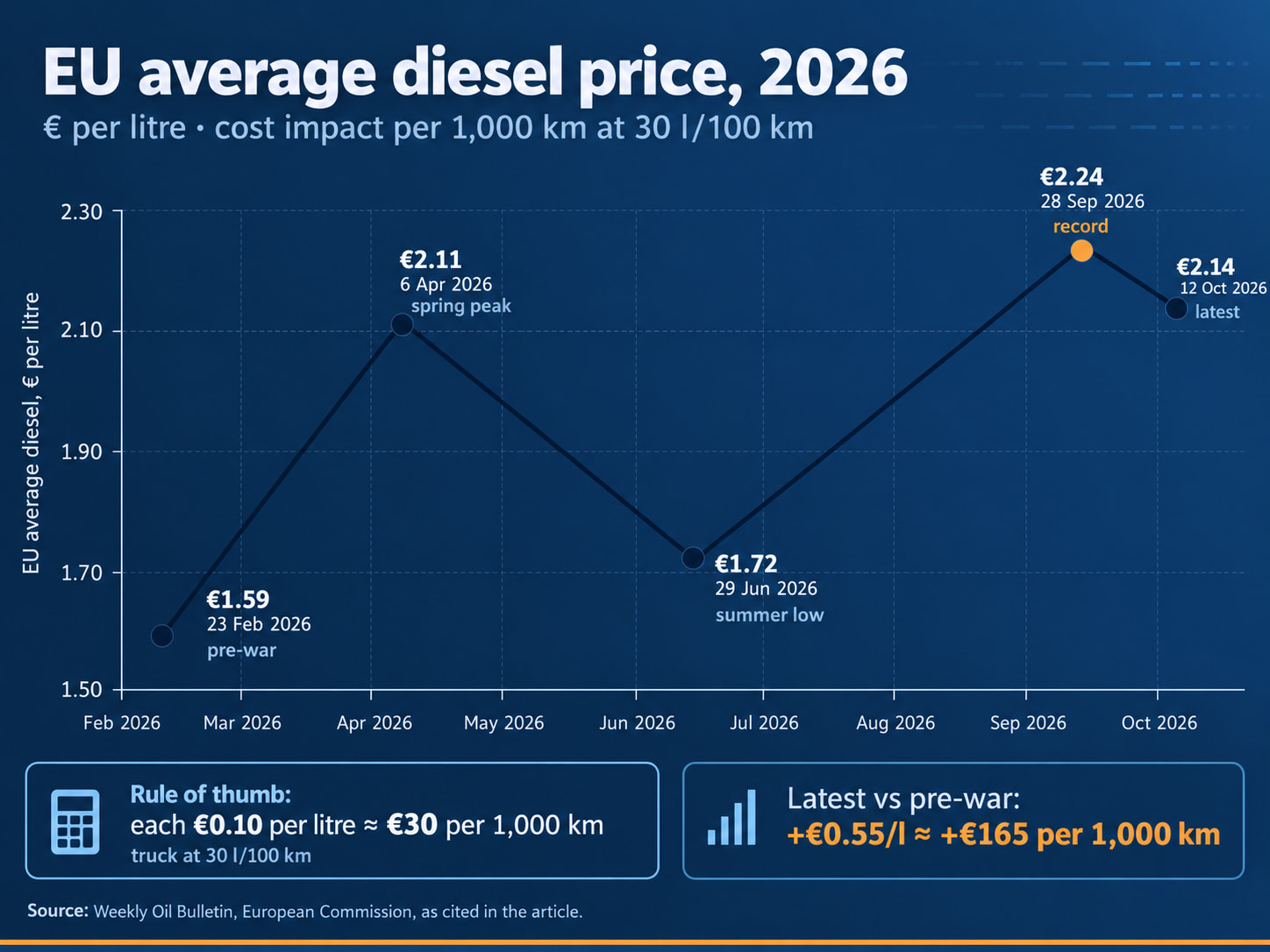
IRU and Transport Intelligence (Ti) attribute the Q2 2026 rate rise mainly to costs, not demand. The EU Weekly Oil Bulletin put average EU diesel at €2.14/l on 12 October 2026, against €1.59/l on 23 February 2026. The International Energy Agency (IEA), in its October 2026 Oil Market Report, expects diesel to stay tight well into 2027.
Europe is short of drivers, not trucks: IRU counts 444,000 unfilled EU truck-driver positions and about 502,000 in a wider European sample. Only a durable reopening of the Strait of Hormuz, the oil route disrupted since February 2026, would bring rate relief in H1 2027.
Key takeaways
- Rates: Q2 2026 contract 148.0, spot 146.8; Q3 data due 10 November 2026.
- Fuel: each €0.10/l of diesel ≈ €30 per 1,000 km (Sea Gate estimate).
- Costs: higher Dutch tolls and a €14.60/h German minimum wage from 1 January 2027; EU carbon pricing on fuel (ETS2) from 2028.
- Drivers: 444,000 EU vacancies on IRU’s preliminary count; about 502,000 in its final, wider European sample.
- Action: index-linked contracts, early volume commitments, groupage for part loads.
This outlook is for SME importers, exporters and procurement managers buying full truckload (FTL) or groupage (LTL) road freight on European and Balkan lanes. It covers rates, costs, capacity and drivers, not sea or air. Figures marked Estimated are Sea Gate calculations, not published data.
On this page:
- What the European Road Freight Rate Benchmark shows for Q2 2026
- Diesel price impact on road freight rates, per kilometre
- Truck tolls, wages and ETS2: the 2027 road freight cost calendar
- European road freight capacity in 2027: more trucks, not more drivers
- How many truck drivers are missing in Europe: 444,000 or 502,000?
- Why the truck driver shortage in Europe will not fix itself by 2027
- Balkan and Türkiye lanes: border friction on the Bulgarian corridor
- European road freight rates 2027: the Rate Pressure Ledger and three scenarios
- Spot vs contract rates in Europe: how to structure your 2027 tender
- Frequently asked questions
- Before you sign your 2027 freight contracts
What the European Road Freight Rate Benchmark shows for Q2 2026

Contract rates on European roads reached 148.0 index points in Q2 2026, 15.2 points above a year earlier. The European Road Freight Rate Benchmark is a quarterly index of contract and spot rates from IRU, Upply (freight market-data platform) and Ti.
A contract rate is agreed for a lane over a term, often six to twelve months. A spot rate is a one-off price for a single load, as our guide to how road freight rates are calculated explains.
| Quarter | Contract index | Spot index | Sentiment index | Published |
|---|---|---|---|---|
| Q4 2025 | 136.9 | 135.1 | 10.7 | 3 Feb 2026 |
| Q1 2026 | 140.1 | 132.3 | 16.9 | 5 May 2026 |
| Q2 2026 | 148.0 | 146.8 | 28.3 | 11 Aug 2026 |
Values as first published; later restatements mean quoted quarterly changes can differ from row differences.
IRU’s Q2 2026 benchmark release put quarterly gains at 7.9 points for contract and 14.6 for spot, “driven primarily by cost rather than demand”.
The Road Freight Sentiment Index hit a record 28.3; 85.9% of respondents expected rates to rise within three months. Of those, 54.0% expected a slight rise and 31.9% a substantial one, a share that stood at 4.9% a quarter earlier.
IRU, Upply and Ti publish no numeric 2027 forecast, so this reading is the closest thing to a road freight rates Europe forecast. Every 2027 rate figure in this European road freight outlook 2027 is Sea Gate’s scenario analysis.
Diesel price impact on road freight rates, per kilometre
A war that began with US–Israeli strikes on Iran on 28 February 2026 has disrupted tanker traffic through the Strait of Hormuz, which carries about a fifth of world oil, AFP reported.
| Date | EU average diesel (€/l, taxes incl.) | What happened |
|---|---|---|
| 23 Feb 2026 | €1.59 | Pre-war level |
| 6 Apr 2026 | €2.11 | Spring peak |
| 29 Jun 2026 | €1.72 | Summer low before the Strait re-closed on 11 Jul |
| 28 Sep 2026 | €2.24 | Record |
| 12 Oct 2026 | €2.14 | Latest reading |
Source: EU Weekly Oil Bulletin, EU-27 weighted average.
The benchmark puts the Q2 2026 diesel average at €1.94/l, up 27% year on year. The IEA’s October 2026 Oil Market Report sees diesel tight well into 2027, with Brent, the benchmark crude oil price, near $106.
A fuel surcharge, or diesel floater, is a contract clause that moves the freight price with a named diesel index.
France’s road-transport cost observatory, the Comité National Routier (CNR), puts long-distance articulated-lorry consumption at 29.6–30.0 l/100 km; Sea Gate uses 30. Each €0.10/l change in diesel moves cost by about €0.03/km, or €30 per 1,000 km (Sea Gate calculation, Estimated). That is on VAT-inclusive pump prices; net of the roughly 20% VAT that hauliers reclaim, it is about €25.
At that rate, the 12 October price of €2.14/l sits €0.55/l above pre-war, about €165 per 1,000 km gross. It is also €0.20/l above the Q2 average, so roughly €60 per 1,000 km gross is not yet visible in published rates (Estimated).
On a 2,000 km full load, the €0.55/l rise since February adds about €330 at pump prices (Estimated).
Truck tolls, wages and ETS2: the 2027 road freight cost calendar
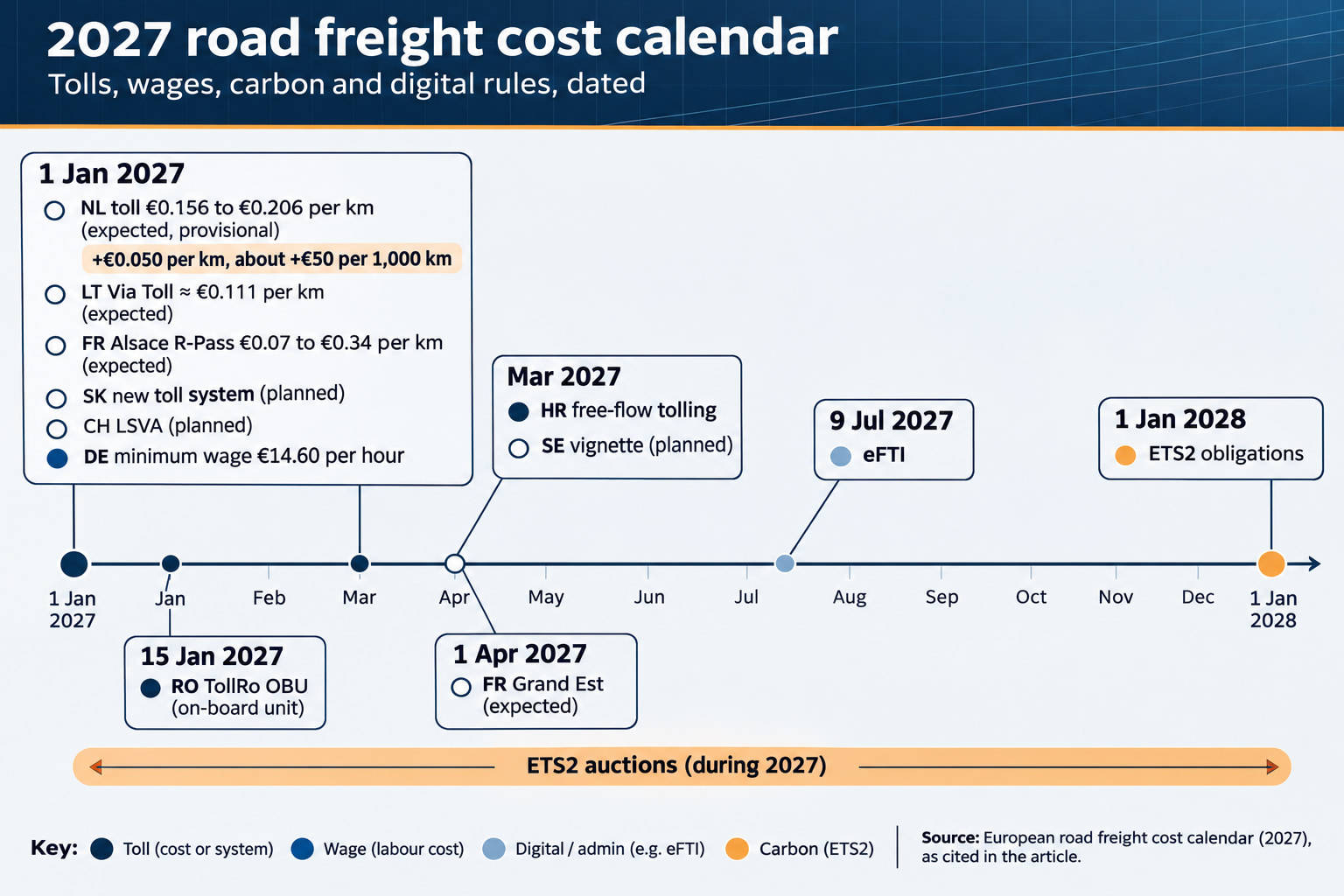
On 1 January 2027 the Netherlands is expected to end its temporary 22.3% toll cut and index rates by 2.6%. A Euro VI truck (the current EU emission standard) over 32 t in CO₂ class 1, the highest-emission band under CO₂-based tolls, would then pay €0.206/km instead of €0.156/km, about 32% more. Dutch rates were still provisional in mid-September, according to trans.info’s 2027 toll round-up. The extra €0.05/km equals about 17 cents per litre of diesel (Estimated).
At Q4 2025 prices, before this year’s diesel rise, toll cost per km already exceeded fuel cost per km in Austria and Hungary, IRU, Upply and Ti reported. Polish truck tolls rose 33% quarter on quarter in Q1 2026, per IRU.
Most rows in the calendar of truck tolls in Europe for 2027 below follow trans.info’s list, which cites IRU; the Swiss row is from Verkehrsrundschau. Rules already in force are in our timeline of 2026 EU freight rules.
| Date | Country / measure | What changes | Cost effect | Status |
|---|---|---|---|---|
| 1 Jan 2027 | Netherlands toll | Cut ends, +2.6% | €0.156 to €0.206/km, Euro VI >32 t, CO₂ class 1 | Expected, provisional |
| 1 Jan 2027 | Lithuania Via Toll | Distance charge | ≈ €0.111/km, Euro VI >12 t, ≤3 axles (IRU estimate) | Expected |
| 1 Jan 2027 | France, Alsace R-Pass | ~200 km tolled | €0.07–0.34/km, >3.5 t | Expected, details not final |
| 1 Jan 2027 | Slovakia | State operator takes over | SkyToll units likely replaced | Planned |
| 1 Jan 2027 | Swiss heavy-vehicle charge | Rises to legal maximum | Higher charge | Planned |
| 1 Jan 2027 | Germany minimum wage | €13.90 to €14.60/h | +5.0%, includes posted drivers (sent temporarily from another EU country) | Scheduled |
| 15 Jan 2027 | Romania TollRo | OBU (on-board unit) or EETS (European Electronic Toll Service) required | n/a | Scheduled |
| March 2027 | Croatia free-flow tolling | OBU needed | n/a | Scheduled |
| March 2027 | Sweden vignette | Extended to goods vehicles >3.5 t | Fee from 3.5 t | Planned (per IRU) |
| 1 Apr 2027 | France, Grand Est | ~525 km more tolled | n/a | Expected, not final |
| 2027 | ETS2 auctions | Auctions begin | n/a | Regulatory |
| 9 Jul 2027 | eFTI, electronic freight transport information | Authorities must accept eFTI data | n/a | Regulatory |
| 1 Jan 2028 | ETS2 obligations | Suppliers buy allowances | ≈ €0.033–0.036/km at €45/t, Sea Gate, Estimated | Regulatory |
ETS2, the EU carbon market for road and building fuels, makes fuel suppliers buy allowances from 1 January 2028, passing the cost on at the pump. The amended EU Climate Law of 5 March 2026 postponed that start; auctions still begin in 2027.
Transport & Environment puts ETS2 at 11–12 euro cents per litre of diesel at the €45/t reference, excluding VAT, so ETS2 road transport costs come to about €33–36 per 1,000 km from 2028 (Estimated). Contracts signed in 2027 that run into 2028 should price that step.
European road freight capacity in 2027: more trucks, not more drivers
EU new truck registrations rose 9.8% to 171,933 in H1 2026, after a 6.2% fall in full-year 2025, according to the European Automobile Manufacturers’ Association (ACEA). Transporeon reads this as fleet replacement — its Freight Perspectives report of 12 October 2026 sees capacity “structurally tight through the rest of 2026 and the first half of 2027”.
On the TIMOCOM freight exchange, freight offers rose 41% year on year in Q1 2026 while listed truck capacity fell 7%. Underlying trade volumes are not the cause: Ti data show road trade between major EU economies down 1.6% year on year in Q2 2026 after an 8% drop in Q1. IRU’s 2026 forecast implies about +1.0% in tonne-km (one tonne moved one kilometre): “stabilisation rather than recovery”. See also our 2026 European freight market overview.
Upply expects demand to “benefit more from 2027”, but that is a demand view and carries no rate forecast. About two-thirds of European operators have turned down new contracts for lack of drivers, IRU reported on 30 June 2026, which points to drivers as the binding constraint on European road freight capacity in 2027.
How many truck drivers are missing in Europe: 444,000 or 502,000?
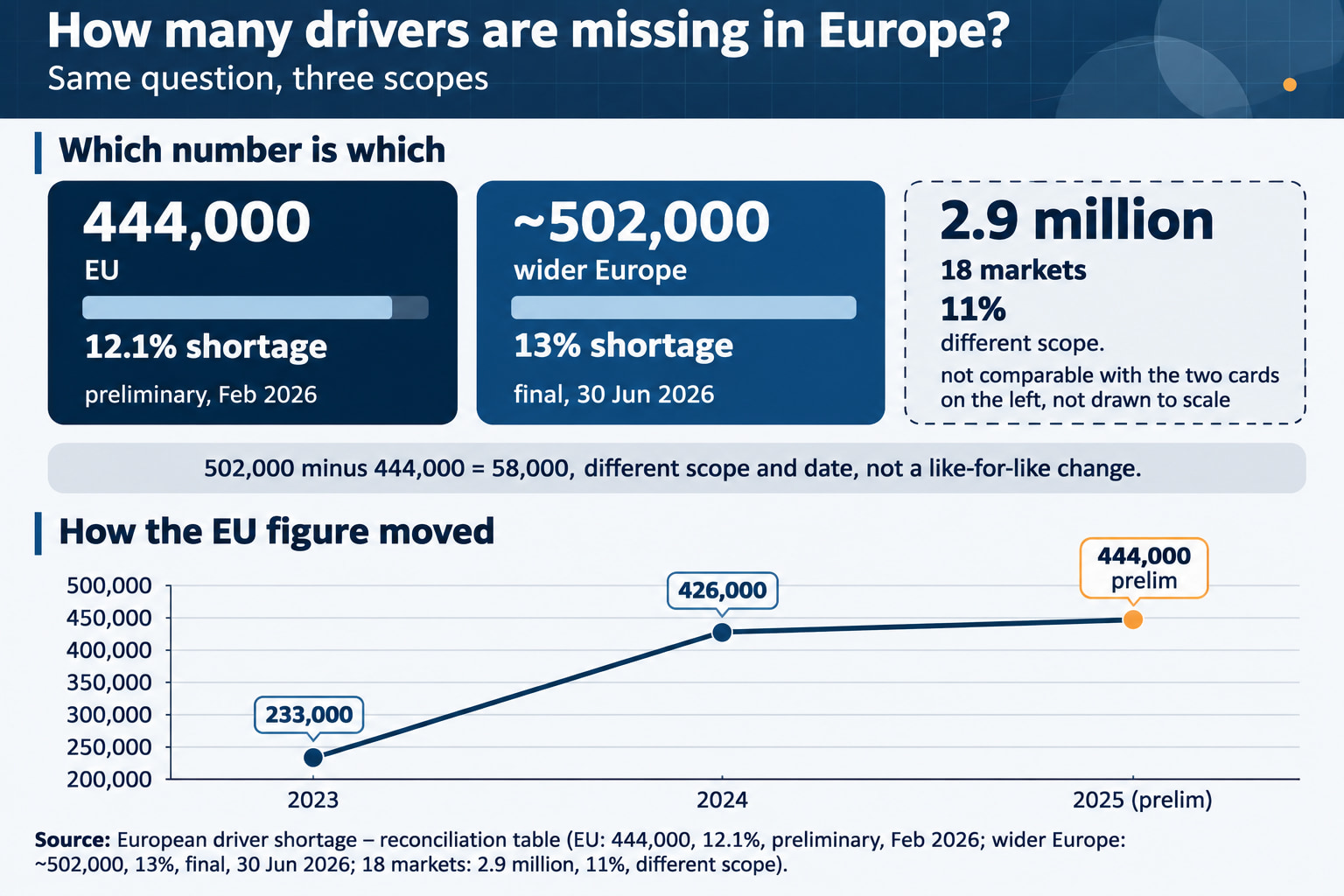
Trade coverage often quotes 444,000 and roughly 502,000 missing drivers side by side. Both are IRU figures: 444,000 is the EU count from the preliminary 2025 survey, and ~502,000 is the final count for a wider European sample.
| Figure | Geography | Shortage rate | Status | Published | Source |
|---|---|---|---|---|---|
| 444,000 | EU | 12.1% | preliminary 2025 survey | Feb 2026 (Q4 2025 benchmark) | IRU annual survey |
| ~502,000 | wider European sample | 13% | final | 30 Jun 2026 | IRU global report 2025 |
| 2.9 million | 18 markets worldwide | 11% | final | 30 Jun 2026 | IRU global report 2025 |
The final IRU Global Driver Shortage Report 2025 puts the wider European rate at 13%, two points above the 11% global rate.
IRU’s EU count rose from 233,000 in 2023 to 426,000 in 2024 and a preliminary 444,000 in 2025, though sample changes limit year-on-year comparisons.
When citing IRU driver shortage report data, use 444,000 for the EU-27 and ~502,000 for the wider sample. The gap reflects scope and survey stage rather than a one-year jump.
Why the truck driver shortage in Europe will not fix itself by 2027
IRU expects about 20% of Europe’s truck-driver workforce to retire within five years, and around 660,500 drivers in Europe to retire by 2030. Five causes keep the truck driver shortage in Europe structural:
- Ageing: IRU’s Global Driver Shortage Report 2024 put about one-third of European drivers over 55 and about 5% under 25.
- Few women: about 4% of European truck drivers are women, IRU’s June 2026 report found.
- Small firms: operators with under 50 employees had shortage rates 6 percentage points above large companies, the same report found.
- Pay competition: Ti recorded double-digit labour-cost rises in Greece, Bulgaria, Latvia and Hungary in Q4 2024.
- Parking: the EU lacks 390,057 safe and secure truck parking spaces, a European Commission study published in April 2025 found.
With German long-haul pay already about €48,600 a year, per Ti, why do the empty seats keep multiplying? IRU now says the shortage is “no longer correcting itself over time”, as trans.info reported.
Directive (EU) 2025/2205 lets 18-year-olds obtain category C licences with an initial Certificate of Professional Competence from 26 November 2029. Transposition (adoption into national law) is due by 26 November 2028, so the directive adds nothing to 2027 capacity. Hiring from outside the EU is the quicker route: at end-2023, Polish firms employed 162,489 non-EU drivers, about 30% of their international drivers, per Poland’s road transport inspectorate via trans.info.
Schengen stay limits cap that route, because they restrict how long non-EU drivers can work on EU routes.
Balkan and Türkiye lanes: border friction on the Bulgarian corridor
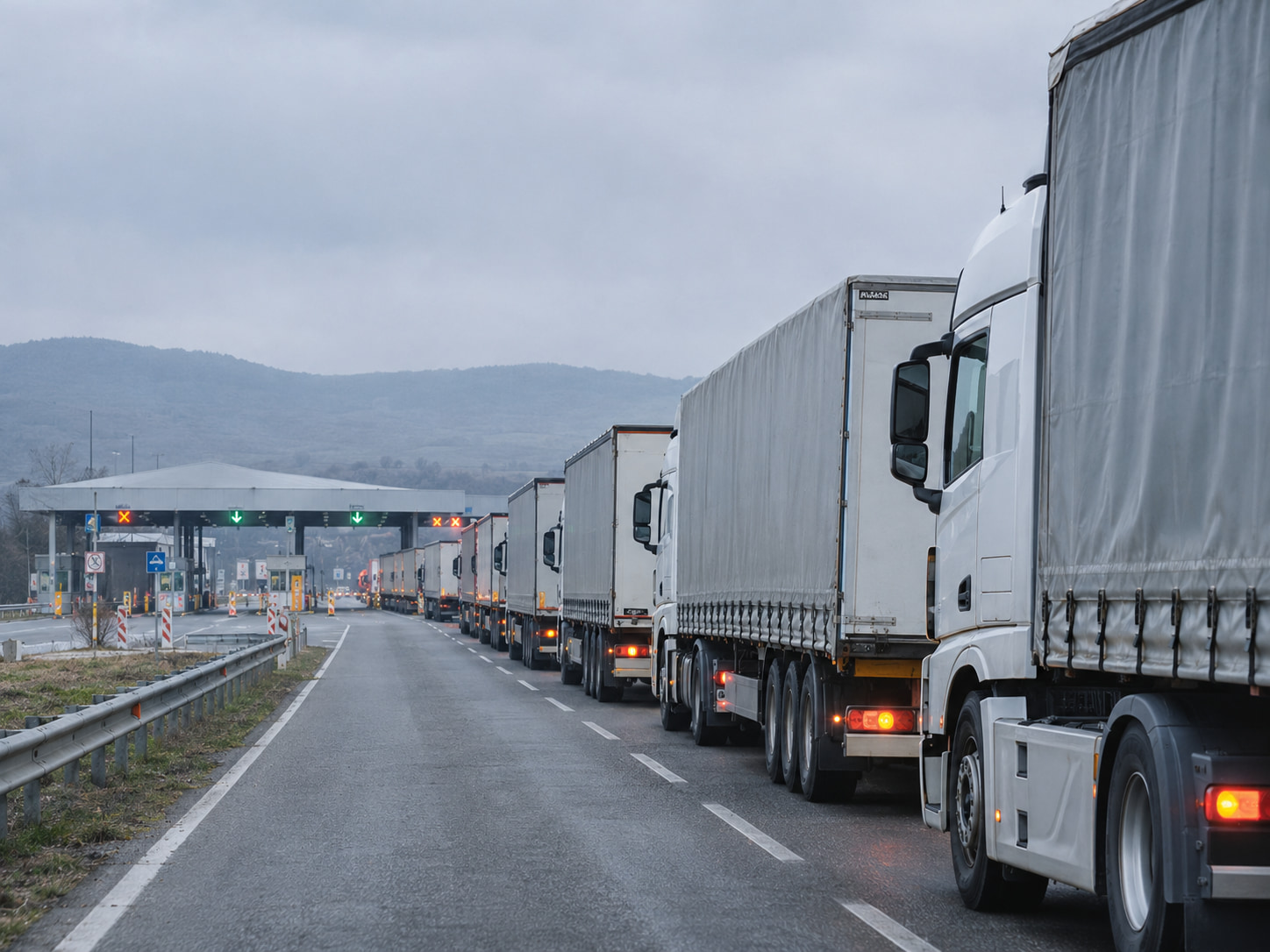
Truck waits at Kapitan Andreevo–Kapıkule reached 24–72 hours in August 2026, up from 12–48 hours, Bulgarian customs data cited by GetTransport show. Turkish drivers protested waits of more than 90 hours at Kapıkule in April 2026, the Bulgarian News Agency (BTA) reported. On 15 October 2026 the forwarder Hecksher warned customers of heavy congestion, Bulgarian border reconstruction works and exhausted Hungarian transit permits at Kapıkule.
Since 10 April 2026, the EU’s Entry/Exit System (EES) has run at all Schengen external borders, the European Commission announced. EES records non-EU travellers’ fingerprints and faces and enforces the 90/180-day short-stay limit, which covers non-EU drivers without a long-stay permit. The EU’s official site for the European Travel Information and Authorisation System (ETIAS) gives no start date; press reports point to 2027.
Bulgaria’s truck tolls have carried a CO₂ component since 1 June 2026, according to AEBTRI, Bulgaria’s international road hauliers’ association. Romania’s TollRo replaced the vignette for vehicles over 3.5 t on 1 October 2026, trans.info reported (roughly €0.10/km on motorways for Euro VI trucks of 12 t or more).
We now advise shippers on the Türkiye–Bulgaria lane to plan a border buffer of one to three days, longer at peaks, in line with the August waits. It is a planning margin for road freight from the Balkan countries and groupage via Burgas.
European road freight rates 2027: the Rate Pressure Ledger and three scenarios
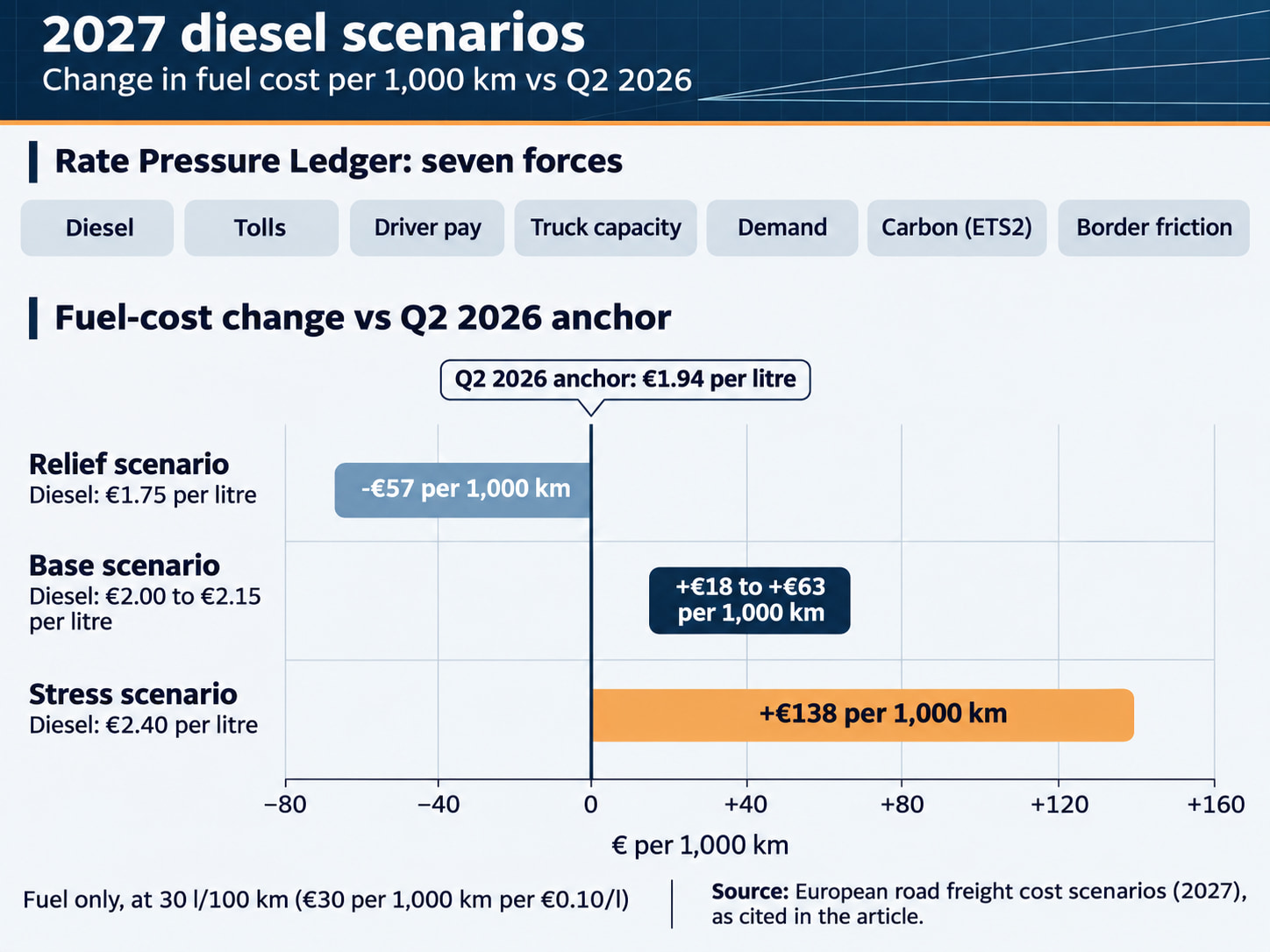
Seven forces will move haulage prices in 2027, and diesel alone can swing costs by more than €100 per 1,000 km. The 2027 Rate Pressure Ledger, the core of Sea Gate’s European road freight 2027 outlook, scores each force by direction, size, trigger and confidence; the scenario table then tests diesel for H1 2027.
| Force | 2027 direction | Size where computable | Dated trigger | Confidence |
|---|---|---|---|---|
| Diesel | Up in H1, swing factor | ≈ €30 per 1,000 km per €0.10/l | Strait of Hormuz; IEA: tight well into 2027 | Medium |
| Tolls | Up | Netherlands +€0.05/km, Euro VI >32 t; Lithuania ≈ €0.111/km; Alsace €0.07–0.34/km | 1 Jan 2027; Croatia, Sweden March 2027 | High; Dutch rates provisional |
| Driver pay | Up | German minimum wage +5.0% to €14.60/h | 1 Jan 2027 | High |
| Truck capacity | Tight | Registrations +9.8% in H1 2026, mostly replacement | Tight through H1 2027 (Transporeon) | Medium |
| Demand | Flat to slightly up | ≈ +1.0% tonne-km in 2026 (IRU) | Possible 2027 rebound (Upply) | Low |
| Carbon (ETS2) | Up from 2028 | ≈ €33–36 per 1,000 km at €45/t | Auctions 2027; obligations 1 Jan 2028 | Medium |
| Border friction | Up on Balkan and Türkiye lanes | 24–72 h waits, Aug 2026 | EES in force; ETIAS reported for 2027 | Medium |
| Scenario | Diesel, H1 2027 | What has to happen | Fuel effect vs Q2 2026 (€1.94/l) | Rate view (Sea Gate, Estimated) |
|---|---|---|---|---|
| Relief | €1.75/l | Strait reopens durably around the turn of the year; diesel nears its €1.72/l summer low | −€0.19/l ≈ −€57 per 1,000 km | Spot eases first; contract flattens, still above 2025 levels |
| Base (Sea Gate working assumption) | €2.00–2.15/l, easing in H2 2027 | IEA view holds: tight diesel, stocks not rebuilt before H2 2027 | +€0.06 to +€0.21/l ≈ +€18 to +€63 per 1,000 km | Contract and spot at or above 148.0 / 146.8 through H1 2027; easing in H2 2027 |
| Stress | €2.40/l | Full Strait closure persists or returns; diesel tops the €2.24/l record of 28 Sep 2026 | +€0.46/l ≈ +€138 per 1,000 km | Spot rises faster than contract, as in Q2 2026 (+14.6 vs +7.9 points); more rejected loads; unindexed fixed prices reopened |
Tolls, wages and, from 2028, ETS2 apply in all three scenarios.
The risks are lopsided: stress adds €138 per 1,000 km, more than twice the €57 that relief removes. Stress needs only a renewed full closure of the Strait; relief also needs a faster stock rebuild than the IEA expects.
The Ledger cannot forecast the Strait. It tracks three dated signals instead: the EU Weekly Oil Bulletin, the monthly IEA Oil Market Report and the November Q3 benchmark. Bulletin readings above the €2.15/l top of the base band point towards stress; readings below €2.00/l point towards relief.
Spot vs contract rates in Europe: how to structure your 2027 tender
Diesel rose €0.55/l between February and October 2026, so choosing between spot vs contract rates in Europe starts with deciding who carries the fuel risk.
| Buying option | Best when | 2027 watch-out |
|---|---|---|
| Fixed-price annual contract | Stable lane, steady volume | Fuel buffers or rejected loads when diesel spikes |
| Index-linked: base rate, diesel floater, toll pass-through | Regular lanes in a volatile H1 2027 | Needs a named index, base price and reset frequency |
| Spot | Irregular or one-off loads | Rose 14.6 points quarter on quarter in Q2 2026 |
| Groupage (LTL) via a forwarder | Part loads of a few pallets | Fixed consolidation days, longer transit |
In our view, an index-linked contract is the better default for regular lanes in 2027; for a lane shipped a few times a year, spot or groupage usually costs less. Full loads go as road freight across Europe and the Balkans, part loads as consolidated cargo.
Who employs the driver who will turn up at your dock in March 2027? Non-EU drivers on short-stay status face the 90/180-day Schengen limit, so a carrier’s rota matters as much as its rate.
- Share 2027 volumes lane by lane early in the Q4 2026 round.
- Agree a diesel floater: Oil Bulletin index, monthly reset and a base price matching the diesel level in the agreed rate, such as the €1.94/l Q2 2026 average.
- Itemise tolls at cost, including the 2027 Dutch, Lithuanian and French changes.
- Add an ETS2 clause to contracts running past 31 December 2027.
- Ask each carrier who employs the driver and what lead time it commits to.
- Add a one-to-three-day buffer on Türkiye–Bulgaria crossings.
- Re-run the numbers after the Q3 2026 benchmark in November.
Frequently asked questions
Will road freight rates go up in 2027?
Sea Gate Logistics’ base case (Estimated) in this European road freight 2027 outlook keeps contract and spot rates at or above their Q2 2026 levels of 148.0 and 146.8 through the first half of 2027. IRU, Ti and Upply publish no numeric 2027 forecast, and Q3 2026 data follows on 10 November 2026.
How many truck drivers is Europe short in 2026?
IRU puts the EU shortage at 444,000 drivers, or 12.1%, in its preliminary 2025 survey. Its final report of 30 June 2026 gives about 502,000, or 13%, for a wider European sample, a difference mainly of scope and survey stage.
Why is there a truck driver shortage in Europe?
IRU expects about 20% of Europe’s truck-driver workforce to retire within five years, and around 660,500 drivers in Europe to retire by 2030. Only about 4% of drivers are women and about 5% are under 25, IRU data show.
Why are carriers turning down loads?
About two-thirds of European operators have turned down new contracts for lack of drivers, IRU reported on 30 June 2026. In the same survey, 65% named the driver shortage their most pressing concern.
Will diesel prices come down in 2027?
A quick fall looks unlikely: diesel was €2.14/l on 12 October 2026, and the IEA expects tight supply well into 2027. Each €0.10/l adds about €30 per 1,000 km (Sea Gate calculation, Estimated).
When does ETS2 start for road transport, and how much will it add to diesel?
ETS2 obligations start on 1 January 2028, with auctions from 2027. Transport & Environment puts the cost at 11–12 euro cents per litre at €45/t, excluding VAT, or roughly €33–36 per 1,000 km (Sea Gate calculation, Estimated).
Should I sign a fixed contract or stay on the spot market for 2027?
Regular lanes suit an index-linked contract with a diesel floater and toll pass-through. Keep irregular loads on spot and part loads in groupage; the spot index rose 14.6 points in Q2 2026 alone.
Before you sign your 2027 freight contracts
Rates start 2027 high, and the European road freight 2027 outlook offers little cost relief. Tolls, wages and the driver shortage are structural; diesel is the swing factor.
Wait for the Q3 benchmark on 10 November 2026, then run the Rate Pressure Ledger on your own lanes before fixing terms.
For a specific lane, request a quote or use the online rate calculator for popular routes on our website; quote requests are answered within the working day.