The EU ETS surcharge 2026 is the tariff line ocean carriers add to recover carbon allowance costs for 100% of in-scope shipping emissions, up from 70% in 2025. The EU Emissions Trading System (EU ETS) is the carbon market where ships surrender EU Allowances (EUAs), each covering one tonne of CO₂-equivalent.
As of 28 September 2026, Maersk’s surcharge per 40-foot dry container from Far East Asia to North Europe was €144, €154 and €133 in Q1–Q3, and €148 applies from 1 October. Each quarter’s rate follows a three-month average EUA price.
LCL pays per W/M (weight or measure: per cubic metre or per 1,000 kg, whichever is greater), at USD 4 from the Far East to North Europe on Maersk’s tariff from 1 October 2026. Whoever pays the ocean freight pays the line: the buyer under FOB, the seller under CIF (Incoterms® 2020).
Key takeaways
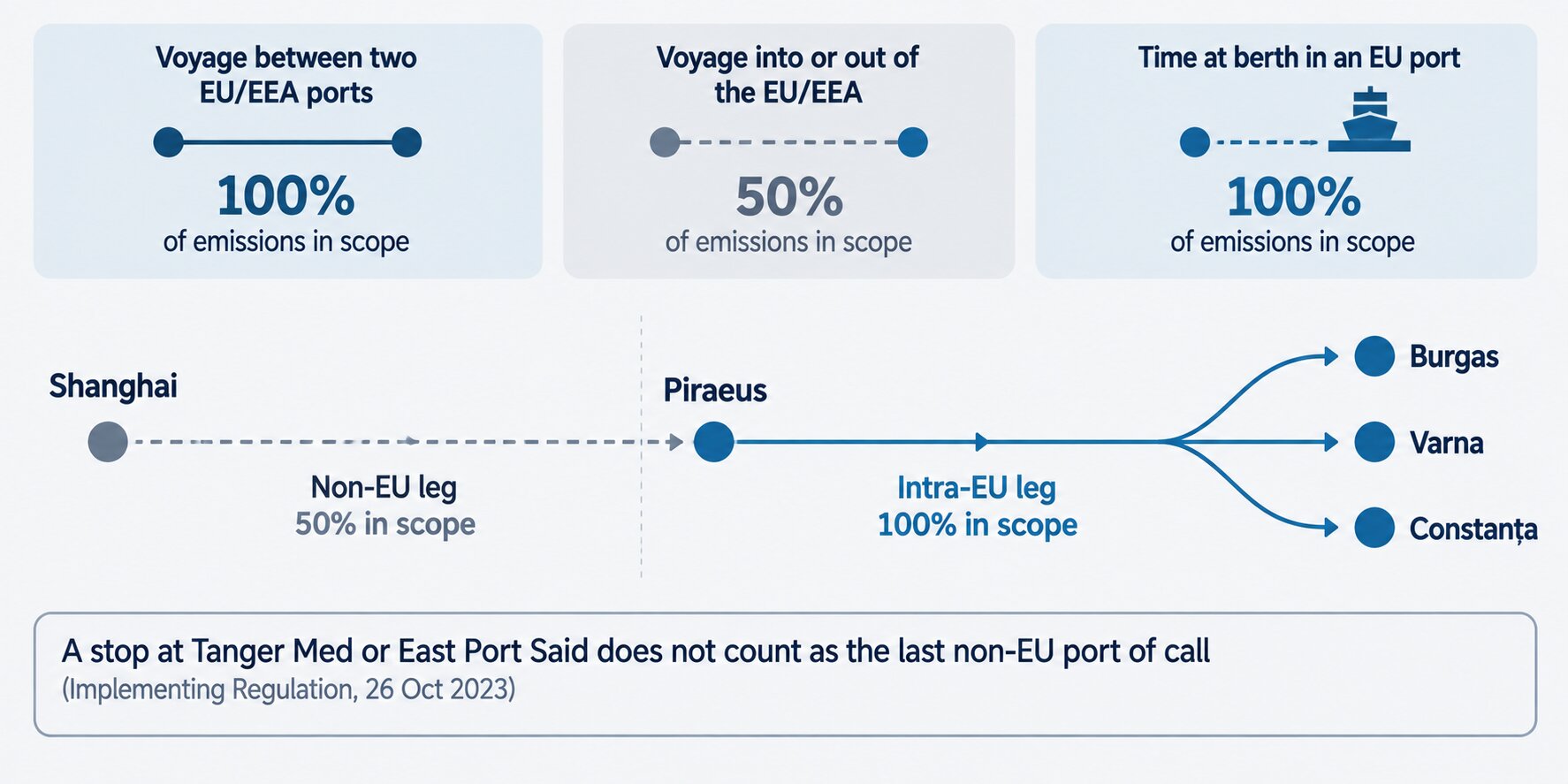
- The EU ETS surcharge 2026 covers 100% of intra-EU/EEA and at-berth emissions, 50% into or out of the EU/EEA.
- Maersk, 40-foot dry, Far East Asia to North Europe: €144, €154, €133 in Q1–Q3 2026; €148 from 1 October.
- Our EUA multiplier held near 1.87 on that lane all year.
- LCL: USD 4 per W/M from the Far East to North Europe from 1 October 2026 (Maersk).
- Q1 2027 at a €80–90 EUA average: about €150–168 on that lane (Estimated).
On this page:
What the EU ETS shipping surcharge covers at 100%
From 1 January 2026, shipping companies need allowances for 100% of in-scope emissions, according to the European Commission.
| Emissions year | Share covered | Allowances surrendered by |
|---|---|---|
| 2024 | 40% | 30 Sep 2025 |
| 2025 | 70% | 30 Sep 2026 |
| 2026 onward | 100% | 30 Sep of the following year (2027 for 2026) |
Coverage is 100% on intra-EU/EEA voyages and at berth and 50% on voyages into or out of the EU/EEA, for cargo and passenger ships of 5,000 GT and above. Methane (CH₄) and nitrous oxide (N₂O) also count from 2026, relevant to LNG-fuelled ships with methane slip.
The step from 70% to 100% alone means 42.9% more allowances per tonne of fuel (Sea Gate calculation). CMA CGM and Hapag-Lloyd pre-announced January 2026 surcharge rises of about 43% and 45%.
Surcharges billed through 2026 pay for allowances surrendered by 30 September 2027, while the surrender for 70% of 2025 emissions falls due on 30 September 2026.
CBAM, the Carbon Border Adjustment Mechanism, is a customs cost on covered goods, not a freight surcharge: see what CBAM means for importers in 2026.
EU ETS surcharge 2026 per container: Maersk’s four quarters
Q2 2026 brought the year’s peak: €154 per 40-foot dry container from Far East Asia to North Europe on Maersk’s tariff. Maersk calls the line ESS on spot bookings and contracts of up to 31 days and EMS on longer ones. It applies to EU/EEA bookings and covers the EU ETS and FuelEU Maritime, the EU cap on the greenhouse-gas intensity of ship fuel.
| Lane (40′ dry, EUR) | Q1 2026 | Q2 2026 | Q3 2026 | Q4 2026 (from 1 Oct) |
|---|---|---|---|---|
| Far East Asia → North Europe | 144 | 154 | 133 | 148 |
| Far East Asia → Mediterranean | 112 | 119 | 100 | 114 |
| North Europe → Far East Asia | 97 | 104 | 88 | 99 |
| Intra-Mediterranean | 48 | 52 | 45 | 50 |
| Intra-North Europe | 27 | 28 | 25 | 27 |
Source: Maersk Emissions Surcharge (EMS/ESS) notices of 1 December 2025, 1 March, 1 June and 1 September 2026. One carrier’s published tariff.
Other carriers price the same lanes differently, and direction matters too: from 1 October 2026, Maersk will charge €148 per 40-foot box from Far East Asia to North Europe but €99 the other way.
Maersk quotes for shipping from China show no separate line (the charge sits inside base freight).
On 24 September 2026, the Drewry World Container Index stood at $3,485 per 40-foot container from Shanghai to Rotterdam and $3,835 to Genoa. Maersk’s Q4 lines of $170 per 40-foot dry box from Far East Asia to North Europe and $131 to the Mediterranean equal about 4.9% and 3.4% of those rates (Sea Gate calculation, illustrative). As spot rates fall, the ETS share rises even with the surcharge unchanged.
How the EU ETS surcharge is calculated: the EUA multiplier
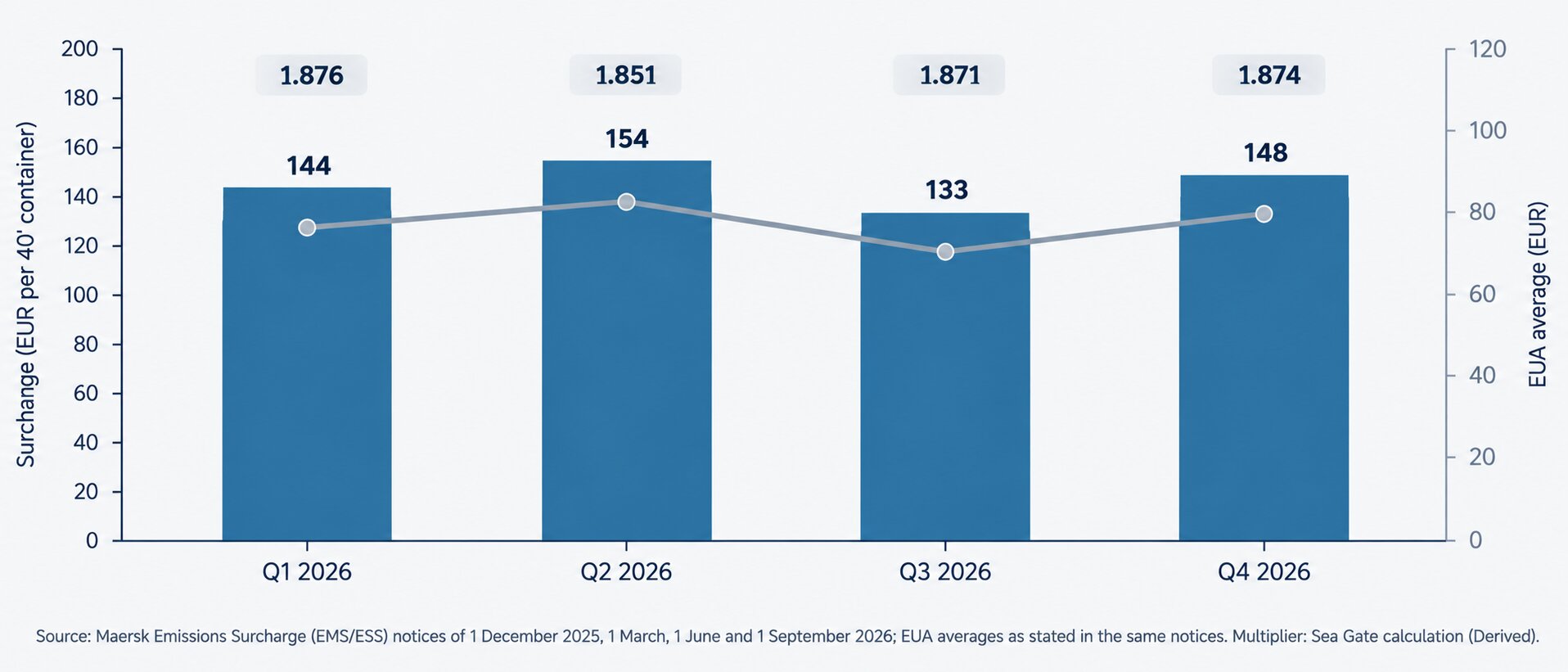
Each 2026 Maersk surcharge followed the average ICE EUA Daily Futures (symbol ECP) price over a three-month window ending on the 15th of the month before the notice. Divide a lane’s 40-foot dry surcharge by that average to get Sea Gate’s EUA multiplier, a price ratio rather than an emissions measurement.
| Quarter | EUA reference window | EUA average | Far East Asia → North Europe, 40′ | Multiplier |
|---|---|---|---|---|
| Q1 2026 | 16 Aug – 15 Nov 2025 | €76.75 | €144 | 1.876 |
| Q2 2026 | 16 Nov 2025 – 15 Feb 2026 | €83.19 | €154 | 1.851 |
| Q3 2026 | 16 Feb – 15 May 2026 | €71.07 | €133 | 1.871 |
| Q4 2026 | 16 May – 15 Aug 2026 | €78.97 | €148 | 1.874 |
Method: Maersk’s EUR surcharge per 40-foot dry container ÷ the EUA average stated in the same notice; four notices, 1 December 2025 to 1 September 2026; Sea Gate calculation (Derived).
From Q2 to Q3 2026 the EUA average fell 14.6% and the Far East Asia to North Europe line 13.6%. From Q3 to Q4 they rose 11.1% and 11.3% (our calculation). The multiplier held within 5% on all five lanes and within 1.4% on that one. In 2026, the EUA price explains almost all quarterly movement in Maersk’s line.
| Lane (40′ dry) | EUA multiplier, 2026 | Q1 2027 at €80 | at €85 | at €90 |
|---|---|---|---|---|
| Far East Asia → North Europe | 1.87 | €150 | €159 | €168 |
| Far East Asia → Mediterranean | 1.44 | €115 | €122 | €130 |
| North Europe → Far East Asia | 1.25 | €100 | €106 | €113 |
| Intra-Mediterranean | 0.63 | €50 | €54 | €57 |
| Intra-North Europe | 0.35 | €28 | €30 | €32 |
Scenario columns are Estimated: multiplier × an assumed EUA average, not a carrier quote.
The inferred Q1 2027 window runs from 16 August to 15 November 2026. On 28 September 2026, with no Maersk Q1 2027 notice yet, EUA spot stood at €86.28 (Trading Economics).
The window’s EUA average × your lane’s multiplier gives a budget figure for the EU ETS surcharge 2027 per box, and a check on any quote.
The multiplier rests on one carrier’s EU ETS surcharge 2026 notices and also carries Maersk’s FuelEU costs and vessel mix, so a change of method would move it. In our reading, it is the most useful number in a surcharge notice, provided the method stays the same each quarter.
EU ETS surcharge on LCL shipments: the per-W/M maths
From 1 October 2026, Maersk’s LCL emissions surcharge applies in US dollars per W/M on all EU/EEA LCL bookings, according to Maersk’s LCL notice of 18 September 2026.
| Trade (Maersk LCL, from 1 Oct 2026) | USD per W/M |
|---|---|
| Far East → North Europe | 4 |
| Far East → South Europe | 3 |
| Middle East & Indian Subcontinent → Mediterranean | 4 |
| USA → North Europe | 3 |
| Europe → West Africa | 13 |
| All remaining EU/EEA inbound and outbound trades | 2 |
Selected rows. ECO Delivery bookings are exempt.
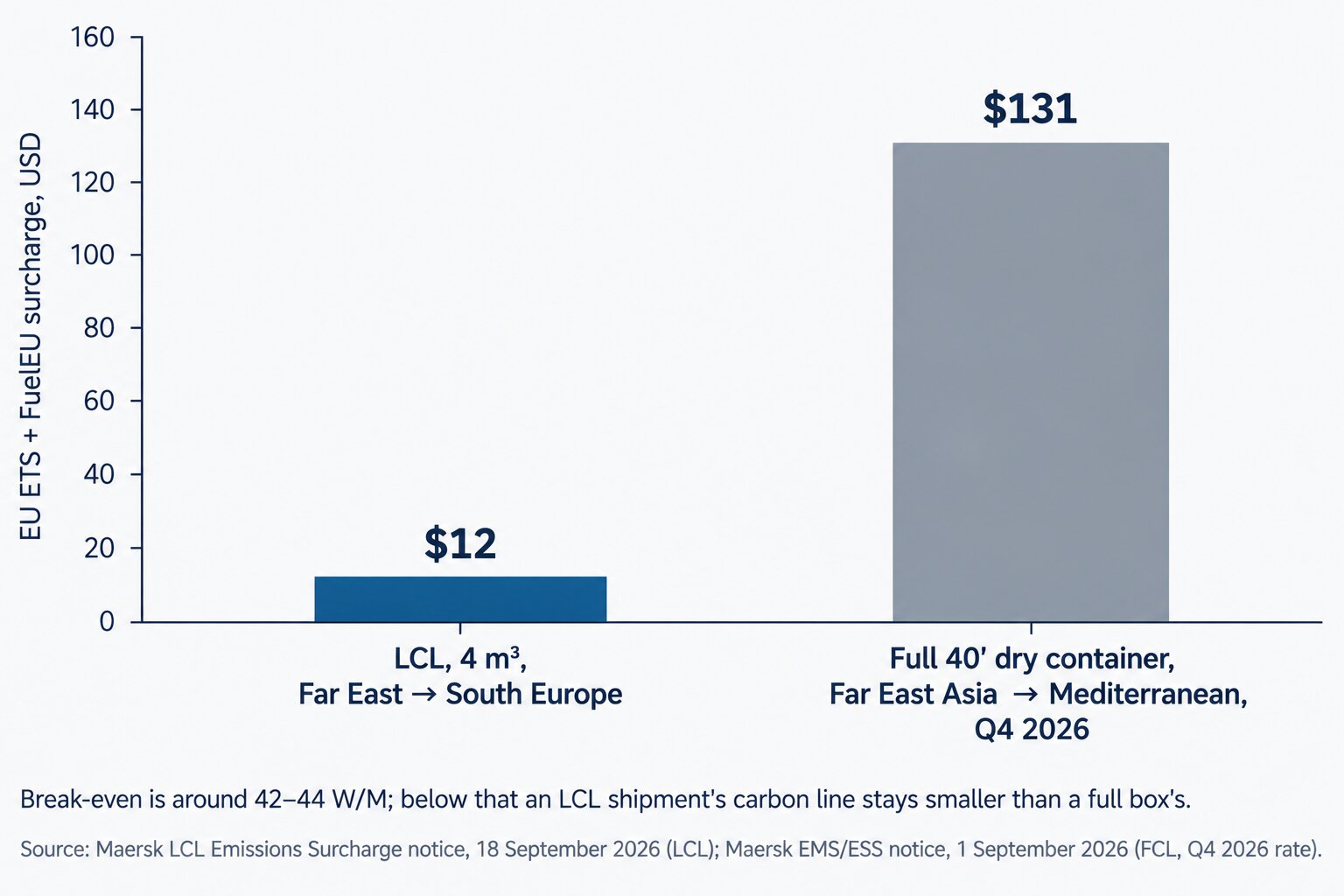
Does a 4 m³ consignment pay the same carbon line as a full box? At Maersk’s Q4 2026 LCL rate, it would pay 4 × $3 = $12 from the Far East to South Europe. Maersk’s Q4 2026 line for a 40-foot dry box from Far East Asia to the Mediterranean is $131 (the LCL notice calls that trade “South Europe”).
By our calculation, LCL reaches the whole-box line only at about 42–44 W/M: $170 ÷ $4 ≈ 42 from Far East Asia to North Europe, and $131 ÷ $3 ≈ 44 to the Mediterranean. A 40-foot box holds about 55–60 m³ usable (industry norm, Estimated).
Below 42 W/M the LCL line is always smaller, so for a few pallets on a consolidated cargo (LCL) service, base freight and handling decide when LCL beats a full container, not carbon. When we price an LCL booking into the EU, we check the trade’s per-W/M row against the chargeable W/M, not gross weight.
Why the emissions surcharge on ocean freight differs by carrier
On intra-North Europe routes in Q1 2026, ETS surcharges ran from $16 per TEU (twenty-foot equivalent unit) at Maersk to $83 at Ocean Network Express (ONE), about 5× apart (Searoutes, 16 January 2026). No other cross-carrier set ranks on Google’s first page.
| Lane (Q1 2026, USD/TEU) | Maersk | Hapag-Lloyd | CMA CGM | ONE |
|---|---|---|---|---|
| East Asia → North Europe | 84 | 82 | 84 | 93 |
| East Asia → Mediterranean | 65 | 87 | 67 | 42 |
| Intra-North Europe | 16 | 49 | 55 | 83 |
Hapag-Lloyd bills a direction-specific “Emission Allowance Surcharge (ETS)” as a separate Bill of Lading (B/L) line, reset for Q3 2026 to the latest EUA prices and Clean Cargo emission factors.
CMA CGM bundles EU ETS, FuelEU Maritime and other assumptions into an Energy Transition Surcharge. It quotes some FAK (freight all kinds) rates inclusive of EU ETS (Container News, 6 September 2026). All-in rates hide the line, so ask for the split, as with the other 2026 surcharges on a freight invoice.
Routing: the last port of call, Tanger Med and the Black Sea feeder
Two tests define a neighbouring container transhipment port: under 300 nautical miles from an EU port and over 65% of containers in transhipment (Implementing Regulation, October 2023). Tanger Med in Morocco and East Port Said in Egypt are listed. A stop at either is not the last port of call, the last non-EU/EEA port before an EU port, where the 50% leg begins.
Searoutes estimated for Q1 2026 that an Asia to Europe service calling last at Tanjung Pelepas, Malaysia, had 12,125 nautical miles (89%) in scope, for $30–45 per TEU. With a last stop at Felixstowe, UK, only 448 (3%) counted, for $3–10 per TEU.
For shippers routing Balkan cargo through Greek ports, the rule adds a leg. A box from Shanghai via Piraeus to Varna, Burgas or Constanța counts 50% of emissions to Piraeus and 100% on the intra-EU feeder. Transhipment at an unlisted hub in Türkiye would put that leg at 50%. No carrier publishes whether its tariff prices this difference.
On Black Sea bookings into Burgas, we ask where the box will be transhipped before comparing carriers’ ETS lines.
T&E’s overcharging evidence and the FuelEU Maritime share
On 58 CMA CGM sailings from Singapore in Q2 2026, VesselBot estimated actual EU ETS exposure at €26.3–30.5 per TEU (Container News, 18 September 2026). CMA CGM’s published Q2 2026 surcharge was €70 per TEU from Singapore to Rotterdam and €56 to Valencia and Piraeus.
Transport & Environment (T&E) estimated in March 2024 that surcharge revenue beat ETS cost on 486 of 565 journeys (86%) by 80 ships of Maersk, Mediterranean Shipping Company (MSC), CMA CGM and Hapag-Lloyd — its model used the 2024 phase-in of 40%. Maersk replied that T&E’s estimates were outdated (Lloyd’s List, 26 March 2024).
Is the line higher than the carbon it pays for? On carbon alone, both studies say yes. But the 2026 line also pays for FuelEU Maritime, whose 2025–2029 limit is 89.34 g CO₂-equivalent per megajoule, according to Lloyd’s Register. Maersk’s 1 December 2025 notice tied its Q1 2026 jump to 100% coverage and rising FuelEU biofuel costs.
Our view: treat both studies as a reason to ask each carrier for its EU ETS and FuelEU Maritime method, not as proof of an inflated 2026 line.
Who pays the EU ETS surcharge under each Incoterm
Maersk makes its line “payable by the payer of ocean freight” (LCL notice), though the shipping company surrenders the allowances. Incoterms® 2020, the International Chamber of Commerce (ICC) rules splitting costs and risk between seller and buyer, decide who that payer is.
| Incoterms® 2020 | Who contracts the main carriage | Who pays the ETS line |
|---|---|---|
| EXW, FCA, FAS, FOB | Buyer | Buyer, on the freight invoice |
| CFR, CIF, CPT, CIP | Seller | Seller, inside the sales price unless itemised |
| DAP, DPU, DDP | Seller | Seller, inside the sales price unless itemised |
Contracts in 2026 use pass-through, a formula per tonne of fuel or share of freight, or cost-sharing (Searoutes, May 2026). Good clauses name the data source, such as the EUA index, and grant audit rights. Allowances behind an EU ETS surcharge 2026 line are surrendered only by 30 September 2027, so both sides can check the charge later.
Checking the ETS line on your next quote: seven steps
At 100% coverage, ocean freight carbon surcharges look like this: the EU ETS surcharge 2026 changes quarterly, differs by carrier, lane and direction, and follows the EUA price.
- Find the line by label, such as EMS, ESS or Energy Transition Surcharge, or inside an all-in rate.
- Match it to the carrier’s row for your lane, direction, equipment and quarter.
- Multiply the window’s EUA average by your lane’s multiplier to sanity-check it.
- Ask for the last non-EU port of call and any intra-EU feeder leg.
- For LCL, confirm the rate per W/M and your chargeable W/M.
- Confirm who pays under your Incoterms® 2020 term.
- On contracts, name the EUA index and data source, and ask for audit rights.
Send your lane, cargo volume and Incoterms® 2020 term via our contact page, and we’ll reply with a sea freight quote within the working day.
FAQ
How much is the EU ETS surcharge per container in 2026?
The EU ETS surcharge 2026 on Maersk’s 40-foot dry box from Far East Asia to North Europe was €144, €154 and €133 in Q1–Q3 and applies at €148 from 1 October 2026. Other carriers differ, by about 5× on intra-North Europe in Q1 2026 (Searoutes).
Who pays the EU ETS surcharge, the shipper or the carrier?
The shipping company holds the legal obligation, but the payer of ocean freight pays the line: the buyer under FOB or FCA, the seller under CFR, CIF or DAP.
Does the EU ETS surcharge apply to LCL shipments?
Yes. From 1 October 2026 Maersk will charge per W/M: USD 4 from the Far East to North Europe and USD 3 to South Europe. A 4 m³ consignment to South Europe would pay USD 12.
Is the ETS surcharge negotiable?
Spot bookings pay the carrier’s published row, so the amount is fixed. On contracts the method is negotiable: pass-through, a formula or cost-sharing, ideally with a named EUA index and audit rights.
Will EU ETS surcharges go up in 2027?
Coverage is already 100%, so 2027 moves come from the carbon price. At an EUA average of €80–90, our multiplier puts Maersk’s Q1 2027 line from Far East Asia to North Europe at about €150–168 per 40-foot box (Estimated). The Commission’s ETS revision proposal of 17 July 2026 is not yet law.
Does the UK ETS add a surcharge from July 2026?
The UK Emissions Trading Scheme has covered shipping since 1 July 2026, but only domestic UK voyages by ships of 5,000 GT and above, Great Britain–Northern Ireland voyages at 50% and time at berth. Maersk is not passing it on.
About the author
This article was prepared by the Sea Gate Logistics editorial team, drawing on the company’s experience as an EU-registered freight forwarder in Burgas, Bulgaria, with 20+ years of collective logistics expertise across ocean, road, air, and consolidated (LCL) cargo.