As of September 2026, freight from Europe to Armenia works through Georgia: by road across Türkiye (Turkey) in about 6–14 days, per the forwarder CLT, or by sea and roll-on/roll-off (ro-ro) ferry, which carries trucks and trailers, into Poti or Batumi. Kars–Akhalkalaki rail opened to Armenian cargo in May 2026 without published transit times, Russia’s Upper Lars crossing is restricted for EU cargo, and the Türkiye–Armenia land border stays closed.
For shipping to Armenia from Europe, paperwork decides the route more than distance does. Armenia, a Eurasian Economic Union (EAEU) member since 2 January 2015, charges EU goods the EAEU tariff, averaging 6.4% per the World Trade Organization, plus 20% VAT on duty and the CIF value, meaning goods, freight and insurance to the border. Westbound, the Council of the European Union adopted a two-year duty suspension for about 80% of Armenian exports on 24 September 2026.
Key takeaways
- Freight from Europe to Armenia runs via Georgia: road through Türkiye in 6–14 days, or sea and ro-ro.
- The Türkiye–Armenia border stays closed; the 11 May 2026 change was paperwork only, and TRIPP isn’t expected before 2027.
- Kars–Akhalkalaki rail opened to Armenian cargo in May 2026, without published transit times.
- Upper Lars is restricted: listed EU goods can’t transit Russia, and it was shut about 200 hours in February 2026.
- EU goods pay the EAEU tariff (6.4% average) plus 20% VAT, about 27.7% of CIF, plus EAC where it applies.
- On 24 September 2026, the EU adopted a two-year duty suspension for about 80% of Armenian exports.
On this page:
· FAQ
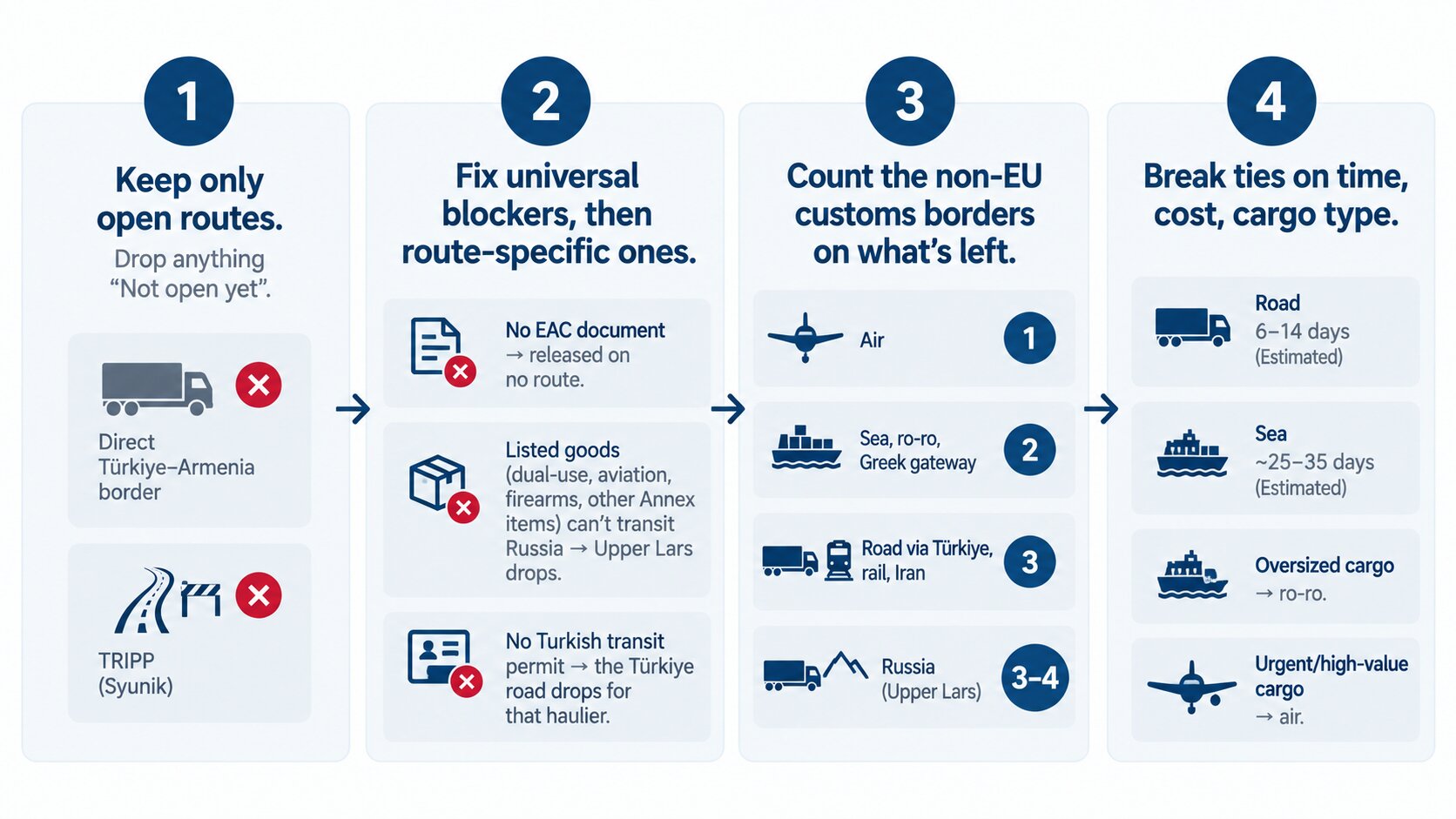
Europe–Armenia shipping routes: the September 2026 status board
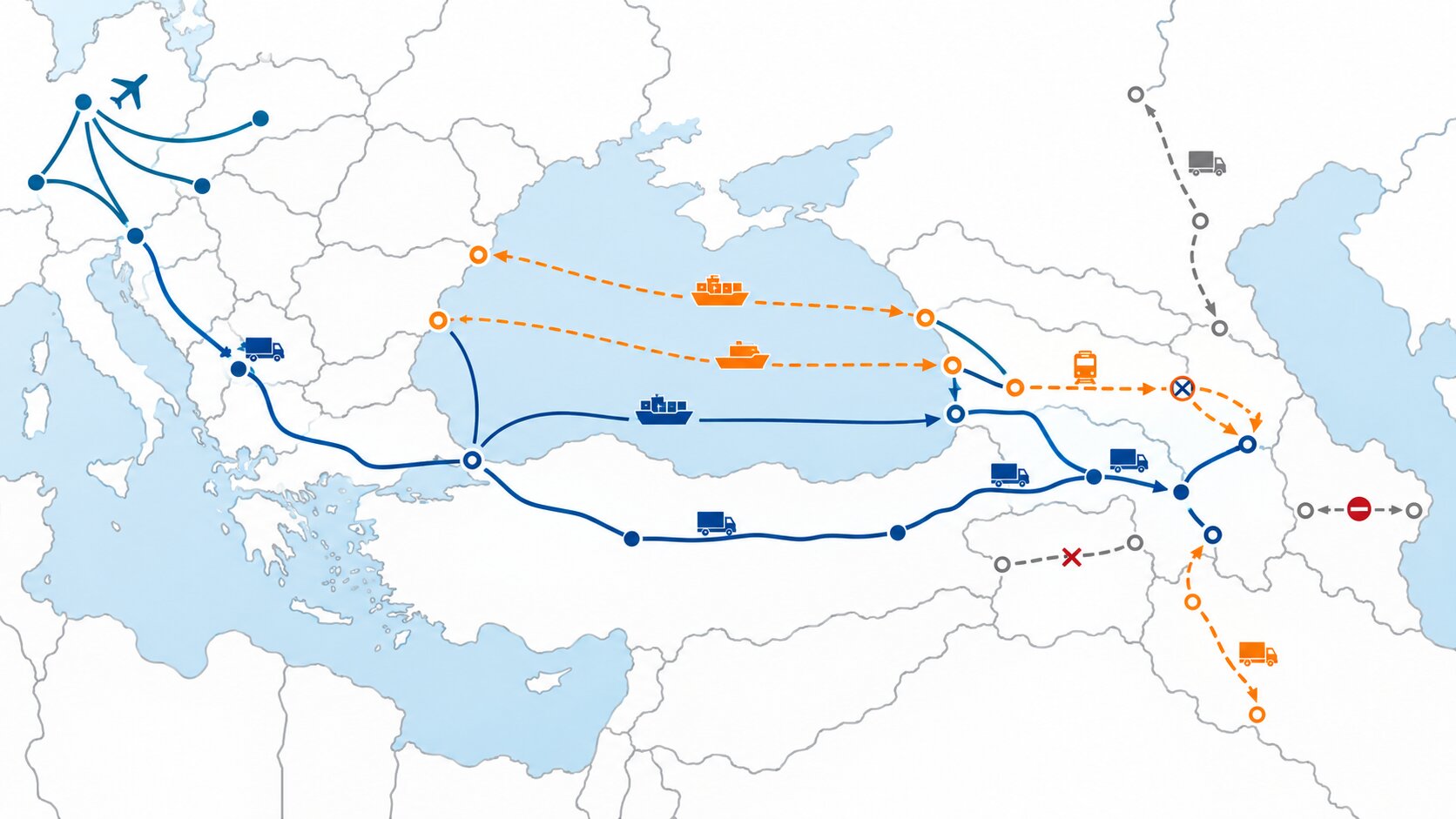
Armenia is landlocked, and with its Türkiye and Azerbaijan borders closed, Europe-bound trade funnels through Georgia (JAMnews; Armenia Guidebook).
| Route | Key legs | Non-EU customs borders | Typical transit | Status (Sep 2026) | What sets the status | Best for |
|---|---|---|---|---|---|---|
| Road via Türkiye and Georgia | Kapıkule → Sarp → Bagratashen or Bavra | 3 (TR, GE, AM) | 6–14 days from the EU; 1–4 days from Turkish cities | Works now | Rikoti highway opened 29 Dec 2025; road-tax exemption for ECMT or BSEC (Black Sea Economic Cooperation) permit trucks, 4 Jun 2026 | Full truckloads (FTL) and groupage |
| Container by sea to Poti | North Europe → Ambarlı transshipment → Poti | 2 (GE, AM) | ~25–35 days port-to-port + ~1–2 days to Yerevan (both Estimated) | Works now | Poti handled 404,760 TEU (twenty-foot equivalent units) in Jan–Jul 2026, +7% | Full containers (FCL), heavy, non-urgent |
| Black Sea ro-ro | Constanța–Poti (twice weekly) or Burgas–Batumi (weekly), then road | 2 (GE, AM) | 2–3 days (Constanța–Poti); ~48 h (Burgas–Batumi); plus road | Works with caveats | Few sailings; war-risk Listed Area JWLA-035 dated 16 Sep 2026 | Trailers, oversized loads, avoiding Türkiye transit |
| Greek gateway | Piraeus–Ambarlı–Poti feeder, or Piraeus → Constanța → ferry | 2 (GE, AM) | 14-day feeder rotation (launched April 2023; confirm current sailings) | Works with caveats | Feeder launched April 2023; no 2026 schedule confirmation | Mediterranean- or Asia-routed boxes |
| Rail via Kars–Akhalkalaki | Turkish rail → Kars → Akhalkalaki (gauge change) → Georgian rail | 3 (TR, GE, AM) | Not published; BTK targets only | Works with caveats | Opened to Armenian cargo, May 2026 | Rail-suited cargo, pilot shipments |
| Road via Russia (Upper Lars) | EU → Russia → Verkhny Lars → Georgia | 3–4 | Unreliable | Restricted | Cumulative closures >130 h Jan 2026, ~200 h Feb 2026; EU transit ban on listed goods | Not for EU-origin cargo |
| Iran (Agarak–Nurduz) | Türkiye → Iran → southern Armenia | 3 (TR, IR, AM) | Long detour | Works with caveats | Open, 400–450 trucks/day in early Mar 2026 | Iran-linked trade, rarely EU cargo |
| Air to Zvartnots (EVN) | EU airport → Yerevan | 1 (AM) | Flight-dependent | Works now | 42,679 t cargo and mail in 2025 | Urgent, high-value, small |
| Direct Türkiye–Armenia (Margara–Alican) | n/a | would be 2 (TR, AM) | n/a | Not open yet | 11 May 2026 change is paperwork only; border closed since 1993 | n/a |
| TRIPP (Syunik) | Azerbaijan ↔ Nakhchivan via Armenia | n/a | n/a | Not open yet | Construction not expected before 2027 | Watch item |
Sources: CLT, Gökay Transport, Investor.ge, PortsEurope, RailFreight.com, Beinsure, Hetq, Public Radio of Armenia. Assessed by Sea Gate Logistics, September 2026.
Status key: Works now = regular, published services · Works with caveats = runs, with a limit · Restricted = unsuitable for most EU-origin cargo · Not open yet = not usable. Border counts include Armenia, not transshipment calls such as Ambarlı.
Containers rate Works now because feeders keep liner schedules. Ro-ro gets a caveat: ferries still carry freight from Europe to Armenia, but every booking has to fit two weekly sailings to Poti or one to Batumi.
The Fewest-Borders Rule: how to pick your route
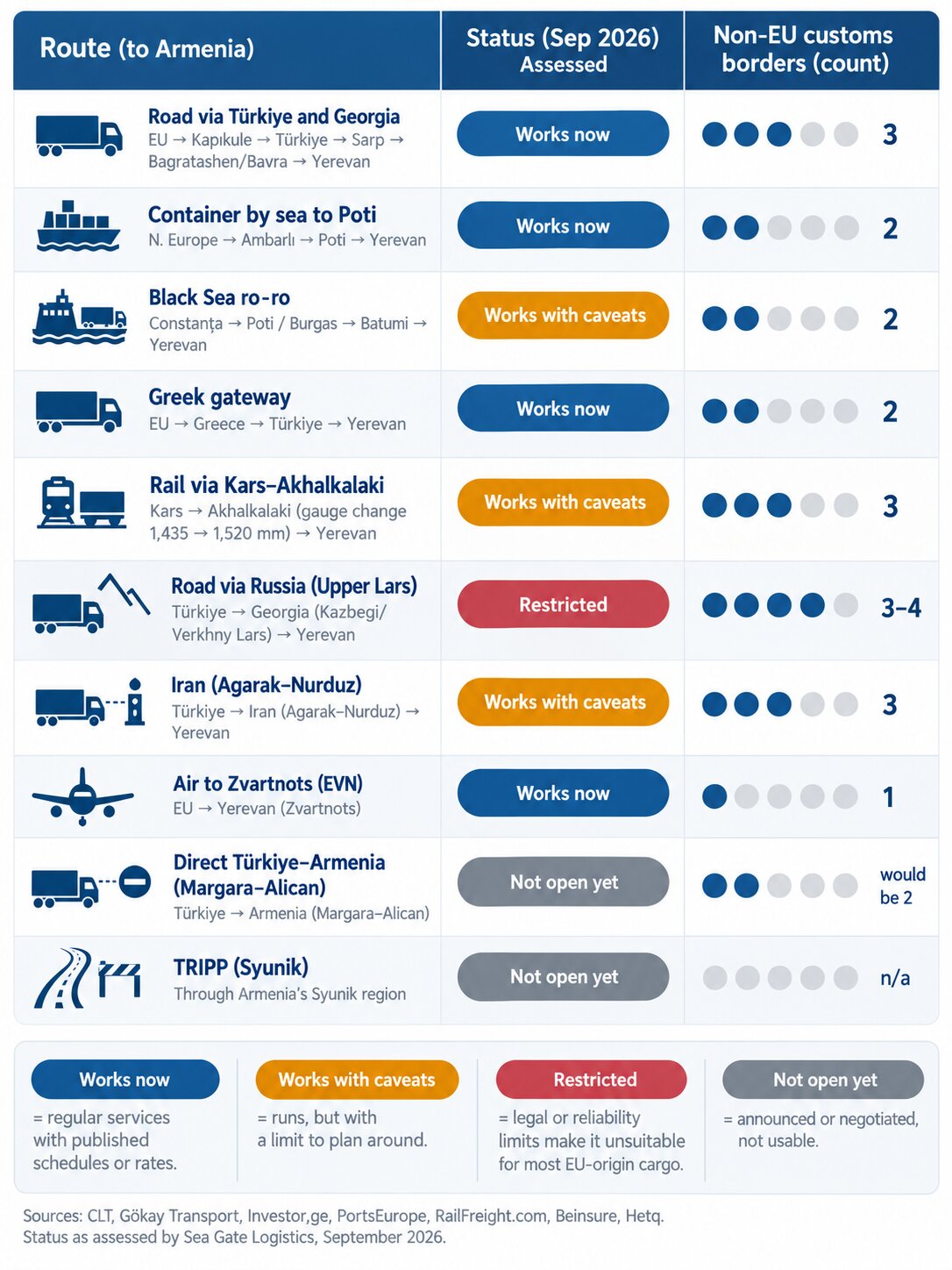
Why start with borders rather than distance? Every non-EU border is another customs check, another queue and another place where one document error stops the load.
The Fewest-Borders Rule: among the routes that are open and that your paperwork can clear, start from the one with the fewest non-EU customs borders, and switch to a route with more borders only when it saves enough time or money to pay for the extra customs event.
The rule finds the best route to ship goods from Europe to Armenia in four steps:
- Keep only open routes, which drops the direct Türkiye–Armenia border and TRIPP.
- Fix what blocks every route, then strike what blocks one. Goods under EAEU technical regulations need EAC conformity documents, an accredited body’s certificate or the applicant’s declaration, on any route. Listed goods such as dual-use items can’t transit Russia, and hauliers without Turkish transit permits can’t take the Türkiye road.
- Count the non-EU customs borders left on the board: 1 by air, 2 by sea or ro-ro, 3 by road, rail or Iran.
- Break ties on time, cost and cargo type: road takes 6–14 days against roughly 25–35 days by sea (Estimated), oversized loads go ro-ro, and urgent or high-value goods fly.
A full truck from Poland or Germany due within two weeks accepts the Türkiye road’s third border: about 6–10 days usually beats the detour to Constanța plus the wait for a sailing. In our view, road stays the default for full truckloads of freight from Europe to Armenia in 2026. The caveat is Kapıkule: when its queues run long, ro-ro starts paying for itself.
Road freight to Armenia through Türkiye and Georgia
Three borders define road freight on this lane: Kapıkule–Kapitan Andreevo out of the EU, Sarp/Sarpi into Georgia, and Bagratashen–Sadakhlo or Bavra–Ninotsminda into Armenia (Bavra leads straight to Gyumri on Armenia’s North–South road).
How long does freight take from Europe to Armenia by road (CLT, published ranges)
| EU origin | Road transit to Armenia |
|---|---|
| Poland | 6–9 days |
| Germany | 7–10 days |
| Czechia / Slovakia | 8–11 days |
| Italy | 9–12 days |
| Netherlands | 10–13 days |
| France / Belgium | 10–14 days |
Turkish origin to Armenia, FTL rates: Gökay Transport list, 2 March 2026 (indicative)
| Origin → destination | Transit | Indicative FTL rate (USD) |
|---|---|---|
| Trabzon → Yerevan | 1–2 days | 3,500–3,750 |
| Istanbul → Yerevan | 2–3 days | 4,400–4,750 |
| Ankara → Yerevan | 2–3 days | 4,200–4,450 |
| Izmir → Yerevan | 3–4 days | 4,700–5,050 |
| Mersin → Yerevan | not published | 4,300–4,650 |
| Istanbul → Gyumri | not published | 4,700–4,950 |
These are one carrier’s rates, published before Türkiye’s 11 May 2026 trade change; EU-origin loads add an unpriced EU → Türkiye leg.
In Georgia, the 52 km Rikoti highway on the E60, with 51 tunnels and 97 bridges, roughly halves travel time over the pass (Civil Georgia). Kapıkule queues reached about 25 km and 15–20 hours in January 2026, after two months of Greek farmers’ protests pushed freight onto the crossing (BTA).
EU hauliers also need Turkish transit permits. Armenian and Turkish drivers still need Schengen visas for the EU leg: the EU–Armenia visa-liberalisation action plan is under way, with assessment missions due in October and December 2026 (European Commission first progress report, May 2026).
Shipping to Armenia via Poti: containers, ro-ro ferries and the new war-risk zone
A record 636,466 TEU passed through APM Terminals Poti in 2025 (APM Terminals). From North Europe, boxes transship at a Mediterranean hub or Istanbul’s Ambarlı, changing ships without being imported. Feeders, smaller ships linking hubs with regional ports such as Poti, cover the last leg. Their liner schedules make Poti the most regular sea option for heavy, non-urgent FCL freight from Europe to Armenia.
| Ferry | Frequency | Crossing | Carries |
|---|---|---|---|
| Constanța–Poti, E60 Shipping Line (Aia) | Twice weekly | 2–3 days | Trucks, trailers, containers, oversized cargo |
| Burgas–Batumi, PB Management “Drujba Line” | Once a week | About 48 hours | Cargo on two-thirds of capacity |
Investor.ge listed €300–€2,600 for the Black Sea ferry Constanța–Poti in February 2025, before the war-risk listing.
The Joint War Committee’s JWLA-035 listing, dated 16 September 2026, puts most of the Black Sea in the Listed Area, where ships need additional war-risk cover. Only the 12-nautical-mile territorial waters of Türkiye, Bulgaria, Romania and Georgia are excluded (Beinsure), so check your war-risk cover before booking.
Mediterranean-routed boxes may also use the Piraeus–Ambarlı–Poti feeder; our guide to shipping via Greek ports covers that gateway.
Kars–Akhalkalaki rail, Upper Lars and Iran: routes with conditions
In May 2026, Prime Minister Nikol Pashinyan announced the Kars–Akhalkalaki railway open to Armenian exports and imports; Public Radio of Armenia reported on 24 May and RailFreight.com on 26 May. The 105 km link, part of the Baku–Tbilisi–Kars (BTK) railway, is Armenia’s first rail route toward the EU. Akhalkalaki needs a gauge change, where cargo transfers between rail systems built to different track widths: Georgia’s 1,520 mm broad gauge and Türkiye’s 1,435 mm standard gauge.
No Armenian-cargo transit times had been published by September 2026; BTK’s goals of 60 hours or less for Kars–Mersin and 70 for Kars–Istanbul are targets, not measured transit.
Verkhny Lars (Upper Lars) is Armenia’s only land link to Russia. Upper Lars truck closures ran to more than 130 hours in January 2026 and roughly 200 in February, about 30% of February 2026’s 672 hours (russiable.com). Under Regulation (EU) 833/2014, EU-origin listed goods may not transit Russia. Russia has also obstructed the transit of certain Armenian goods (European Commission proposal COM(2026) 348).
Agarak–Nurduz, Armenia’s only crossing with Iran, lies about 376 km south of Yerevan (Armenia Guidebook); check EU restrictive measures on Iran before routing EU goods there.
Is the Turkey–Armenia border open? What changed on 11 May 2026
No: the Türkiye–Armenia land border, closed since 1993, remains shut to trucks and trains in September 2026. The 11 May 2026 change concerned paperwork only. Türkiye’s Foreign Ministry said shipments moving through a third country may now declare Türkiye or Armenia as origin or final destination, Euronews reported on 13 May.
For Türkiye–Armenia direct trade in 2026, Turkish-origin goods can now be documented through to Armenia, but the truck still runs via Sarp and Georgia. Margara–Alican has opened only for humanitarian convoys.
Rail work has started on the Turkish side of the line. After a joint working group met in Kars on 28 April 2026, Türkiye began restoring the 18–20 km Akyaka–Gyumri section of the Gyumri–Kars railway, idle since 1993, which still cannot carry cargo until the border opens (Türkiye’s Foreign Ministry; Armenpress). Armenia’s Deputy Foreign Minister Vahan Kostanyan said on 24 June 2026 that Armenia expects open borders with two of its neighbours by 2030 (Hürriyet Daily News).
TRIPP, the Trump Route for International Peace and Prosperity, is a planned route of about 43 km through Syunik linking Azerbaijan with Nakhchivan; construction is not expected before 2027 (RFE/RL).
Paperwork decides the route: EU export rules and Armenian customs
Without required EAC documents, a load is not released at Bagratashen, whichever route it took: customs clearance in Armenia follows the same EAEU rules at every border post. On the EU side, the European Commission sanctions FAQs explain the Art. 12g clause for common high priority items (CHPI), battlefield-relevant goods watched for diversion to Russia.
| Side | Rule or document | Effect on your route | Who handles it |
|---|---|---|---|
| EU export | Art. 12g, Regulation (EU) 833/2014: “no re-export to Russia” contract clause for CHPI, aviation goods, jet fuel, firearms | Every route; breaches are criminal offences in most Member States | Exporter |
| EU export | No transit via Russia for listed goods: dual-use, Annex VII technology, firearms, aviation/space goods, jet fuel, Annex XXXVII items | Rules out Upper Lars; other third countries not prohibited | Exporter, forwarder |
| EU → Türkiye, road | Turkish transit permits under bilateral quotas | Caps road capacity on the Türkiye route | Haulier |
| Armenia import | EAEU Common Customs Tariff: 6.4% simple average, 8.2% trade-weighted, 15.8% of lines duty-free (WTO, 2024) | Every route; the tariff line sets the rate | Importer, customs broker |
| Armenia import | 20% VAT on CIF + duty at entry; no 20-day deferral for EU goods | Every route; a cash-flow hit | Importer |
| Armenia import | EAC certificate or declaration via an EAEU-based applicant or authorised representative | No EAC, no release | Manufacturer, importer |
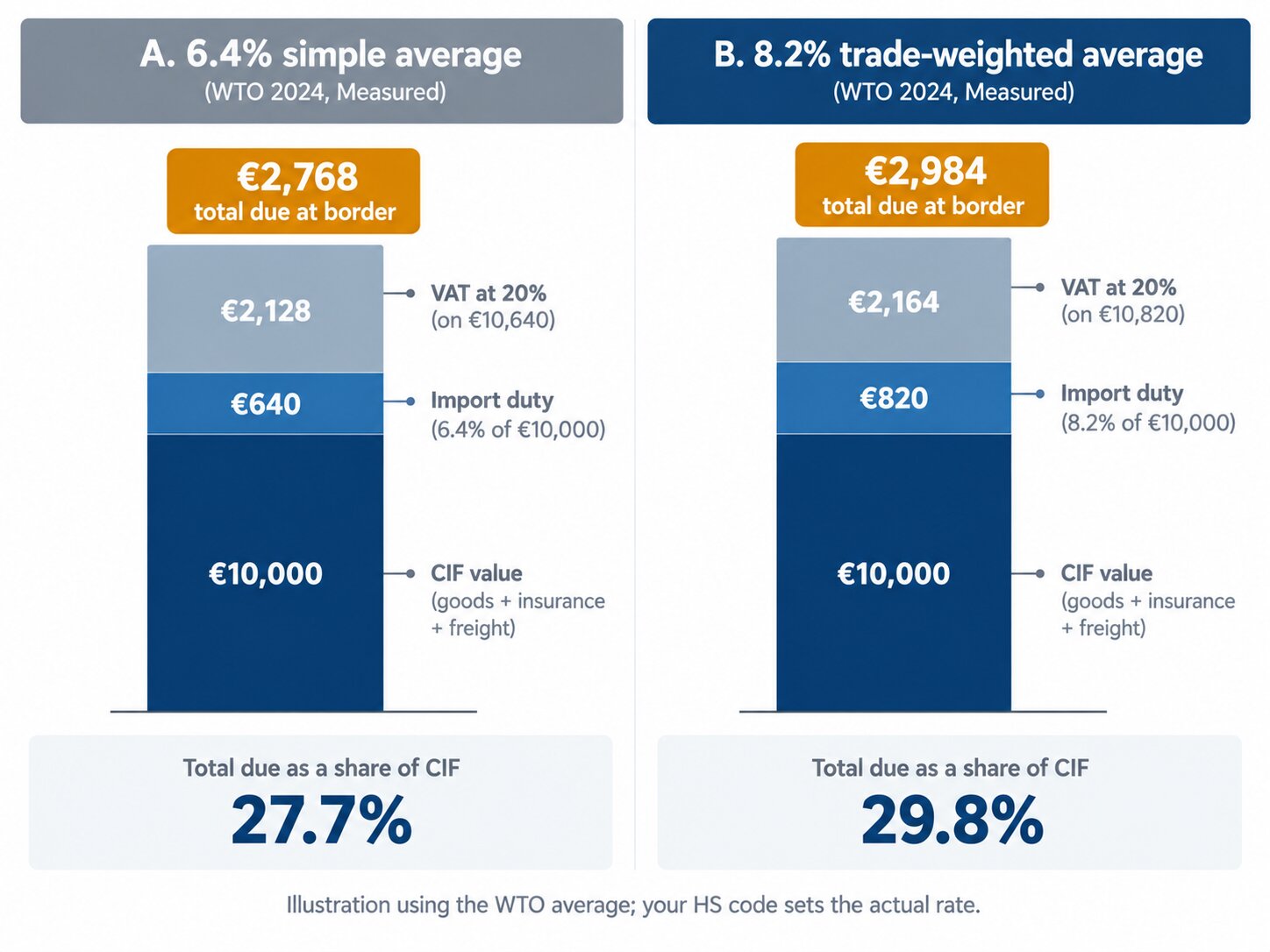
At the WTO 6.4% average, €10,000 CIF pays €640 duty plus 20% VAT on €10,640 (€2,128), so €2,768 is due at the border, about 27.7% of CIF. At the 8.2% trade-weighted average, it is €2,984, or 29.8%. Both are illustrations, since your HS (Harmonized System) code sets the real rate.
Sanctions annexes change (the Council of the EU adopted the 20th package on 23 April 2026), so check them at booking. Under Incoterms® 2020 DAP (Delivered at Place), the Armenian buyer pays at entry; under DDP (Delivered Duty Paid), the seller does.
Exporting from Armenia to the EU: the direction that changed most in 2026
In 2024 the EU exported €2,004 million of goods to Armenia and imported €410 million, down 42.9% (European Commission, Eurostat data). In value terms, freight from Europe to Armenia outweighs the return flow almost five to one.
After Russia restricted Armenian flowers, brandy, wine, mineral water and fish in May and June 2026 (The Moscow Times), the Council of the EU adopted temporary trade measures on 24 September. For two years, they liberalise about 80% of Armenian exports to the EU, covering about 99% of the fresh fruit, vegetables and plants and over 91% of the drinks Armenia sold to Russia.
Eight fresh products get tariff-rate quotas of 750–7,000 tonnes, volumes entering at reduced duty before the normal rate applies. The measures apply once published in the Official Journal of the EU. Westbound produce moves in reefers, temperature-controlled trucks or containers, by road via Sarp and Kapıkule or by ro-ro to Constanța or Burgas. We expect more loaded westbound trucks once the measures apply, though that depends on exporters meeting the origin rules.
Groupage to Yerevan, LCL and air: small and urgent shipments
Two standard EUR pallets (1.2 × 0.8 m) take about 0.8 loading metres, the length of trailer deck the cargo occupies. That is roughly 6% of a 13.6 m deck. Why pay for 13.6 metres of trailer to move 0.8? A full truckload from Turkish cities to Armenia costs an indicative USD 3,500–5,050 on Gökay Transport’s list.
Groupage, or LTL (less than truckload), fixes that: several shippers’ pallets share one truck, and each pays by loading metre, volume or weight. Gökay Transport’s groupage leaves Türkiye for Armenia on Wednesdays and Fridays, plus a conditional Monday. From our base in Burgas, Kapıkule is the first non-EU border on this lane and the one we watch most closely when we plan consolidated loads.
LCL to Armenia (Less than Container Load) works the same way at sea, in a shared container; the LCL vs FCL comparison shows where a full box starts to pay.
Cargo and mail at Zvartnots (EVN) rose about 83% from 23,340 tonnes in 2022 to 42,679 tonnes in 2025, but only 1% in 2025 itself (Hetq); cost limits air to urgent or high-value shipments.
Which route to book for freight from Europe to Armenia
Two corridors carry nearly all EU cargo into Armenia in September 2026: road through Türkiye and Georgia, and sea or ro-ro into Poti or Batumi. The Fewest-Borders Rule picks between them:
| If you ship… | Book first | Fallback |
|---|---|---|
| Full truck of general cargo, Central or Eastern EU | Road via Türkiye and Georgia (6–14 days) | Ro-ro Constanța–Poti |
| Trailer from Romania or Bulgaria, or oversized load | Ro-ro Constanța–Poti or Burgas–Batumi, skipping Turkish permits and Kapıkule | Road via Türkiye |
| Full container from a North Sea port, not urgent | Sea via Ambarlı to Poti (~25–35 days, Estimated) | Greek gateway feeder |
| 1–5 pallets | Groupage via Türkiye | LCL by sea |
| Urgent or high-value goods | Air to Zvartnots | Express groupage |
| Armenian produce or drinks to the EU | Reefer truck via Georgia and Türkiye | Ro-ro Poti–Constanța |
| Dual-use or other listed goods | Any route except Russia, with licences checked | n/a |
Before booking, check war-risk cover on Black Sea legs, EAC documents for regulated goods and, westbound, the Official Journal date.
Send the origin, cargo type and pallet count to our freight team, and we’ll reply within the working day with a route and cost, or browse Sea Gate’s routes first.
FAQ
How long does road freight take from Europe to Armenia?
About 6–14 days via Türkiye and Georgia, by EU origin (CLT). Kapıkule queues cause the widest swings, reaching 15–20 hours in January 2026 (BTA).
Is the Turkey–Armenia border open in 2026?
No. The Türkiye–Armenia land border, closed since 1993, stays shut in September 2026. The 11 May 2026 change only lets goods routed through third countries name Türkiye or Armenia as origin or destination.
Can freight go from Europe to Armenia by rail?
Only partly. The Kars–Akhalkalaki line opened to Armenian cargo in May 2026, giving freight from Europe to Armenia a rail option via Türkiye and Georgia. No transit times had been published by September 2026.
Can EU cargo for Armenia go through Russia?
Listed EU goods, such as dual-use items, may not transit Russia under Regulation (EU) 833/2014. Upper Lars was also closed for more than 130 hours in January 2026 and about 200 in February.
What import duty and VAT does Armenia charge on EU goods?
EU goods pay the Eurasian Economic Union’s Common Customs Tariff, averaging 6.4% simple or 8.2% trade-weighted (WTO, 2024), plus 20% VAT on the CIF value and duty, paid at entry. Goods under EAEU technical regulations also need an EAC certificate or declaration.
What does the EU’s 2026 tariff suspension mean for Armenian exporters?
The EU’s temporary trade measures, adopted by the Council of the EU on 24 September 2026, liberalise about 80% of Armenian exports to the EU for two years. They apply once published in the Official Journal.
Can I ship a few pallets to Yerevan?
Yes, by groupage: two EUR pallets take about 0.8 loading metres of a shared 13.6 m trailer. Turkish groupage departs on Wednesdays and Fridays (Gökay Transport).
About the author
This article was prepared by the Sea Gate Logistics editorial team, drawing on the company’s experience as an EU-registered freight forwarder in Burgas, Bulgaria, with 20+ years of collective logistics expertise across ocean, road, air, and consolidated (LCL) cargo.