Cargo insurance for European shipments typically costs 0.3% to 0.5% of declared cargo value, and consolidated LCL cargo is usually quoted nearer 1% to 1.5% (Estimated bands, not quotes). On a €24,000 road consignment that is roughly €98. Cover is not legally mandatory anywhere in the EU, and only two of the eleven Incoterms® 2020 rules oblige anyone to buy it.
It is worth buying because of the gap it fills: carriers pay by weight, not value. The CMR Convention caps international road carriage at 8.33 SDR (Special Drawing Right, an IMF reserve-currency unit) per kilogram, so 1,200 kg of cargo returns about €11,900 whether the goods were worth €24,000 or €240,000.
The decision rule is short. Insure whenever the cargo is worth more than the convention cap multiplied by its gross weight, which for manufactured goods is almost always. This guide covers commercial cargo moving to, from and within Europe by sea, road and air, for SME importers and exporters. It does not cover personal effects, household removals or vehicle fleet insurance. It is general information, not insurance or legal advice, and rates here are indicative.
Key takeaways
- General cargo runs 0.3%–0.5% of value; LCL and groupage form a separate class at 1.0%–1.5% (Estimated).
- Insured value is standard at 110% of CIF: cost plus freight plus 10%.
- Carrier caps are weight-based: 8.33 SDR/kg road, 26 SDR/kg air, 2 SDR/kg or 666.67 SDR per package by sea (Measured).
- Across three European lanes, the uninsured gap ran 77 to 164 times the premium that would have closed it.
- Only CIF (ICC (C) minimum) and CIP (ICC (A) since Incoterms® 2020) require anyone to insure. Under every other rule, whoever bears risk is bare.
What Cargo Insurance Actually Covers (and What Carrier Liability Doesn’t)
Two different things get called “insurance” in a freight quote, and confusing them leaves shippers short after a loss.
Cargo insurance is a policy the cargo owner buys on the declared value of the goods. It responds to physical loss or damage in transit regardless of fault. The claim is direct: you claim on your own insurer, which then chases the carrier itself under subrogation, its right to recover what it paid you.
Carrier liability is something else. It is the transport operator’s capped legal responsibility under the convention governing the mode, written per kilogram of gross weight rather than per euro of value, and recovering under it means proving the goods were tendered in good order and lost in the carrier’s custody. That claim is indirect, fault-based and limited before it starts. A carrier’s liability policy protects the carrier, not your goods.
If a shipment does go wrong, the procedure and deadlines are in our guide on what to do if your cargo is lost or damaged. Cost is the question that comes before it.
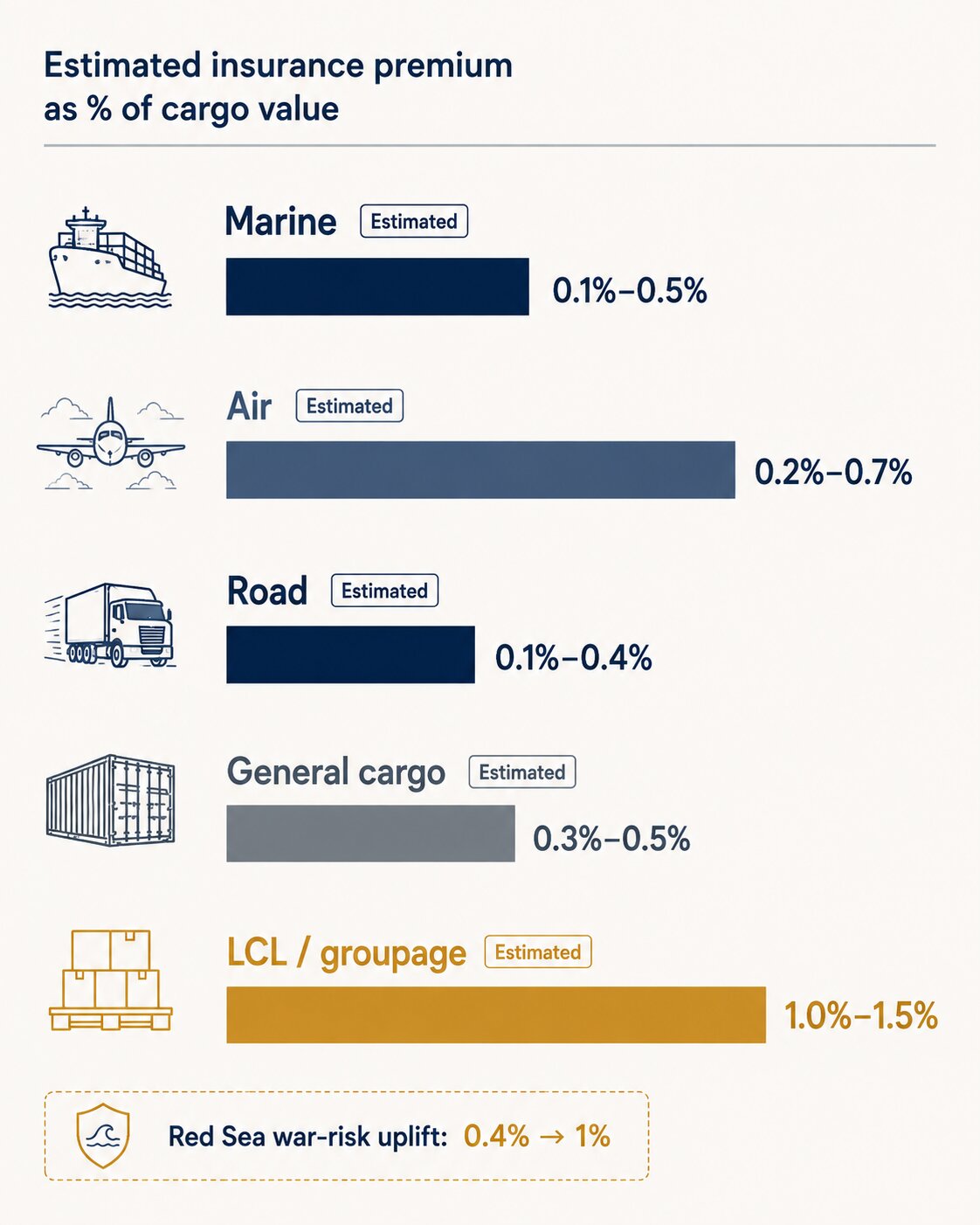
What Cargo Insurance Costs in 2026: Rates by Mode
Published bands cluster tightly for a product priced case by case.
| Mode | Typical premium band (% of insured value) | Label |
|---|---|---|
| Sea / ocean freight | 0.1% – 0.5% | Estimated |
| Road freight | 0.1% – 0.4% | Estimated |
| Airfreight | 0.2% – 0.7% | Estimated |
| General cargo, all modes | 0.3% – 0.5% | Estimated |
| LCL / consolidated cargo | 1.0% – 1.5% | Estimated |
Four variables move a quote inside those bands. Commodity comes first: electronics, pharmaceuticals and branded goods attract theft and price above resilient industrial cargo. Lane follows, since a Balkan corridor with limited secure parking prices differently from an intra-Benelux run. A higher deductible buys a lower rate. Mode and handling close the list, and handling is why the LCL band sits above the rest.
Rates are drifting upward on higher theft, replacement costs and tighter limits. The global cargo line wrote USD 22.64 billion in premium in 2024, up 1.6%, according to the International Union of Marine Insurance (Measured).
How the Premium Is Calculated: CIF Value Plus 10%
The formula is standard across the London market:
Insured value = (cost of goods + freight) × 1.10 Premium = insured value × rate
That extra 10% is not padding. It covers anticipated profit, the survey and claim-handling costs a total loss creates, and replacement-price inflation between loss and repurchase.
Goods invoiced at €24,000 with €1,400 of freight give an insured value of €27,940. At 0.35%, the premium is roughly €98 (Estimated rate). CIF here means cost, insurance and freight to the named destination port, so the freight figure must be the one actually paid on that lane. Underinsurance is settled proportionally: declare 70% of true value and you recover 70% of the loss.
The Gap, in Euros: What the Carrier Would Actually Pay
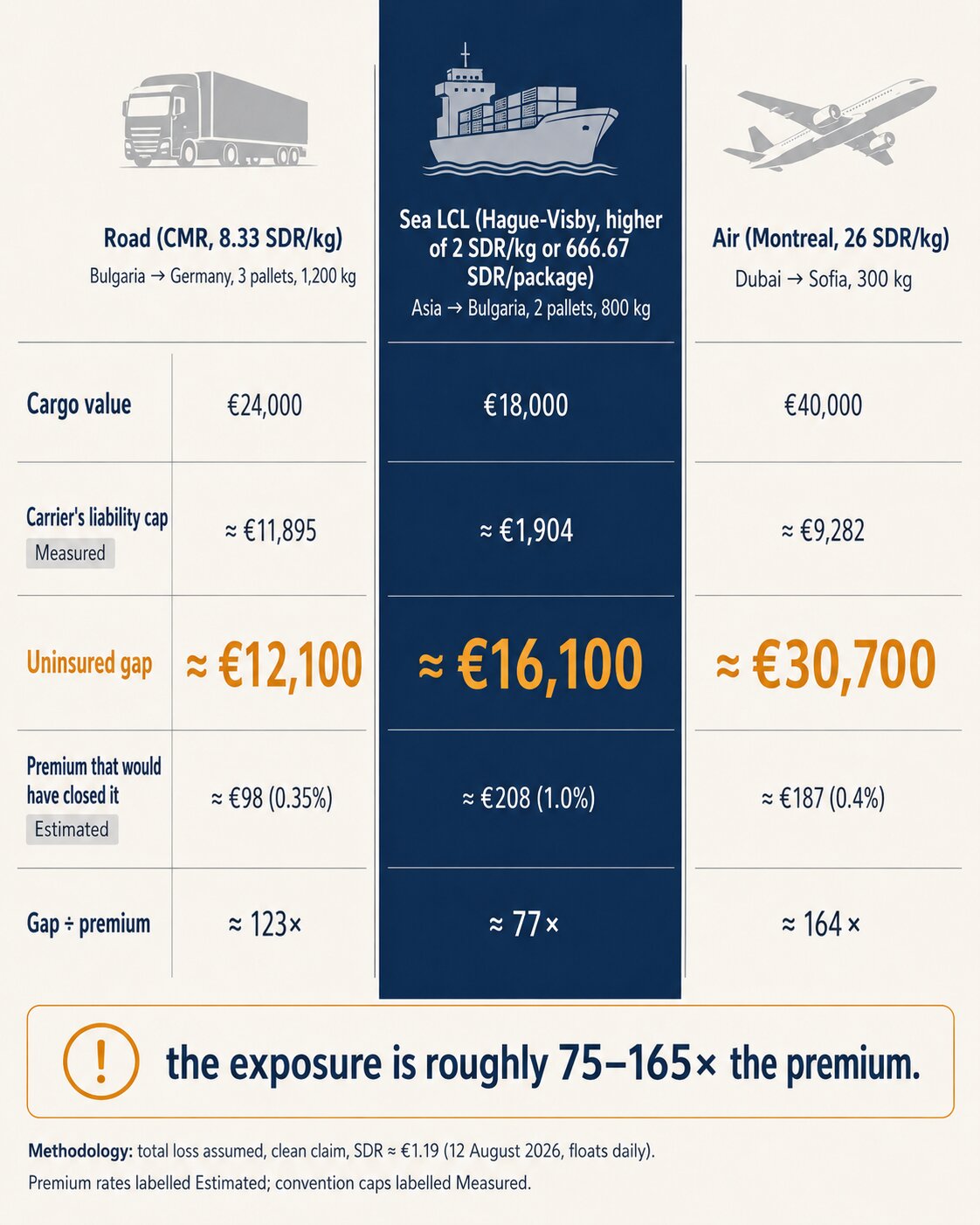
Convention caps get concrete once converted into euros beside cargo value and premium. Three European lanes, one per mode:
| Lane (convention) | Cargo value | Weight | Freight | Insured value | Carrier pays | Gap | Premium | Gap ÷ premium |
|---|---|---|---|---|---|---|---|---|
| Road, Bulgaria → Germany, 3 pallets (CMR Art. 23, 8.33 SDR/kg) | €24,000 | 1,200 kg | €1,400 | €27,940 | ≈ €11,895 | ≈ €12,100 | ≈ €98 (0.35%) | ≈ 123× |
| Sea LCL, Asia → Bulgaria, 2 pallets (Hague-Visby, 2 SDR/kg or 666.67 SDR/package) | €18,000 | 800 kg | €900 | €20,790 | ≈ €1,904 | ≈ €16,100 | ≈ €208 (1.0%) | ≈ 77× |
| Air, Dubai → Sofia (Montreal Art. 22, 26 SDR/kg) | €40,000 | 300 kg | €2,500 | €46,750 | ≈ €9,282 | ≈ €30,700 | ≈ €187 (0.4%) | ≈ 164× |
Method, stated openly so the arithmetic can be checked. Premium equals insured value × the rate shown, where insured value is (cargo value + freight) × 1.10 from the formula above. That is why each premium runs slightly above the rate applied to cargo value alone. Each row assumes a total loss and a clean, undisputed claim, the carrier’s best case rather than the typical one. Caps are the published convention limits (Measured): 8.33 SDR per kilogram under Article 23 of the CMR Convention, 26 SDR per kilogram under Montreal, and the higher of the two Hague-Visby calculations by sea. Each pallet counts as one package in the sea row, though the per-kilogram figure governs there in any case. SDR converts at about €1.19 on 12 August 2026, published by the International Monetary Fund, and that rate floats daily.
The sea row surprises people. Two pallets at 800 kg return under €2,000 against €18,000 of cargo, because a light shipment gains little from a per-kilogram cap. Skipping cover on all three lanes saves about €490 and carries roughly €58,900 of unfunded risk.
Institute Cargo Clauses A, B and C: Choosing Your Cover Level
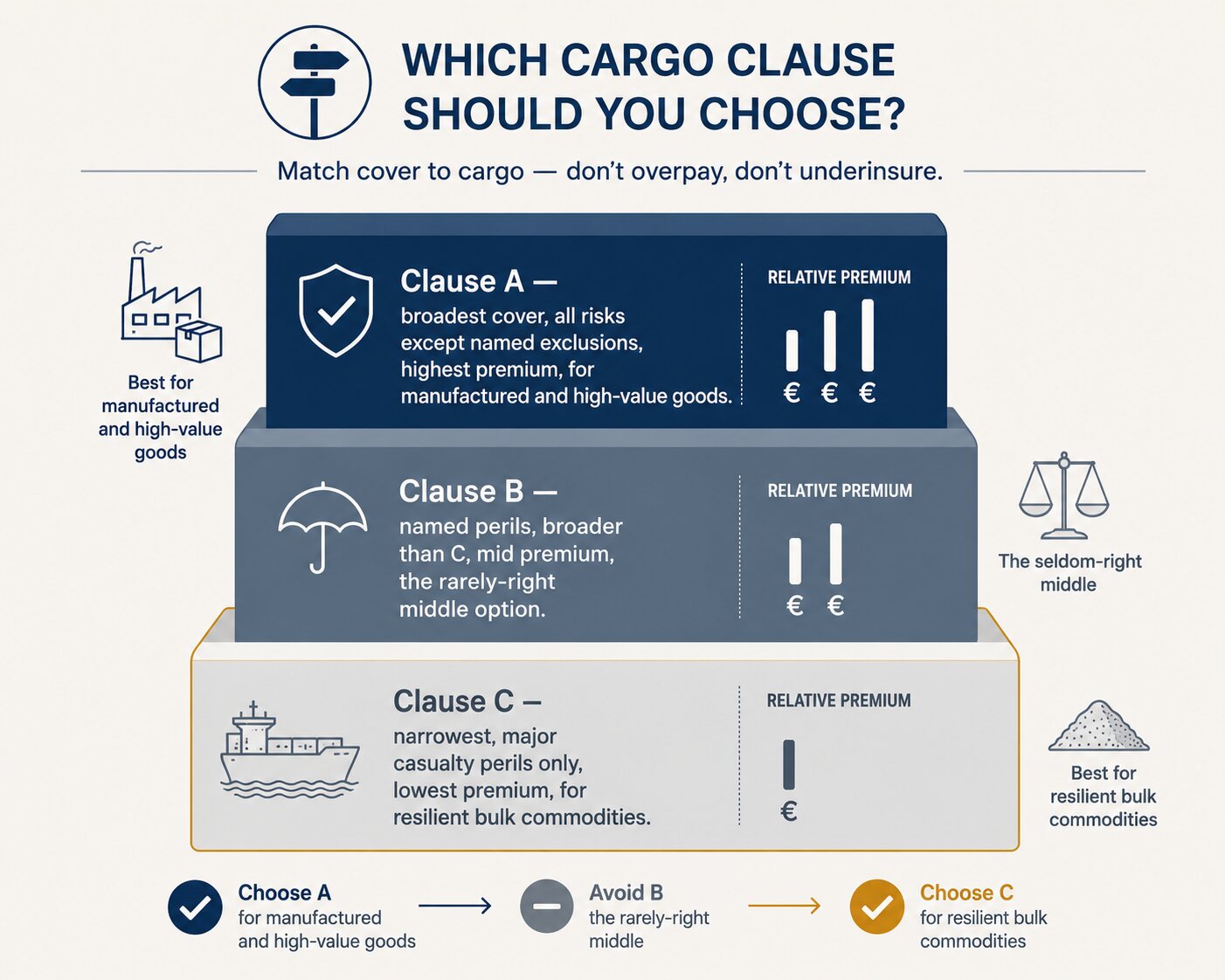
Institute Cargo Clauses are the standard London-market wordings from the Institute of London Underwriters. Nearly every marine cargo policy sold in Europe uses one of the three (Measured).
| Clause | What it covers | Relative premium | Typical cargo |
|---|---|---|---|
| ICC (A) | All risks except named exclusions: theft, pilferage, rough handling, weather | Highest | Manufactured and high-value goods, electronics, machinery, pharma |
| ICC (B) | Named perils: fire, explosion, collision, stranding, water damage, jettison, earthquake | Moderate | Mid-risk cargo where all-risks is hard to justify |
| ICC (C) | Major casualty only: fire, explosion, stranding, collision, jettison, general average (shared loss from a voluntary sacrifice) | Lowest | Bulk commodities, low-value resilient cargo |
The choice is less balanced than the table suggests. For manufactured goods in mixed traffic, Clause A is the only wording that answers the loss most likely to happen, theft or handling damage rather than a vessel casualty. Clause C suits dense, cheap cargo where the realistic loss really is the ship sinking. Clause B is the rarely-right middle: it costs more than C while still excluding pilferage and rough handling, so buyers pay for an upgrade and keep the exposure that worried them.
Incoterms® 2020: Who Is Supposed to Buy the Insurance
Two rules out of eleven create an insurance obligation. That is the whole list.
Under CIF, the seller must obtain a minimum of ICC (C), for sea and inland waterway only, unchanged from Incoterms 2010. Under CIP, the seller must obtain ICC (A), upgraded from Clause C in the 2020 revision, for any mode. Both are set out by the International Chamber of Commerce (Measured).
CIF contains a trap that produces denied claims every year. Risk passes to the buyer once the goods are on board, so the buyer carries the exposure for the whole sea leg, yet the policy protecting that leg belongs to the seller and needs only to meet Clause C. Cartons stolen in transit fall outside Clause C. Ask which clause the seller actually bought.
Under EXW, FCA, FOB, DAP, DDP and the rest, nobody is required to insure. Risk still transfers at a defined point, so one party is uninsured from that moment. Which party was that on your last shipment?
When You Actually Need Cargo Insurance for European Shipments: A Five-Question Test
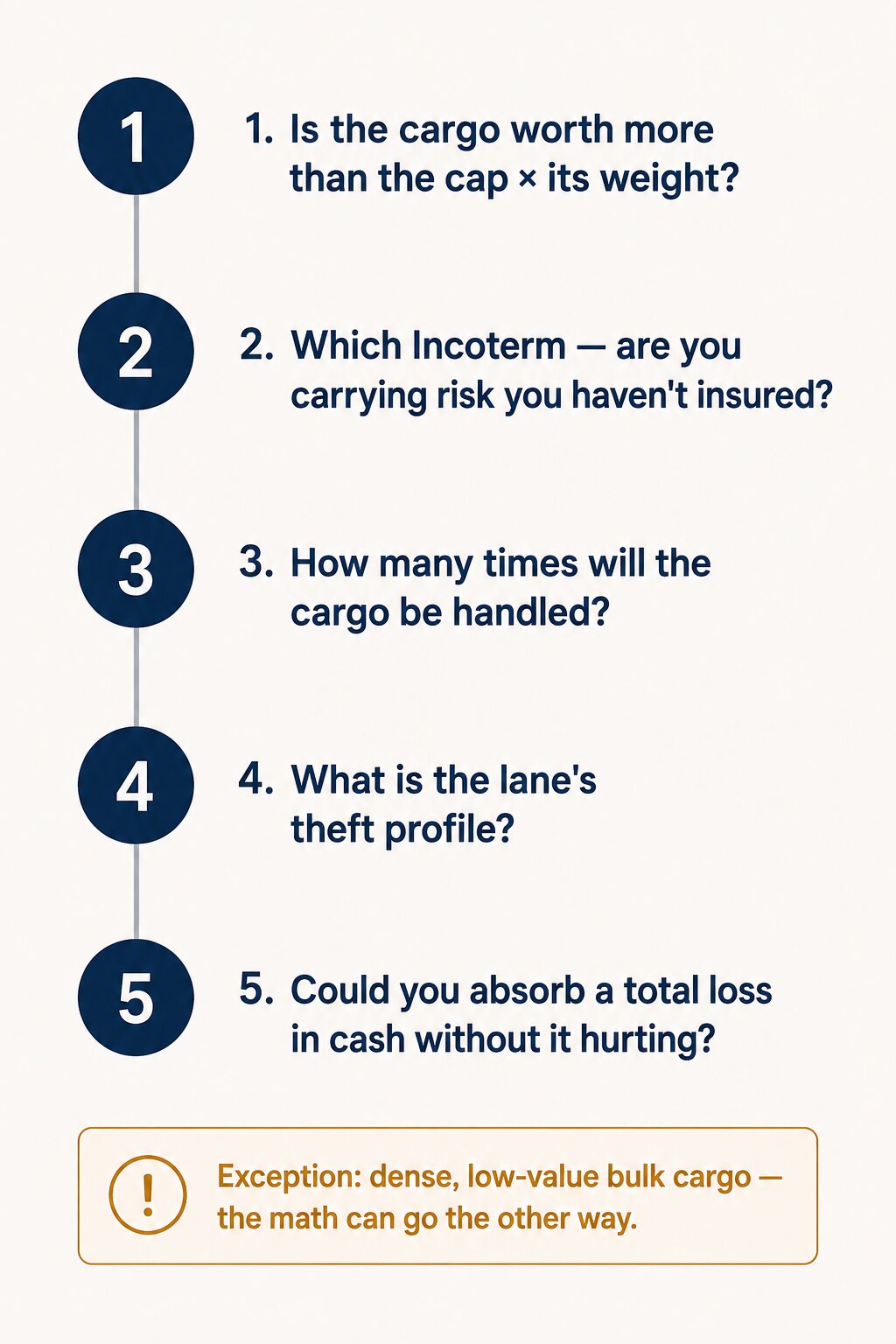 Five questions decide it. Call it the value-risk-tolerance test, and run it before booking rather than after the incident.
- Is the cargo worth more than the cap multiplied by its weight? Take the convention cap for the mode, multiply by gross weight, convert at the current SDR rate. Anything above that line is unfunded exposure.
- Which Incoterm are you shipping on? Anything other than CIF or CIP means nobody is obliged to insure; on CIF, check the clause.
- How many times will the cargo be handled? A direct FTL run is handled twice; an LCL box on a transshipment routing can be handled six times.
- What is the lane’s theft profile? European cargo crime is at a high. TAPA EMEA recorded 1,168 cargo thefts in February 2026 alone, losses near €166.5 million, and more than €1 billion of freight theft in the 18 months to 30 June 2026 (Measured). Germany, Italy and Spain led the June 2026 counts, and intrusion attacks such as curtain-cutting make up two-thirds of cases.
- Could you absorb a total loss in cash without it hurting? If the honest answer is no, the question is answered.
There is a real counter-case, and most guides pretend otherwise. Where cargo is heavy and cheap, the weight-based cap moves close to the cargo value and the argument weakens. A 24-tonne road load of building materials worth €9,000 sits under a CMR cap near €238,000. Cover still buys certainty against a contestable claim, so we would take it anyway on a lane with a poor security record, but this is the one case where declining is defensible.
LCL and Groupage: Why Consolidated Cargo Is Priced Differently
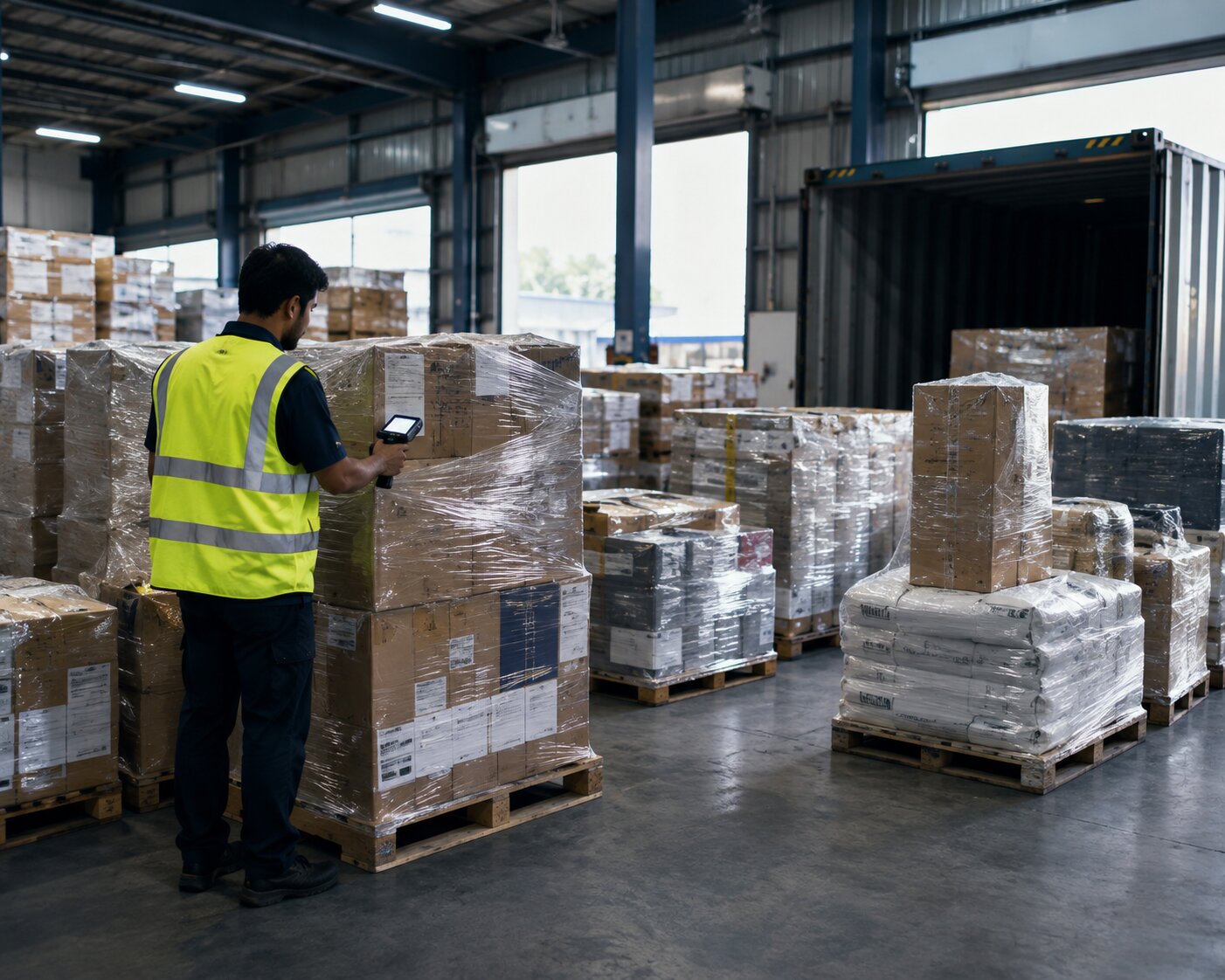
LCL is quoted at 1.0% to 1.5% of value against 0.3% to 0.5% for general cargo, two to three times the rate (Estimated bands). Underwriters are pricing three mechanics a full container lacks, not penalising small shippers.
- Handling multiplies. A consolidated consignment is packed at an origin CFS (container freight station) alongside other shippers’ goods, often moves through a transshipment hub, then is deconsolidated at destination.
- Neighbours contaminate. Your pallets sit next to cargo you did not choose, and leakage, odour transfer and condensation from someone else’s goods are ordinary LCL claims.
- Attribution gets hard. Establishing when and where damage occurred decides whose liability responds. Three parties hold different liability scopes on one LCL box: consolidator, ocean carrier, deconsolidator.
One misconception costs SMEs more than any other. A freight forwarder’s own liability cover is not insurance on your goods. It protects the forwarder against its contractual and negligence exposure, usually capped per kilogram by its trading conditions. Without a cargo policy in your name for a declared value, the goods are uninsured.
On Balkan and China lanes we typically see two-pallet consignments with invoice values well into five figures, where the premium sits near €200 and realistic carrier recovery is a tenth of that.
What Cargo Insurance Does Not Cover
Some losses fall outside the policy even under ICC (A), and exclusions are where claims die.
- Insufficient or unsuitable packing, where the insured packed the goods. This is the exclusion SMEs lose on most often.
- Inherent vice: deterioration from the nature of the goods themselves, such as perishables spoiling on a normal transit.
- Delay, and any loss proximately caused by it, excluded even under all-risks wording.
- Ordinary leakage, ordinary loss in weight or volume, ordinary wear and tear.
- Wilful misconduct of the insured, and insolvency or default of the carrier.
War and strikes sit outside the base clauses and are bought back through the Institute War Clauses and Strikes Clauses, so on any lane touching a conflict-affected corridor, confirm those extensions are on the policy. Packing is where most denials start, and export-standard packing, moisture barriers for sea freight and photographs of the goods as loaded cost very little against that risk.
How to Buy It: Single Shipment or Open Cover
Two structures cover almost every SME.
Single-shipment cover is bought per booking for one consignment. The unit rate is higher, there is no commitment, and it fits occasional shippers or valuable one-off loads. Most forwarders, ourselves included, arrange it alongside the freight so cover attaches before the goods move.
Open cover is an annual policy across all shipments in a period, with consignments declared as they move. Underwriters price predictable premium flow better than sporadic risks, so the effective rate is usually lower. Past a handful of shipments a year, ask for both side by side.
Confirm five things before the cargo moves:
- Who buys the cover, and on which Incoterm.
- The insured value, as (cost + freight) × 1.10.
- When cover attaches and ends: warehouse to warehouse, or port to port.
- The deductible, and whether it applies per consignment or per event.
- Which Institute Cargo Clause applies.
Frequently Asked Questions
How much does cargo insurance cost for a European shipment?
General cargo is typically quoted at 0.3% to 0.5% of insured value: sea 0.1%–0.5%, road 0.1%–0.4%, air 0.2%–0.7% (Estimated bands). On goods worth €24,000 with €1,400 of freight, a 0.35% rate gives a premium near €98. Consolidated LCL cargo is priced separately at 1.0% to 1.5%.
Is cargo insurance mandatory in the EU?
No EU law requires a shipper to insure commercial cargo. Two indirect obligations exist: the Incoterms® 2020 rules CIF and CIP require the seller to buy cover, and some letters of credit make an insurance certificate a condition of payment.
Does the freight forwarder already insure my cargo?
No. A forwarder’s liability insurance covers the forwarder’s own exposure under its trading conditions, capped by weight rather than paying the value of your goods. Cargo insurance is a separate policy in the cargo owner’s name on a declared value, which your forwarder can arrange per booking.
What is the difference between cargo insurance and carrier liability?
Cargo insurance pays the declared value of your goods regardless of fault, claimed directly on your own insurer. Carrier liability is capped and fault-based, set per kilogram by convention: 8.33 SDR/kg for road under CMR, 26 SDR/kg for air under Montreal. On a 1,200 kg road consignment the CMR cap returns about €11,900 whatever the cargo cost.
Does cargo insurance cover theft?
Under ICC (A), yes, subject to the standard exclusions. ICC (B) and ICC (C) do not cover theft or pilferage, which matters given the €1 billion of European freight theft TAPA EMEA recorded in the 18 months to 30 June 2026.
Who pays for insurance under CIF and CIP?
The seller buys and pays for cover under both. Under CIF the minimum is ICC (C), for sea transport only; under CIP it has been ICC (A) since Incoterms® 2020, for any mode. On CIF terms the buyer bears risk from loading while holding only Clause C protection.
Is cargo insurance worth it for a small LCL shipment?
Usually yes, because weight-based caps pay very little on light consignments. On a 2-pallet, 800 kg LCL shipment worth €18,000, the Hague-Visby cap returns about €1,904 against a premium near €208 at 1.0%. The gap is around 77 times the cost of the cover.
The Cost, One Last Time
Cargo insurance for European shipments costs 0.3% to 1.5% of value depending on mode and consolidation, and the decision rule is one line: buy it whenever your cargo is worth more than the convention cap multiplied by its weight. On the three lanes above, that fee was 77 to 164 times smaller than the exposure it removed. Bands and SDR rates move, so use these figures to run the arithmetic, not as a quote.
Send us the commodity, value, weight and lane, and we will price cover alongside the freight so you see both numbers before booking.