The shipping terms every business owner should know are Incoterms 2020, the Bill of Lading, FCL vs LCL, the freight forwarder (or NVOCC), demurrage and detention, customs duty (with VAT and the HS code), chargeable (volumetric) weight, the EORI number, consolidation (groupage), and CBAM. Together these ten cover the language you meet from the moment you request a quote to the day your goods clear customs. They matter because they tell you who pays for what, where your liability starts and stops, and which charges can quietly inflate a shipment. A single misread term on an Incoterm or a Bill of Lading can shift hundreds of euros, or the legal risk for lost cargo, onto your side of the deal. This guide covers the terms an SME importer or exporter actually meets on quotes, Bills of Lading and customs forms. It is not a full A-to-Z logistics glossary, and it skips the deep jargon you will never sign for. It is written for owners, procurement staff and logistics managers who run real shipments without being logistics specialists. Read each term once, and the next quote you open will make far more sense.
Key Takeaways
- Incoterms decide how cost and risk split between buyer and seller.
- The Bill of Lading is three documents in one: receipt, contract, and title to the goods.
- LCL lets you ship a single pallet instead of paying for a whole container.
- Demurrage and detention are avoidable surprise charges that build up when containers sit too long.
- Chargeable weight means bulky-but-light cargo gets billed by the space it fills, not its actual weight.
- CBAM is the EU’s new 2026 carbon levy that importers of certain goods must check before they buy.
In this guide:
- Incoterms 2020 · 2. Bill of Lading · 3. FCL vs LCL · 4. Freight Forwarder & NVOCC · 5. Demurrage & Detention · 6. Customs Duty, VAT & HS Code · 7. Chargeable / Volumetric Weight · 8. EORI Number · 9. Consolidation / Groupage · 10. CBAM (2026)
1. Incoterms 2020
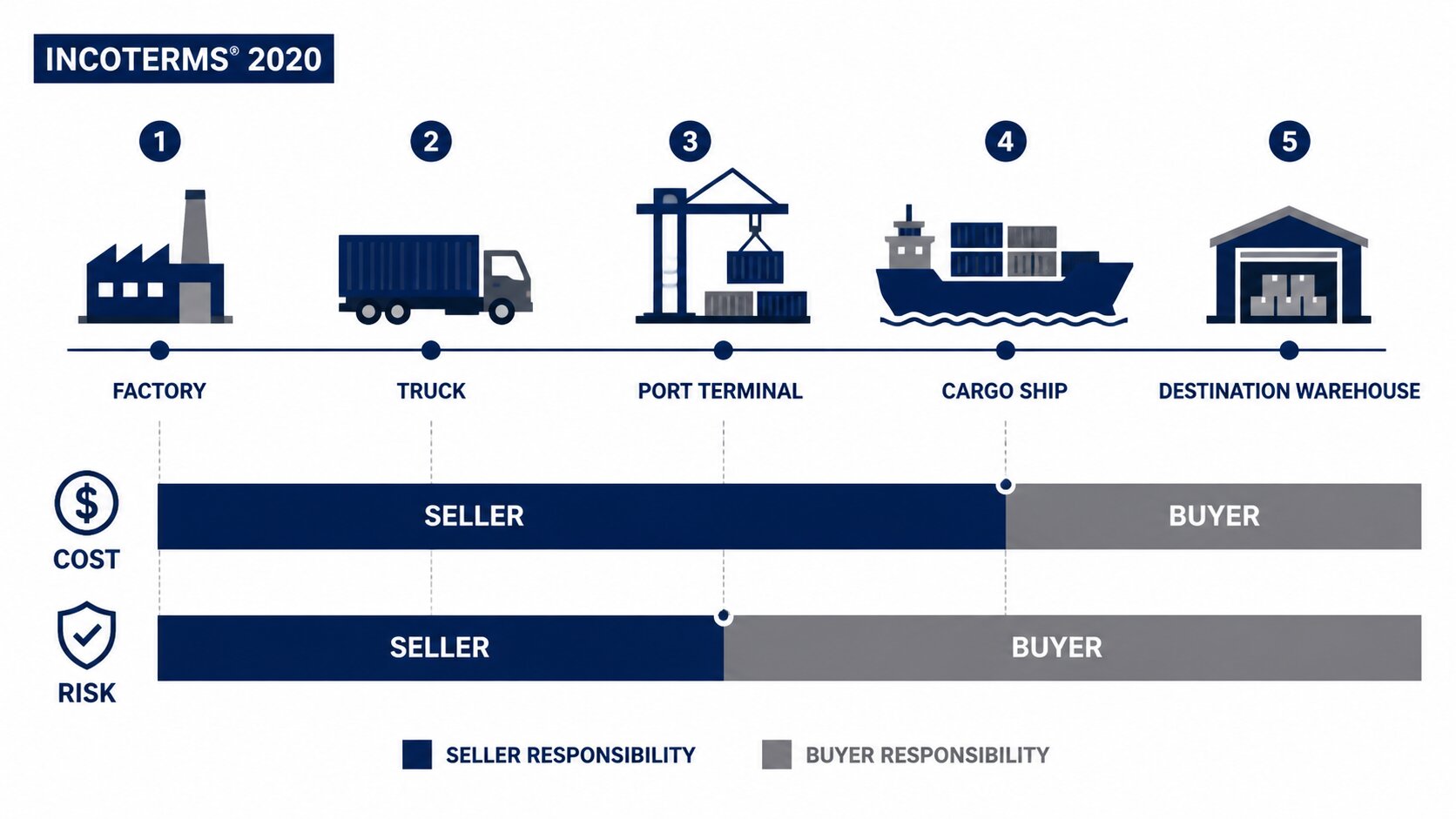
Incoterms® 2020 are 11 standard trade rules published by the International Chamber of Commerce (ICC), in force since 1 January 2020, that define who pays for and who bears the risk of goods at each stage of an international shipment. Think of them as a shared rulebook so a buyer in Sofia and a seller in Shenzhen mean the same thing by a single three-letter code.
For an SME, the practical value is clarity on cost and liability. The rules run from EXW (Ex Works, where you arrange almost everything from the seller’s door onward) to DDP (Delivered Duty Paid, where the seller delivers the goods to your door with duties already paid). Pick the wrong one and you can find yourself unexpectedly responsible for ocean freight, insurance or import customs.
The 11 rules split into two groups:
- 7 rules for any mode of transport: EXW, FCA, CPT, CIP, DAP, DPU, DDP
- 4 rules for sea and inland waterway transport: FAS, FOB, CFR, CIF
That second group matters most if you move containers by sea, which covers the bulk of SME importing.
Agreeing the Incoterm in writing before the goods move prevents the most common billing dispute we see: two parties each assuming the other booked and paid for a leg of the journey. One line in the purchase order settles who owns the cost and the risk at every handover.
2. Bill of Lading
A Bill of Lading (B/L) is the carrier’s document that does three jobs at once: a receipt for the goods, the contract of carriage, and a document of title that proves ownership. It is one of the oldest documents in trade, and it still governs how cargo gets released today.
For an SME, the B/L sits at the centre of getting paid and getting goods released. Whoever holds the original B/L controls release of the cargo, so banks and sellers use it as security until payment clears. Lose track of the original and your container can sit at the port while everyone waits.
One concrete distinction is worth learning early. An original B/L must be physically presented at destination to collect the cargo, which protects the seller when payment is still pending. A telex release (an electronic confirmation that the originals have been surrendered) or a sea waybill speeds things up when payment is already settled, because no paper original needs to travel by courier. Choosing the right form up front can save several days at delivery.
3. FCL vs LCL
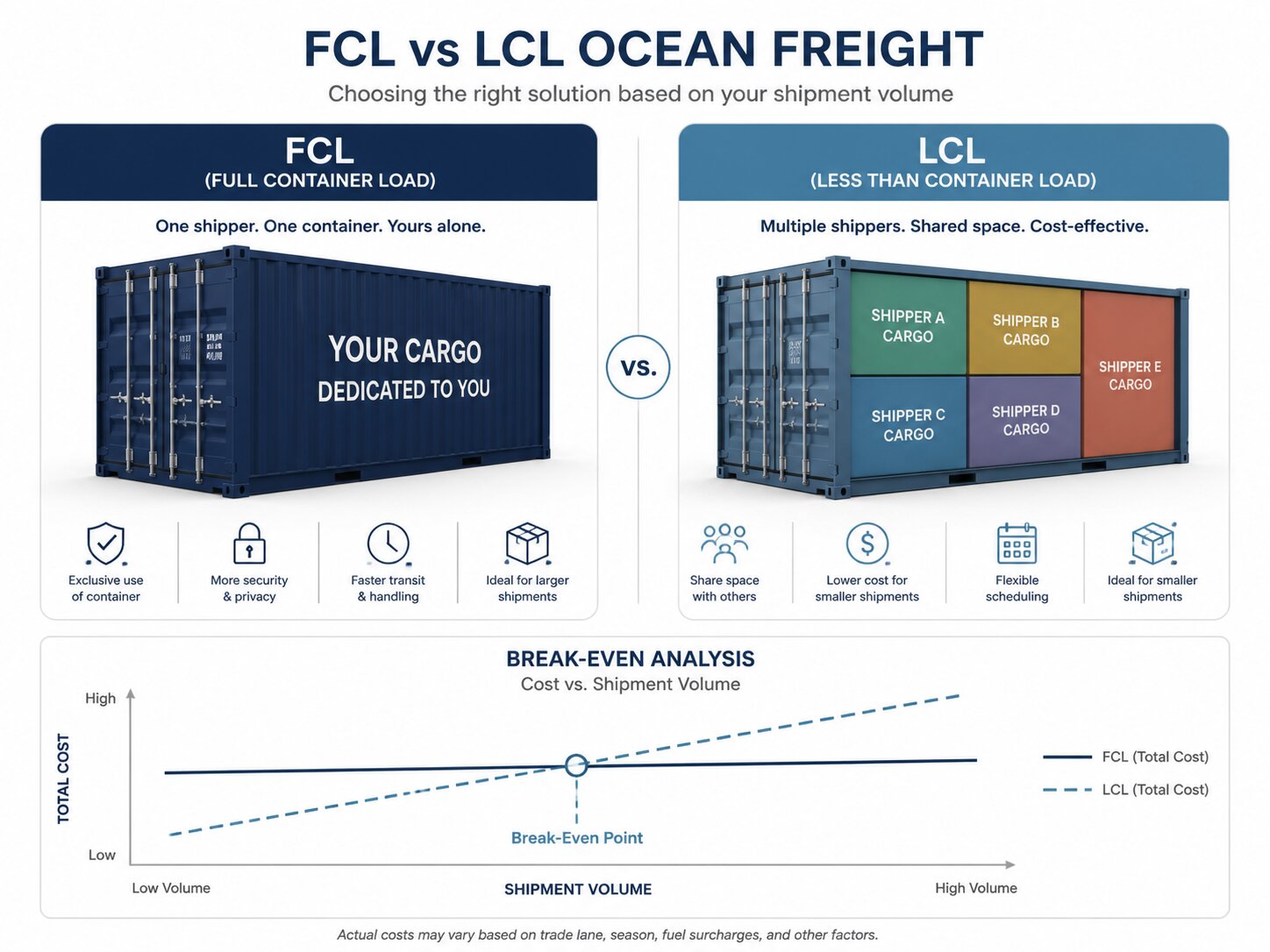
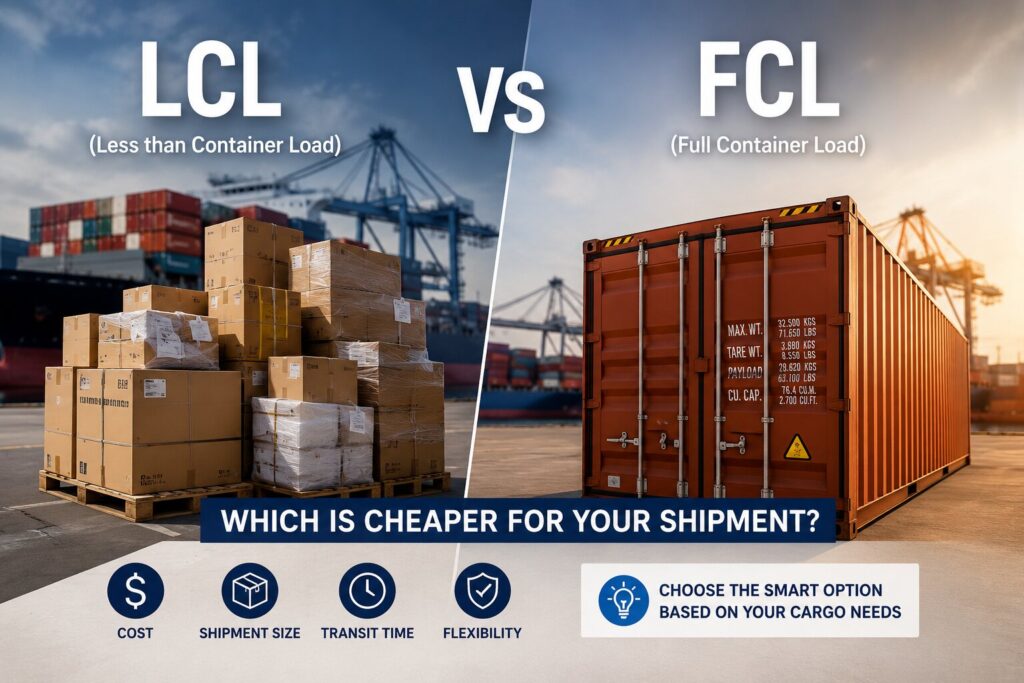
FCL (Full Container Load) means your cargo books a whole container (20, 40 or 45 ft), while LCL (Less than Container Load) means you share a container and pay only for the space your goods occupy, after they are consolidated with other shippers’ cargo at a Container Freight Station (CFS). Both move the same boxes across the same ocean; the difference is whether you rent the whole space or a slice of it.
The non-obvious part is the break-even. Below roughly 13-15 CBM (cubic metres) LCL usually wins, because you pay per cubic metre rather than for empty air. Above that volume, a full container’s flat rate is cheaper, since the per-CBM cost of FCL keeps dropping as you fill the box.
On Balkan and CIS lanes we move a high share of LCL, because most SME orders never fill a 20-foot box. A typical first order of components or finished goods lands at a few cubic metres, well inside LCL territory. [case study placeholder — real Sea Gate LCL break-even example on a Balkan/CIS lane]
The simple rule for newcomers: when your volume is small, ship a pallet, not a container. Our consolidated-cargo service exists for exactly this, grouping your shipment with others heading the same way so you pay for space, not for air. As your order sizes grow past the break-even, switching to FCL is straightforward, and we will tell you when the maths tips that way.
4. Freight Forwarder & NVOCC
A freight forwarder arranges, books and consolidates your transport and handles customs paperwork on your behalf, acting as your single point of contact across carriers. An NVOCC (Non-Vessel Operating Common Carrier) is a carrier that issues its own Bills of Lading and sells container space without owning the ships.
For an SME, the distinction that saves confusion is the one between a forwarder and a licensed customs broker. A forwarder coordinates the whole journey: booking space, arranging trucking, preparing documents, and tracking the cargo. A customs broker specifically handles customs formalities, the declarations and duty calculations that clear goods through border control. Many forwarders either hold broker licences or work closely with brokers, so you often get both through one contact.
This is the role Sea Gate plays. We are an asset-light forwarder, meaning we do not own ships or trucks but work through a global agent network to find the right capacity for each lane. Behind that sit 20+ years of collective team experience and 1,000+ shipments delivered, which is what lets us match a small importer with the carriers and routes that actually fit their cargo and budget.
5. Demurrage & Detention
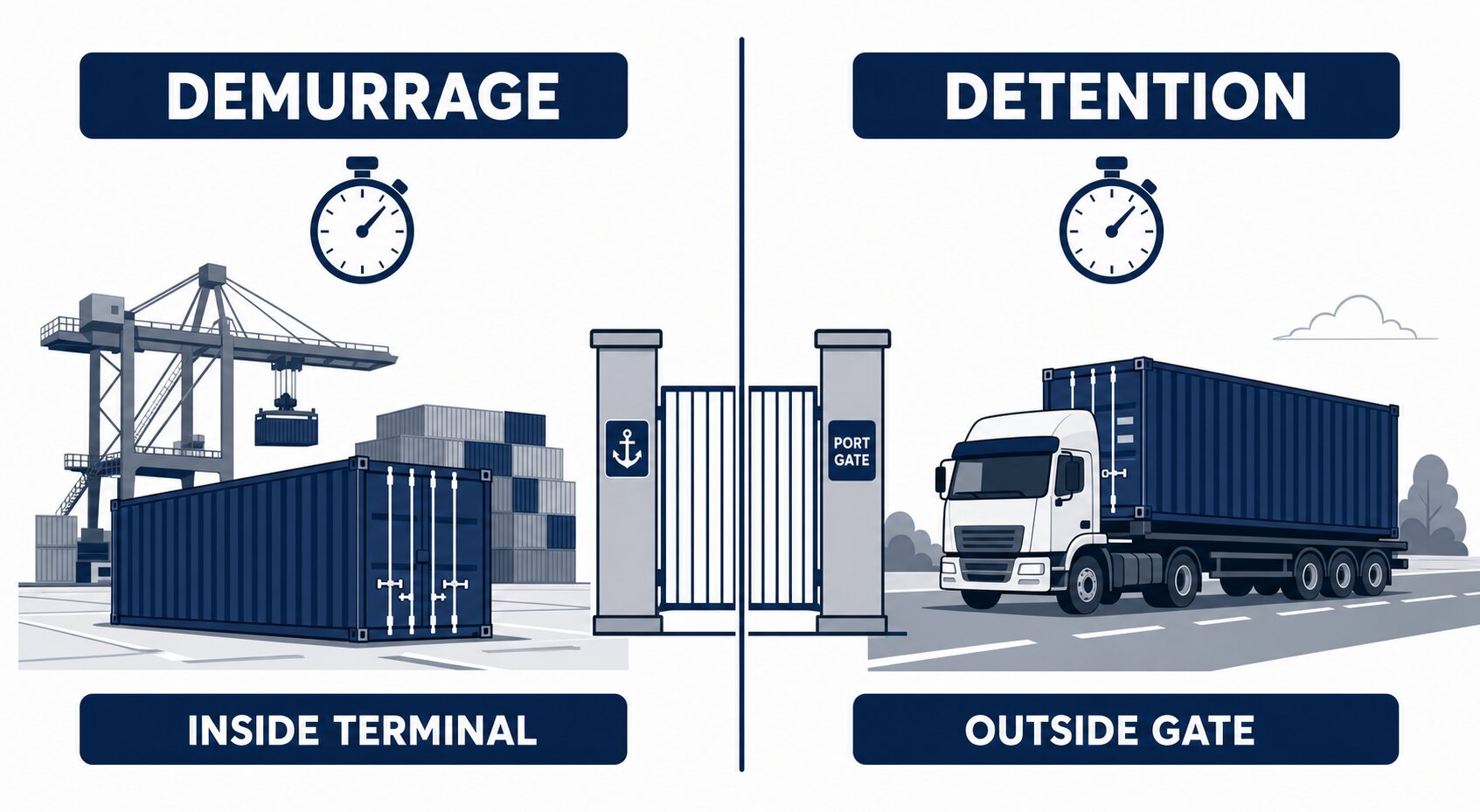
Demurrage and detention are two separate late fees tied to your container, and mixing them up is a fast way to misread an invoice. Demurrage is charged when your container sits at the port or terminal beyond its free time after discharge. Detention is charged when you keep the container outside the port (in your yard) too long before returning it to the carrier.
For an SME, these are the avoidable surprise charges that wreck a shipment budget. Maersk’s knowledge base notes that each container comes with a set number of free days before the clock starts, and the meters run per day after that. Both the free-time windows and the daily rates vary by carrier, port and season, so treat the figures below as Estimated.
| Demurrage | Detention | |
|---|---|---|
| Where | Container at the port/terminal | Container outside the port (your yard) |
| Triggered by | Cargo not collected after free time | Container not returned in time |
| Typical free time | ~2-7 days (Estimated) | ~5-10 days (Estimated) |
| Typical charge | ~$75-150/day, up to ~$200 (Estimated) | ~$75-150/day (Estimated) |
Stack a few days of each together and a combined demurrage-plus-detention delay can exceed $1,000 per container (Estimated).
6. Customs Duty, VAT & HS Code
An HS code (Harmonized System code) is the standardised commodity number that classifies your goods and tells customs which import duty rate and VAT treatment to apply at the border. Every product moving across an EU frontier carries one, and it travels with your shipment from the supplier’s invoice to the final clearance.
Get the code wrong and the consequences land on your bottom line: the wrong duty rate, an unexpected VAT bill, and goods held while customs queries the mismatch. Duty and import VAT are both calculated on the customs value of your goods, and that value depends on the agreed Incoterm, so the same product can carry different charges depending on who pays for freight and insurance. According to the EU Taxation and Customs Union, the same code feeds both the duty rate and the import declaration across all member states.
For an SME, the practical win is settling the code before the goods ship, not after they arrive. A misclassification on a single container can swing the duty owed by several thousand euros (Estimated), and correcting it means re-filing the declaration while demurrage charges tick up at the port. Confirming the HS code with your supplier and forwarder up front turns a guessing game into a fixed, predictable cost line.
7. Chargeable / Volumetric Weight
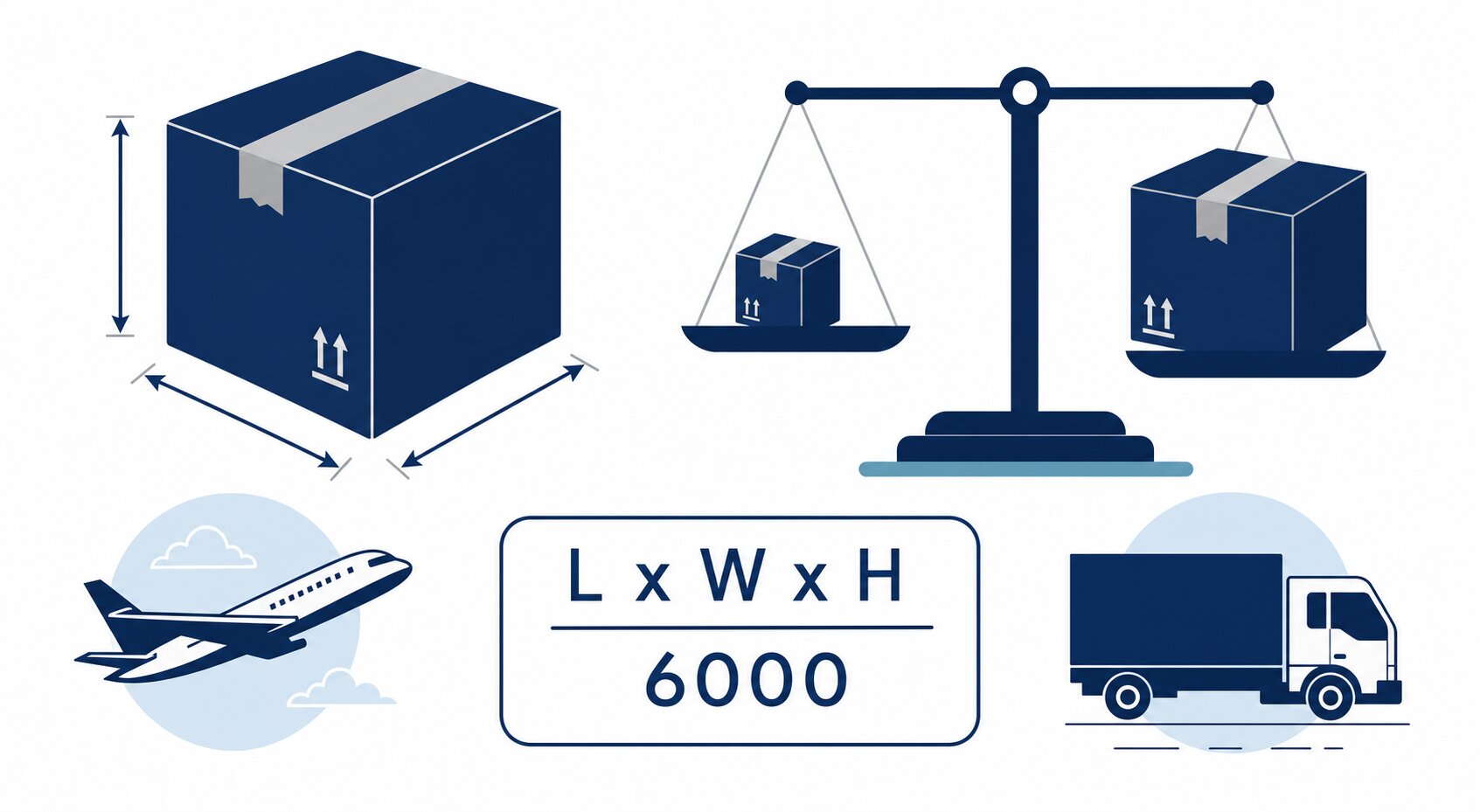
Chargeable weight is the higher of a shipment’s actual weight and its volumetric (dimensional) weight, so light but bulky cargo gets billed for the space it occupies rather than the kilos on the scale. Carriers use it because a trailer or aircraft hold runs out of room long before it runs out of weight capacity.
The maths is straightforward once you see it. For air freight, volumetric weight in kg = length × width × height in cm ÷ 6000, which is the IATA industry standard. For sea freight, cargo is usually priced per CBM (cubic metre), where 1 CBM = 1,000 litres, so a consignment that fills a lot of cubic metres pays for them even if it is feather-light.
Why did 12 kg of cushions cost as much to fly as 80 kg of bolts? Because the cushions filled a large box. Run the numbers: a carton measuring 60 × 50 × 40 cm gives 120,000 cubic centimetres, divided by 6000 equals 20 kg of volumetric weight, well above the 12 kg on the scale, so the airline charges for 20. The dense box of bolts, small and heavy, gets billed on its real weight instead.
For an SME, this is the single biggest reason a quote arrives higher than expected. Measuring and declaring accurate dimensions before booking lets you compare real costs and avoid a revised invoice after collection. Under IATA rules, that 6000 divisor has been the standard reference for air cargo for decades.
8. EORI Number
An EORI number (Economic Operators Registration and Identification) is the ID the EU requires before any business can import or export commercially. It links your company to every customs declaration you make, so authorities can track goods consistently across borders.
Without one, your goods simply cannot clear EU customs, which makes a missing EORI one of the most common first-shipment blockers for new SME importers. Cargo can sit at the port while the registration is sorted, and demurrage starts adding up before a single carton has moved.
The reassuring part is how little admin it takes. One EORI number works across the whole EU, so you register once and use it for shipments into any member state. The EU Taxation and Customs Union sets a single route to get one: you apply through the customs authority of the member state where your business is established, and the number is typically issued within a few working days (Estimated). Sorting it before your first order ships keeps the goods moving on arrival.
9. Consolidation / Groupage
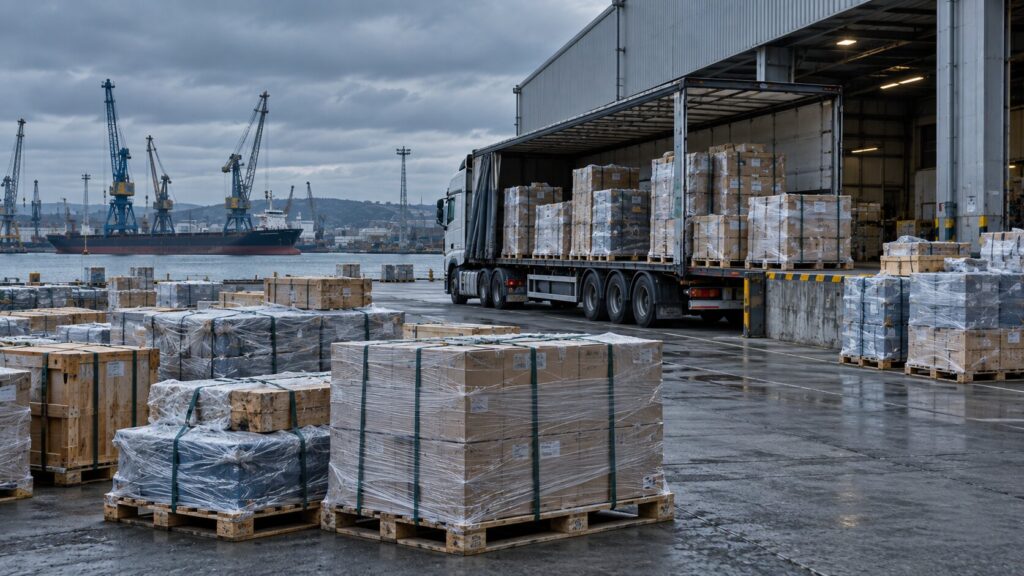
Consolidation (also called groupage in road freight) is the practice of combining several shippers’ smaller consignments into one container or trailer, so everyone shares the cost of the move instead of paying for empty space. The forwarder books the full unit, then splits the charge across each business inside it.
This is the mechanism behind LCL (covered in term 3), and it is the reason a single pallet can travel economically rather than waiting weeks to fill a whole container. On our Balkan, Eastern Europe, and CIS corridors, where steady freight flows keep trailers loading regularly, an SME can ship two or three pallets at a fair per-cubic-metre rate without committing to volumes it does not have.
The frequency of departures is what makes the difference. A well-fed consolidation lane might run several times a week, so your cargo joins the next available unit rather than sitting in a warehouse. You can check live pricing for popular routes on our online rate calculator before you commit.
10. CBAM (2026)
CBAM (the Carbon Border Adjustment Mechanism) is the EU’s carbon levy on certain imports, and its definitive period began on 1 January 2026. It puts a price on the emissions embedded in covered goods made outside the EU, matching the carbon costs that EU producers already pay.
For importers, this is a real compliance obligation, not a future warning. Per the EU Taxation and Customs Union, businesses bringing in more than 50 tonnes a year of covered goods must become authorised CBAM declarants, buy and surrender CBAM certificates that reflect the embedded emissions, and file an annual CBAM declaration by 30 September of the following year. Missing the threshold check is easy to do when you are tracking value rather than tonnage.
The covered-goods scope is specific. As things stand it includes:
- Cement
- Iron and steel
- Aluminium
- Fertilisers
- Electricity and hydrogen
- Selected precursors of the above
This is the newest term on the list, and one most shipping glossaries have not caught up with yet, because the rules only took full effect this year. If you import any of these materials, even as components, the practical step is to check your annual tonnage now and confirm whether you cross the 50-tonne line. Sorting your declarant status early avoids a scramble when the first reporting deadline arrives, and it keeps a steel or aluminium shipment from being held while paperwork catches up.
Duty, VAT, EORI and CBAM obligations vary by goods and country, and the rules change. Treat this guide as a plain-English starting point, and confirm your exact position with your customs broker or national authority before you commit.
FAQ
Which shipping terms matter most for a small business?
The three with the biggest impact on cost and risk are Incoterms (who pays and who is liable at each stage), the FCL vs LCL choice (whether you book a full container or share one), and demurrage and detention (the fees that hit when containers sit too long). Getting these right protects your margin, since a single misread Incoterm can shift hundreds or thousands of euros in freight, insurance, and duty onto your account. For most SME importers, these three terms explain the majority of unexpected charges on an invoice.
What is the difference between FCL and LCL?
FCL (Full Container Load) means you book a whole container and pay a flat rate for it, whether it is full or not. LCL (Less than Container Load) means your cargo is consolidated with other shippers’ goods and you pay only for the space you use, measured in cubic metres (CBM). LCL usually works out cheaper below roughly 13 to 15 CBM, above which a full container often costs less per unit.
What is the difference between demurrage and detention?
Demurrage is charged when your container sits inside the port or terminal beyond the agreed free time, waiting to be collected. Detention is charged when you keep the container outside the port too long before returning the empty unit. Free time typically runs about 2 to 7 days for demurrage and 5 to 10 days for detention (Estimated, since it varies by carrier and port), after which daily fees apply.
How many Incoterms are there in 2020?
There are 11 Incoterms rules published by the International Chamber of Commerce (ICC), in force since 1 January 2020. Seven apply to any mode of transport (EXW, FCA, CPT, CIP, DAP, DPU, and DDP), and four apply only to sea and inland waterway transport (FAS, FOB, CFR, and CIF). They define exactly where cost and risk pass from seller to buyer.
What is chargeable weight?
Chargeable weight is the higher of a shipment’s actual weight and its volumetric (dimensional) weight, and carriers bill you on whichever is greater. For air freight, the volumetric weight in kilograms equals length × width × height in centimetres divided by 6000, which is the IATA standard. This means a light but bulky pallet can be priced on its volume rather than its scale weight.
Do I need an EORI number to import into the EU?
Yes, an EORI (Economic Operators Registration and Identification) number is required to clear EU customs for commercial shipments. You register once with the customs authority in your home member state, and that single number is recognised across all 27 EU countries. Without it, your goods can be held at the border until registration is completed.
Does CBAM affect my 2026 imports?
CBAM (the Carbon Border Adjustment Mechanism) only applies if you import covered goods, namely cement, iron and steel, aluminium, fertilisers, electricity, and hydrogen, above 50 tonnes a year. If you cross that threshold you must be an authorised CBAM declarant and report the embedded emissions of those goods. Its definitive period began on 1 January 2026, so shipments below the 50-tonne mark stay outside the scheme.
Wrapping up
Knowing these ten terms is what turns a confusing freight quote into a decision you can actually make. Once you can read FCL against LCL, spot a demurrage clock ticking, or check which Incoterm sits behind a price, you stop guessing and start comparing offers on equal footing. A good next step is to pull out your most recent quote and match each line against the terms above to see where the real costs sit. If anything still reads like code, the Sea Gate Logistics team is happy to price your shipment or give you a plain-English read of it, especially for consolidated cargo moving on Balkan and CIS lanes. Just send over the details whenever it suits you, and we will walk through the options with you.