Intermodal rail from Türkiye to Europe is a realistic alternative in 2026 for one profile: steady weekly full loads in 45ft containers or craneable trailers between terminal cities. Craneable trailers already sailing from Pendik or Ambarlı to Trieste also qualify, since trains run on from there.
Rail does not yet suit pallet-scale LCL, standard non-craneable trailers, irregular loads or urgent orders. Road stays the default. IKV (Türkiye’s Economic Development Foundation) reported in March 2025 that trucks carry more than 40% of exports from Türkiye (Turkey) to the EU.
On 22 January 2026, trucks waited 15–20 hours at the Kapitan Andreevo–Kapıkule border, Bulgaria’s BTA news agency reported. ÖBB Rail Cargo Group says its trains clear Kapıkule in 12–24 hours, and its Budapest–Istanbul TransFER runs 5 round trips a week.
The Çerkezköy–Kapıkule section of the Halkalı–Kapıkule railway is due to open in October 2026, with the rest following in 2027–2028. For shippers who fit, 2026 is a year to pilot one lane, not to switch everything.
Takeaways
- Rail fits steady weekly full loads; part, irregular and urgent loads stay on the road.
- Three options exist: a direct block train, Ro-Ro + rail via Trieste, or Ro-La, which carries truck and driver by train.
- The 2026 case for rail freight from Turkey to Europe rests more on road problems than on rail gains.
- Operators publish no rail tariffs, so compare door-to-door quotes for one lane.
- The five-question Rail-Fit Test decides whether a lane should move.
This guide covers rail versus trucking for full-load freight from Türkiye into the EU, not Asia–Europe transit trains or rail tariffs. It is for SME shippers and logistics managers weighing a move off trucks.
Contents:
- Definitions
- Services running in 2026
- Rail vs road vs Ro-Ro
- The all-in cost
- The 2026 Disruption Ledger
- Upgrade timeline
- The loading-unit problem
- The Rail-Fit Test
- FAQ
- The verdict
Intermodal transport between Turkey and Europe: the terms that matter
The UN Economic Commission for Europe’s Terminology on Combined Transport defines intermodal transport as moving one loading unit or road vehicle across two or more modes “without handling the goods themselves in changing modes.” Four terms matter on this lane:
- Combined transport: mostly rail, waterway or sea with short road legs at each end; EU legal basis: Directive 92/106/EEC.
- Block train: wagons that run together from terminal to terminal without shunting.
- Ro-Ro + rail: an unaccompanied trailer, without tractor unit or driver, crosses by roll-on/roll-off ferry, then continues by train.
- Ro-La, the “rolling road”: whole trucks ride low-floor wagons with their drivers aboard, used around Austria’s transit limits.
For intermodal rail from Türkiye to Europe, the difference a shipper feels is the driver: Ro-La keeps one aboard, while block trains and Ro-Ro + rail need none.
Rail freight from Turkey to Europe: the services running in 2026
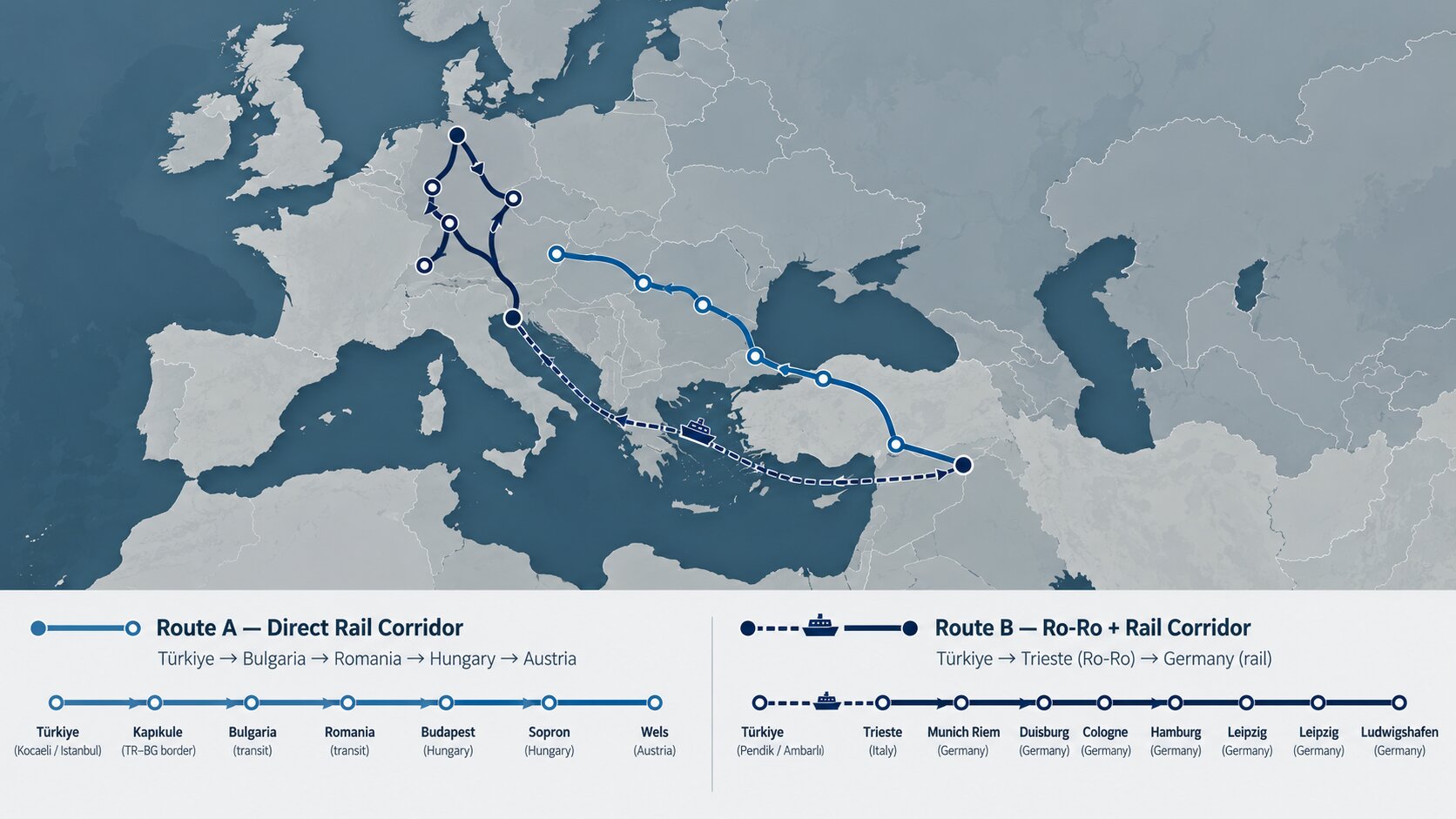
As of September 2026, intermodal rail from Türkiye to Europe runs in three formats: direct block trains, Ro-Ro and rail via Trieste, and Ro-La across Austria.
| Service | Route / terminals | What moves | Status |
|---|---|---|---|
| ÖBB Rail Cargo Group (RCG) TransFER | Budapest–Istanbul, Sopron–Istanbul; network to Wels, Vienna, Ludwigshafen, Duisburg, Zeebrugge | 45ft containers, craneable trailers | Running; Sopron replaced Sládkovičovo |
| Pasifik Eurasia | Istanbul–Budapest, 1,549 km: Türkiye 278, Bulgaria 406, Romania 634, Hungary 231 | Block-train cargo | First run 18 Oct 2024; 600 trains, 750,000 t a year planned |
| METRANS from Railport Kocaeli | Arkas and duisport terminal, Kocaeli | Intermodal units | New; see the Disruption Ledger |
| DFDS Pendik–Trieste + rail | Ferry to Trieste, train to Duisburg and Cologne | Unaccompanied trailers | Running |
| Grimaldi Ambarlı–Trieste + Kombiverkehr | Ferry to Trieste, train to Munich Riem, then Duisburg, Hamburg, Cologne, Leipzig, Ludwigshafen | Unaccompanied trailers | Launched; 2 weekly departures from each port |
| Ro-La on Austrian lines | Austrian transit routes | Whole trucks with driver | Used once Austrian permits run out |
Per RCG (25 November 2025), one Istanbul–Budapest block train carries up to 36 × 45ft containers, replacing 40–50 trucks; RCG, DFDS and Grimaldi also serve freight transport to Türkiye.
The Trieste ferry is Türkiye’s busiest intermodal link: IKV’s March 2025 brief gives it 71% of 2023 Europe-bound Ro-Ro and Sète 23%; Tuzla/Pendik–Trieste carried 107,659 vehicles, or 44.9%. Turkish carriers sent 39% of their Europe exports by Ro-Ro, 61% by road. Rail replaces only the post-Trieste leg, and only for craneable trailers.
Rail vs road vs Ro-Ro: transit time, departures and border exposure
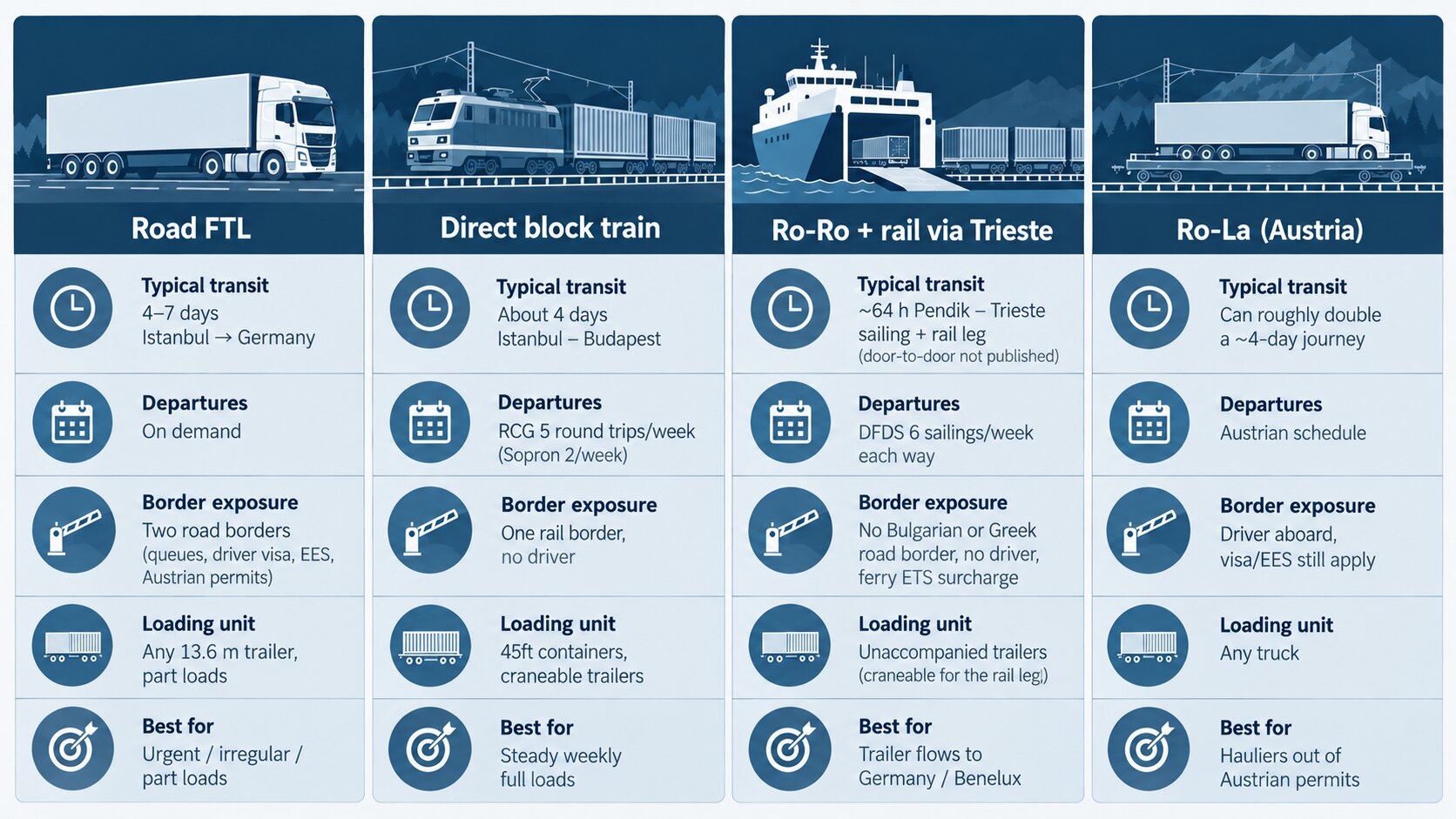
No operator publishes a door-to-door time for shipping Turkey to Germany by rail, so this rail vs road freight Turkey–Europe comparison uses published benchmarks.
| Option | Typical transit | Departures | Border exposure | Loading unit | Best for |
|---|---|---|---|---|---|
| Road, full truckload | 4–7 days Istanbul–Germany, variance mostly border waiting | On demand | Bulgarian or Greek border queues, driver visa, EU Entry/Exit System (EES), Austrian permits | Any 13.6 m trailer, part loads | Urgent, irregular or part loads |
| Direct block train | About 4 days Istanbul–Budapest, per Pasifik Eurasia | RCG 5 round trips a week, up from 4; Sopron–Istanbul 2 | One rail border, no driver | 45ft containers, craneable trailers | Steady weekly full loads between terminals |
| Ro-Ro + rail via Trieste | About 64 h Pendik–Trieste sailing plus rail; door-to-door not published | DFDS 6 sailings a week each way | No Balkan road border, no driver; EU carbon surcharge on the ferry | Unaccompanied trailers, craneable for rail | Trailer flows to Germany and Benelux |
| Ro-La, Austria | Can roughly double a 4-day trip, per IKV | Austrian schedule | Driver aboard; visa and EES checks apply | Any truck | Hauliers out of Austrian permits |
Choose road when loads are urgent, irregular or part-size, since road freight across Europe never waits for a departure day. Choose rail freight from Turkey to Europe when full loads repeat every week and border delays, not transit days, are the problem.
Is rail freight cheaper than road? How to compare the all-in cost
IKV’s March 2025 brief calls intermodal “slower and less flexible” and 56% more expensive than road. That figure describes a haulier forced off the road when Austrian permits run out, not a shipper planning a weekly rail lane.
The same brief puts Ro-La at roughly €400–650 extra per truck (€650 in its summary, €400 in the body from an older source). The Trieste ferry leg’s surcharge under the EU Emissions Trading System (ETS) also rises in 2026, as the Disruption Ledger shows.
With no public tariff for rail freight from Turkey to Europe, compare road and intermodal door-to-door quotes for one lane on six lines:
- Pre-carriage: truck to the Turkish terminal or port
- Terminal lifts and handling at both ends
- Main leg: train, or ferry plus rail with its ETS surcharge
- On-carriage: truck from the EU terminal to the consignee
- Buffer stock between weekly departures
- Fallback: rerouting by road when a departure or line is lost
What does a cheaper main leg save if two truck legs and one missed departure eat the difference? For general costs, see the cheapest way to ship from Türkiye to Europe.
The 2026 Disruption Ledger: what got worse and better on each route
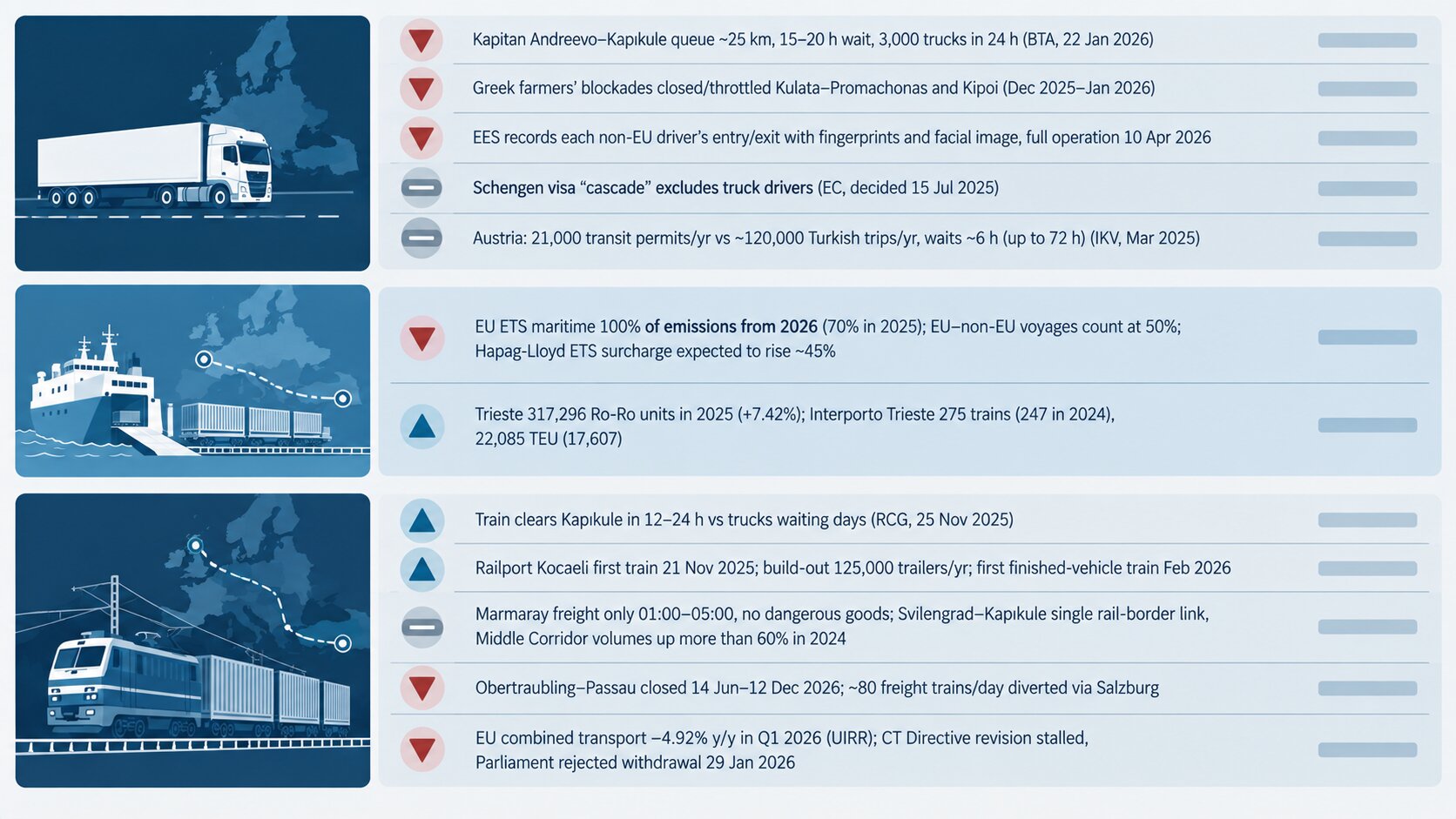
Twelve changes since March 2025, logged by Sea Gate Logistics, bear on intermodal rail from Türkiye to Europe.
| Route | What changed (source) | When | Direction | What it means for a shipper |
|---|---|---|---|---|
| Road | Kapitan Andreevo–Kapıkule queue ~25 km, 15–20 h wait, 3,000 trucks in 24 h (BTA) | 22 Jan 2026 | Worse | Longer lead times |
| Road | Greek farmers’ blockades closed or throttled Kulata–Promachonas and Kipoi (BTA) | Dec 2025–Jan 2026 | Worse | Fewer open crossings |
| Road | EES records non-EU drivers’ fingerprints and facial images (European Commission) | Full operation 10 Apr 2026 | Worse | Extra step per crossing |
| Road | Schengen visa “cascade” for Turkish citizens excludes truck drivers (European Commission) | 15 Jul 2025 | Unchanged for drivers | Driver risk persists |
| Road | Austria’s transit-permit quota: 21,000/yr vs ~120,000 Turkish trips; waits ~6 h per crossing, up to 72 h (IKV) | Mar 2025 | Unchanged (structural) | Ro-La once permits run out |
| Ro-Ro + rail | Maritime EU ETS: 100% of emissions from 2026 (70% in 2025), EU–non-EU voyages at 50% (EC Climate Action); container-line benchmark: Hapag-Lloyd expected a ~45% higher surcharge | 2026 | Worse (cost) | Dearer Trieste ferry leg |
| Ro-Ro + rail | Trieste 317,296 Ro-Ro units, +7.42% (PortsEurope); Interporto 275 trains vs 247 in 2024, 22,085 TEU vs 17,607 (AdriaPorts) | 2025 | Better | More Trieste rail capacity |
| Direct rail | Trains clear Kapıkule in 12–24 h “while trucks often wait for days” (Rail Cargo Group) | 25 Nov 2025 | Better | Predictable border time |
| Direct rail | Railport Kocaeli first train; build-out 125,000 trailers/yr; first finished-vehicle train Feb 2026 (RailFreight) | 21 Nov 2025 | Better | New Asian-side terminal |
| Direct rail | Marmaray freight 01:00–05:00 only, no dangerous goods (World Bank); single border link Svilengrad–Kapıkule shared with Middle Corridor trains after more than 60% growth in 2024 | Ongoing | Unchanged (bottleneck) | Fixed night slots |
| Direct rail | Obertraubling–Passau closed; ~80 freight trains/day diverted via Salzburg (ÖBB Infrastruktur) | 14 Jun–12 Dec 2026 | Worse (temporary) | Slower German legs |
| Direct rail | European combined transport −4.92% y/y (UIRR); Directive 92/106/EEC revision stalled, Parliament rejected withdrawal 29 Jan 2026 | Q1 2026 | Worse / no help yet | No EU incentives yet |
Road got less predictable: queues, EES checks, cascade-excluded drivers and permit caps forcing the Ro-La Turkey–Austria workaround. The Ro-Ro leg got dearer. Rail gained at Kapıkule and in Kocaeli but lags in Germany until 12 December 2026. In our experience from Burgas, the Kapitan Andreevo queue is usually the first variable we check when a Türkiye road load runs late — a queue that trains bypass.
The Halkalı–Kapıkule railway and what comes after: the upgrade timeline
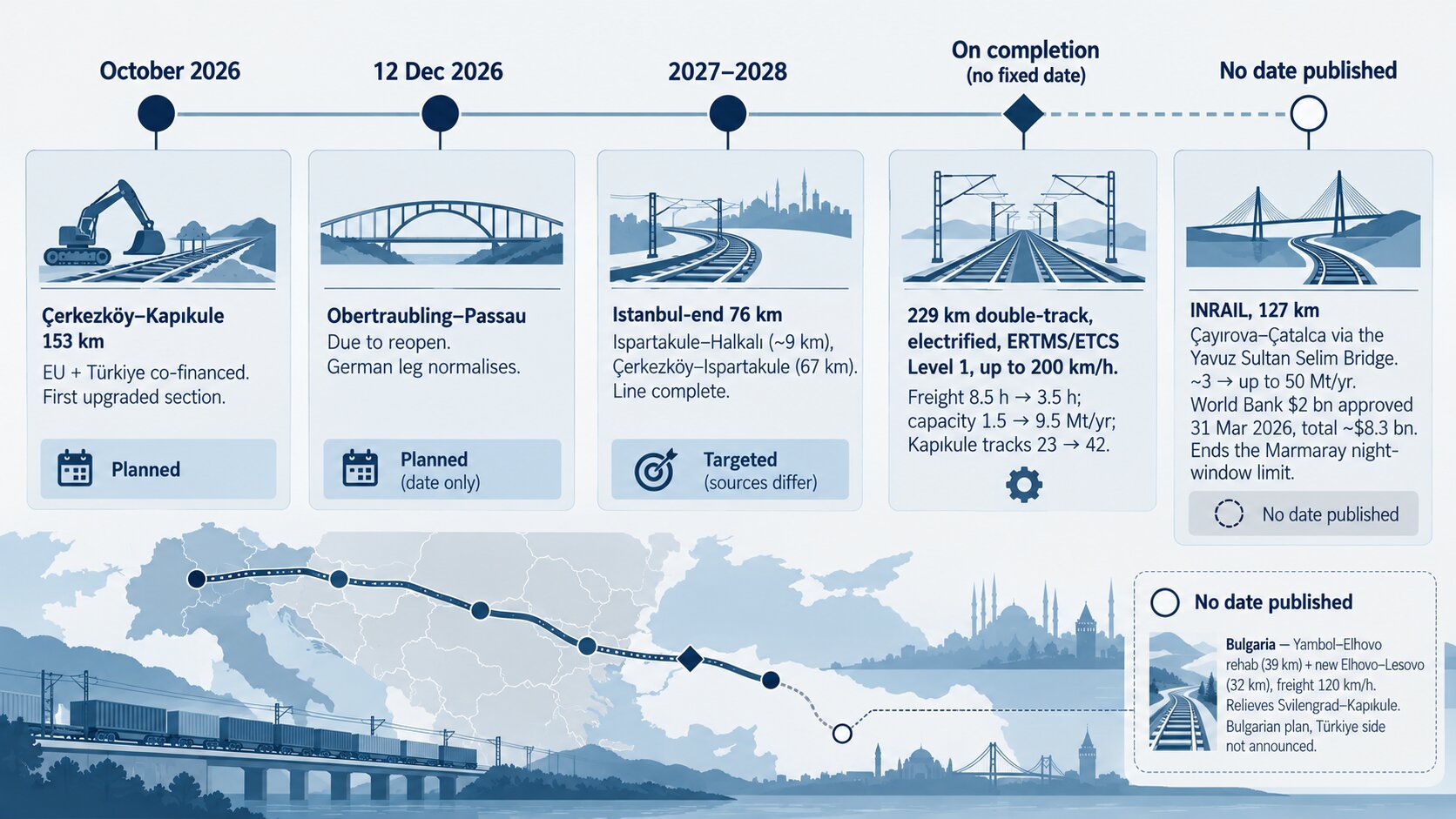
As of September 2026, only one section of the Halkalı–Kapıkule railway has an opening month.
| When | What | Freight effect | Status |
|---|---|---|---|
| October 2026 | Çerkezköy–Kapıkule, 153 km, EU + Türkiye co-financed | First upgraded section | Planned (Transport Minister Abdulkadir Uraloğlu via RayHaber, 28 Sep 2026) |
| 12 Dec 2026 | Obertraubling–Passau due to reopen | German leg normalises | Planned (date only) |
| 2027–2028 | Istanbul-end 76 km: Çerkezköy–Ispartakule (67 km), Ispartakule–Halkalı (~9 km) | Line complete | Targeted; sources differ |
| On completion | 229 km double-track, electrified, ERTMS/ETCS Level 1, up to 200 km/h | Freight run 8.5 h → 3.5 h; 1.5 → 9.5 Mt/yr; Kapıkule tracks 23 → 42 | Needs all sections (Railway Supply) |
| No date published | INRAIL, the Istanbul North Rail Crossing: 127 km Çayırova–Çatalca via the Yavuz Sultan Selim Bridge, ~$8.3 bn total | Bosphorus freight ~3 → up to 50 Mt/yr; a second freight crossing beside Marmaray’s night window | Financed; World Bank $2 bn, 31 Mar 2026 |
| No date published | Bulgaria: Yambol–Elhovo rehab (39 km) + new Elhovo–Lesovo (32 km), freight 120 km/h | Relieves Svilengrad–Kapıkule | Bulgarian plan; Türkiye side not announced (Railway Gazette) |
Since the 3.5-hour run needs all three sections, price multi-year contracts for rail freight from Turkey to Europe on today’s capacity. INRAIL is the real Bosphorus fix; the World Bank release gives no completion year.
The loading-unit problem: why most trailers can’t simply go on a train
About 90–95% of European semi-trailers are non-craneable, according to RailFreight and industry figures from 2026, which makes the trailer itself the first filter for intermodal rail from Türkiye to Europe. A craneable semi-trailer has reinforced lifting points that let a terminal crane place it on a pocket wagon.
Only these codified trailers, plus swap bodies and containers, fit standard wagons; the rest need NIK cradles, horizontal systems such as CargoBeamer, Modalohr or r2L, or Ro-La, which carries the whole truck. The usual substitute is a 45ft pallet-wide container, which takes 33 EUR-pallets, the same as a standard 13.6 m trailer.
If your supplier loads curtain-siders today, can the same goods leave the factory in a 45ft container next month with the same pallet count? Switching units is a fleet or packing decision, not a booking one.
The Rail-Fit Test: five questions before you move a lane to rail
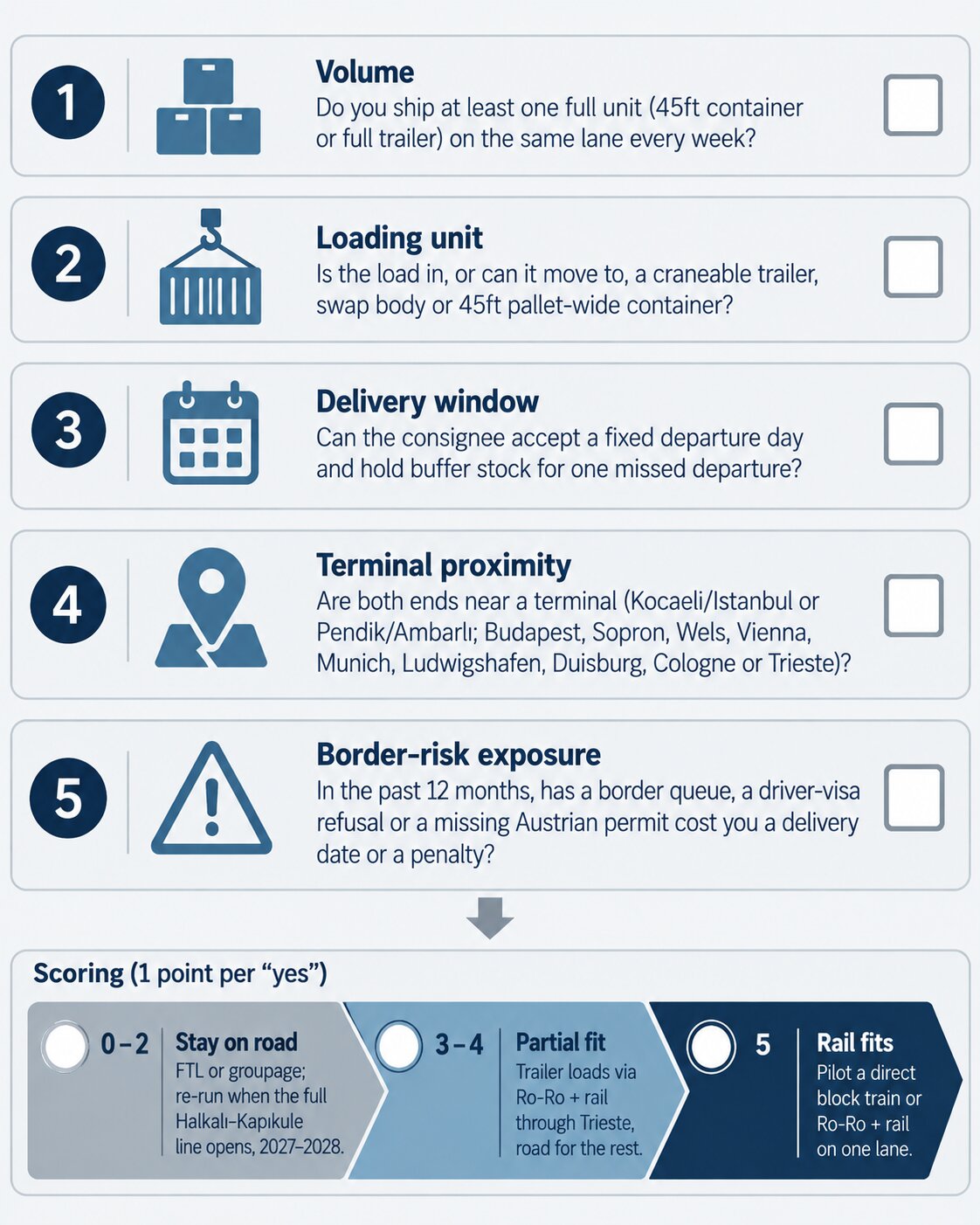
Score a lane for intermodal rail from Türkiye to Europe: one point per yes.
- Volume: do you ship at least one full container or trailer on the same lane every week? Why: fixed, per-unit departures.
- Loading unit: is the load in, or movable to, a craneable trailer, swap body or 45ft pallet-wide container? Why: few trailers are craneable.
- Delivery window: can the consignee accept a fixed departure day and buffer stock for one missed train? Why: trains run less often.
- Terminal proximity: is the Turkish end near Kocaeli, Istanbul, Pendik or Ambarlı, and the EU end near Budapest, Sopron, Wels, Vienna, Munich, Ludwigshafen, Duisburg, Cologne or Trieste? Why: truck kilometres erode savings.
- Border risk: in the past 12 months, has a border queue, driver-visa refusal or missing Austrian permit cost you a delivery date? Why: rail removes that risk.
| Score | Verdict | Next step |
|---|---|---|
| 5 | Rail fits | Pilot a direct block train or Ro-Ro + rail on one lane |
| 3–4 | Partial fit | Trailer loads via Ro-Ro + rail through Trieste; road for the rest |
| 0–2 | Stay on road | FTL or groupage; retest when the full Halkalı–Kapıkule line opens, 2027–2028 |
At 3+ points, pilot first:
- Pick one steady lane.
- Get door-to-door road and intermodal quotes for that lane.
- Run the pilot with a road fallback agreed in advance.
- Compare on-time delivery and total landed cost, not the main-leg price.
Frequently asked questions
Is rail freight cheaper than road from Turkey to Europe?
Rail freight from Turkey to Europe is not automatically cheaper than trucking. IKV found intermodal 56% dearer, but for hauliers forced onto rail once Austrian permits ran out. Without public rail tariffs, compare door-to-door quotes for one lane.
How long does a freight train take from Istanbul to Europe?
Pasifik Eurasia’s Istanbul–Budapest train takes about 4 days. Germany-bound cargo takes longer while the Obertraubling–Passau works slow the Danube route until December 2026. No operator publishes a door-to-door Istanbul–Germany rail time; ask your forwarder for one in writing.
Can I send a few pallets (LCL) by rail from Turkey?
Rail is a poor fit for a few pallets from Türkiye because operators sell whole units: a full container or craneable trailer. Pallet loads move better as road groupage, the consolidated cargo service where shippers share one truck.
Does rail avoid the truck-driver visa and permit problems?
Unaccompanied rail units avoid truck-driver visa and permit problems. Containers, swap bodies and craneable trailers travel driverless, so Schengen visas, EES checks and Austrian transit permits do not apply. Ro-La is the exception: the driver travels aboard.
Which documents does a rail shipment from Turkey need?
Rail cargo from Türkiye moves on a CIM consignment note, the COTIF rail waybill, and enters the EU under NCTS T1 transit. Industrial goods add an A.TR certificate proving Customs Union status. Under the EU–Türkiye Customs Union, in force since 31 December 1995, mode does not change duty.
Is rail freight from Turkey lower-carbon than trucking?
Rail is lower-carbon on the main leg. The EU Agency for Railways puts rail freight at about 9 times less CO2e than road, and the European Environment Agency rates rail’s tonne-kilometre emissions very low against trucks. Truck legs at both ends still count.
When will the Halkalı–Kapıkule railway open?
The Çerkezköy–Kapıkule section of the Halkalı–Kapıkule railway is due to open in October 2026. The Istanbul-end sections, Çerkezköy to Halkalı, are targeted for 2027–2028, and only the finished line gives intermodal rail from Türkiye to Europe its full time saving.
The verdict: when rail is a realistic alternative in 2026
Intermodal rail from Türkiye to Europe is a realistic alternative in 2026 for lanes that pass the Rail-Fit Test, not a general replacement for trucks.
We would pilot one lane now and scale after the full Halkalı–Kapıkule line and the Obertraubling–Passau works are done, advice that holds for steady full loads only. If a lane scores 3 or more, request a door-to-door quote from Sea Gate Logistics for it by road and by intermodal rail.