HS classification for goods from Turkey decides how much duty you pay, which certificates you need, and whether your shipment clears EU customs without a hold. An HS code (Harmonised System code) is the standardised numerical label that customs authorities use to identify a product and attach the correct duty rate, taxes, and trade measures to it. If you buy from Turkish suppliers and import into the EU, this code sits underneath every figure on your customs declaration.
The scope here is narrow on purpose: EU import of goods bought from Turkish sellers, aimed at SME importers and exporters who run the buying themselves rather than a dedicated customs department. Get the code right and an industrial product can enter at 0% duty under the Customs Union. Get it wrong and you can face the standard tariff, which runs roughly 3% to 20% or higher depending on the product (EU Access2Markets). The code also determines whether newer rules, such as carbon reporting, apply to you at all. One number, several consequences.
Key takeaways
- The 10-digit TARIC code, not the 6-digit HS code, sets your EU import duty on Turkish goods.
- “From Turkey” no longer means “duty-free”: CBAM, trade-defence duties, and the agri/coal/steel carve-out all cut across the Customs Union.
- An A.TR proves free circulation (the route); a EUR.1 proves origin (the source), and duty increasingly follows origin.
- The importer of record, not the supplier, is legally liable for the code.
- For a borderline product, a Binding Tariff Information (BTI) locks the classification for three years.
Why “it’s from Turkey, so it’s duty-free” is now a trap
For years, low-volume importers treated the EU–Türkiye Customs Union as a blanket 0%, so the code felt like paperwork. So why does a customs union still leave room for a duty bill? Because three shifts have turned that assumption into a liability.
- CBAM went definitive on 1 January 2026. Iron, steel, aluminium, cement, and fertilisers now carry a carbon cost on EU import, scoped by CN code (EU CBAM). The code you assign decides whether you are pulled into carbon reporting.
- The A.TR proves free circulation, not origin. Anti-dumping, countervailing, and safeguard duties follow the origin of the goods, not the route they travelled. The EU has applied trade-defence measures to certain steel products depending on their origin, and an A.TR does nothing to spare you those.
- The Customs Union never covered everything. Agricultural products, coal, and steel sit outside it. For those, you need proof of preferential origin, not an A.TR.
The thread running through all three: the route your cargo takes and the origin of the goods are two different facts, and duty increasingly depends on the second.
HS, CN and TARIC: the code, layer by layer
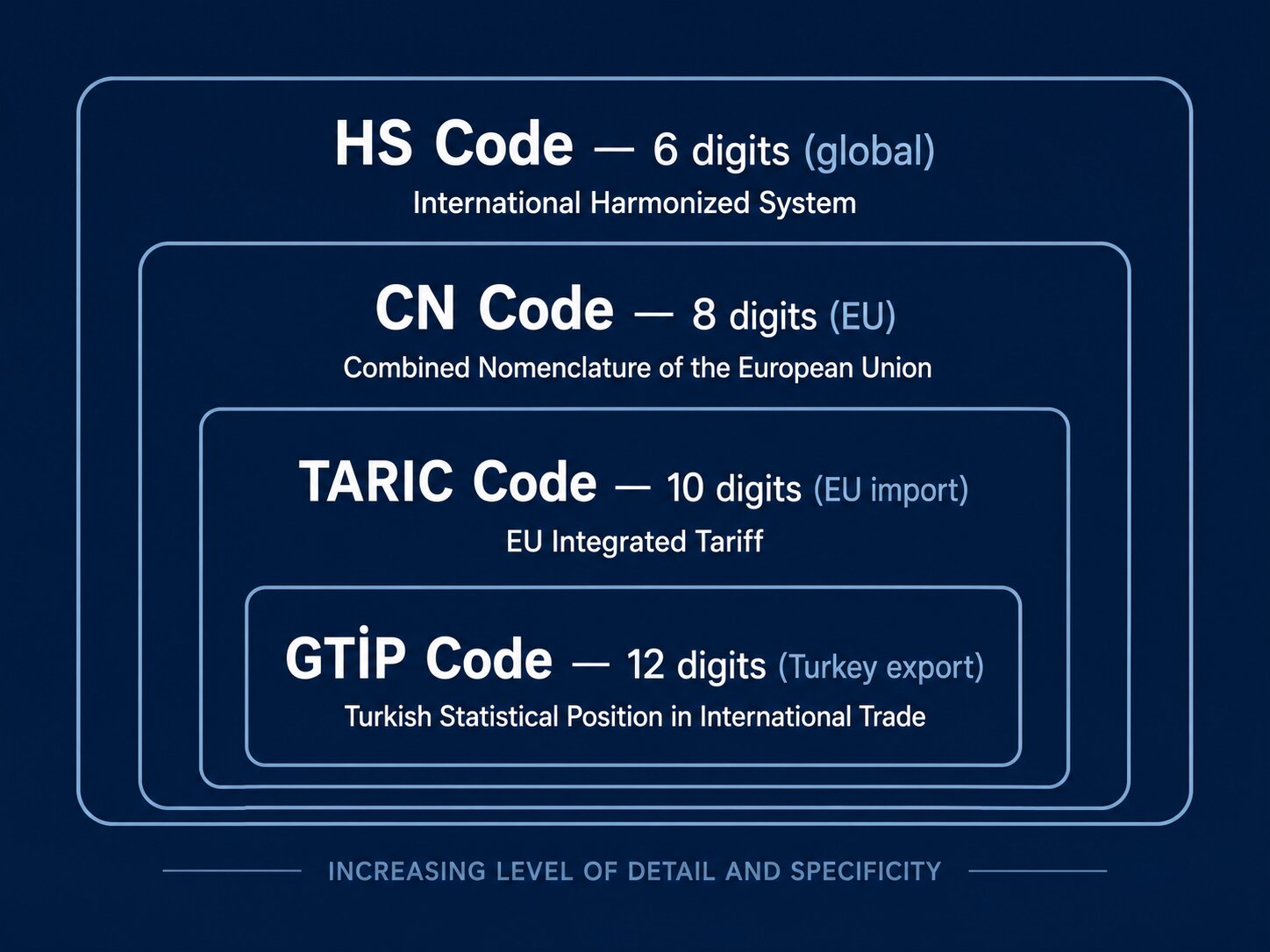
Think of the code as a set of nested layers, each adding detail. The base is the six-digit HS number, shared by more than 200 countries under the World Customs Organization. The EU then extends it, and Turkey runs its own longer version for exports.
| Code | Digits | Who sets it | What it adds |
|---|---|---|---|
| HS | 6 | World Customs Organization | Chapter (2) → heading (4) → subheading (6); the global base |
| CN (Combined Nomenclature) | 8 | European Union | Digits 7–8: EU subdivisions and the base duty rate |
| TARIC | 10 | European Union | Digits 9–10 (plus additional codes where used): anti-dumping duties, quotas, preferential rates |
| GTİP | 12 | Turkey | Turkey’s national extension, used on the export side |
For an EU import, only the full ten-digit TARIC number is decisive, because those last digits (and any TARIC additional code) carry the measures that change what you actually pay. A six-digit HS code alone will not tell you your duty. Your Turkish supplier will quote a GTİP; that is their code, built for their export declaration, and it is not the number your EU customs entry runs on.
A.TR vs. a certificate of origin — what each one does
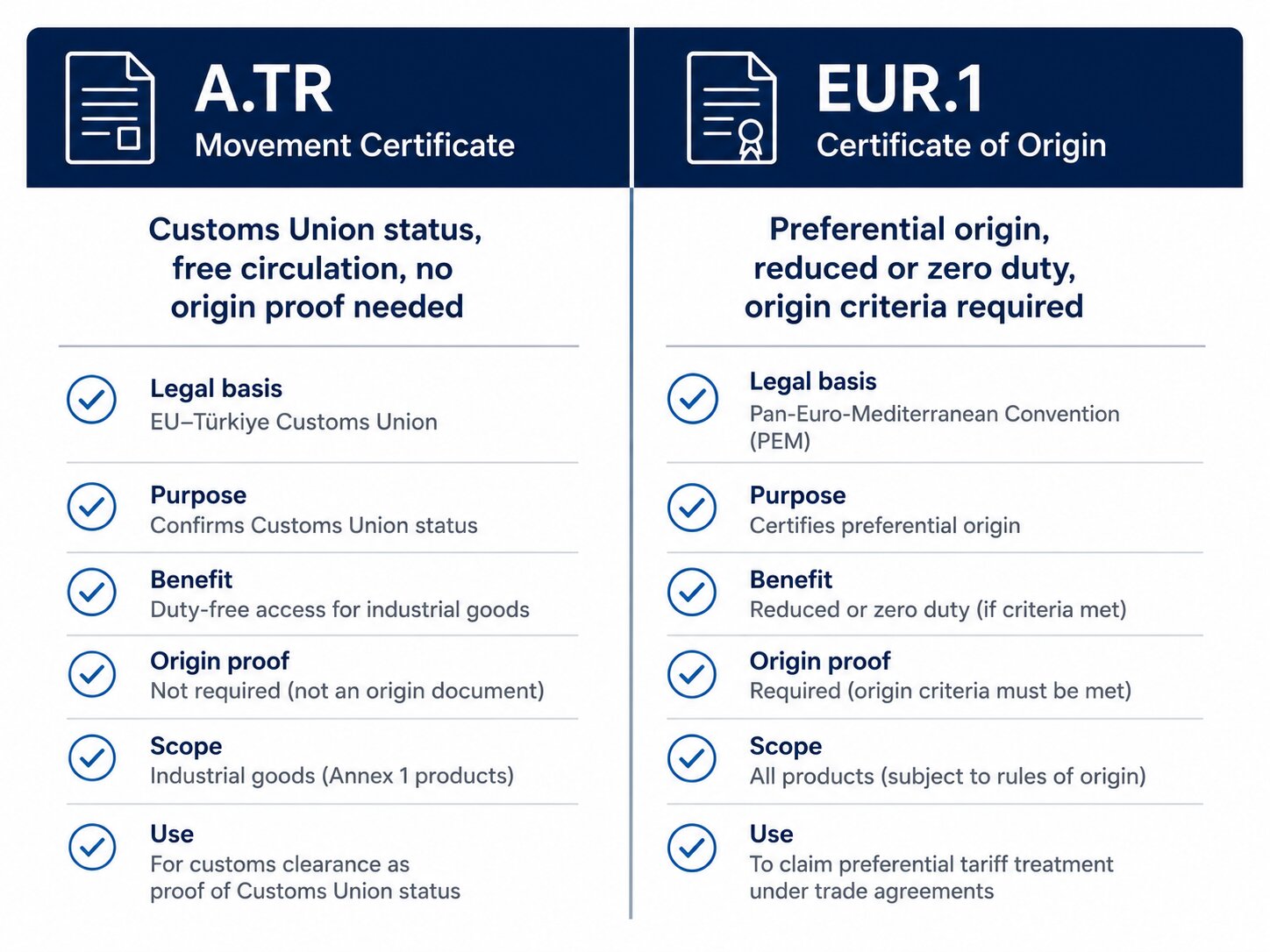
An A.TR and a EUR.1 answer two different questions, and importers routinely confuse them. The A.TR certificate confirms that goods are in free circulation within the Customs Union, which lets qualifying industrial products enter at 0% duty (Customs Support). It says nothing about where the goods were made. A certificate of origin (EUR.1, or an invoice declaration for smaller consignments) proves preferential origin, and that is what you need for agricultural products, coal, and steel, plus any goods exposed to origin-based anti-dumping measures.
A useful way to hold the distinction: the A.TR is about the route (free circulation), the EUR.1 is about the source (origin). By most estimates, well over 85% of Turkey–EU trade moves under an A.TR, which is why it feels like the default. One deadline matters: the A.TR must be presented to import customs within four months of its visa date, or it lapses.
How the right code is found: the 6 General Rules of Interpretation
Classification is not a search for the closest marketing label. The World Customs Organization sets out six General Rules of Interpretation (GIR), applied in strict order, and you stop at the first that resolves the goods (WCO).
- GIR 1. Classify by the wording of the headings and the legal notes to the relevant section and chapter. Most goods are settled here.
- GIR 2. Handles incomplete or unassembled goods, and mixtures, extending a heading to cover them.
- GIR 3. For goods that could fall under two or more headings, choose by the most specific description, then by essential character, then by the last heading in numerical order.
- GIR 4. For goods with no obvious heading, classify with the most akin product.
- GIR 5. Covers packaging and cases presented with the goods.
- GIR 6. Applies the same logic down at subheading level.
The practical questions are always the same: what is it made of, what does it do, how is it built? A steel bracket is classified as a steel article, whatever the catalogue calls it.
The supplier’s HS code is not your HS code
The number on your Turkish supplier’s proforma is a starting hint, not an answer. Overseas suppliers assign the export-country code that suits their own declaration, and sometimes the one that minimises their duty. Under EU law the importer of record carries legal responsibility for the code on the entry, no matter who first suggested it.
On Turkish road lanes we see this often, and it bites hardest on LCL consignments. When a groupage trailer out of Istanbul carries pallets from four suppliers, each line arrives with its own twelve-digit GTİP, and every one has to be re-mapped to the correct ten-digit TARIC before the goods cross into the EU. The two do not always line up cleanly at the subheading level. A mismatch that looks trivial on the invoice can change the duty rate or trigger a measure the supplier’s code never flagged. Checking the code against the EU tariff, rather than copying it across, is the cheaper habit.
CBAM in 2026 — when classification pulls you into carbon reporting
The Carbon Border Adjustment Mechanism entered its definitive period on 1 January 2026, and the CN code is what decides whether your goods are in scope. Steel, aluminium, cement, and fertilisers are the categories that matter for Turkish imports; unwrought aluminium under heading 7601, for instance, falls squarely inside CBAM (EU CBAM).
Is a single pallet of aluminium brackets really the same compliance risk as a container of steel coil? Not quite, and the threshold is where that plays out. Importers below a 50-tonne annual threshold for CBAM goods (a figure set under the 2025 simplification) are exempt from the declarant obligations, which spares most SME shipments. Whether you sit above or below that line depends on totalling your imports by CN code across the year, so the classification work feeds directly into knowing your CBAM status. If you move a few pallets of aluminium parts a year, you are almost certainly clear; if steel is your main line, the code tells you where you stand.
What getting it wrong costs
A wrong code rarely stays a quiet error. Customs can hold the shipment at the border, recalculate the duty upward, and pursue retroactive duty on past entries under the same code. Penalties stack on top, and for businesses holding Authorised Economic Operator (AEO) trusted-trader status, a pattern of misclassification can put that status at risk.
The penalty scale is real money. Using the UK framework as an illustration of how tax authorities structure this: a careless error can draw a penalty of up to 30% of the unpaid duty (dropping to 0% for an unprompted disclosure), a deliberate error up to 70%, and deliberate-and-concealed up to 100%. Applied retroactively across a year of repeated entries, a small per-shipment slip becomes a bill worth taking seriously.
Buy certainty with a Binding Tariff Information (BTI)
When a classification is genuinely borderline, you can remove the doubt in advance. A Binding Tariff Information is a formal customs decision on the correct code for a specific product, valid for three years and binding on customs authorities across all 27 EU member states (EU BTI). You apply electronically before the transaction, and once issued, the code is settled: customs cannot reopen it, and you can plan duty and CBAM exposure around a fixed number.
Check the public EBTI database first, where prior BTI decisions are searchable. If a comparable product has already been ruled on, you may find your answer without applying at all. For a product line you will import repeatedly, a BTI turns a recurring risk into a one-time task.
A pre-shipment checklist for SME importers from Turkey
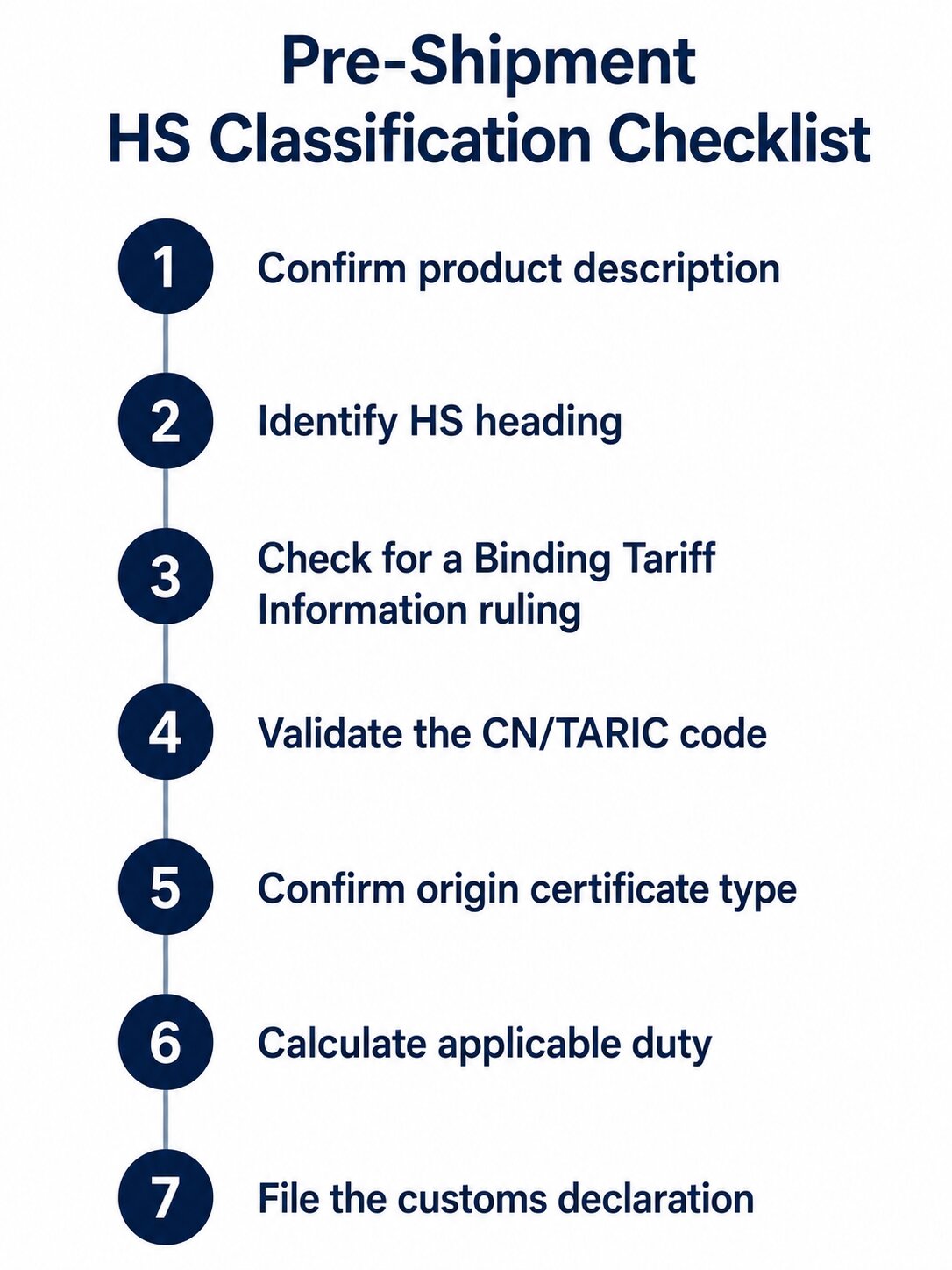
Running these steps before the goods move keeps surprises off the customs entry.
- Classify the product yourself by material, function, and construction, applying the GIR in order rather than copying the supplier’s GTİP.
- Convert to the full ten-digit TARIC and read off the duty rate, any anti-dumping measures, and CBAM scope.
- Confirm the paperwork: an A.TR for free circulation on industrial goods, or a EUR.1 / invoice declaration where origin is what counts.
- Check the four-month rule so the A.TR reaches import customs inside its validity window.
- Total your CBAM goods for the year against the 50-tonne threshold to see whether reporting applies.
- Request a BTI for any code you are unsure about, or for lines you will reorder.
- Plan the transport so consolidation and timing fit the paperwork, whether that is LCL from Turkey, a full road freight load on the Turkey lane, or a routing through our Balkans hub.
This is where a forwarder who knows the corridor earns its keep. On our Turkish road lanes we handle the GTİP-to-TARIC mapping and the certificate check as part of booking, so a low-volume shipper can ship a pallet, not a container, without a customs education first.
If you would like the duty and routing worked out before you commit, request a quote from our team and we will price the lane with the classification in view.
FAQ
Is everything shipped from Turkey duty-free in the EU?
No. Industrial goods can enter at 0% under the Customs Union with a valid A.TR, but agricultural products, coal, and steel sit outside that arrangement and need proof of preferential origin. Some steel products can also carry trade-defence duties (anti-dumping, countervailing, or safeguard) depending on origin, regardless of the A.TR. Without the right certificate, the standard tariff of roughly 3% to 20% or more applies.
What’s the difference between an HS code and a TARIC code?
The HS code is the six-digit global base set by the World Customs Organization and shared by more than 200 countries. The TARIC code is the EU’s ten-digit extension, where the extra digits carry EU-specific measures such as anti-dumping duties, quotas, and preferential rates. For an EU import, only the full ten-digit TARIC number determines your duty; the six-digit HS on its own is not enough.
Does an A.TR certificate prove the origin of my goods?
No. An A.TR proves that goods are in free circulation within the Customs Union, which is about the route, not the source. It does not establish where the goods were made. When origin matters, such as for agricultural goods, coal, steel, or goods facing anti-dumping measures, you need a EUR.1 certificate or an invoice declaration instead.
If the HS code is wrong, who is responsible, me or my supplier?
The importer of record is legally responsible for the code on the EU customs entry, regardless of who supplied the number. Your Turkish supplier’s twelve-digit GTİP is built for their export declaration and should be verified, not copied. A wrong code can bring retroactive duty and penalties, so the check sits with you.
Are Turkish steel and aluminium affected by CBAM in 2026?
Yes, if they fall within the scoped CN codes and you exceed the threshold. CBAM’s definitive period began on 1 January 2026 and covers iron, steel, aluminium, cement, and fertilisers. Importers below a 50-tonne annual threshold for CBAM goods are exempt from the declarant obligations, which clears most small shipments.
How do I get a guaranteed HS classification?
Apply for a Binding Tariff Information (BTI), a formal EU customs decision valid for three years and binding across all 27 member states. You submit the application electronically before the transaction, and once issued the code cannot be reopened by customs. Prior BTI decisions are searchable in the public EBTI database, so a comparable ruling may already exist for your product.
By the Sea Gate Logistics Editorial Team. This article was prepared by the Sea Gate Logistics editorial team, drawing on the company’s experience as an EU-registered freight forwarder in Burgas, Bulgaria, with 20+ years of collective logistics expertise across ocean, road, air, and consolidated (LCL) cargo.