EU low-emission zones are set city by city in 2026 because no binding EU law harmonises them, so a truck’s or van’s access depends on the destination, its Euro class, meaning the EU exhaust-emission standard it was approved to, and its date of first registration. Eurocities counted 703 low- and zero-emission zone schemes across 26 European countries in February 2024. Diesel trucks need Euro VI in Brussels, Greater Paris and Lyon, while Germany’s green sticker covers Euro IV trucks.
Dutch zero-emission zones for freight admit vans and trucks first registered from 1 January 2025 only if zero-emission. Euro 5 diesel vans lost Brussels LEZ access on 1 January 2026 and lose Dutch ZE zone access on 1 January 2027. Foreign-registered vehicles need a sticker in France and Germany and registration in Brussels, Flanders, Kraków, Spanish cities and, for older diesel vehicles, Denmark. Brussels has issued €350 fines since 1 July 2026; Italy’s 24 September 2026 decree-law moved the Po Valley Euro 5 diesel ban to 1 October 2027.
Key takeaways
- No binding EU law harmonises these zones; each city sets its own standard, sticker or registration.
- Diesel trucks need Euro VI in Brussels, Greater Paris and Lyon.
- Foreign plates often need a sticker or registration before entry.
- 2026 moved both ways: Italy delayed, Stockholm’s planned zone was annulled again, France’s repeal failed, and Brussels and Lyon began fining.
- Run the Plate, Class, Pass check before booking.
This guide covers vans and trucks in 11 EU countries, not cars or UK schemes, for SME shippers and small hauliers; our overview of cross-border trucking regulations in Europe covers general rules.
Contents
- LEZ, ZEZ and UVAR explained
- 2026 country matrix
- Plate, Class, Pass check
- Netherlands
- Belgium
- France and Germany
- Italy
- Spain, Poland and Denmark
- Eastern EU and the Balkans
- 2026 scoreboard and calendar
- What shippers should do
- FAQ
How urban access restrictions for trucks work: LEZ, ZEZ and UVAR
Low- and zero-emission zones make up 73% of Europe’s urban vehicle access regulation (UVAR) schemes, according to urbanaccessregulations.eu. Zero-emission zones for freight admit vans and trucks only if they have no tailpipe emissions.
| Term | Meaning | Example |
|---|---|---|
| Low-emission zone (LEZ) | Vehicles below a set Euro standard are banned, charged or time-restricted, usually via number-plate cameras or stickers | Brussels LEZ, German Umweltzonen |
| Zero-emission zone (ZEZ) | Entry only with no tailpipe emissions: battery-electric or hydrogen fuel-cell | Dutch zero-emission zones for freight, vans and trucks only |
| UVAR | Any city rule on which vehicles may enter, when and at what cost | LEZs, ZEZs, congestion charges, limited-traffic zones, pedestrian areas |
| N1 | Goods vehicle up to 3.5 t; standards written Euro 5, Euro 6 | Delivery van |
| N2 / N3 | Goods vehicle 3.5–12 t / over 12 t; standards written Euro V, Euro VI | Box truck, rigid truck, tractor unit |
Active low-emission zones rose 40%, from 228 in 2019 to 320 in 2022, according to the Clean Cities Campaign.
On 14 March 2024, the European Commission’s Expert Group on Urban Mobility adopted UVAR recommendations on road-user information, methods for non-residents and user-friendly enforcement.
EU low-emission zones for trucks and vans: the 2026 country matrix
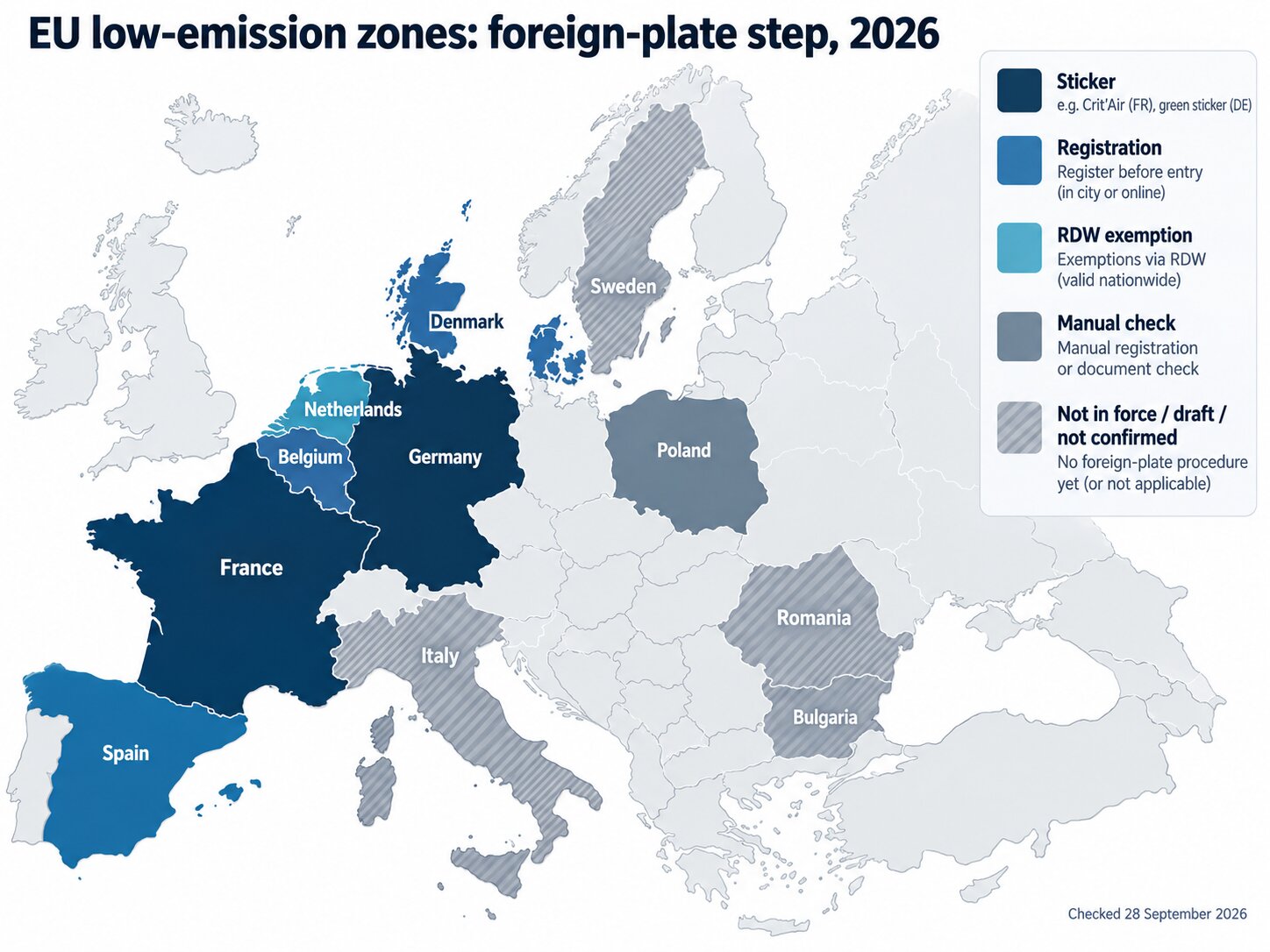
In 11 EU countries, 2026 access to low-emission zones for goods vehicles turns on five points; the rows draw on official portals and dated trade press checked on 28 September 2026, and “not confirmed” means sources are silent.
| Country | Scheme | Trucks (N2/N3), 2026 | Vans (N1), 2026 | Foreign-plate step | Fine | Next dated change |
|---|---|---|---|---|---|---|
| Netherlands | ZE zones for freight, 18 cities at launch | Zero-emission if first registered from 1 Jan 2025; Euro VI registered 2017–2024 admitted for now | Same 2025 rule; Euro 5 and Euro 6 admitted for now | RDW exemptions and dispensations, nationwide since 1 Jan 2026 | €320 truck, €130 van | 1 Jan 2027: Euro 5 vans out |
| Belgium | Brussels LEZ; Flemish LEZs (Antwerp, Ghent) | Euro VI diesel; Flanders also Euro V with paid pass* | Euro 6 diesel; Flanders also Euro 5 with paid pass* | Brussels: register before entry; Antwerp, Ghent: by midnight the day after entry* | Brussels €350 since 1 Jul 2026; Flanders €150, €250, €350* | Brussels: further stages to 2035–2036 |
| France | ZFE-m with Crit’Air (Greater Paris, Lyon) | Euro VI diesel (Crit’Air 2) | Euro 5 or Euro 6 diesel (Crit’Air 2) | Crit’Air sticker, only from certificat-air.gouv.fr | Lyon: €135 HGV, €68 van | 31 Dec 2026: Paris “informative” checks end |
| Germany | Umweltzonen, about 35 | Green sticker: Euro IV, or Euro III with filter | Green sticker: Euro 4 diesel, or Euro 3 with filter | Green sticker, also for transit | €100 | 1 Oct 2026 or 1 Jan 2027: German E-plate EVs sticker-free |
| Italy | Po Valley Euro 5 diesel ban; Milan Area B | Ban postponed to 1 Oct 2027; check the published decree | Same as trucks | Not confirmed; check the city portal | Lombardy: €168–679 | 1 Oct 2027: postponed ban date |
| Spain | ZBE in about 150 municipalities | Barcelona: Euro IV or newer; Madrid: DGT label | Madrid: DGT label; other cities vary | Register with each city before entry | €200, or €100 if paid promptly; Barcelona over 3.5 t: €500–999 | 31 Dec 2026: Madrid residents’ exemption ends |
| Poland | SCT in Kraków and Warsaw | Kraków: Euro VI or built 2012+; Warsaw: Euro V or 17 years old at most | Warsaw: diesel Euro 5 or 17 years old at most; Kraków: not confirmed | Kraków: manual registration; Warsaw: manual document check | Warsaw: up to PLN 500 | 2027: Kraków pass PLN 250/month; paid entry ends 31 Dec 2028 |
| Denmark | Miljøzoner in 5 cities | Euro VI if first registered before 1 Jan 2015 | Euro 5 or particulate filter if registered before 1 Sep 2016 | Register online before entry, valid 5 years | DKK 12,500 lorry, DKK 1,500 van | None dated in our sources |
| Sweden | Stockholm class-3 zone | Planned class-3 zone never took effect; annulled again 20 May 2026 | Same as trucks | Not applicable | Not applicable | City appeal to Transportstyrelsen pending |
| Bulgaria | Sofia winter LEZ (1 Dec to 28 Feb) | Truck scope not confirmed | Not confirmed; sources describe older cars | About 180 cameras | €25–100 | 1 Dec 2027: group II added to the Big Ring |
| Romania | Urban Code; Bucharest draft | Draft: below Euro 3 barred, Euro 6+ inner zones | Same as trucks (draft) | Not yet defined | RON 300 first offence (draft) | Zones due within 12 months of 25 Aug 2026 |
*Flanders data comes from a 2025 secondary source; confirm on the city portal.
Plate, Class, Pass: a pre-booking check for foreign vehicles
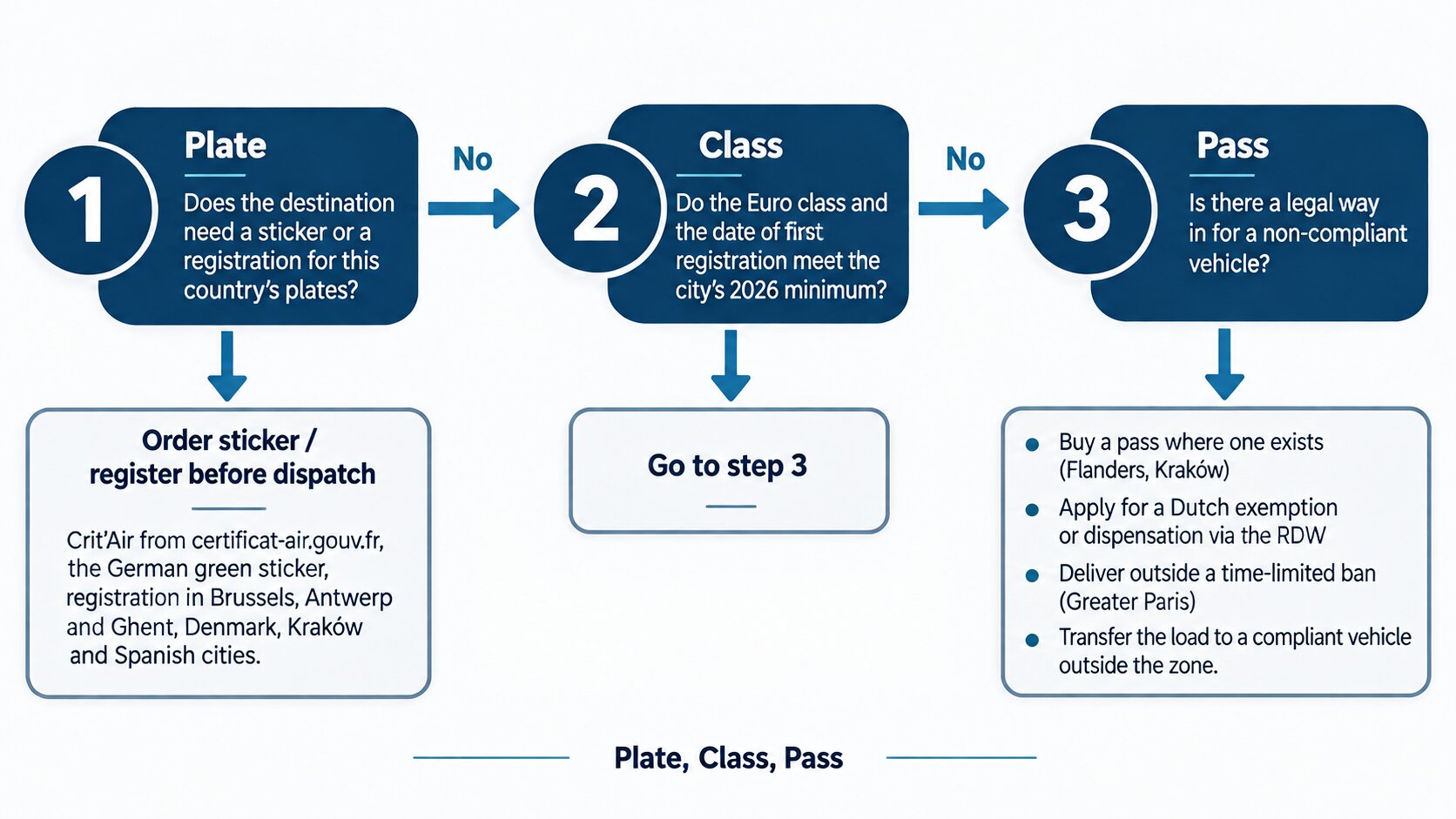
Barcelona fines an unregistered foreign vehicle from €200 even when it meets the emission standard, according to the Àrea Metropolitana de Barcelona: LEZ registration for foreign vehicles is a separate legal duty. Run the three-step Plate, Class, Pass check before booking any city-centre delivery into a low-emission zone.
| Step | What to check | Where to find it | If not |
|---|---|---|---|
| 1. Plate | Does the destination need a sticker or registration for foreign plates? | 2026 matrix, foreign-plate column; the official city portal | Order or register before dispatch: Crit’Air via certificat-air.gouv.fr, the German green sticker, registration for Brussels, Antwerp and Ghent, Kraków, Spanish cities and, for older diesels, Denmark |
| 2. Class | Do the Euro class and date of first registration meet the city’s 2026 minimum? | Registration certificate of the vehicle making the final drop | Don’t dispatch on assumption; go to step 3 |
| 3. Pass | Is there a legal way in for a non-compliant vehicle? | The official city portal | Buy a pass in Flanders or Kraków; seek a Dutch exemption or dispensation via the RDW; deliver outside Greater Paris ban hours; or cross-dock to a compliant vehicle outside the zone |
A Euro VI tractor unit first registered in 2016 meets the 2026 diesel minimum in Brussels, Greater Paris and Kraków, yet falls outside the transitional list for Dutch ZE zones — the list starts at a first registration in 2017. An otherwise identical 2017 tractor still qualifies. Euro VI truck city access can hinge on the registration date as much as on the Euro class.
Which vehicle will cross the zone boundary on delivery day? In our freight forwarding work, we check the registration certificate of the vehicle that will make the final drop, not only the linehaul truck, before confirming any city-centre delivery.
Netherlands: zero-emission zones for vans and trucks, stage by stage
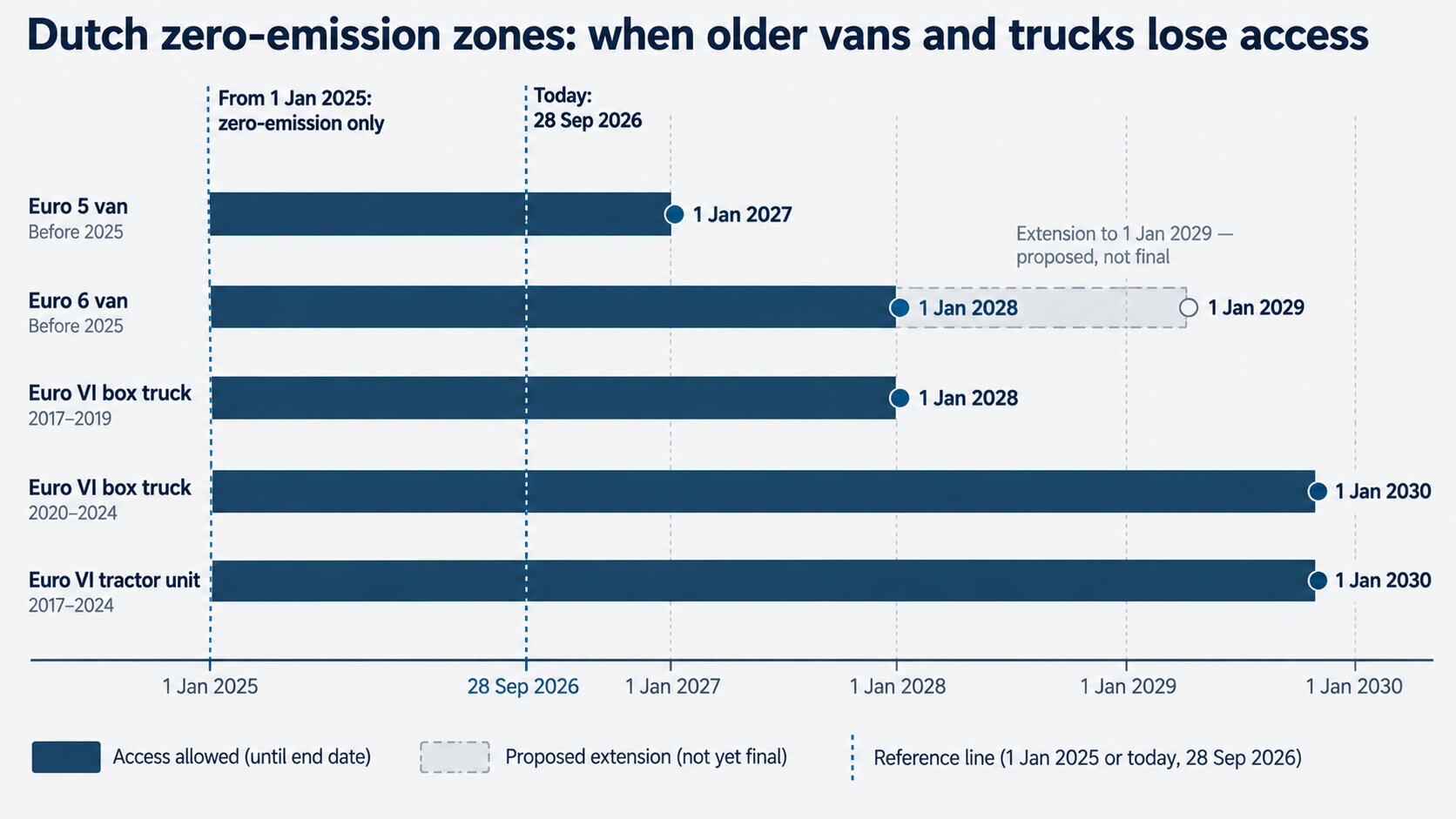
Since 1 January 2025, 18 Dutch cities, including Amsterdam, Rotterdam and Utrecht, have run zero-emission zones for freight, according to the Clean Cities Campaign. By 2030 that rises to 28 cities plus Schiphol, says business.gov.nl.
| Vehicle | First registered | Access to Dutch ZE zones until |
|---|---|---|
| Any van or truck | From 1 Jan 2025 | Zero-emission only |
| Euro 5 van | Before 2025 | 1 Jan 2027 |
| Euro 6 van | Before 2025 | 1 Jan 2028 (extension to 1 Jan 2029 proposed) |
| Euro VI box truck | 2017–2019 | 1 Jan 2028 |
| Euro VI box truck | 2020–2024 | 1 Jan 2030 |
| Euro VI tractor unit | 2017–2024 | 1 Jan 2030 |
A Dutch government proposal to extend Euro 6 van access to 1 January 2029, consulted on until 13 August 2026, is not final as of September 2026. Exemptions apply automatically by registration number; dispensations and all foreign-vehicle cases go through the RDW, and since 1 January 2026 both are valid nationwide. Fines in 2026 are €130 for a van and €320 for a truck, according to Op weg naar ZES.
In the first half of 2025, 78.4% of new Dutch vans were battery-electric, against an EU average of 8.5%, and electric truck registrations rose 187.6% year on year, a Clean Cities Campaign study of Dutch zero-emission zones found.
Belgium: Brussels LEZ 2026 fines and Flemish registration
Since 1 January 2026, Euro 5 diesel vans and lorries no longer meet the Brussels LEZ criteria, after Belgium’s Constitutional Court suspended the postponement ordinance on 11 September 2025. A first offence brings a warning letter; since 1 July 2026, the fine is €350, at most once per vehicle every three months, according to the LEZ Brussels agenda. That exposed 13,219 already-warned vehicles, newmobility.news reported. Further stages run to 2035–2036. Foreign-plated vehicles must register before entering.
Antwerp and Ghent in Flanders admit Euro VI diesel trucks and Euro 6 diesel vans free, and Euro V or Euro 5 diesels only with a paid pass. Foreign vehicles other than Belgian and Dutch ones register free by midnight the day after entry; one registration covers both cities for 3 years, but not Brussels. Fines escalate from €150 to €250 and €350; these Flemish figures date from July 2025, so check the city portal.
France and Germany: Crit’Air and green sticker rules for trucks
France’s low-emission zones (ZFE-m) remain in force: the Constitutional Council censored Parliament’s repeal article on 21 May 2026 on procedural grounds. All vehicles, foreign trucks included, need a Crit’Air sticker from certificat-air.gouv.fr, the only official issuer.
| Diesel vehicle | Euro class | Crit’Air | Greater Paris and Lyon, 2026 |
|---|---|---|---|
| Truck (HGV) | Euro VI (registered from 2014) | 2 | Allowed |
| Truck (HGV) | Euro V | 3 | Barred |
| Van | Euro 5 or Euro 6 | 2 | Allowed |
| Van | Euro 4 | 3 | Barred |
Inside the A86’s 77 communes, Greater Paris restricts HGVs daily and vans Monday–Friday, 8:00–20:00, but the Métropole du Grand Paris keeps checks “occasional and informative” until 31 December 2026. Métropole de Lyon cameras have fined €135 per HGV and €68 per van since 1 July 2026.
The Umweltbundesamt counts about 35 German Umweltzonen as of 26 August 2026, all requiring a green sticker (Umweltplakette). Trucks, foreign ones in transit included, need Euro IV or Euro III with a particulate filter; the fine is €100. On 25 September 2026 the Bundesrat approved exempting German E-plate vehicles from the green sticker, effective 1 October 2026 if published in the Federal Law Gazette in September, otherwise 1 January 2027. It does not address foreign EVs.
Italy: the Euro 5 diesel ban moves to October 2027
Italy’s Council of Ministers approved a decree-law on 24 September 2026 moving the Po Valley Euro 5 diesel ban from 1 October 2026 to 1 October 2027, according to Il Post. Lombardy alone had not suspended the ban, which would have started the following week in Milan, Monza, Brescia and Bergamo. Italian press counts about 600,000 Euro 5 diesel commercial vehicles nationwide, about 200,000 in the valley.
Piedmont lifted its ban on 29 June 2026 for about 307,000 vehicles around Turin and Novara. Before the decree, Lombardy’s schedule set N1 and N2 for 1 October 2027 and N3 for 1 October 2028, on weekdays 7:30–19:30 with fines of €168–679, Il Sole 24 Ore reported. Milan’s Area B bars Euro 6 A/B/C diesels, vans included, from 1 October 2028, according to the Comune di Milano.
Whether the decree also moves those 2027 and 2028 stages depends on its Gazzetta Ufficiale text, so check the published decree.
Spain, Poland and Denmark: ZBE, clean transport zones and registration
Law 7/2021 required about 150 Spanish municipalities over 50,000 inhabitants to create a ZBE before 2023, with minimums in Royal Decree 1052/2022, yet in 2026 activation and enforcement vary by city. DGT environmental labels and ANPR cameras govern access; the general fine is €200, or €100 if paid promptly. Spain’s ZBE rules for trucks with foreign plates require city registration with proof of Euro class. Barcelona’s ZBE Rondes has excluded N2/N3 trucks below Euro IV since 1 January 2022 and fines non-compliant vehicles over 3.5 t €500–999, according to the Àrea Metropolitana de Barcelona.
The Kraków SCT (Strefa Czystego Transportu) has required diesel vehicles over 3.5 t to meet Euro VI or date from 2012 or later since 1 January 2026, according to ZTP Kraków. Foreign vehicles register manually; non-compliant non-residents may pay PLN 2.50 an hour or PLN 100 a month in 2026, PLN 250 in 2027 and PLN 500 in 2028, until paid entry ends on 31 December 2028. Warsaw SCT stage 2 has required diesel vehicles to meet Euro 5 or be at most 17 years old since the same day. Foreign plates are missing from Poland’s CEPiK database, so municipal guards check them manually; fines reach PLN 500.
Denmark’s miljøzoner in Copenhagen, Frederiksberg, Aarhus, Odense and Aalborg require Euro VI from foreign diesel trucks over 3.5 t first registered before 1 January 2015. Diesel vans first registered before 1 September 2016 need Euro 5 or a particulate filter. Both groups register online at mz.miljoezoner.dk before entry; fines are DKK 12,500 for lorries and DKK 1,500 for vans.
Eastern EU and the Balkans: Sofia, Bucharest and subcontracted trucks
Sofia ran a winter low-emission zone from 1 December 2025 to 28 February 2026, with about 180 cameras and fines of €25–100, according to Novinite and BNR. Aimed at older cars, the zone has no confirmed truck scope, so check before winter 2026/27; group II joins the Big Ring ban from 1 December 2027.
Romania’s Urban Code, in force since 25 August 2026, gives municipalities 12 months to delimit low- and zero-emission zones. Bucharest’s draft, prepared with the EBRD, would bar vehicles below Euro 3 and set a RON 300 first-offence fine, according to Bucureşti FM. These are plans, not rules in force.
EU trucks average 14.1 years old, Greek trucks 22.6, the oldest, according to ACEA. That suggests many predate Euro VI, which Crit’Air dates from 2014 registrations. A subcontracted linehaul truck on Balkan road corridors can pass every motorway leg yet fail a Western city minimum, so check it at the transfer point. Türkiye loads also face the permit quotas that already cap Turkish trucks on EU roads.
In our view, the LEZ risk on Eastern EU and Türkiye groupage sits in the final city leg, not the long haul — whenever the linehaul truck is below the destination’s minimum.
[case study placeholder: a Balkan or Türkiye groupage load transferred to a compliant vehicle before a Western-EU city delivery]
Low emission zones in Europe 2026: what eased, what tightened, what’s next
Easing in 2026 came as delays and grace periods, while tightening came as money: Brussels and Lyon started fining on 1 July 2026. Courts cut both ways: Belgium’s restored the Brussels ban and France’s kept the ZFEs. Stockholm’s planned class-3 zone, which would have admitted essentially only zero-emission vehicles, never took effect: it was suspended before its planned 31 December 2024 start, and the County Administrative Board (Länsstyrelsen) annulled it for the second time on 20 May 2026; the city is appealing to Transportstyrelsen. No 2026 retreat changed the diesel-truck minimum in Brussels, Greater Paris or Lyon.
The scoreboard lists nine 2026 zone changes, checked 28 September 2026.
| Date (2026) | Where | What happened | Direction |
|---|---|---|---|
| 1 Jan | Brussels | Euro 5 diesel vehicles lose LEZ access | Tightened |
| 1 Jan | Kraków, Warsaw | Kraków SCT starts; Warsaw stage 2 | Tightened |
| 20 May | Stockholm | Planned class-3 zone annulled a second time by Länsstyrelsen; appeal pending | Eased |
| 21 May | France | Constitutional Council censors ZFE abolition | Repeal blocked |
| 29 Jun | Piedmont | Euro 5 diesel ban lifted | Eased |
| 1 Jul | Brussels, Lyon | Fines start: €350 (Brussels), €68/€135 (Lyon) | Tightened |
| 25 Aug | Romania | Urban Code: LEZs and ZEZs due within 12 months | Tightened |
| 24 Sep | Italy | Po Valley Euro 5 diesel ban moved to 1 Oct 2027 | Eased |
| 25 Sep | Germany | Bundesrat approves green-sticker exemption for German E-plate EVs | Eased (EVs only) |
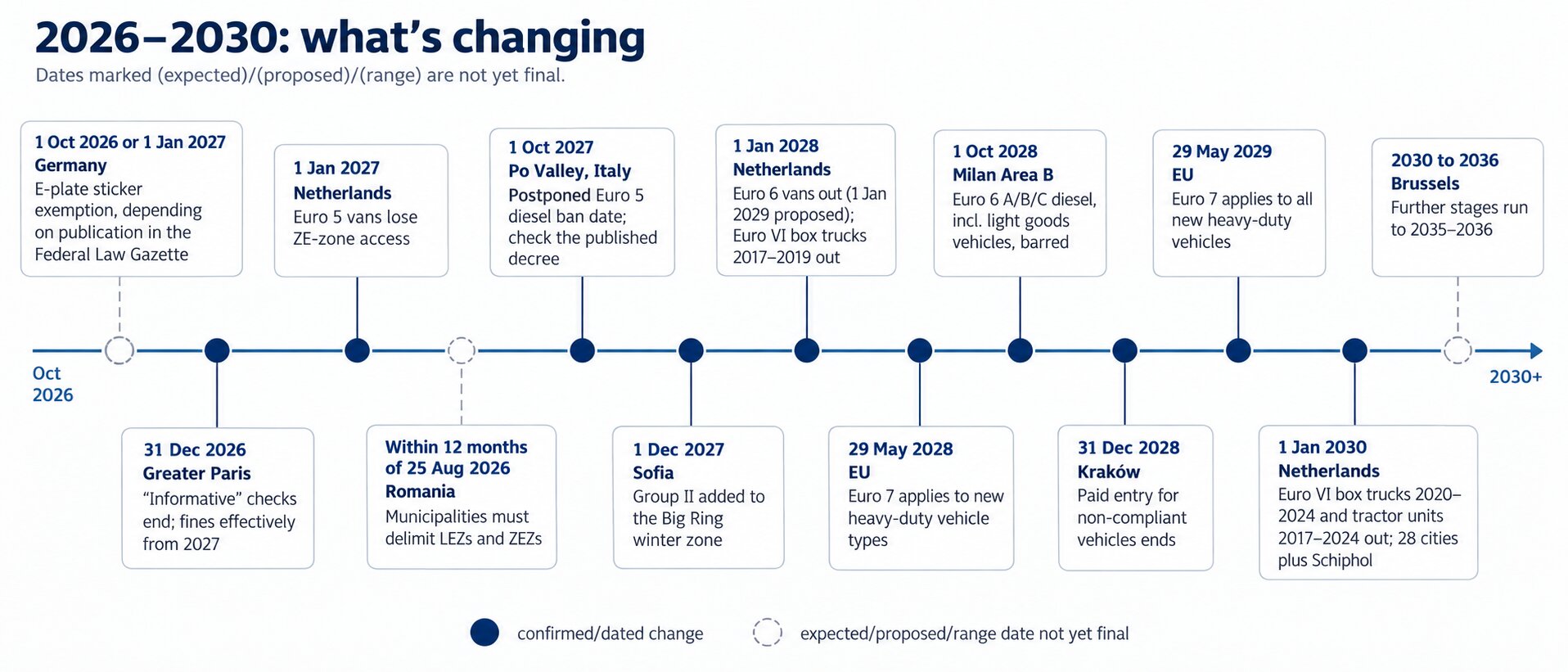
The calendar runs from October 2026, with Euro 7 dates set by Regulation (EU) 2024/1257; no city in the country matrix has dated a Euro 7 access requirement.
| Date | Where | What changes |
|---|---|---|
| 1 Oct 2026 or 1 Jan 2027 | Germany | E-plate sticker exemption, depending on publication |
| 31 Dec 2026 | Greater Paris | “Informative” checks end; fines effectively from 2027 |
| 1 Jan 2027 | Netherlands | Euro 5 vans lose ZE-zone access |
| Within 12 months of 25 Aug 2026 | Romania | Municipalities must delimit LEZs and ZEZs |
| 1 Oct 2027 | Po Valley, Italy | Postponed Euro 5 diesel ban; check the published decree for vans and trucks |
| 1 Dec 2027 | Sofia | Group II added to the Big Ring winter zone |
| 1 Jan 2028 | Netherlands | Euro 6 vans out (1 Jan 2029 proposed); Euro VI box trucks from 2017–2019 out |
| 29 May 2028 | EU | Euro 7 applies to new heavy-duty vehicle types |
| 1 Oct 2028 | Milan Area B | Euro 6 A/B/C diesel, including light goods vehicles, barred |
| 31 Dec 2028 | Kraków | Paid entry for non-compliant vehicles ends |
| 29 May 2029 | EU | Euro 7 applies to all new heavy-duty vehicles |
| 1 Jan 2030 | Netherlands | Euro VI box trucks 2020–2024 and tractor units 2017–2024 out; 28 cities plus Schiphol |
| By 2035–2036 | Brussels | Further stages; no Euro levels published in our sources |
What shippers should do: fines, costs and a compliant last mile
Only 1.3% of about 30.1 million vans on EU roads, and 0.1% of about 6 million trucks, are electrically chargeable, according to ACEA. With zero-emission delivery vans that scarce, a compliant final leg into a low-emission zone must be planned at booking.
- Run Plate, Class, Pass for every city stop and vehicle before booking, not after dispatch.
- Who pays when a compliant pallet arrives on a non-compliant truck? Agree in writing who bears an LEZ fine and the cost of a failed or repeated delivery: carrier, forwarder or shipper.
- Ask for LEZ-related costs such as passes, transfers and re-delivery as named quote lines; how surcharges are built into a 2026 freight rate shows where each belongs.
- For part loads, consolidate outside the zone: two pallets for a shop in central Brussels can ride long-haul consolidated groupage to a transfer point, then enter on a compliant vehicle (a transfer adds a handling step, so price it in).
Settle the compliant city vehicle before the linehaul, so compliance, cost and consolidation land in one booking.
FAQ: low emission zones for trucks and vans
Do low emission zones apply to foreign-registered trucks and vans?
Yes, zones in the Netherlands, Belgium, France, Germany, Spain, Poland and Denmark apply to foreign-registered vehicles. France and Germany require stickers; Brussels, Antwerp, Ghent, Kraków, Spanish cities and, for older diesel vehicles, Denmark require registration.
What Euro standard does a truck need to enter a city in 2026?
A diesel truck needs Euro VI for Brussels, Greater Paris and Lyon in 2026. Germany’s green sticker and Barcelona admit Euro IV.
What is the difference between a low emission zone and a zero-emission zone?
A low-emission zone bans, charges or time-restricts vehicles below a set Euro standard. A zero-emission zone admits only vehicles with no tailpipe emissions, such as battery-electric trucks.
Can Euro 6 diesel vans still enter Dutch zero-emission zones?
Yes, Euro 6 vans first registered before 2025 may enter Dutch zero-emission zones until 1 January 2028. A proposed extension to 1 January 2029 is not final.
Is the Brussels LEZ ban on Euro 5 diesel in force in 2026?
Yes, the Brussels LEZ has excluded Euro 5 diesel vans and lorries since 1 January 2026. After a first warning letter, €350 fines have applied since 1 July 2026.
Has Italy postponed the Euro 5 diesel ban?
Yes, a decree-law of 24 September 2026 moved the Po Valley Euro 5 diesel ban from 1 October 2026 to 1 October 2027. Check the published decree for van and truck stages.
Are France’s low-emission zones (ZFE) being abolished?
No, France’s Constitutional Council censored the abolition article on 21 May 2026, so ZFEs remain in force. Lyon has fined non-compliant lorries €135 since 1 July 2026.
Before you book the next city delivery
A truck or van can enter EU low-emission zones in 2026 when it passes Plate, Class, Pass: its plate is stickered or registered where required, and its Euro class and first-registration date meet the city minimum or a legal pass applies. The next deadlines are 1 January 2027 for Euro 5 vans in Dutch ZE zones and 1 October 2027 in Italy.
For groupage, send us the delivery address and we’ll build the city rules into your quote for road freight into EU cities.
About the author
This article was prepared by the Sea Gate Logistics editorial team, drawing on the company’s experience as an EU-registered freight forwarder in Burgas, Bulgaria, with 20+ years of collective logistics expertise across ocean, road, air, and consolidated (LCL) cargo.