Oversized cargo transport in Europe crosses into abnormal-load territory at four numbers: 2.55 m wide, 4.00 m high, 18.75 m long for a road train, and 40 t gross vehicle weight (European Commission). Pass any one of them and the move needs a special permit in every country it touches, granted only for an indivisible load, one that cannot be split without cost or risk of undue damage. No single European permit exists today, and Germany, Austria and France push the decision down to regional authorities.
Lead times run from 3–7 working days in the Netherlands to 15–30 in Spain, and complex multi-country moves should start at least eight weeks ahead (Estimated). Escort rules diverge as sharply: Italy requires an escort above 3.0 m of width, while the European guideline triggers a police escort above 4 m wide and 50 m long on motorways. The strictest country, structure or authority on the route sets your permit clock, your escort bill and the width you can run.
Key takeaways
- Four numbers define the threshold. Over 2.55 m wide, 4.00 m high, 18.75 m long or 40 t gross, and ordinary freight becomes an abnormal load.
- Permits stack country by country. No single European permit exists, and Germany, Austria and France decide region by region.
- The tightest link sets the clock. One bridge or one slow authority governs the lead time, the escort bill and the feasible width.
- Escort rules are not harmonised. The guideline points to police above 4 m and 50 m; Italy requires an escort from 3.0 m.
- The 2026 reform is agreed, not in force. National rules apply unchanged, and the planned one-stop-shop stops at the EU border.
Scope and audience: this is for SME shippers buying one-off oversized moves (machinery, plant, energy equipment) who need to know what an oversized move costs in time and conditions, not for hauliers seeking operator licences. It covers EU road permits, escorts, route planning, the Balkan leg and the sea, barge and rail alternatives. Lifting engineering and UK STGO categories sit outside.
What counts as an oversized load in Europe
The EU truck dimension limits in Directive 96/53/EC fix the shape of an ordinary lorry on European roads with four figures.
| Limit | Standard maximum |
|---|---|
| Width | 2.55 m |
| Height | 4.00 m |
| Length, articulated combination | 16.50 m |
| Length, road train | 18.75 m |
| Gross vehicle weight | 40 t (44 t on intermodal legs within 150 km) |
Abnormal or oversized transport is any road movement exceeding one or more of those limits; it may circulate only under a special permit issued by the competent authorities on a non-discriminatory basis (European Commission). Indivisible load is the qualifier that decides whether you get one: a load that cannot be divided into two or more loads without cost or risk of undue damage. ESTA, the European Association of Abnormal Road Transport and Mobile Cranes, uses a shorter shorthand, treating anything over 40,000 kg or wider than 2.5 m as abnormal.
The cheapest lever sits at the very start. A machine that can legally be dismantled and reassembled is not indivisible, so it leaves the permit regime and travels as ordinary European road freight or as consolidated (LCL) cargo. That decision belongs on the purchase order. Once the machine is skidded onto a frame, the option has gone.
The Tightest-Link Rule: the four-gate check
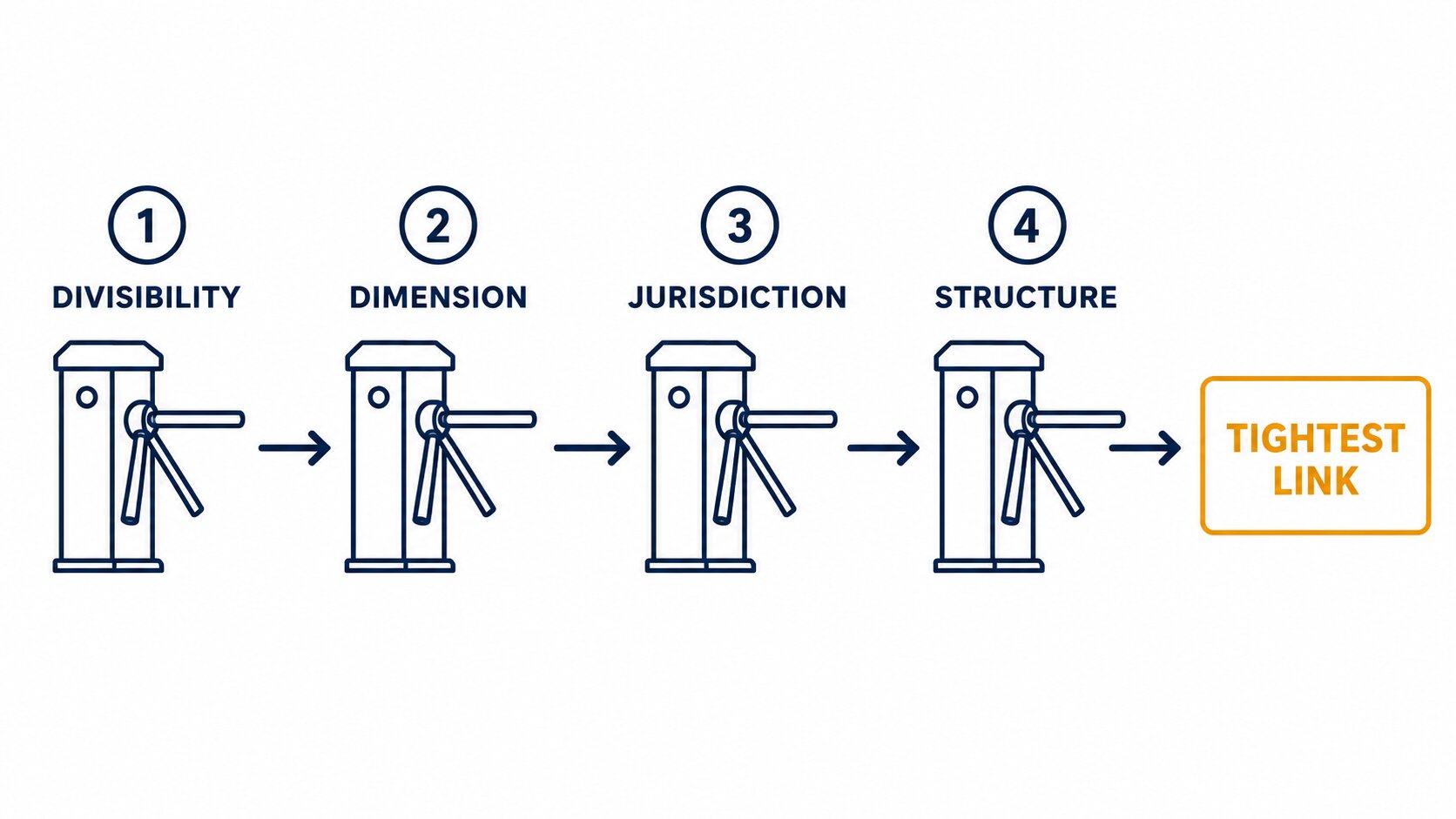
Distance is rarely what makes an abnormal move expensive. A 1,400 km run across three countries with clear structures can be simpler than 200 km ending at one 1960s river crossing built for farm traffic.
We work to a rule we call the Tightest-Link Rule: measure the four numbers in transport position, on the trailer rather than in the crate specification, then find the strictest country, structure and authority on the route. That link sets your permit clock, your escort bill and your feasible width. Every other link has slack.
Run it as four gates.
- Divisibility gate. Can the load legally be split or dismantled? If it can, the permit system stops applying.
- Dimension gate. Which of the four numbers do you break, in transport position? Deck height and lashing add real centimetres, and height catches shippers out most often.
- Jurisdiction gate. Count every country on the route, then count again inside Germany, Austria and France, where regional authorities decide. That count, not the mileage, drives your lead time.
- Structure gate. Identify the worst bridge, tunnel, roundabout and overhead line on the corridor. Those four points set your true width and weight ceiling.
Why does a method like this need a name? Because almost every guide on the subject is a compliance checklist for hauliers, and the haulier cannot change the cargo. The shipper still can. On Balkan lanes we plan around a single structure or a single non-EU border far more often than around kilometres, and the moves that go wrong were measured in the crate rather than on the trailer.
Permits for oversized cargo transport in Europe: who issues them and how long they take
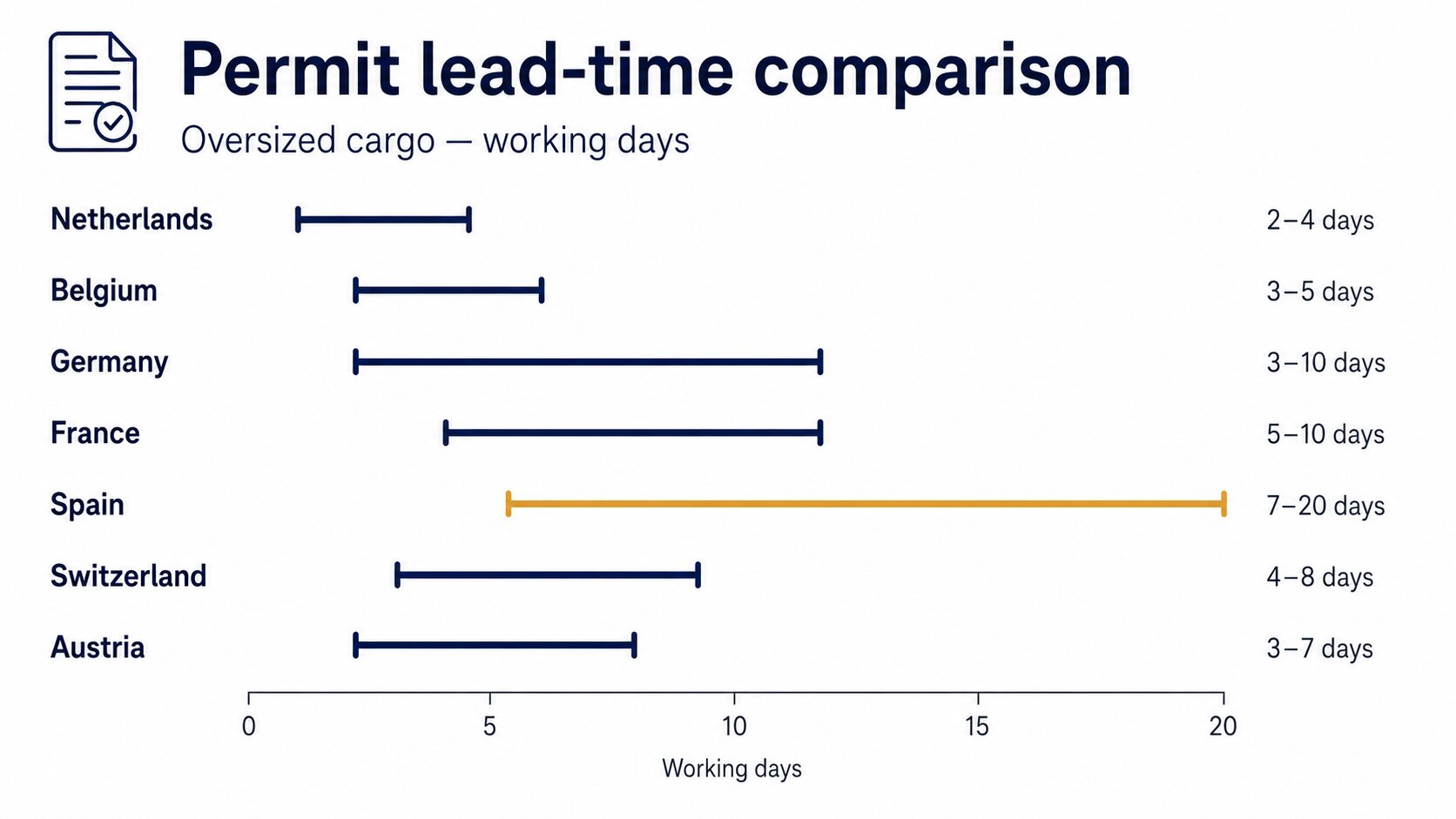
There is no single European permit. Abnormal load permits in Europe are issued country by country, so oversized cargo transport in Europe means four or five applications running on four or five clocks between Rotterdam and Milan.
Three permit types cover most traffic (European Best Practice Guidelines for Abnormal Road Transports): a single permit for one journey, a period permit valid weekly, monthly or yearly for repeat movements on a fixed profile, and a general or corridor permit covering a defined route or network.
The decision model, not the mileage, drives the lead time. The Netherlands and Switzerland issue centrally, through RDW and the federal ASTRA one-stop-shop. Germany, Austria and France decentralise: an oversize transport permit in Germany is filed on the federal VEMAGS platform but decided by the states, SOTRA routes to the Austrian provinces with ASFINAG involved, and French prefectures rule on applications filed through the central MTE platform. Each region sets its own escort and travel-time conditions — which is how a two-country move arrives with more sets of conditions than it has countries.
| Country | System | Lead time (as of August 2026) |
|---|---|---|
| Netherlands | RDW, centralised; VGRP portal | 3–7 working days; standard automated cases “within seconds” |
| Belgium | national | 5–10 working days |
| Germany | VEMAGS, federal platform / state decisions | 5–15 working days; complex moves several weeks |
| France | central MTE platform, prefecture decisions | 7–21 working days |
| Spain | national | 15–30 working days (variable) |
| Switzerland | ASTRA federal one-stop-shop | simple cases a few days; complex rarely over two weeks |
| Austria | SOTRA, provincial decisions, ASFINAG involved | complex moves frequently several weeks |
Six documents travel with the vehicle: the permits (originals where required), the route survey report, the lashing calculation, the cargo drawing and specification, insurance papers, and contact numbers for each permit authority. Budget 1 to 8 weeks for planning, and at least 8 weeks for a complex multi-country move (Estimated).
On cost, honesty beats a number. Permit fees, escort rates and survey costs are set nationally and are not published in any comparable way across Europe. Count the drivers instead: countries and regions crossed, separate permits, escort type and hours, any route survey or bridge assessment, night-only or convoy conditions, and any structure needing reinforcement. A forwarder prices those per move.
Escorts: one car, two cars, or police
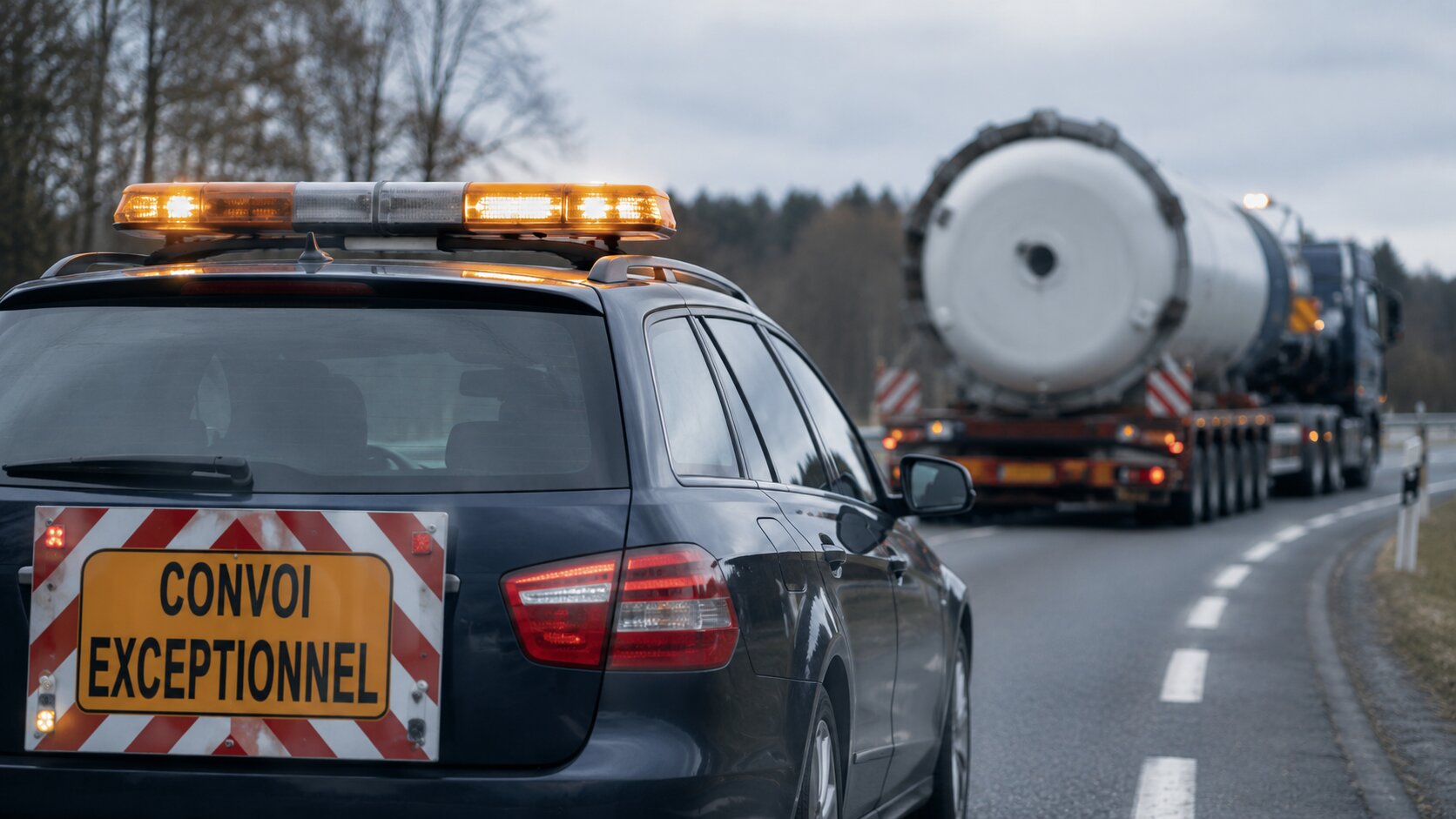
Escorting is required by the majority of EU member states, and the rules on escorts, time frames, authorised speeds and lighting vary from country to country and sometimes from region to region (European Best Practice Guidelines for Abnormal Road Transports).
A Type A escort is at least one escort vehicle, normally a marked pilot car ahead of or behind the load. A Type B escort is police plus one escort vehicle, or two escort vehicles, and the motorway trigger in the guidance is a vehicle over 4 m wide and over 50 m long. National thresholds sit well below it.
| Where | Escort trigger |
|---|---|
| EU guideline | Type B above 4 m width and 50 m length on motorways |
| Netherlands | one escort car above 3.5–4.0 m width off-motorway, 4.0–4.5 m on motorways |
| Italy | escort mandatory above 3.0 m width (3.2 m for snowploughs and rail cars) |
| Germany | private BF-3 / BF-4 escort vehicles supplied by the applicant; police only where those are insufficient |
So what does a 3.4 m wide transformer cost you in escorts? In Italy it needs a mandatory escort for the whole national leg, while in the Netherlands it may need nothing away from the motorway. That spread is why escort vehicle requirements for oversized transport have to be priced against the strictest country on the route, not the average of them.
Abnormal transport route planning: the survey, the bridge and the swept path
A route survey is a physical drive of the exact route in a pilot vehicle, not a desk exercise on a mapping tool. The surveyor records tight turns, low cables, underpasses and clearances, logs each bridge by identifier, material, year built and last rehabilitation date, then compares your axle groups and gross weight against that structure’s allowable limits.
The arithmetic is where schedules break. Many older rural bridges were designed for 20–30 t agricultural traffic, while a modern heavy move can exceed 200 t. The answer is a bypass or steel-plate reinforcement — schedule items with approvals of their own, not paperwork cleared the week before loading.
Swept path analysis models the tail swing of the trailer and the off-tracking of the tractor unit through each turn, so the load does not clip a signal post or a guardrail.
Authorities then attach operating conditions to the permit:
- night-only movement,
- weekend exclusions, notably in France,
- reduced maximum speeds,
- fixed time windows on named sections.
Commission the survey early. The report feeds the permit application rather than following it, and it finds the tightest link before the authority does.
The Balkan and Black Sea leg: where the EU rulebook stops
Bulgaria issues abnormal-transport permits through Agency “Road Infrastructure” under Ordinance №11 of the Ministry of Regional Development and Public Works, coordinated with the Traffic Police (Bulgarian Ministry of Interior). Two extra documents appear at defined thresholds:
- a transport schedule above 100 t total mass, 4.50 m width or 30.00 m length;
- a route protocol above 100 t mass, 5 m height, 40 m length or 5.50 m width.
Police approval follows the geography of the move. The Regional Directorate of Interior approves where the route crosses one or two neighbouring regions, and the National Police General Directorate where it crosses more than two.
South and west of Bulgaria the EU rulebook stops. Serbia, North Macedonia, Bosnia and Herzegovina and Türkiye sit outside the reform, with separate national permits, escort rules and application languages, and Corridor X (Salzburg–Belgrade–Skopje–Greece) carrying most of the traffic. The consequence stands whatever the timetable: the coming EU one-stop-shop stops at the EU border, so a Munich to Istanbul move is still assembled bilaterally.
On Balkan road corridors we plan around the non-EU crossings and the tightest single structure rather than around kilometres, and clean paperwork at a border is worth more than a fast truck. Burgas sits on that seam, which is why our shipping from Bulgaria work often prices a road permit chain against a Black Sea or Danube sailing.
When the road is the wrong answer: sea OOG, Danube barge and rail
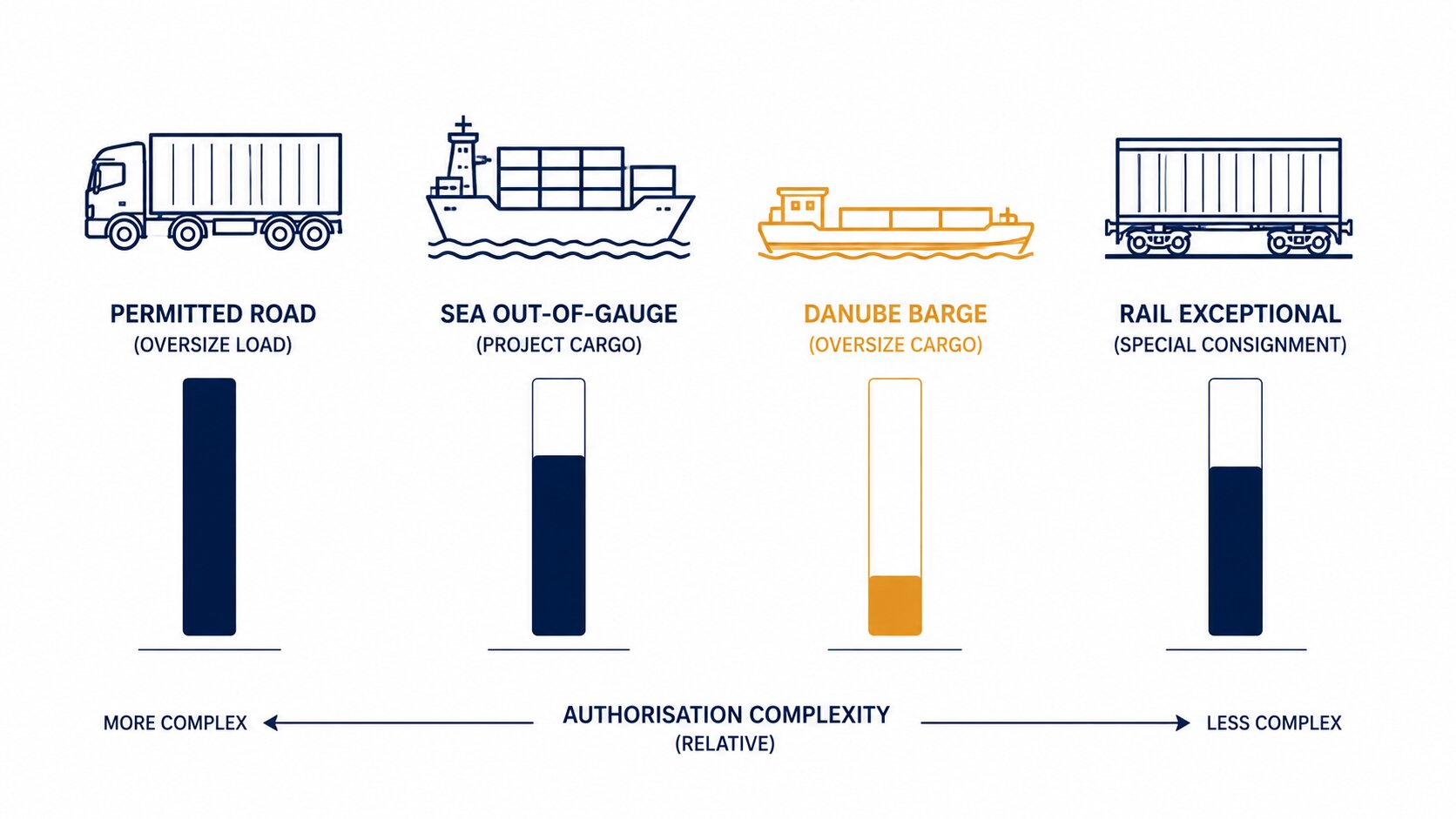
Out of gauge (OOG) cargo is anything beyond a container’s internal usable dimensions: over 2.35 m wide, over 2.39 m high (2.69 m in a high cube) or over 12.03 m long. Breakbulk is cargo loaded piece by piece rather than in a container, roughly beyond 40 ft long, 14 ft wide, 14 ft high or 30 t (Estimated). Project cargo in Europe is defined by coordination rather than size: a programme of moves, not one consignment. A 20 ft flat rack typically gives a floor of roughly 5.6–5.7 m by 2.24–2.44 m depending on the build, with end walls around 1.96 m. Surcharges for out of gauge cargo shipping run USD 200–800+ per container (Estimated).
Then comes the joint the sea guides and the permit guides both miss, because different people write them. The flat rack still has to leave the port on a permitted trailer. Ocean freight moves the problem down the route; it does not always remove it.
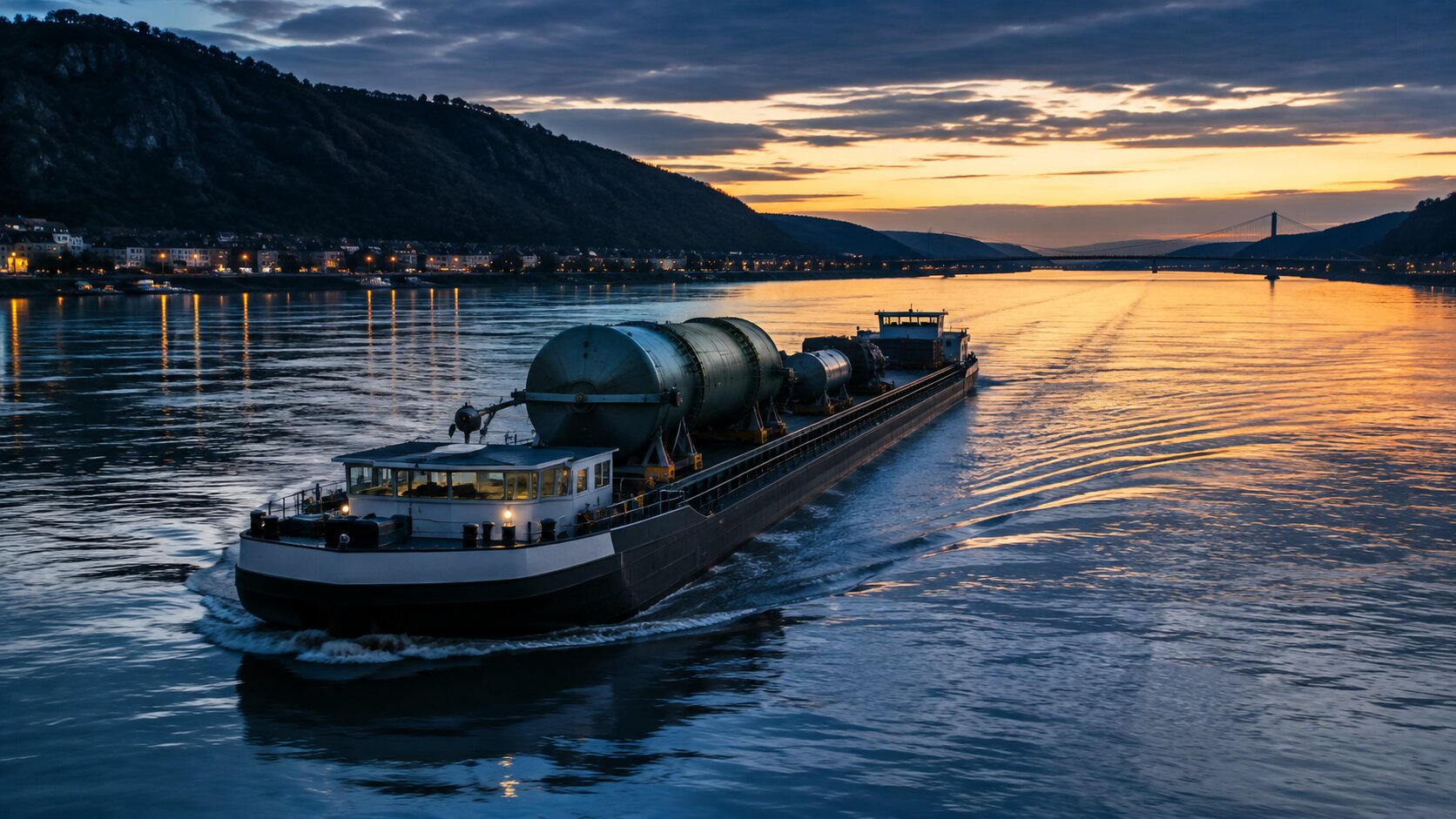
Two options genuinely bypass the road. Use of the Danube is free of charge, its locks run at night and at weekends, bridge clearances give a loading gauge no road can match, and the corridor links Constanța with Bulgaria, Serbia, Hungary, Austria, Slovakia, Germany, the Netherlands and Belgium (viadonau). Self-propelled barges typically run 1,000–5,000 DWT and pushed convoys reach up to 12 barges. Rail is the second: beyond the loading gauge a load becomes an exceptional consignment needing authorisation in every country on the route, a Bza in Germany, against gauges of GC at 3.15 m × 4.65 m and C at 3.60 m × 4.83 m.
| Mode | What it takes | Authorisation | Where it wins | The catch |
|---|---|---|---|---|
| Permitted road | Escorts, route survey | Every country and region crossed | Door to door, no handling | Slow to authorise; the tightest link caps width |
| Sea OOG | Flat rack, open top or Ro-Ro | Carrier acceptance, port handling | Very heavy or very wide pieces | Needs a permitted trailer at both ends |
| Danube barge | River berth, transhipment | Waterway free of charge | Most of the distance on a large gauge | Serves the Danube corridor only |
| Rail exceptional consignment | Gauge check against GC or C | Separate authorisation per country | Predictable slots, long distances | Gauge is unforgiving; terminal legs by road |
What the 2026 reform changes, and what it does not
On 4 December 2025 the Council of the European Union agreed its general approach on the revision of the Weights and Dimensions Directive, keeping the special-permit flexibility for indivisible loads (Council of the EU). Trilogue negotiations opened on 9 December 2025, and a second trilogue produced a provisional agreement reflected in a Council working document dated 12 June 2026.
The package covers:
- a one-stop-shop per country for permit applications,
- standardised application forms and electronic permits,
- permitting systems in all EU languages,
- harmonised escorting rules and vehicle markings,
- pan-European corridors and an EU label for vehicles longer than 18.75 m.
ESTA director Ton Klijn called it potentially “the most positive reforms of Europe’s heavy transport regulations in a generation”.
Nothing is in force. National rules apply unchanged until the directive is adopted and transposed, so a load moving this quarter still plans under today’s rules, and the one-stop-shop will stop at the EU border.
Your planning sequence for oversized cargo transport in Europe
- Measure in transport position and test divisibility before the purchase order is signed. A dismantled machine is ordinary freight.
- Map every country and every region on the route, then name the tightest link.
- Take the lead time of the slowest authority on that list and count backwards, allowing at least 8 weeks for a complex multi-country move (Estimated).
- Commission the route survey early, because it feeds the permit application.
- Price the escort requirement of the strictest country, never the average.
- Before committing to road, price sea OOG, Danube barge and rail against it.
The opening question is the one worth returning to: is the load genuinely abnormal, and can it be made not to be? The cheapest oversized move is the one that turned out to be divisible. Answer that at the purchase order, then work the gates outward from the tightest link. See our routes and services for the lanes we run.
FAQ
What counts as an oversized load in Europe?
A road movement is abnormal once it exceeds any Directive 96/53/EC limit: 2.55 m width, 4.00 m height, 18.75 m length for a road train, or 40 t gross vehicle weight. A permit is granted only for an indivisible load, one that cannot be divided without cost or risk of undue damage.
Do I need a separate permit for every country?
Yes. Every country on the route issues its own permit, and no single European permit exists. Germany, Austria and France decide at state, provincial or prefecture level, so one country can produce several approvals. The agreed reform adds a one-stop-shop per country but is not in force.
How long does an abnormal transport permit take?
Published lead times run from 3–7 working days in the Netherlands to 15–30 in Spain, with Germany at 5–15 and France at 7–21. Complex moves in Germany and Austria frequently take several weeks. Plan 1 to 8 weeks overall, and at least 8 weeks for a complex multi-country move (Estimated).
When do I need an escort vehicle, and when does it have to be police?
A Type A escort is at least one escort vehicle. A Type B escort is police plus one escort vehicle, or two escort vehicles, triggered on motorways above 4 m width and 50 m length. National thresholds bite earlier: Italy from 3.0 m of width, the Netherlands from 3.5–4.0 m off-motorway. Germany expects private BF-3 or BF-4 escorts.
How much does an oversized transport permit cost?
Permit fees are set nationally and are not published in a way that compares across Europe, so any single European figure would mislead you. Price the drivers instead: countries and regions crossed, number of permits, escort type and hours, route survey and any bridge work, and night-only or convoy conditions.
What is the difference between project cargo, breakbulk and out-of-gauge?
Out of gauge means the piece exceeds a container’s internal usable dimensions, over 2.35 m wide, 2.39 m high or 12.03 m long. Breakbulk is loaded piece by piece rather than in a container, roughly beyond 40 ft long, 14 ft wide or 30 t (Estimated). Project cargo is defined by coordination rather than size.
How early should I book an oversized shipment?
Typical planning windows run 1 to 8 weeks, and complex multi-country moves should start at least 8 weeks ahead (Estimated). Add time wherever a route survey or bridge assessment is likely, because the survey feeds the permit application.
Send us the dimensions in transport position, the weight and the two end points, and we will tell you which link on the route is the binding one, what the strictest authority on it is likely to ask for, and whether road, sea OOG or a Danube barge is the cheaper way to move it. Get in touch while the drawing is still a drawing.