Road freight is the circulatory system of the European economy. Despite the growing attention paid to rail corridors, short-sea shipping, and digital supply chain innovation, trucks still carry roughly 75 percent of all inland freight transported across the European Union – more than all other modes of inland transport combined. Every day, hundreds of thousands of heavy goods vehicles move across the continent’s interconnected highway network, delivering raw materials to factories, finished goods to distribution centers, and consumer products to retail shelves and doorsteps from Lisbon to Warsaw and from Helsinki to Athens. For any business involved in cross-border trade within Europe – whether as a manufacturer, an importer, a retailer, or a logistics service provider – understanding how European road freight services work, what regulations govern them, and what drives their cost is not merely useful background knowledge. It is a practical commercial necessity that directly affects your supply chain performance, your compliance obligations, and your bottom line.
The European Road Freight Landscape
The physical backbone of European road freight is the Trans-European Transport Network, known as the TEN-T. This is the European Union’s flagship infrastructure policy framework, which designates a set of priority road, rail, port, and airport connections across the continent that member states are committed to developing and maintaining to common standards. The TEN-T network’s core layer comprises nine main freight corridors that span the EU’s 27 member states plus Norway, Switzerland, and several Western Balkan countries, connecting major industrial regions, seaports, and inland logistics hubs into a coherent continental network. These corridors – including the Rhine-Alpine Corridor connecting the Port of Rotterdam to northern Italy, the Mediterranean Corridor running from the Iberian Peninsula to the Hungarian border, and the North Sea-Baltic Corridor linking the Baltic states to Western Europe – are the arteries along which the highest volumes of international road freight flow, and their quality and capacity directly determine how efficiently European supply chains can function.
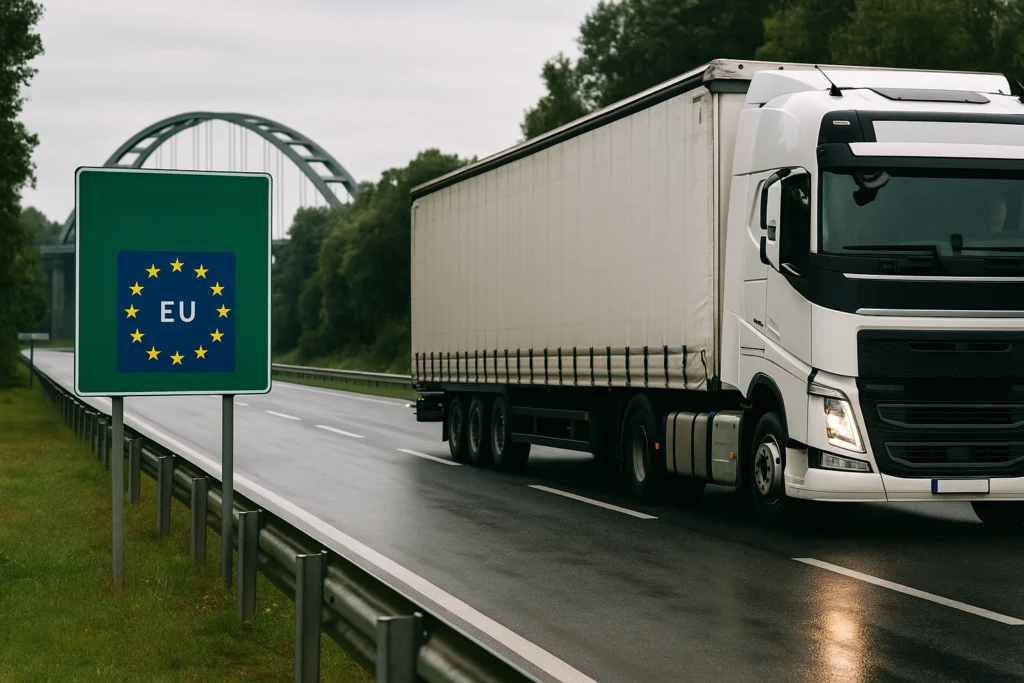
Within this network, road freight services exist on a spectrum from purely domestic haulage – a truck moving goods between two points within a single country – to complex multi-country international transport operations that cross four, five, or more national borders in a single journey. The European Union’s single market framework removes most internal customs barriers for intra-EU trade, which means that a truck moving goods from Germany to Spain crosses no customs frontier, presents no customs declaration, and experiences no mandatory border stop beyond whatever inspections individual member states choose to conduct. This is a profound commercial advantage that makes European road freight fundamentally more efficient than cross-border trucking in almost any other region of the world – but it coexists with a thick layer of technical, safety, social, and environmental regulations that every carrier and logistics operator must navigate with precision.
Full Truckload and Groupage: Choosing the Right Service
Like ocean freight, road freight services in Europe are organized around two primary service models: Full Truckload (FTL) and Less than Truckload (LTL), the latter also widely referred to as groupage or part load service. Understanding the practical difference between these two options is the starting point for any business evaluating how to ship goods across the continent, because the choice has direct implications for cost, transit time, cargo security, and the minimum order quantities that make commercial sense to ship.
A Full Truckload service means that one shipper’s cargo occupies an entire vehicle – typically a standard curtainsider trailer with a maximum payload of approximately 24 tonnes and a loading capacity of around 33 standard EUR-pallets. The truck travels directly from the collection point to the delivery destination without any intermediate stops to collect or deliver other cargo, which produces the fastest possible transit times and the lowest number of cargo handling events. FTL is the natural choice for large, regular shipments of goods that benefit from dedicated vehicle space – whether because of their volume, their value, their fragility, or their time-sensitivity. When a production line depends on a regular delivery of components arriving at a precise time, or when a retailer is replenishing a high-volume product category ahead of a promotional period, the predictability and directness of a full truckload service is difficult to substitute with any other option. Pricing for FTL shipments is typically quoted as a flat rate per vehicle, negotiated based on the lane, the frequency of shipments, the loading and unloading requirements, and the current spot market conditions on that route.
Groupage, or LTL service, pools the cargo of multiple shippers into a single vehicle, with each customer paying only for the space – measured in loading meters or pallets – that their goods occupy. A freight forwarder or groupage network operator collects individual consignments at a consolidation depot, builds them into a single full load, dispatches the vehicle on the required route, and distributes the shipments at a deconsolidation hub near the destination. For businesses shipping smaller quantities – typically fewer than eight to ten pallets – groupage is almost always more cost-effective than booking a dedicated truck. Pan-European pallet networks such as those operated by major logistics companies across Western and Central Europe offer next-day or two-day delivery services for single pallets and small shipments, bringing the speed advantages of road freight within reach of small and medium-sized businesses that could never justify full truckload bookings on a regular basis. The trade-off, as with LCL ocean freight, is that groupage cargo goes through more handling stages, transits through multiple depots, and takes longer to arrive than a direct FTL service on the same lane – typically by one to three additional days depending on the route.
| Characteristic | FTL – Full Truckload | LTL – Groupage / Part Load |
|---|---|---|
| Minimum cargo volume | No minimum – but commercially viable from ~10 pallets | As little as 1 pallet or 1 loading meter |
| Pricing model | Flat rate per vehicle per lane | Per pallet, loading meter, or weight/volume ratio |
| Transit time | Fastest – direct point-to-point | 1–3 days longer due to depot consolidation |
| Cargo handling frequency | Minimum – loaded once, unloaded once | Multiple – collected, consolidated, deconsolidated, delivered |
| Cargo security | High – no co-loading with other shippers | Moderate – shared space, more handling events |
| Flexibility | Lower – requires full or near-full load to be cost-effective | High – ship any quantity, on demand |
| Best suited for | Large volumes, time-critical goods, fragile or high-value cargo | Small businesses, low-volume lanes, market testing |
Core Regulations Every Shipper Must Understand
European road freight operates within one of the most regulated transport frameworks in the world, and the regulations governing it span international conventions, EU legislation, and national rules that together define how carriers must operate, how cargo must be documented, how drivers must manage their working time, and what safety standards vehicles must meet. For shippers and logistics buyers, understanding the most important of these regulations is not a legal exercise – it is a practical necessity, because non-compliance by your carrier or freight forwarder creates legal liability, insurance gaps, and cargo security risks that can have direct financial consequences for your business.
The CMR Convention – the Convention on the Contract for the International Carriage of Goods by Road – is the foundational legal framework governing all international road freight movements across its 55 signatory countries, which include every EU member state, the United Kingdom, Turkey, and most CIS countries. The CMR establishes the form and content of the consignment note (CMR waybill) that must accompany every international road freight shipment, defines the carrier’s liability for cargo loss, damage, or delay during transit, and sets out the rights and obligations of the shipper, the carrier, and the consignee. The carrier’s standard liability under CMR is capped at 8.33 Special Drawing Rights (SDR) per kilogram of gross weight of the goods lost or damaged – a limit that is often significantly lower than the actual commercial value of the cargo. This gap between CMR liability and cargo value is one of the primary reasons why shippers of valuable goods should always arrange separate all-risk cargo insurance rather than relying solely on the carrier’s CMR liability cover for financial protection in the event of a claim.
The EU Mobility Package, which entered into force progressively between 2020 and 2022, introduced a comprehensive set of social and market access rules that reshaped the operating conditions for international road haulage across Europe. Among its most significant provisions are the rules governing cabotage – the practice of a non-resident carrier performing domestic transport operations within another country. Under the current framework, a carrier that has completed an international delivery into a host EU member state may perform a maximum of three cabotage operations within that country in the seven days following the international delivery, after which the vehicle must leave the country. This rule was introduced to prevent systematic cabotage – the practice of foreign carriers effectively operating as domestic hauliers in lower-wage countries to undercut local competition – and its enforcement has become significantly more rigorous in France, Germany, and the Benelux countries in recent years. For businesses designing complex multi-stop European distribution operations, understanding cabotage limits is essential, because a logistics solution that relies on unconstrained domestic collections or deliveries by a foreign carrier may be commercially attractive on paper but legally non-compliant in practice.
Cross-Border Documentation and Customs in Practice
While the EU single market eliminates internal customs barriers for movements entirely within the bloc, the practical documentation requirements for international road freight remain substantial, and they become considerably more complex for shipments that involve non-EU countries – including the United Kingdom post-Brexit, Turkey, Switzerland, Norway, and the CIS countries. A standard intra-EU road freight shipment requires a correctly completed CMR waybill, a commercial invoice, a packing list, and any product-specific certificates of conformity, phytosanitary certificates, or other documentation that the nature of the goods requires. Getting these documents right – particularly ensuring that the goods description, weight, and value on the invoice match the CMR exactly – is a seemingly mundane task that nonetheless causes a disproportionate share of commercial disputes, delivery delays, and insurance claim complications when done carelessly.
For shipments entering or exiting the EU, the documentation and customs compliance requirements are far more demanding. Goods moving between the EU and Turkey, for example, benefit from a Customs Union that eliminates tariffs on industrial goods and requires no customs duties in either direction for qualifying products – but they do require EU customs export declarations and Turkish customs import declarations, and the A.TR movement certificate must accompany the shipment to prove that the goods are in free circulation within the EU Customs Union territory. Goods moving under the TIR Convention – the international transit framework that allows sealed trucks to cross multiple countries with a single TIR Carnet rather than separate transit declarations at each border – benefit from significantly simplified border crossing procedures across the 77 TIR member countries, making TIR a particularly valuable instrument for road freight moving between Europe and the CIS or Turkey. The electronic CMR, or eCMR, is an increasingly adopted digital version of the traditional paper consignment note that reduces the administrative burden of document preparation, speeds up border processing, and provides a legally valid electronic record of the transport contract – its adoption is now widespread in Western Europe and growing steadily in Central and Eastern European markets.
What Drives Road Freight Rates Across Europe
Road freight rates in Europe are influenced by a combination of structural market factors and short-term supply and demand dynamics that can cause significant price volatility on even the most established lanes. Fuel costs are historically the single largest variable in a haulier’s operating cost structure, typically representing 25 to 35 percent of total running costs depending on the vehicle type and route profile. Most professional freight contracts include a fuel surcharge mechanism – usually expressed as a percentage of the base rate – that adjusts automatically with diesel price movements according to an agreed index, preventing either party from being exposed to extreme fuel price swings over the life of a longer-term transport agreement. When diesel prices spiked across Europe in 2022 and 2023, fuel surcharges on many lanes doubled or tripled, and shippers who had not negotiated clear surcharge mechanisms found themselves facing invoice surprises that their logistics budgets had not anticipated.
The structural driver shortage in European trucking is a second factor that exerts persistent upward pressure on road freight rates and is unlikely to resolve itself quickly. Industry estimates put the number of unfilled truck driver positions across Europe at over 400,000, with the shortage most acute in the United Kingdom, Germany, Poland, and the Benelux countries. An ageing driver workforce, the high cost and time required to obtain a Category C or CE driving licence, and the physically demanding and socially isolating nature of long-haul driving have collectively made driver recruitment a chronic challenge for hauliers across the continent. This shortage limits carriers’ ability to expand their fleets in response to demand spikes, constrains capacity on busy lanes during peak periods, and supports freight rates at levels that would otherwise come under competitive pressure. Shippers that offer carriers clean, predictable, and efficiently managed loading and unloading operations – where drivers are not kept waiting for hours at loading bays – are increasingly able to negotiate preferential rates and better service commitments, because carriers actively prioritize customers whose operations minimize driver downtime.
Environmental Compliance and the Green Freight Transition
The European road freight industry is in the early stages of the most significant operational transformation it has faced since the introduction of electronic tachographs and digital fleet management systems – the transition toward decarbonized transport. The European Union has established a binding target for new heavy-duty vehicles: a 45 percent reduction in CO2 emissions by 2030 compared to 2019 levels, rising to 90 percent by 2040. These targets, combined with the extension of the EU Emissions Trading System to road transport from 2027, which will put a direct carbon price on diesel fuel used in commercial trucking, are reshaping the economic calculus for fleet investment across the European haulage industry. Euro 6 is currently the mandatory emissions standard for new heavy goods vehicles entering service across the EU, and cities across Europe are progressively introducing Low Emission Zones that restrict or prohibit the access of older, higher-emission vehicles – creating differentiated access rights that shippers and carriers must factor into their urban distribution planning.
Electric trucks and hydrogen fuel cell vehicles are advancing rapidly from demonstration projects toward commercial deployment, with major manufacturers including Volvo, Daimler Truck, DAF, and Scania having introduced battery-electric heavy goods vehicles that are now operating in regular commercial service on short and medium-distance routes. The most significant current limitation for long-distance electric trucking remains charging infrastructure: the European Alternative Fuels Infrastructure Regulation (AFIR) requires EU member states to deploy public high-power charging points for heavy trucks along the TEN-T core network at intervals of no more than 60 kilometers by 2025, but actual deployment has been uneven across the continent, with Western Europe significantly ahead of Central and Eastern Europe. For businesses with sustainability commitments, green freight certifications, or customers requiring verified CO2 reporting on their supply chains, choosing carriers that can provide transparent emissions data and that are actively investing in low-carbon fleet technology is becoming a meaningful differentiator – both in terms of meeting contractual obligations and in managing exposure to future carbon pricing that will inevitably feed through into freight rates for conventionally powered vehicles.
How to Select the Right Road Freight Partner in Europe
With thousands of freight forwarders, hauliers, and logistics platforms operating across the European market, selecting the right road freight partner is a decision that deserves considerably more rigorous evaluation than simply comparing spot quotes on a digital platform. The cheapest rate on any given lane rarely reflects the full cost of a transport relationship, because the hidden costs of poor service – delayed deliveries, damaged cargo, missing documentation, unresponsive customer service, and compliance gaps that create regulatory exposure – consistently exceed the savings made on the headline freight rate. A transport provider’s value is ultimately measured by the reliability of their service over time, and that reliability is built on the quality of their equipment, the training of their drivers and operations staff, the robustness of their compliance management systems, and the depth of their carrier network on the specific lanes you need to use regularly.
When evaluating road freight providers for European operations, the most important areas to examine carefully are their carrier licensing and certification status – including their Community Licence for international EU road freight and any relevant national permits – their insurance coverage and the specific terms of their CMR liability and cargo insurance policies, their real-time shipment tracking capabilities and their communication protocols when a delivery is at risk of running late, their experience and active network density on your specific origin-destination lanes, and their approach to compliance with social legislation including driver hours regulations and the Mobility Package’s cabotage and return-home rules. Reputable carriers will be transparent about all of these areas without hesitation, and they will typically be members of recognized industry associations – such as the International Road Transport Union (IRU) or national equivalents – that require adherence to defined professional and ethical standards. For businesses that want to turn reliable capacity into a competitive advantage, partnering with a provider that can combine strong road freight execution with streamlined logistics and consolidation across their European network – including the ability to build cost-efficient consolidated cargo solutions for smaller shipments – offers a pragmatic way to balance cost, flexibility, and service quality over the long term.