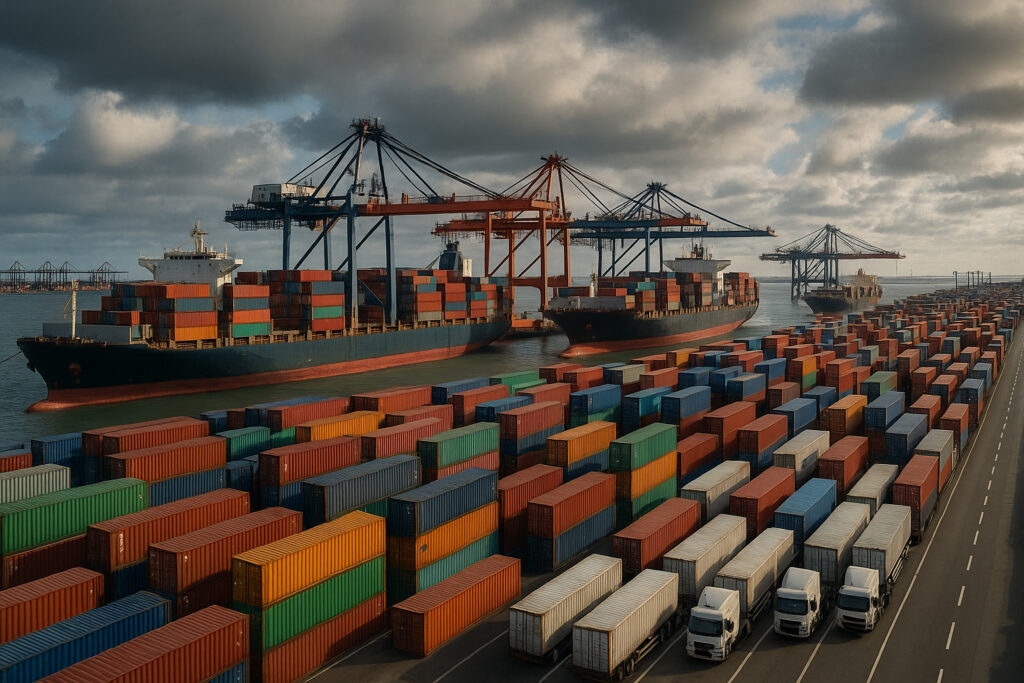
When your business ships goods internationally by sea, one of the most consequential decisions you will make is whether to book a Full Container Load or a Less than Container Load shipment. These two ocean freight options are fundamentally different in how they work, what they cost, and what risks they carry – and getting this choice wrong can quietly eat into your profit margins or delay your supply chain at the worst possible time. Understanding the mechanics behind each model is not just useful; it is essential for any business that wants to compete effectively in global trade.
Understanding the Two Shipping Models
FCL, which stands for Full Container Load, means that your company books an entire shipping container exclusively for your own cargo. You pay a flat rate for the container itself – regardless of whether your goods fill every inch of it – and once that container is sealed at the point of origin, no other shipper’s goods will ever share that space. The most common container sizes used in international shipping are the 20-foot unit, which offers roughly 25 to 28 cubic meters of usable volume, and the 40-foot unit, which provides approximately 55 to 60 cubic meters. From the moment your container leaves your supplier’s warehouse to the moment it arrives at your destination port, it remains sealed and undisturbed, which is a significant advantage from both a security and a quality-control standpoint.
LCL, which stands for Less than Container Load, operates on an entirely different principle. Instead of renting a whole container, your company pays only for the space your cargo actually occupies, measured in cubic meters (CBM), and a freight forwarder fills the remaining space with goods from other shippers. This process is known as cargo consolidation at the origin end and deconsolidation at the destination end. In practical terms, your shipment will be collected, brought to a consolidation warehouse, loaded alongside other companies’ cargo into a single container, transported to the port, shipped overseas, unloaded at a deconsolidation facility, sorted, cleared through customs individually, and then finally dispatched to you. Each one of these additional steps is a legitimate part of the process, and experienced freight forwarders manage them smoothly – but it does mean your goods exchange hands far more times than they would in a full container booking.
How the Costs Actually Stack Up
The cost structure for FCL shipping is straightforward. You pay a flat rate for the entire container, and that rate is negotiated based on the shipping lane, the time of year, and the carrier. As of 2026, a standard 20-foot container on major international routes typically runs between $2,300 and $3,950, while a 40-foot container generally falls between $3,500 and $5,500. These figures can shift considerably during peak shipping seasons – typically from August through October – when container availability tightens and freight rates climb across the board. The predictability of FCL pricing is itself a meaningful business advantage, because you can budget your landed costs with a high degree of confidence well before your goods leave the factory floor.
LCL pricing, on the other hand, is calculated per cubic meter and typically runs between $60 and $105 per CBM on the main international shipping lanes. That sounds attractively simple at first glance, but the true cost of an LCL shipment almost always includes a range of additional charges: consolidation fees, deconsolidation fees, container freight station (CFS) handling charges at both origin and destination, documentation fees, and port handling surcharges. These extras can add $100 to $300 or more to your final bill, depending on the route and service provider. This means that when you are comparing LCL quotes to FCL quotes, you must ask your freight forwarder for a full all-in rate that reflects every line item – not just the per-CBM headline number – or you risk an unpleasant surprise when the final invoice arrives.
The critical inflection point that logistics professionals call the break-even typically falls somewhere between 12 and 15 CBM. Below roughly 13 CBM, LCL is almost always the more affordable option and can run 40 to 70 percent cheaper than booking an entire container. Above 15 CBM, an FCL booking generally becomes more cost-effective, and the savings grow more pronounced as your volume increases. Research from Drewry Maritime indicates that for shipments filling 75 percent or more of a container, FCL tends to deliver a clear and consistent cost advantage. Some businesses even find it worthwhile to book an FCL shipment at 60 to 70 percent capacity when speed, security, or seasonal timing requirements make the extra expense justifiable.
| Factor | FCL – Full Container Load | LCL – Less than Container Load |
|---|---|---|
| Pricing model | Flat rate per container (20ft or 40ft) | Per cubic meter (CBM) + add-on fees |
| Ideal cargo volume | 15+ CBM | Under 13–15 CBM |
| Estimated cost range | $2,300–$5,500 per container | $60–$105 per CBM + $100–$300 in fees |
| Transit time | Faster, direct routing | 1–2 weeks slower on average |
| Cargo security | High – sealed from origin to destination | Lower – multiple handling points |
| Flexibility | Low – one container, one destination | High – ship small amounts more frequently |
| Best suited for | High-volume, time-sensitive, or fragile goods | Small businesses, new markets, seasonal testing |
Transit Time and Shipping Reliability
When it comes to how long your goods will actually take to arrive, FCL holds a clear advantage. Because the container is sealed and moves as a single unit from port of loading to port of discharge, there are no intermediate stops, no waiting for other shippers’ cargo to arrive at a consolidation warehouse, and no delays caused by complications with someone else’s documentation or goods. FCL shipments follow a direct, predictable path that your freight forwarder can track at every stage, giving you a reliable estimated arrival time that holds up well even during periods of moderate port congestion. For businesses operating on tight production schedules, retailer delivery windows, or just-in-time inventory systems, this level of reliability is often worth more than any per-unit cost saving.
LCL shipments typically add one to two weeks to the overall transit time compared to an FCL booking on the same shipping lane. That extra time is not simply idle waiting – it reflects the very real and necessary work happening at the consolidation and deconsolidation warehouses on both ends of the journey. What makes LCL transit times even harder to predict is the risk of cascading delays: if another shipper’s goods packed in the same container trigger a customs inspection at the destination port, your cargo may be held up even though your own paperwork is perfectly in order. This kind of uncontrollable variable is one of the more significant practical challenges of shared container shipping, and it is something that businesses managing perishable goods, seasonal merchandise, or production-critical components need to take very seriously when evaluating which service to use.
Cargo Safety and the Risk Factor
The security profile of FCL and LCL shipments is quite different from each other, and this difference matters most for companies shipping fragile, high-value, or easily contaminated goods. With a full container load, your container is sealed at the origin – typically at your supplier’s factory or a nearby container yard – and that seal is not broken until the container reaches the customs inspection point at the destination port. Your cargo never comes into contact with another company’s goods, and the number of times it is physically handled is kept to an absolute minimum. For shipments of electronics, fine furniture, pharmaceutical products, food items, or luxury merchandise, this exclusivity is not an indulgence; it is a fundamental risk management requirement that directly protects the quality of what your customers receive.
LCL cargo goes through considerably more hands by the very nature of the shared model. At the consolidation warehouse, your goods are loaded alongside cargo from businesses you have no prior knowledge of – and that cargo might carry moisture, strong chemical odors, or other residues that could affect your products even through proper packaging. Each loading and unloading cycle, no matter how carefully managed by a professional freight forwarder, introduces a nonzero probability of damage, mislabeling, or misplacement. Industry data consistently shows that LCL shipments carry a higher rate of cargo insurance claims than FCL. This does not mean LCL is inherently unsafe, but it does mean you should treat cargo insurance as a non-negotiable requirement when shipping LCL, and you should be selective about which freight forwarder you trust to handle the consolidation process on your behalf.
Flexibility and Inventory Management
One of LCL’s most underappreciated advantages is the genuine flexibility it gives smaller and growing businesses over their inventory strategy. When you are not required to fill an entire container before you can ship, you gain the freedom to send goods more frequently in smaller quantities – and that has a direct positive impact on your cash flow. Instead of tying up capital in a large inventory batch sitting in a warehouse waiting to be ordered or sold, you can maintain leaner stock levels and replenish more responsively to actual demand. Small and medium-sized businesses entering new international markets benefit especially from this approach, because it allows them to test demand with modest, low-risk shipments before committing to the volumes and upfront investment that full container shipping requires.
FCL, by contrast, works best when your business has reached a level of operational maturity and volume predictability that justifies booking whole containers on a regular basis. Companies with established supplier relationships, stable and substantial order quantities, and the storage capacity to receive large shipments at once will find FCL not just cost-effective but operationally far simpler to manage. There are no minimum cargo requirements to coordinate, no reliance on a consolidation facility’s schedule, and no risk that vessel departure will be disrupted by logistical issues affecting other shippers in the same load. During periods of peak shipping demand – particularly in the weeks leading up to major retail seasons – full container bookings can also be easier to secure than LCL space, because ocean carriers tend to prioritize FCL customers when capacity is constrained.
How to Make the Right Choice for Your Business
The decision between FCL and LCL rarely comes down to a single factor. It is almost always a combination of your cargo volume, the nature of your goods, your delivery timeline, your budget, and your overall tolerance for supply chain risk. That said, most experienced freight forwarders and logistics managers use cargo volume as the primary starting point, and the 15 CBM threshold is a reliable rule of thumb backed by consistent real-world pricing data. Once you know your shipment’s volume and weight, the most important next step is to request detailed, all-in quotes for both options on the same lane and compare the true total costs rather than the headline rates alone. The difference between the two can be surprisingly small in the 12 to 15 CBM zone – and sometimes the FCL quote wins on total value even when LCL looks cheaper at first glance.
To make the comparison more concrete, here is a straightforward breakdown of the scenarios where each option tends to make the most sense:
- Choose FCL if your cargo exceeds 15 CBM, your goods are fragile, high-value, or sensitive to contamination, your delivery deadline is firm and non-negotiable, you are shipping hazardous or temperature-controlled materials, or you simply cannot afford the operational risk that comes with additional handling points and unpredictable transit times.
- Choose LCL if your cargo is below 13 CBM, you are a small or growing business exploring a new product line or overseas market, you prefer to ship frequently in smaller and more manageable quantities, maintaining healthy cash flow is a higher short-term priority than shipping speed, or you are comfortable working within a slightly longer and less rigid delivery window.
- Request quotes for both if your cargo falls in the 13 to 15 CBM range, because this is the break-even zone where the right answer depends on the specific shipping lane, current spot market rates, destination handling fees, and any time or quality constraints specific to your cargo – and only an itemized comparison will give you a clear picture.
The Role of Your Freight Forwarder
No matter which shipping method you ultimately choose, the quality and expertise of your freight forwarder will have an enormous influence on how smoothly your international shipment goes from door to door. A knowledgeable freight forwarder does far more than simply book container space – they advise you on appropriate packaging standards for the chosen shipping method, prepare all necessary export and import documentation, manage customs clearance at both ends, coordinate cargo insurance, and communicate proactively if something unexpected arises during transit. For businesses that need to balance ocean freight with time-critical shipments, working with a forwarder who can also coordinate reliable airfreight options gives you an extra layer of flexibility in your logistics strategy.
When your cargo volume or urgency suggests that full container shipping is the better fit, partnering with a forwarder that has deep expertise in container transportation across key global trade lanes ensures that you capture the full cost and reliability benefits of FCL while minimizing operational risk. When evaluating your shipping strategy, it is always worth asking your freight forwarder to run the numbers on both FCL and LCL for the same lane, even if you already have a strong preference. The cost difference between the two options may surprise you, and an experienced forwarder will also factor in variables that you might not immediately consider – such as current port congestion on the route, carrier reliability, the compatibility of your cargo with the LCL environment, and whether combining two smaller orders into a single FCL shipment might deliver both cost and risk benefits simultaneously. Building a strong, long-term working relationship with a freight forwarder who genuinely understands your product, your business cycle, and your supply chain priorities is one of the most valuable investments any importer or exporter can make – and it will serve you well regardless of whether you ship FCL, LCL, or a strategic combination of both as your business grows.