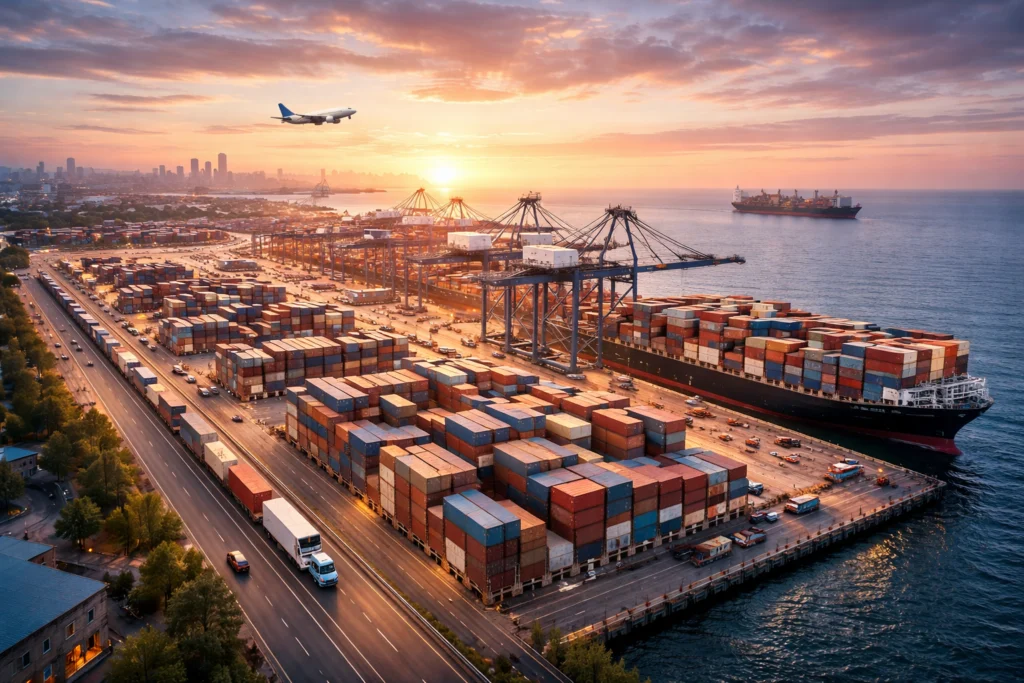
Between 2024 and 2025, global supply chains have been hit by a combination of geopolitical tensions, climate-related events, cyber incidents, and pressure on critical maritime routes such as the Suez and Panama Canals. Trade lanes were rerouted, transit times extended, freight costs spiked, and many companies struggled to secure key materials, making supply chain disruption a constant rather than an exception. At the same time, surveys show that the majority of supply chain leaders now expect volatility to continue for at least the next two years, which means resilience planning has moved from a tactical project to a core element of corporate strategy.
The data illustrates how deep the problem runs: documented disruptions increased significantly in the first half of 2024 compared with the previous year, and economic forecasts for 2025 point to persistent uncertainty linked to inflation, fragmented trade policies and social unrest. Climate-driven events such as floods, wildfires and droughts have also become a material source of logistics risk, directly impacting ports, shipping channels and inland transport infrastructure. In this environment, building a resilient global supply chain is no longer about simply having a crisis plan; it is about redesigning networks, governance and technology so that operations can adapt, absorb shocks and even gain competitive advantage when markets are under stress.
What the 2024–2025 disruptions taught global shippers
The first clear lesson from 2024–2025 is that concentration risk can paralyze an entire network when a single route, region or supplier fails. The Red Sea security crisis and water shortages in the Panama Canal forced a large share of global container traffic to divert to longer routes, increasing vessel demand, adding a week or more to transit times and raising costs and emissions. Companies that relied heavily on these corridors without alternative scenarios in place faced delayed deliveries, inventory stock-outs and production stoppages that could have been mitigated with more flexible routing options.
The second lesson is that risk is multi-dimensional: physical assets, digital systems and regulatory frameworks are now tightly intertwined, and disruption in one area quickly spills over into others. Cyber attacks on suppliers and logistics providers grew sharply in recent years, exposing how vulnerable data flows and software dependencies can cripple operations even when warehouses and factories are functioning normally. At the same time, changes in tariffs and trade policies have forced businesses to reassess sourcing and distribution footprints, showing that resilience requires both operational agility and strong regulatory awareness.
Key risk categories shaping the global supply chain
To build a truly resilient global supply chain, companies need a structured view of the main risk categories they face. While each industry has its own specifics, several hotspots stand out across markets:
- Geopolitical and trade risk. Conflicts, sanctions, regional tensions and shifting trade blocs can suddenly restrict access to suppliers, ports or overland corridors, requiring rapid reconfiguration of sourcing and transport plans.
- Climate and environmental risk. More frequent extreme weather events, droughts and floods disrupt ports, canals, key highways and production sites, and climate policies introduce new regulatory and reporting obligations.
- Cyber and digital risk. Attacks on software supply chains, logistics platforms and industrial systems can halt operations, corrupt data and undermine trust in planning and visibility tools.
- Market and demand volatility. Economic instability, inflation and changing consumer behaviour generate unpredictable demand patterns, forcing companies to reconsider inventory strategies and capacity commitments.
Recognizing these risk families helps organizations move from ad-hoc firefighting to a more systematic approach, where risk assessment, monitoring and mitigation are embedded into everyday supply chain management. Executive teams that treat resilience as a continuous capability rather than a one-off project are better positioned to respond quickly, control losses and capture opportunities when competitors are still reacting.
Strategic levers for a resilient global supply chain
The most successful companies emerging from the disruptions of 2024–2025 are those that diversified intelligently instead of simply adding cost to every part of the network. They looked closely at which flows, suppliers and routes were truly critical, then combined multi-sourcing, nearshoring and flexible capacity with deeper collaboration and better data. Four strategic levers appear consistently in recent resilience case studies and surveys.
Diversification of suppliers and geographies
Multi-sourcing from different regions reduces exposure to any single country, trade lane or political decision, particularly for high-value or long-lead-time components. Companies are increasingly complementing global suppliers with regional options through nearshoring and friendshoring, shortening lead times and creating backup capacity closer to key markets. This shift does not mean abandoning traditional low-cost regions, but rather balancing them with alternative sources so that a disruption in one area does not take down the entire chain.
Network redesign, nearshoring and warehousing optimization
Recent events have triggered a rethink of global distribution networks, with more companies re-evaluating where to place hubs, cross-docks and regional warehouses. Leading players are experimenting with blended models that mix large central hubs for cost efficiency with smaller regional or local facilities that enable faster response and rerouting options during crises. By repositioning safety stock and overflow capacity, they can buffer demand spikes, circumvent congested ports and delay duties or tariffs until goods are closer to the final market.
Digital visibility, predictive analytics and scenario planning
End-to-end visibility tools, real-time tracking and predictive analytics are now considered essential for supply chain resilience rather than optional upgrades. Digital twins and scenario modeling platforms allow logistics teams to simulate what would happen if a major port closed, a supplier failed or a tariff changed, then test different mitigation strategies before problems escalate. Organizations that invest in these capabilities are moving from reactive crisis management to proactive risk identification, with early-warning signals that trigger predefined playbooks.
Stronger partnerships and governance
Another crucial lever is the quality of relationships with logistics providers and strategic suppliers, supported by clear governance and shared KPIs. Companies that treat partners as long-term collaborators rather than purely transactional vendors benefit from faster information sharing, joint contingency planning and shared investments in technology and capacity. Many are also setting up dedicated risk and resilience teams that coordinate across procurement, operations, finance and IT, ensuring that decisions about cost, service and risk are aligned at the enterprise level.
Practical steps to strengthen your supply chain resilience
Turning these strategic levers into concrete actions requires a roadmap that combines quick wins with longer-term transformation. The following steps illustrate how organizations can systematically harden their supply chains against future disruption while maintaining competitiveness.
- Map end-to-end risk and critical flows. Start with a visibility exercise that identifies critical products, suppliers, routes and facilities, including upstream tiers where data is often incomplete.
- Run stress tests and “what if” scenarios. Use historical events from 2024–2025 as templates to model port closures, route blockages, sudden demand drops or spikes, cyber incidents and policy changes.
- Prioritize diversification for high-impact nodes. Apply multi-sourcing, nearshoring or alternative routes to those parts of the network where a single point of failure would cause major revenue or service damage.
- Redesign inventory and safety stock policies. Combine lean practices with targeted buffers for critical items, using forecasting tools and service-level analysis rather than rule-of-thumb decisions.
- Invest in visibility and data quality. Connect systems across procurement, logistics, warehousing and sales, and ensure that data standards support real-time monitoring, alerts and predictive models.
- Strengthen supplier and logistics partnerships. Establish joint KPIs for resilience, hold regular risk reviews and share forecasts and disruption scenarios to support coordinated responses.
When these steps are embedded into regular business planning and performance management, resilience becomes a continuous capability and part of the organization’s culture, not just an emergency project after a major disruption. Over time, this approach can lower the total cost of resilience by replacing expensive last-minute interventions with smarter design, better information and more flexible partnerships.
Balancing cost, efficiency and resilience in 2025 and beyond
A recurring concern for executives is how to balance cost efficiency with the additional investments required for resilience. Recent research suggests that the leading companies are not simply choosing one over the other; instead, they are redesigning supply chains to find a sweet spot where robust networks, digital tools and strong partnerships actually reduce the long-term cost of disruption. This “cost of resilience” mindset acknowledges that some redundancy, extra capacity or local sourcing may increase unit costs, but it also quantifies the value of avoided downtime, protected revenue and lower reputational risk.
Looking ahead, the structural forces behind today’s disruptions are unlikely to disappear: geopolitical competition, climate change, cyber threats and evolving trade regimes will continue to shape global logistics. Companies that invest now in resilient global supply chains will be better prepared not only to withstand the next crisis, but also to seize opportunities when markets shift, competitors stumble and new trade routes or technologies emerge. In that sense, resilience is becoming a source of strategic differentiation, enabling businesses to deliver reliably in an unreliable world.